TPS is Just the Entry Ticket, Ordering Decides Success or Failure: On-Chain Transactions Enter a New Era of 'Application-Awareness'

marsbitОпубликовано 2025-12-29Обновлено 2025-12-29

Введение

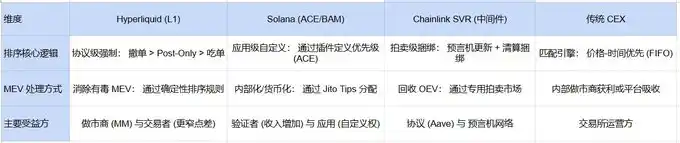
The competition between blockchains has shifted from TPS (transactions per second) to transaction ordering, which critically impacts market maker behavior, liquidity depth, and pricing. Transaction ordering refers to how transactions in the mempool are sequenced and included in blocks. This process affects transaction cost, MEV (Maximal Extractable Value), success rate, and fairness. For market makers, the ability to cancel orders quickly during volatility is essential—failure leads to risks like sniping, where high-Gas transactions exploit pending orders, forcing wider spreads and reduced liquidity. Innovations are moving from generic, Gas-based ordering to "application-aware sequencing," where transaction intent and fairness rules take priority. Examples include: - Hyperliquid, which prioritizes cancellations and post-only orders at the consensus layer. - Solana’s Application Controlled Execution (ACE) and BAM nodes, allowing DEXs to set custom ordering rules (e.g., market-maker priority). - Chainlink’s SVR, which uses MEV auctions to redistribute value from liquidations triggered by oracle updates. These developments suggest that tailored transaction sequencing is becoming essential—not just an improvement—for on-chain trading, potentially enabling DEXs to surpass CEXs in efficiency and fairness.

Competition between chains has escalated to the level of "transaction ordering," which directly impacts market makers' bid-ask spreads and depth🧐🧐

The demand for "general-purpose chains" has been disproven. Current chain-to-chain competition focuses on two levels:

1) Building "application chains" on the foundation of existing mature businesses, allowing blockchain to supplement existing operations in areas like settlement;

2) Competition at the level of "transaction ordering."

This article focuses on the second level.

Ordering directly influences the behavior of market makers. This is the core issue.

What is Transaction Ordering?

On-chain, user transactions are not immediately written to a block; they first enter a "waiting area" (Mempool). There may be thousands of transactions simultaneously, and it must be decided by a sequencer, validator, or miner:

1) Which transactions are included in the next block?

2) In what order are these transactions arranged?

The process of "deciding the order" is transaction ordering, which directly affects the transaction costs for on-chain users, MEV conditions, transaction success rate, and fairness.

For example, during network congestion, ordering determines whether a transaction can be quickly added to the chain or waits indefinitely in the mempool.

For high-frequency traders like market makers, whether a cancellation order takes effect is more critical than a placement order succeeding. The priority given to processing cancellation orders directly impacts whether market makers dare to offer deep liquidity.

In the last cycle, everyone pursued TPS, believing that speed alone could improve on-chain transaction settlement. But it has been proven that, besides speed, the risk pricing of market makers is equally important.

On centralized exchanges, trade matching strictly follows the "price-time priority" principle. In this highly deterministic environment, market makers can provide deep order book liquidity with extremely narrow spreads.

On-chain, after transactions enter the Mempool waiting area, nodes select transactions based on Gas fees, which creates room for sniping existing orders by offering higher Gas.

Suppose TRUMP is priced at $4.5, and a market maker places a buy order at $4.4 and a sell order at $4.6 to provide depth. But the exchange price of TRUMP suddenly crashes to $4.

At this point, the on-chain market maker wants to cancel the $4.4 buy order but gets sniped by a high-frequency trader offering higher Gas—buying at $4 and selling to the market maker at $4.4.

Therefore, market makers can only widen their spreads to reduce risk.

The purpose of the new generation of ordering innovations is to transition from "general ordering" to "Application-Aware Sequencing."

The ordering layer can understand transaction intent and order based on preset fairness rules, not just based on Gas fees.

1) Define the ordering method at the consensus layer

A typical case is Hyperliquid. It stipulates at the consensus layer that cancellation and Post-Only transactions take priority, breaking the Gas priority rule.

For market makers, being able to exit is paramount. During sharp price fluctuations, cancellation requests are always executed before others' takers.

Market makers fear being sniped the most. Hyperliquid precisely guarantees that cancellations are always prioritized—when the price drops, market makers cancel their orders, and the system forcibly prioritizes processing the cancellations, allowing market makers to successfully hedge risks.

On the day of the 10.11 crash, Hyperliquid market makers stayed online continuously, with spreads of 0.01–0.05%. The reason is that market makers knew they could get out.

2) Add new ordering methods at the sequencing layer

For example, Solana's Application Controlled Execution (ACE). Jito Labs developed BAM (Block Assembly Marketplace), introducing specialized BAM nodes responsible for transaction collection, filtering, and ordering.

Nodes run in a Trusted Execution Environment (TEE), ensuring the privacy of transaction data and the fairness of ordering.

Through ACE, DEXs on Solana (like Jupiter, Drift, Phoenix) can register custom ordering rules with BAM nodes. For example, market maker priority (similar to Hyperliquid), conditional liquidity, etc.

Additionally, proprietary AMM market makers like HumidiFi represent innovation at the ordering level, using Nozomi to connect directly with major validators to reduce latency and complete transactions.

During specific transactions, HumidiFi's off-chain servers monitor prices across platforms. The oracle communicates with the on-chain contract to inform it of the situation. Nozomi acts like a VIP channel, allowing effective order cancellation before execution.

3) Utilizing MEV facilities and private channels

Chainlink SVR (Smart Value Recapture) focuses on the归属 (belonging) of the value generated by ordering (MEV).

By deeply integrating with oracle data, it redefines the ordering rights and value distribution of liquidation transactions. After generating a price update, Chainlink nodes send it through two channels:

1) Public channel: Sent to the standard on-chain aggregator (serving as a backup, but in SVR mode, there is a slight delay to leave an auction window).

2) Private channel (Flashbots MEV-Share): Sent to an auction market supporting MEV-Share.

This way, the auction proceeds from liquidations triggered by oracle price changes in lending protocols (i.e., the amount searchers are willing to pay) are no longer solely captured by miners; most are captured by the SVR protocol.

Summary

If TPS is the entry ticket, then having only TPS is completely insufficient now. Custom ordering logic might not just be an innovation but a necessary path for putting transactions on-chain.

It might also be the beginning of DEXs surpassing CEXs.

Связанные с этим вопросы

QWhat is the core argument of the article regarding the evolution of blockchain competition beyond TPS?

AThe article argues that competition between blockchains has moved beyond just transaction speed (TPS) and is now focused on the critical layer of 'transaction ordering' (sequencing). Effective and fair transaction ordering directly impacts market maker behavior, liquidity depth, and the overall user experience, making it a decisive factor for success.

QHow does transaction ordering on a blockchain negatively impact market makers, according to the article?

AIn a default 'gas-first' ordering system, market makers are vulnerable to being sniped. When an asset's price moves, a high-frequency trader can pay a higher gas fee to have their 'take order' (e.g., buying the asset at a low price) processed before the market maker's 'cancel order' (e.g., trying to withdraw their offer). This forces the market maker to buy the asset back at their own, now outdated, higher price, leading to losses and causing them to widen their spreads to mitigate risk.

QWhat is 'Application-Aware Sequencing' and can you name a project that implements it at the consensus layer?

A'Application-Aware Sequencing' is an innovative approach where the sequencing logic understands the intent of transactions (e.g., a cancelation vs. a trade) and orders them based on predefined fairness rules, not just gas fees. Hyperliquid is a prime example that implements this at the consensus layer by mandating that cancel and post-only orders are always prioritized over others, ensuring market makers can escape unfavorable positions.

QBesides consensus-layer changes, what other method does the article mention for improving transaction ordering on Solana?

AThe article mentions Solana's Application Controlled Execution (ACE) and the Block Assembly Marketplace (BAM) developed by Jito Labs. This allows decentralized exchanges (DEXs) like Jupiter and Drift to register custom ordering rules (e.g., market maker priority) with specialized BAM nodes, which operate in a Trusted Execution Environment (TEE) for privacy and fairness.

QHow does Chainlink's Smart Value Recapture (SVR) model change who benefits from MEV generated by oracle price updates?

AChainlink's SVR model changes MEV distribution by creating a two-path system for oracle price updates. After generating a new price, Chainlink nodes send it through a public channel (with a slight delay) and a private channel to a MEV auction market (like Flashbots MEV-Share). This allows the value from auctions for liquidation trades triggered by the price update to be captured mostly by the SVR protocol itself, rather than being kept entirely by miners/validators.

Похожее

"Agents' Last Exam", Claude Fable 5 Actually Loses to GPT 5.5

Surprisingly, in the newly released "Agents' Last Exam" (ALE) benchmark from UC Berkeley, GPT-5.5 has outperformed the recently launched and highly-regarded Claude Fable 5. ALE tests AI agents on their ability to perform real-world tasks across 55 professional domains—such as 3D modeling in Siemens NX, creating game scenes in Unreal Engine, and visual effects work in Adobe After Effects—by granting them full GUI and command-line access. In the core task completion rate ranking, GPT-5.5 configurations secured the top two spots (24.0% and 23.0%), while Claude Fable 5 with Claude Code came in third (22.0%). Notably, the highest pass rate was only 24%, and the most difficult "Last-Exam" tier saw most top models, including GPT-5.5 and Fable 5, scoring zero. The benchmark also revealed significant cost and efficiency gaps: Fable 5 spent over four times more money than GPT-5.5's most expensive configuration for a slightly lower score, and was much slower. ALE differs from previous knowledge-based benchmarks by evaluating practical "ability to do" rather than static knowledge retrieval. Its tasks are derived from real expert projects, automatically scored, and designed to prevent cheating through a rotating pool of private challenges. The results suggest that high performance on traditional benchmarks does not necessarily translate to proficiency in complex, open-ended real-world work. The study also notes that agents often fail by prematurely declaring tasks complete without proper verification, and that no single model excels uniformly across all diverse domains.

marsbit5 мин. назад

"Agents' Last Exam", Claude Fable 5 Actually Loses to GPT 5.5

marsbit5 мин. назад

Retail Ecology Dwindles, ZKsync Bets on Bank Pilots for a Breakthrough

Amidst declining retail activity, ZKsync is pivoting to target institutional banking as its primary growth strategy. The article explores this shift, contrasting it with the competitive "survival of the fittest" narrative by highlighting a cooperative model inspired by naturalist Peter Kropotkin. ZKsync is developing infrastructure like its private, permissioned Prividium suite for banks (e.g., Deutsche Bank's use case via Memento), enabling private transactions with public verifiability via zero-knowledge proofs. This appeals to institutions needing privacy, compliance, and Ethereum-based settlement security, unlike fully private chains (e.g., JPMorgan's Kinaxis) or consortium models (e.g., R3 Corda). However, this strategic focus has coincided with a steep decline in its public DeFi ecosystem, evidenced by plunging TVL and the departure of major protocols like Aave due to low fees. The network's future now hinges on banking adoption, with upcoming pilots like the Cari Network involving regional banks holding over $600 billion in deposits. A significant challenge is balancing this institutional focus with ZKsync's decentralized governance. Banks must operate on a network where rules and fees (denominated in the volatile ZK token) can be changed via community vote, and where a Security Council holds emergency control—a stark contrast to the predictable, contract-bound environments of traditional finance. The coming 18 months will test whether ZKsync can successfully onboard traditional banks onto a dynamically governed public chain or if institutions will ultimately revert to proprietary solutions.

Foresight News47 мин. назад

Retail Ecology Dwindles, ZKsync Bets on Bank Pilots for a Breakthrough

Foresight News47 мин. назад

The Recursive AI Anthropic Warned About: Tian Yuandong's New Company Has Just Taken the "First Step"

Anthropic recently highlighted the rapid progress toward "recursive self-improvement," where AI systems autonomously design and train their successors. In response, Recursive Superintelligence, a new company co-founded by former Meta researcher Tian Yuan Dong, has publicly demonstrated its first step toward automating AI research. The company released a system designed to autonomously execute the full AI research cycle: generating ideas, implementing code, running experiments, and learning from results. It validated this approach by achieving state-of-the-art results on three diverse benchmarks: 1. **NanoChat Autoresearch:** Optimizing a small language model's validation loss under a fixed 5-minute GPU budget, improving upon the community's best result. 2. **NanoGPT Speedrun:** Reducing the time to train a GPT model to a specific loss on 8 H100 GPUs from 79.7 seconds to 77.5 seconds, beating a highly optimized, human-driven community effort. 3. **SOL-ExecBench:** Improving the overall score on NVIDIA's suite of 235 GPU kernel optimization tasks by 18%, closing the gap to the hardware limit. The system discovered novel optimizations in this highly specialized domain without direct human expertise. Recursive's system operates as a general framework, capable of parallel exploration and cross-task knowledge transfer while incorporating safeguards against reward hacking. The company, backed by $650M in funding and a star-studded team including Richard Socher and Alexey Dosovitskiy, aims to create AI that recursively enhances its own research capabilities. This development represents an early but concrete move toward a new paradigm where AI accelerates its own advancement. It occurs alongside Anthropic's warnings about the need for industry coordination and potential pauses when recursive self-improvement thresholds are reached, highlighting the dual trajectory of rapid technical progress and growing calls for careful stewardship.

marsbit54 мин. назад

The Recursive AI Anthropic Warned About: Tian Yuandong's New Company Has Just Taken the "First Step"

marsbit54 мин. назад

Торговля

Спот
Фьючерсы

Популярные статьи

Как купить SFP

Добро пожаловать на HTX.com! Мы сделали приобретение SafePal (SFP) простым и удобным. Следуйте нашему пошаговому руководству и отправляйтесь в свое крипто-путешествие.Шаг 1: Создайте аккаунт на HTXИспользуйте свой адрес электронной почты или номер телефона, чтобы зарегистрироваться и бесплатно создать аккаунт на HTX. Пройдите удобную регистрацию и откройте для себя весь функционал.Создать аккаунтШаг 2: Перейдите в Купить криптовалюту и выберите свой способ оплатыКредитная/Дебетовая Карта: Используйте свою карту Visa или Mastercard для мгновенной покупки SafePal (SFP).Баланс: Используйте средства с баланса вашего аккаунта HTX для простой торговли.Третьи Лица: Мы добавили популярные способы оплаты, такие как Google Pay и Apple Pay, для повышения удобства.P2P: Торгуйте напрямую с другими пользователями на HTX.Внебиржевая Торговля (OTC): Мы предлагаем индивидуальные услуги и конкурентоспособные обменные курсы для трейдеров.Шаг 3: Хранение SafePal (SFP)После приобретения вами SafePal (SFP) храните их в своем аккаунте на HTX. В качестве альтернативы вы можете отправить их куда-либо с помощью перевода в блокчейне или использовать для торговли с другими криптовалютами.Шаг 4: Торговля SafePal (SFP)С легкостью торгуйте SafePal (SFP) на спотовом рынке HTX. Просто зайдите в свой аккаунт, выберите торговую пару, совершайте сделки и следите за ними в режиме реального времени. Мы предлагаем удобный интерфейс как для начинающих, так и для опытных трейдеров.

241 просмотров всегоОпубликовано 2026.05.22Обновлено 2026.06.02

Как купить SFP

Как купить CTR

Добро пожаловать на HTX.com! Мы сделали приобретение Citrea (CTR) простым и удобным. Следуйте нашему пошаговому руководству и отправляйтесь в свое крипто-путешествие.Шаг 1: Создайте аккаунт на HTXИспользуйте свой адрес электронной почты или номер телефона, чтобы зарегистрироваться и бесплатно создать аккаунт на HTX. Пройдите удобную регистрацию и откройте для себя весь функционал.Создать аккаунтШаг 2: Перейдите в Купить криптовалюту и выберите свой способ оплатыКредитная/Дебетовая Карта: Используйте свою карту Visa или Mastercard для мгновенной покупки Citrea (CTR).Баланс: Используйте средства с баланса вашего аккаунта HTX для простой торговли.Третьи Лица: Мы добавили популярные способы оплаты, такие как Google Pay и Apple Pay, для повышения удобства.P2P: Торгуйте напрямую с другими пользователями на HTX.Внебиржевая Торговля (OTC): Мы предлагаем индивидуальные услуги и конкурентоспособные обменные курсы для трейдеров.Шаг 3: Хранение Citrea (CTR)После приобретения вами Citrea (CTR) храните их в своем аккаунте на HTX. В качестве альтернативы вы можете отправить их куда-либо с помощью перевода в блокчейне или использовать для торговли с другими криптовалютами.Шаг 4: Торговля Citrea (CTR)С легкостью торгуйте Citrea (CTR) на спотовом рынке HTX. Просто зайдите в свой аккаунт, выберите торговую пару, совершайте сделки и следите за ними в режиме реального времени. Мы предлагаем удобный интерфейс как для начинающих, так и для опытных трейдеров.

235 просмотров всегоОпубликовано 2026.05.25Обновлено 2026.06.02

Как купить CTR

Обсуждения

Добро пожаловать в Сообщество HTX. Здесь вы сможете быть в курсе последних новостей о развитии платформы и получить доступ к профессиональной аналитической информации о рынке. Мнения пользователей о цене на A (A) представлены ниже.

活动图片