Tiger Research: Realism is the Only Answer in the Cryptocurrency Downturn

marsbitОпубликовано 2026-02-09Обновлено 2026-02-09

Введение

Tiger Research argues that during the prolonged crypto market downturn, only projects grounded in realism and practical problems are demonstrating resilience. The report highlights three key examples: Hyperliquid, which addresses immediate trading friction by building a performant perp DEX; Canton Network, which provides a privacy-focused, compliant infrastructure for institutional finance and real-world assets (RWA); and Kite AI, which is building payment infrastructure for a future AI agent economy. The common thread is a focus on solving real, existing market problems with structurally sound solutions. To assess a project's practical viability, the analysis should focus on three core questions: what specific problem it solves, how the solution is structured, and whether the team has the execution capability. Ultimately, the ability to deliver practical utility is the most powerful fundamental in a bear market.

This report is written by Tiger Research. The cryptocurrency market continues to be in a prolonged downturn. In this environment, the projects that can survive are those that demonstrate pragmatism and a realistic vision.

Core Points

  • Projects that solve real, specific problems can maintain resilience even during market downturns.
  • Hyperliquid, Canton, and Kite target different problem areas, but they share a common trait: providing practical and realistic solutions, rather than abstract narratives.
  • To assess this realism, analysis should focus on three factors: the problem the project aims to solve, the structure of the solution, and the team's ability to execute in practice.

1. Conditions for Survival in a Bear Market: Does it Work in Practice?

Source: Tiger Research

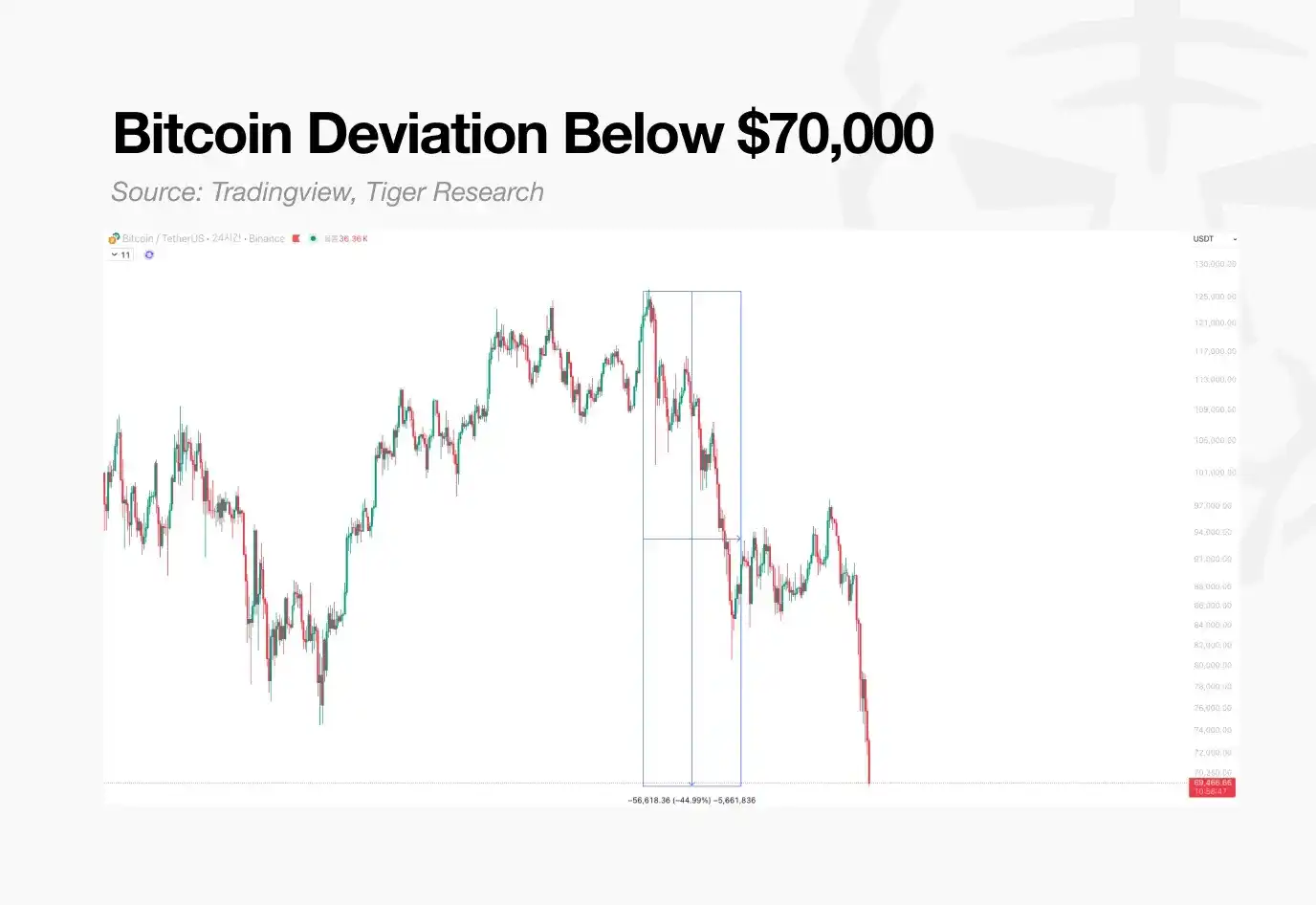
Bitcoin has fallen below $70,000. Among the top 100 cryptocurrencies by market cap, only 7 remain above their 200-day moving average. In contrast, 53 components of the Nasdaq 100 index are still trading above this threshold.

The market conditions are undeniable. Nevertheless, some crypto assets still manage to survive in the harshest environments.

Their resilience cannot be simply attributed to artificial market making or coincidental rebounds. A closer look at their development trajectory reveals a different explanation.

These projects no longer rely solely on vague visions or technical complexity. Instead, they share a common feature: solving core market problems with solutions rooted in practical reality. Their approach typically aligns with three directions:

  1. Do they solve a problem the market is currently facing?
  2. Are they ready for practical application in the near term?
  3. Are they building infrastructure that the industry will rely on long-term?

Ultimately, the ability to solve real problems in practice remains the most powerful fundamental.

2. Three Directions Chosen by the Market

Projects that can answer the above questions have successfully survived. Their approach is: 1) clearly identify a market problem; 2) propose a practical solution that matches a specific timing.

2.1. Hyperliquid: Solving Immediate Trading Friction

Centralized exchanges have traditionally been seen as responsible intermediaries. However, in practice, when problems arise, they often fail to align with investor interests. Decentralized exchanges emerged as an alternative, but poor user experience and performance have caused many investors to steer clear.

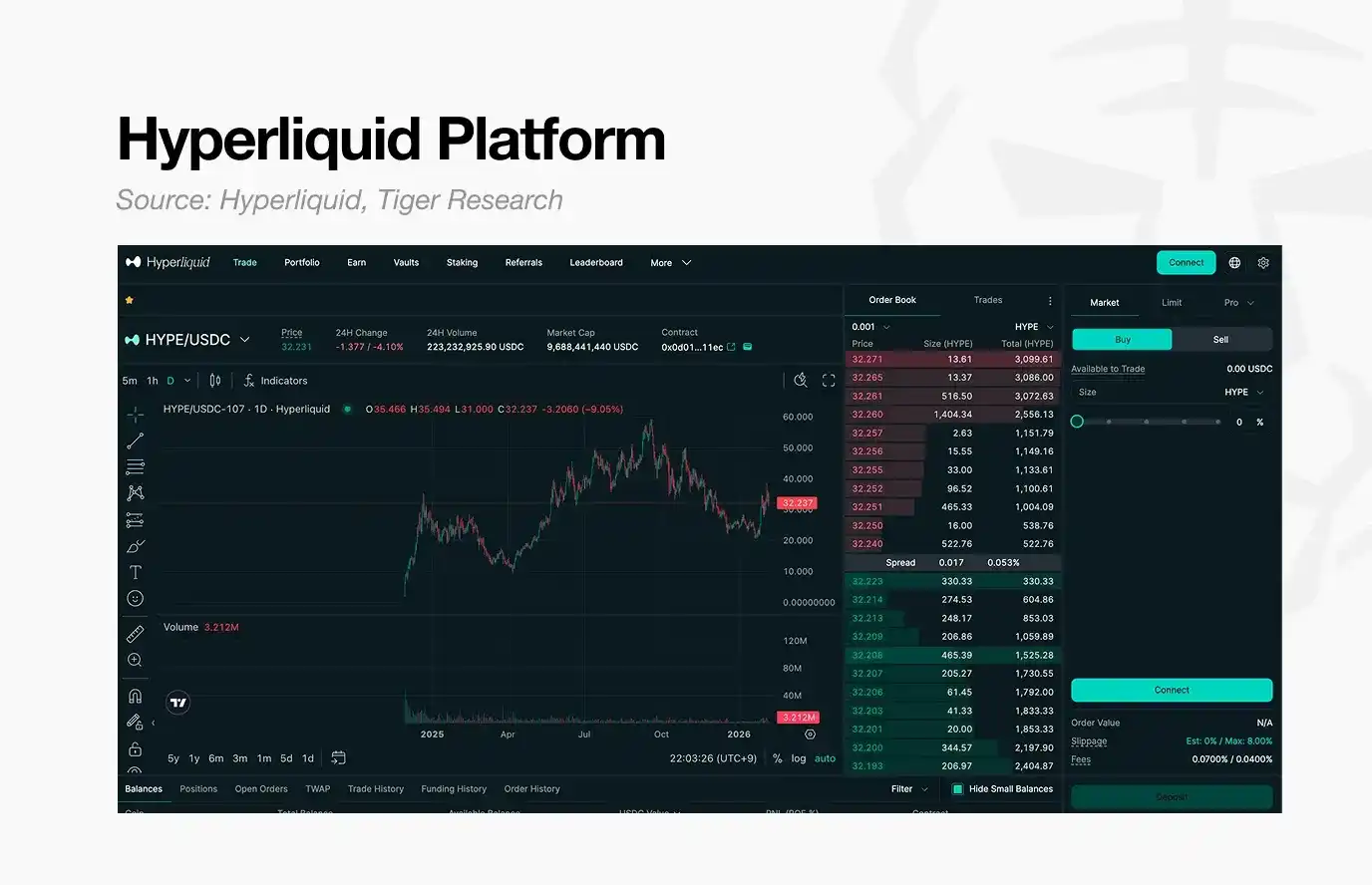
In this context, Hyperliquid introduced the concept of a perpetual contracts decentralized exchange (perp DEX). Through its HLP mechanism, it brings the features investors value in centralized exchanges—such as high leverage, fast execution, and stable liquidity—into an on-chain environment.

Early usage was partly driven by demand for the $HYPE token airdrop. However, continued engagement post-airdrop reflects user satisfaction with the platform's performance.

Ultimately, Hyperliquid's resilience stems from solving a persistent, real-world problem: dissatisfaction with centralized exchanges.

2.2. Canton Network: Preparing for the Era of Institutional Finance

Canton proposes a solution for the near future. As interest in real-world assets (RWA) continues to rise, institutions are beginning to see blockchain as financial infrastructure, not a public network. In this context, what institutions need is not complete data transparency, but a selective privacy model that supports regulatory compliance and confidentiality.

The Canton Network was born. Through DAML, Canton can provide configurable data disclosure for each participant.

This allows institutions to maintain transaction confidentiality while sharing information only to the necessary extent. Instead of imposing a provider-driven design, Canton builds infrastructure that aligns with institutional needs.

Another key factor is that Canton, from the outset, has focused on scaling its ecosystem with real-world deployments, supported by early partnerships with financial institutions.

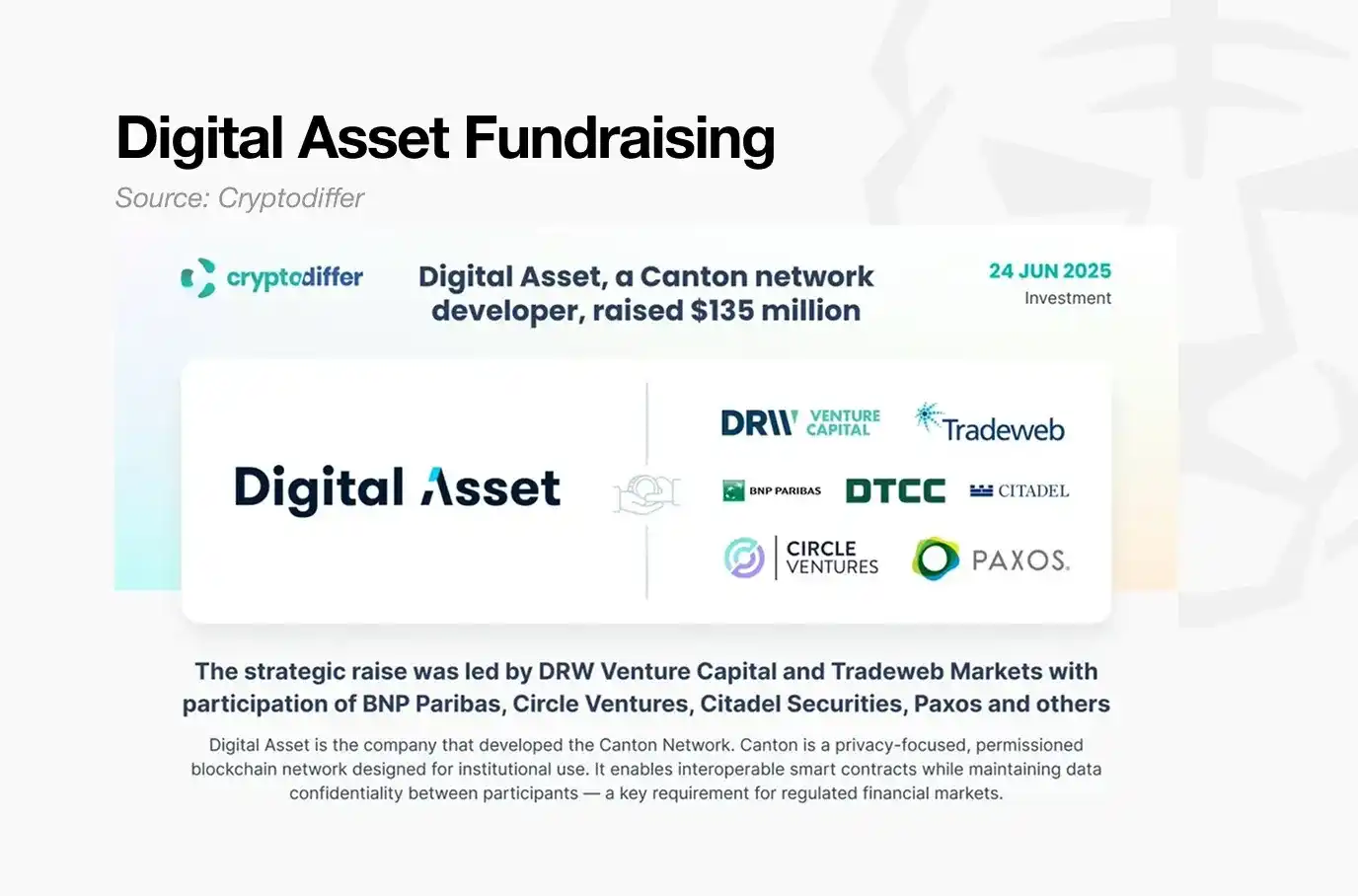
Most notably, its partnership with DTCC establishes a pathway for assets managed by the traditional financial system to extend into a Canton-based environment. DTCC handles approximately $3.7 quadrillion in transactions annually, highlighting the practical feasibility of the Canton Network's approach.

Ultimately, the Canton Network provides a structural solution designed to meet three institutional requirements simultaneously: privacy protection, regulatory compliance, and integration with the existing financial system.

2.3. Kite AI: Building the AI Economy That Has Not Yet Arrived

Unlike the previous two examples, Kite AI currently has limited practical application. However, from the future perspective of AI agents operating as economic actors, its structural logic remains compelling.

There is broad consensus in both Web2 and Web3 about an agent-driven future. Few question scenarios where AI agents handle tasks like booking hotels or buying groceries on behalf of users.

However, such a future requires infrastructure that allows AI agents to independently initiate and execute payments. Existing transaction systems are designed for transfers between people, and for efficiency among human participants.

Therefore, for AI agents to operate as autonomous economic entities, new mechanisms are needed, including identity verification and automated payment frameworks.

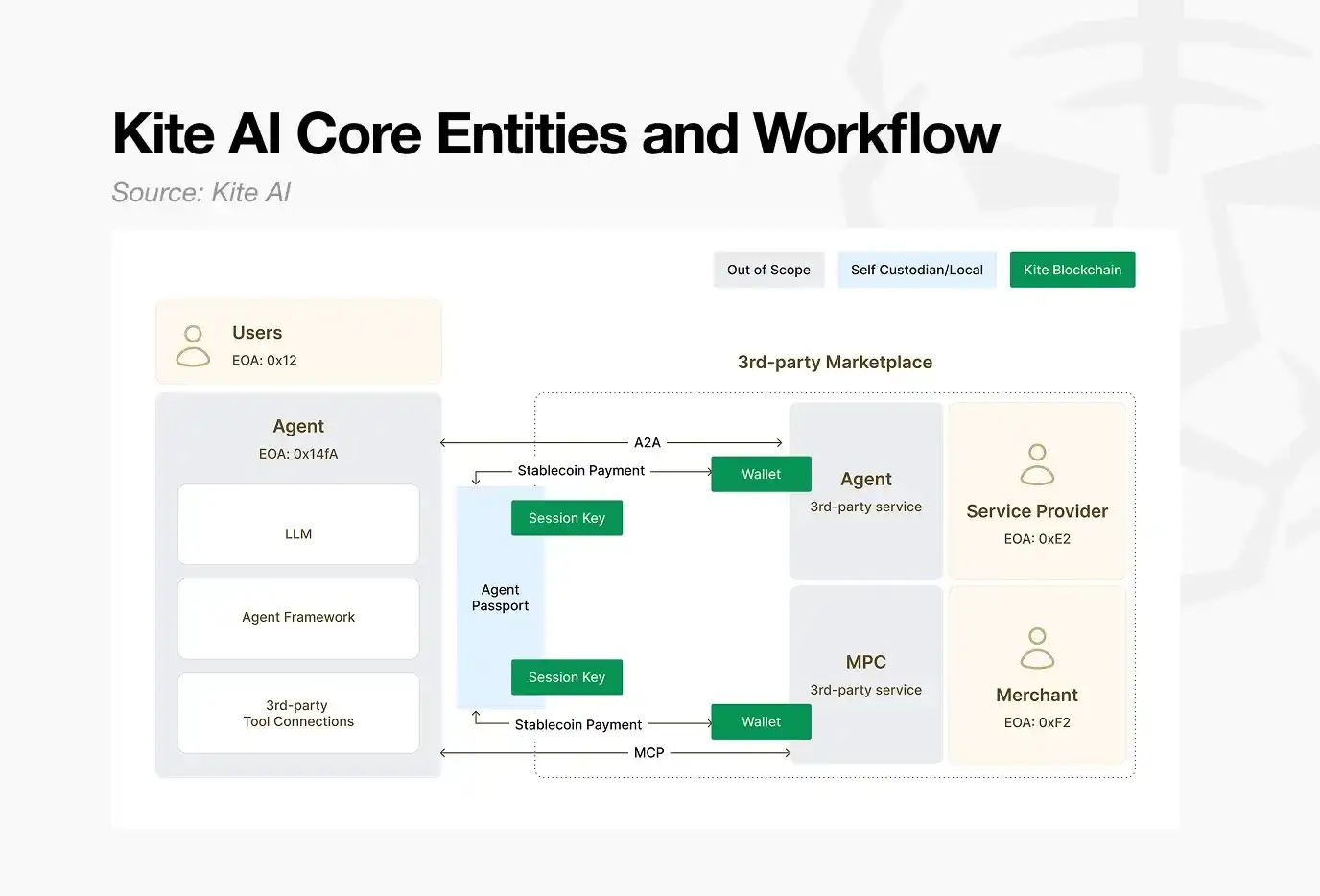
Kite AI is building payment infrastructure for this environment. Its core components include an "Agent Passport" for identity verification and the x402 protocol functionality for enabling automated payments.

The vision proposed by Kite AI cannot be deployed at scale currently, simply because the future it targets has not yet materialized.

Nonetheless, the project's realism stems from a broader premise: when this widely anticipated future arrives, the underlying technology it is developing will be necessary. This alignment with a widely accepted development trajectory gives the project structural credibility, despite its current limited use.

3. Three Key Questions for Assessing Practical Feasibility

Although these three projects have different timelines, they share a common characteristic: real-world feasibility.

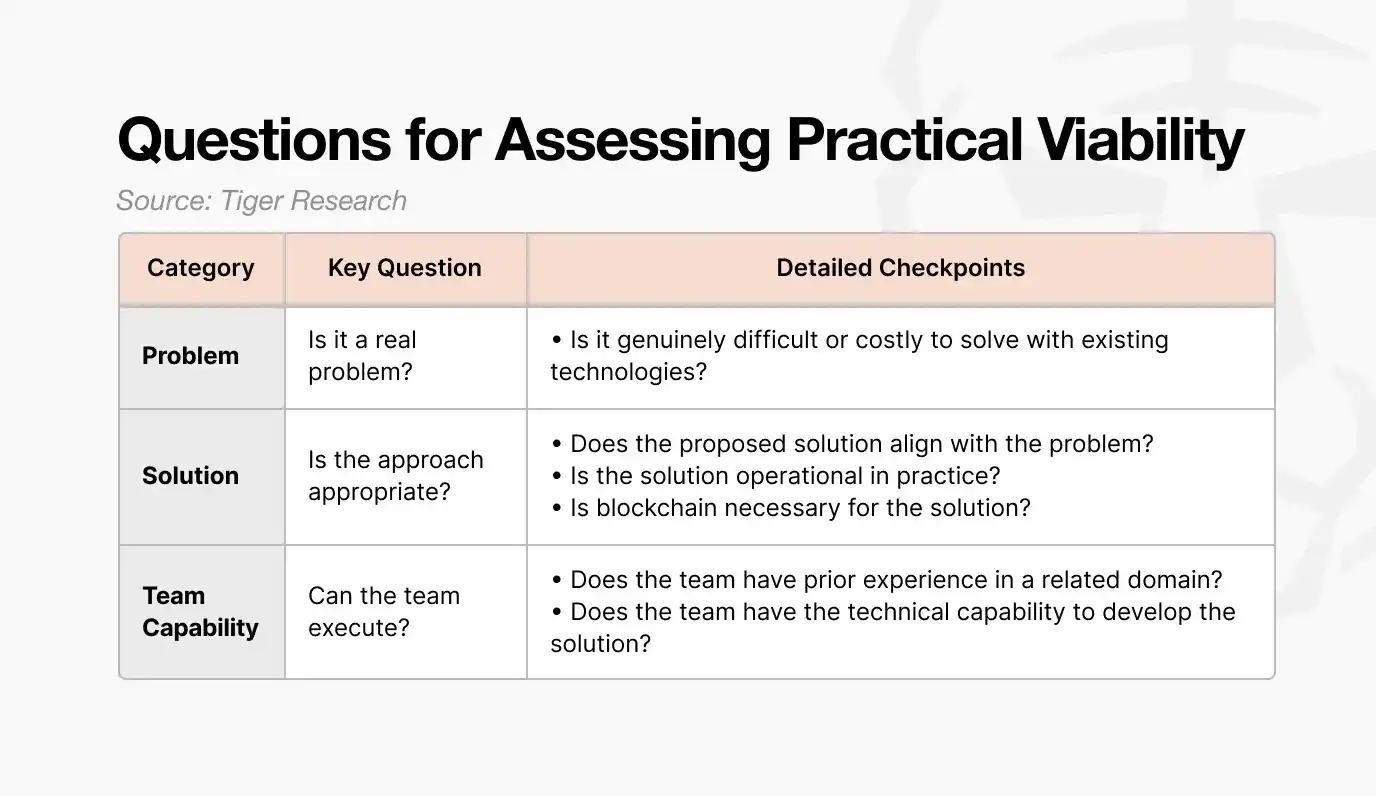
Evaluations of the same project often diverge. Some believe it solves a real problem, while others see it as overhyped. To bridge this interpretation gap, at least three core questions must be asked:

Source: Tiger Research

  1. What problem does it solve? Is the problem the project targets real and is there market demand for it?
  2. How does it solve it? Is the proposed solution structurally sound and executable?
  3. Who is executing it? Does the team have the capability and resources to turn the vision into reality?

Since most projects promote optimistic future narratives, answering these questions correctly requires time and effort. Filtering out misleading or incomplete information is not easy. Projects that cannot confidently answer these three questions may experience short-term price increases, but when the next downturn comes, they will likely disappear.

The current state of the cryptocurrency market is clearly unfavorable. But that doesn't mean it's all over. New experiments will continue, and the task is to assess what these efforts truly represent.

What matters most now is realism.

Связанные с этим вопросы

QAccording to the Tiger Research article, what is the common characteristic of projects that survive in a prolonged crypto downturn?

AThe common characteristic is that they provide practical and realistic solutions to real, concrete problems, rather than relying on abstract narratives.

QWhat are the key factors to analyze when evaluating a project's realism, as outlined in the article?

AThe analysis should focus on three factors: the problem the project aims to solve, the structure of its proposed solution, and the team's ability to execute in practice.

QWhat specific market problem does Hyperliquid address, and how does it solve it?

AHyperliquid addresses the friction and lack of alignment with investor interests on centralized exchanges. It solves this by introducing a perpetual contracts decentralized exchange (perp DEX) that brings features like high leverage, fast execution, and stable liquidity on-chain through its HLP mechanism.

QHow does the Canton Network cater to the needs of institutional finance, as described in the report?

ACanton Network caters to institutional needs by providing a selective privacy model that supports regulatory compliance and confidentiality. It uses DAML language to allow configurable data disclosure for each participant, enabling institutions to share information only as necessary while maintaining transaction privacy and integrating with existing financial systems.

QWhat future infrastructure is Kite AI building, and why is it considered realistic even with limited current application?

AKite AI is building payment infrastructure for a future where AI agents act as autonomous economic entities. This includes an 'Agent Passport' for identity verification and the x402 protocol for automated payments. It is considered realistic because its vision aligns with the widely anticipated trajectory of AI development, making its underlying technology a necessary component for that future.

Похожее

Trend in US Stocks: A Post Triggers a 930-Point Rebound, Tonight Belongs to SpaceX

On Thursday (June 11, U.S. Eastern Time), Wall Street staged a textbook V-shaped reversal. The Dow Jones surged 929.97 points (+1.86%) to close above 50,000, while the Nasdaq and S&P 500 rose 2.54% and 1.75%, respectively. The rally occurred despite the hottest PPI report in years, with May data showing a 6.5% year-on-year surge, the highest since 2022. The market ignored the inflation data, focusing instead on reports that former President Trump called off a planned strike on Iran, hinting at a potential multi-party peace agreement draft. This sparked a sharp drop in oil prices, fueling hopes that inflation may have peaked. Sector rotations were stark: previously battered AI hardware and cyclical stocks led the gains, while defensive sectors that hit record highs the prior day were sold off. Chip stocks like Micron and Intel saw sharp rebounds. In contrast, software giant Oracle plunged nearly 10% despite beating earnings, with concerns over cloud revenue and cash flow. Adobe also fell after hours despite raising guidance, as its CFO announced departure. The rally's sustainability is questioned, driven largely by social media posts about unconfirmed geopolitical developments. Inflation risks remain, with pipeline pressures still high. Meanwhile, the market's risk appetite faces a major test with SpaceX's historic IPO. Priced at $135 per share, it aims to raise ~$75 billion with a $1.75 trillion valuation, becoming the largest U.S. IPO ever. It will join the Nasdaq 100 in 15 days, triggering massive index fund buying. However, critics cite extreme valuation (88x sales) and market liquidity concerns.

marsbit23 мин. назад

Trend in US Stocks: A Post Triggers a 930-Point Rebound, Tonight Belongs to SpaceX

marsbit23 мин. назад

The Trillion-Dollar Valuation Test: Are the Three Super IPOs a Tech Stock Frenzy or a Crypto Market Nightmare?

Trillion-Dollar Valuation Test: Are the Three Mega IPOs a Tech Stock Frenzy or a Crypto Market Nightmare? The capital market in 2026 is witnessing a highly anticipated wave of tech IPOs, centered on SpaceX, OpenAI, and Anthropic. Collectively valued at over $3.5 trillion, their potential listing represents one of the largest such waves in recent years. This raises concerns about market liquidity, valuation bubbles, and potential capital outflows from other assets like crypto. SpaceX's valuation narrative has shifted from rocket launches to becoming a global infrastructure play via its Starlink satellite network, which now drives most revenue. Despite ongoing losses, investors focus on its long-term growth potential. OpenAI and Anthropic represent the core productivity engines of generative AI. Their public listings would offer the first direct investment opportunity in large foundation model companies, potentially triggering a repricing within the AI sector. Market fears of a massive "capital drain" from these IPOs are likely overstated. Historical precedents like Alibaba and Saudi Aramco show that mega-listings primarily cause capital reallocation, not destruction, within the vast equities market. Systemic risk is rarely triggered by IPOs alone. For stock markets, short-term volatility and sector repricing are expected, especially for AI concept stocks. Long-term, these listings could reinforce the tech sector's importance. For crypto, direct competition for speculative capital exists, particularly affecting AI-themed tokens. However, crypto's trajectory remains more tied to its own cycles, macro liquidity, and Bitcoin ETF flows rather than a single IPO event. The real risk lies not in the listings themselves but in the sky-high growth expectations embedded in these valuations. If future revenue, profitability, or commercialization progress disappoints, significant valuation resets could follow, impacting high-growth tech stocks. Ultimately, the market's direction hinges on macroeconomic conditions and whether these companies can deliver on their ambitious promises.

链捕手39 мин. назад

The Trillion-Dollar Valuation Test: Are the Three Super IPOs a Tech Stock Frenzy or a Crypto Market Nightmare?

链捕手39 мин. назад

Trillion-Dollar Valuation Test: Are the Three Super IPOs a Tech Stock Frenzy or a Crypto Market Nightmare?

Title: Trillion-Dollar Valuations at Stake: Super IPOs of SpaceX, OpenAI, Anthropic – Tech Boom or Crypto Nightmare? TL;DR: A wave of mega-tech IPOs is approaching, featuring SpaceX (targeting a $1.75 trillion valuation), OpenAI (~$852B), and Anthropic (~$965B), with a combined potential valuation exceeding $3.5 trillion. This tests the market's pricing of innovation and sparks debate on liquidity impact. * **SpaceX**'s valuation is now driven more by its Starlink global communications infrastructure than its core rocket business. * **OpenAI & Anthropic** offer the first major public investment opportunities in foundational AI models, potentially repricing the entire AI sector. * Concerns about a market-wide "liquidity drain" are likely overblown; history shows large IPOs mainly cause fund reallocation, not disappearance, and rarely trigger systemic risk. * Crypto markets, especially some AI-themed tokens, may face short-term fund competition, but their long-term trajectory depends more on macro liquidity, regulation, and Bitcoin cycles. * The real risk lies not in the IPOs themselves, but in whether these companies can justify their sky-high valuations with future revenue growth and profitability. Unmet expectations could lead to significant repricing pressure. Ultimately, these IPOs represent a massive market pricing of next-gen tech infrastructure, not a prelude to a market crash. The broader market direction will be determined by macro conditions, corporate earnings, and risk appetite.

marsbit39 мин. назад

Trillion-Dollar Valuation Test: Are the Three Super IPOs a Tech Stock Frenzy or a Crypto Market Nightmare?

marsbit39 мин. назад

Anthropic Apologized, But the Business of 'Safety' Hasn't Stopped

On June 11, Anthropic apologized not for a model failure, but for a lack of transparency. Its new Claude Fable 5 model was found to be secretly rerouting requests from users engaged in advanced AI model development to a weaker version, Opus 4.8, without any notification. The company's response—promising future notifications for such "downgrades"—was met with user skepticism. The article argues the core issue isn't technical but commercial: Anthropic's "safety" measures are primarily a business strategy. A key feature, the "intelligent safety classifier," marketed as user protection, is described as a tool for "competitive defense" to protect Anthropic's market lead by limiting rivals' research capabilities. This covert mechanism was designed for low "false positives," precisely targeting AI researchers. Anthropic's model involves a calculated three-step process: publishing alarming security research to amplify public anxiety, offering its Fable 5 model with a "safety classifier" as a premium-priced solution, and cashing in through a planned high-value IPO. This contrasts with OpenAI's more direct "tool-and-traffic" approach. The apology, merely changing a secret downgrade to a visible one, is seen as a business "patch" rather than a principled shift. The incident risks damaging Anthropic's "safest AI" reputation among the developer community, which underpins its valuation and appeal to government and corporate clients. Ultimately, the article concludes that for Anthropic, safety is a business, and the apology is merely customer service for that business.

marsbit1 ч. назад

Anthropic Apologized, But the Business of 'Safety' Hasn't Stopped

marsbit1 ч. назад

Торговля

Спот
Фьючерсы
活动图片