This Could Be the AI-Powered Siri We Get

marsbitОпубликовано 2026-05-29Обновлено 2026-05-29

Введение

Apple is set to unveil a major overhaul of Siri at its upcoming WWDC event, marking its most significant update since the AI assistant's debut in 2011. Faced with criticism for lagging behind competitors like ChatGPT and Google Gemini, the new Siri will feature a completely redesigned interface with a dark theme and chatbot-style interaction, deeply integrated with the Dynamic Island. Key upgrades include persistent conversation memory, addressing a long-standing user complaint. Most notably, Apple will reportedly allow third-party AI models, such as Google Gemini and Anthropic's Claude, to be integrated directly into Siri, transforming it into an AI model distribution platform. This strategic shift positions iOS not as having the single best AI model, but as the best platform for accessing and utilizing various AI models through superior system-level integration. Apple's approach leverages its strengths in hardware-software integration, privacy, and access to user data (contacts, calendar, photos) to create a differentiated experience, even while potentially relying on external infrastructure like Google's for some queries. This move represents a calculated bet that the ultimate AI advantage lies not in having the most powerful model, but in which system can integrate and utilize AI most seamlessly for the user. The success of this strategy will be tested by whether the new Siri can win back users who have grown accustomed to more advanced standalone AI tools.

Once again, Apple's WWDC is just around the corner. For Apple, the most important thing is not just the farewell speech by 'old leader' Tim Cook, but the urgent need to answer the world's expectations for 'AI'.

Apple must confront its most embarrassing question of the past three years—why does the world's most expensive smartphone come with the dumbest AI assistant?

On May 28th local time, ten days before the event, foreign media provided a glimpse of the answer.

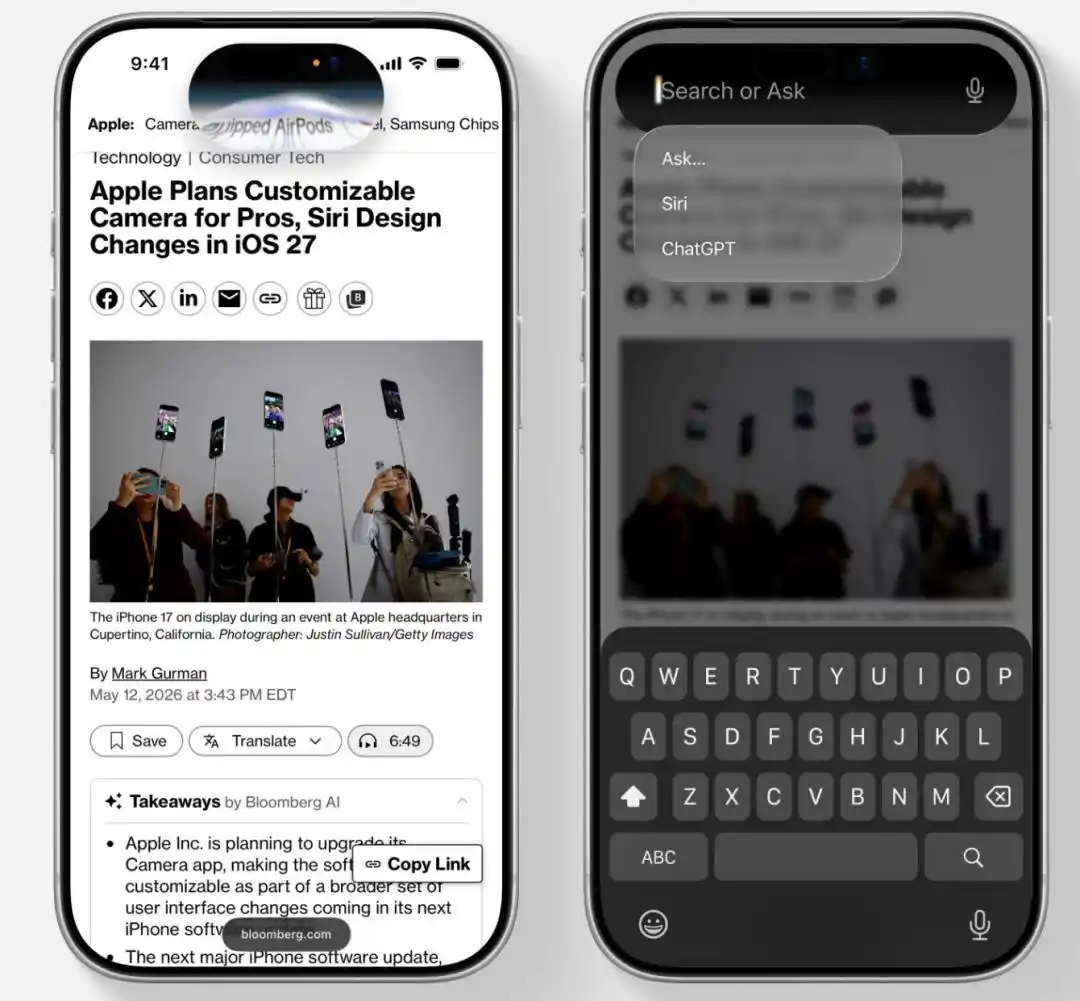
Reportedly, the scale of this Siri revamp is unprecedented since Siri's debut with the iPhone 4S in 2011. The new interface adopts a dark color scheme, is rebuilt with a chatbot interaction paradigm, and is deeply integrated with the Dynamic Island.

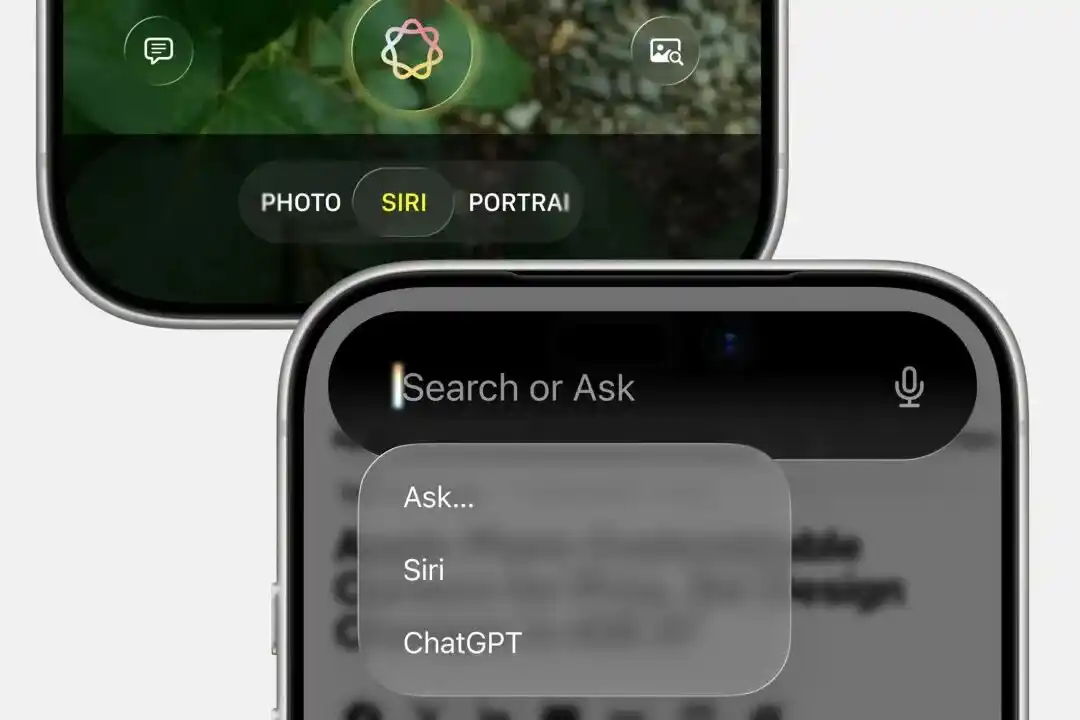
More crucially, Apple will allow users to directly 'plug in' Google's Gemini and Anthropic's Claude into the Siri experience—Siri is set to become a distribution platform for AI models.

Everyone will wonder, what will Siri infused with AI actually look like?

01. A Complete Interface Overhaul

According to a Bloomberg report, the new version of Siri has several core changes. Looking at them together reveals Apple's complete logic.

Possible Siri and Dynamic Island fusion interaction | Image source: Instagram

The first is a complete interface rebuild. A chatbot-style interaction interface, dark color scheme, Dynamic Island integration—Siri transforms from a 'pop-up layer' into an independent application experience entry point. This is more than a visual upgrade; it importantly implies that Apple wants users to treat Siri as a tool they 'actively use', not a voice command line occasionally summoned.

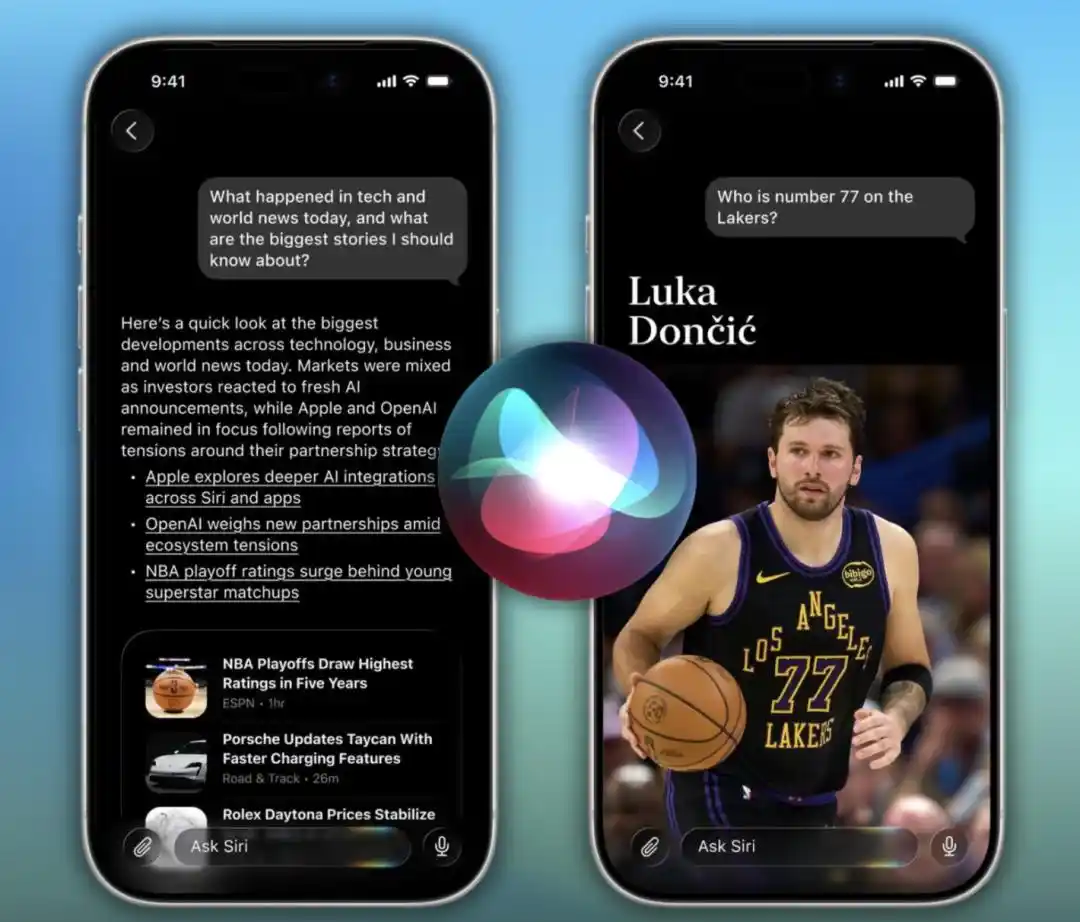
The second is conversational persistence. For years, one of the biggest pain points of talking to Siri was its lack of memory. Every wake-up started from zero—no context, no continuity. The new Siri reportedly fixes this issue—it sounds like a small thing, but it's the foundational condition for the 'assistant' feeling to be valid.

The third, and most noteworthy, is the 'Extensions framework'—allowing third-party AI models to plug into Siri.

The deeper implication of this design is that Apple is no longer taking 'building the best AI model' as its sole path, but rather repositioning iOS as 'the platform for the best AI models to compete'. Just as the App Store doesn't require Apple to develop all apps itself, the new Siri ecosystem doesn't need Apple to outperform everyone in model capabilities—it just needs to bring in all the models and retain users through system-level integration.

Put simply, Apple is fighting the 'model' war with a 'platform' logic.

02. Siri's Three Years of Debt

To understand the weight of this revamp, one must first understand how passive Apple has been in recent years.

In 2023, ChatGPT burst onto the scene, redefining 'conversational AI'. In 2024, Google embedded Gemini into Android, and Samsung turned AI features into selling points. The entire industry accelerated at a breakneck pace, and what was Siri doing? It was still misunderstanding user commands, still interpreting 'set an alarm for 8 AM tomorrow' as opening the alarm app.

Apple, of course, hasn't been idle. At WWDC 2024, Apple Intelligence debuted with great fanfare, promising a host of deeply integrated AI features. But the reality is that many features were either delayed, available only in specific regions, or their actual experience fell far short of the on-stage demos. A long-time Apple tech analyst bluntly stated, 'This doesn't feel like a finished comeback; it feels more like Apple finally arrived at the AI race—only to find itself still in mid-development.'

After three years of accumulated disparity, Apple desperately needs a true turnaround victory.

Two days ago, Apple quietly launched the subdomain genai.apple.com. This small move created significant ripples in tech circles—many interpreted it as a signal that Apple is making final public relations preparations for this WWDC's 'AI transformation'.

03. The Must-Answer Conundrum

But there is a paradox here, already being discussed by many media outlets.

One of Apple's long-standing core moats is privacy. 'Your data is processed only on your device' is Apple's core promise to users and the reason for architectures like Private Cloud Compute.

Now, to make Siri more powerful, Apple is planning to introduce Google's infrastructure to handle some AI queries.

This isn't a technical problem; it's a trust problem.

Possible Siri Q&A interface | Image source: Instagram

When Apple personally breaks the red line of 'only using its own computing infrastructure', its privacy promise to users is no longer absolute. Users can, of course, choose not to use the Google Gemini integration, but 'can choose not to use' and 'doesn't touch by default' are two entirely different things. How Apple explains this shift to users during the keynote will be one of the most-watched details on June 8th.

Furthermore, there's an even more fundamental question. A user on Reddit asked a simple but pointed question—if the Claude inside Siri offers the same experience as using Claude directly, why would I use a shelled version?

Apple must provide a compelling answer, and currently, there seems to be only one candidate—system-level integration: an AI that can access contacts, calendar, photos, health data is a completely different experience from an AI that runs in isolation.

This is Apple's last and most important bargaining chip.

While there is much criticism of Apple's AI pace, a counter-narrative is also circulating—maybe Apple is slow because it's waiting for others to step on the landmines first.

Over the past two years, OpenAI, Google, and Meta have invested hundreds of billions of dollars in data centers, chips, and model training, raising concerns about an AI bubble. In contrast, Apple's strategy seems to be: don't rush to build the 'strongest model', but once the track stabilizes, use its core strength of 'system integration' to catch up from behind.

To some extent, the iOS 27 layout is fulfilling this logic. Don't compete head-on in model capability, but bring in both Gemini and Claude, then build differentiated experience moats using capabilities Android cannot replicate, like the Dynamic Island, personal data permissions, and on-device processing.

This isn't a hasty catch-up by a laggard; it's a calculated bet.

The bet is: the endgame of AI is not about whose model is strongest, but whose system uses models most seamlessly.

On June 8th, Apple will present its complete answer. Whether Siri can truly impress users already accustomed to ChatGPT and Gemini will be the real test of this high-stakes gamble.

Fifteen years later, Siri owes its users an explanation.

*Cover image source: Instagram

This article is from the WeChat public account "GeekPark" (ID: geekpark), author: Hua Lin Wu Wang

Связанные с этим вопросы

QWhat is the most significant change to Siri's interface according to the article?

AThe most significant change is a complete rebuild of Siri's interface, adopting a chatbot-style interactive interface with a dark color scheme and deep integration with Dynamic Island. This transforms Siri from a pop-up layer into an independent application experience entry point.

QWhat is one of the biggest historical shortcomings of Siri that the new version aims to fix?

AOne of the biggest historical shortcomings is Siri's lack of conversational persistence. Siri did not remember context from previous interactions, forcing users to start from scratch with each new request. The new version reportedly fixes this by introducing memory and continuity to conversations.

QHow is Apple's strategy for the new Siri described in relation to competing AI models?

AApple's strategy is described as positioning iOS as a 'platform for the best AI models to compete.' Instead of solely trying to build the best AI model itself, Apple is introducing an 'Extensions framework' to allow third-party AI models like Google Gemini and Anthropic's Claude to be integrated into Siri. This approach uses a 'channel' logic to compete in the 'model' war.

QWhat privacy paradox does Apple face with the new Siri, according to the article?

AApple faces the paradox of needing to utilize external AI infrastructure, like Google's, to enhance Siri's capabilities, which may conflict with its long-standing core promise of user privacy that emphasizes on-device data processing. This move challenges Apple's principle of 'only using its own computing infrastructure' and raises a user trust issue that Apple must address.

QWhat is described as Apple's 'final and most important chip' in creating a differentiated AI experience?

AApple's 'final and most important chip' is its system-level integration. The ability of its AI to access and utilize personal data from contacts, calendar, photos, and health data—coupled with features like Dynamic Island and on-device processing—creates a fundamentally different experience compared to isolated AI models, which Android cannot easily replicate.

Похожее

$9.4 Billion: The Largest Robotics Funding This Year Has Emerged

Munich-based humanoid robotics company Neura has completed a $1.4 billion (approximately RMB 94.9 billion) Series C funding round, valuing the company at around $7 billion and positioning it among the global leaders in the sector. The investment round is notable not just for its size—reportedly the largest in robotics this year—but also for its strategic backers, which include tech giants like NVIDIA and Amazon, alongside established industrial players such as German engineering firms Bosch and Schaeffler. This mix of investors signals a significant shift in the industry's focus from technological demonstrations and general-purpose narratives toward practical, industrial deployment and commercialization. Neura's approach centers on developing humanoid robots for defined, high-value industrial tasks rather than pursuing a general-purpose model. Its early validation comes from a partnership with BMW, where its robots are being tested on actual production lines. The involvement of Bosch and Schaeffler, companies deeply embedded in global manufacturing, underscores a growing belief that humanoid robots are transitioning from labs to viable factory-floor solutions. The article highlights two converging trends driving investment: advancements in AI and large language models, which enhance robots' perception and decision-making in unstructured environments, and mounting pressure from labor shortages and rising costs in major manufacturing regions. The funding landscape is now bifurcating between companies like Figure AI, focusing on versatile general-purpose robots, and firms like Neura, targeting specific vertical industrial applications with clearer, shorter paths to ROI. While technical hurdles remain, the core challenges for widespread adoption are increasingly seen as engineering and commercial in nature: managing the high integration and customization costs for different factory environments and establishing robust, localized maintenance and service networks. The record investment in Neura, particularly from industrial capital, indicates the industry's growing confidence in moving from proving feasibility to solving the practical problems of scalability, reliability, and building sustainable business models around humanoid robots in real-world settings like automotive manufacturing and hazardous labor environments.

marsbit2 ч. назад

$9.4 Billion: The Largest Robotics Funding This Year Has Emerged

marsbit2 ч. назад

"119 to 176 Dollars": Behind SpaceX's Listing, MSX Once Again Successfully Executes the Pre-IPO Closed Loop

Following May's 300% gain on Cerebras, MSX delivered another outstanding performance during SpaceX's listing night. On June 12, SpaceX (SPCX) launched on Nasdaq, reaching a high of $176. This marked the successful culmination of MSX's Pre-IPO project launched in March, where users subscribed at $119, achieving gains of approximately 40-48%. This event validated MSX's complete Pre-IPO mechanism, a crucial advantage in a market where access to top-tier private company equity is typically limited to institutions. MSX's model provides a full cycle for users: subscription (at $119 for SpaceX), real-time on-chain portfolio tracking, optional early redemption, seamless conversion to tradable spot assets (SPCX.M) upon IPO, and final settlement in stablecoins. This end-to-end process distinguishes MSX from platforms that faced settlement issues during the SpaceX IPO, highlighting that the core challenge of Pre-IPO is not just access, but a clear exit and conversion path post-listing. This success with SpaceX is MSX's second major Pre-IPO verification, following the Cerebras listing in May, which yielded ~300% returns for early participants. These back-to-back achievements demonstrate MSX's capability to source, structure, and deliver real assets through a replicable on-chain model. The true barrier for Pre-IPO products lies not in providing an entry point, but in ensuring reliable fulfillment from subscription through to post-IPO liquidity. MSX's proven闭环 (closed-loop) process addresses this, offering Web3 users a structured way to access high-growth, pre-public companies in sectors like AI and frontier tech. MSX plans to continue expanding its Pre-IPO portfolio with this focus on authenticity, transparency, and post-listing execution.

Odaily星球日报15 ч. назад

"119 to 176 Dollars": Behind SpaceX's Listing, MSX Once Again Successfully Executes the Pre-IPO Closed Loop

Odaily星球日报15 ч. назад

Торговля

Спот
Фьючерсы

Популярные статьи

Неделя обучения по популярным токенам (2): 2026 может стать годом приложений реального времени, сектор AI продолжает оставаться в тренде

2025 год — год институциональных инвесторов, в будущем он будет доминировать в приложениях реального времени.

1.8k просмотров всегоОпубликовано 2025.12.16Обновлено 2025.12.16

Неделя обучения по популярным токенам (2): 2026 может стать годом приложений реального времени, сектор AI продолжает оставаться в тренде

Обсуждения

Добро пожаловать в Сообщество HTX. Здесь вы сможете быть в курсе последних новостей о развитии платформы и получить доступ к профессиональной аналитической информации о рынке. Мнения пользователей о цене на AI (AI) представлены ниже.

活动图片