Theft Is Just the Beginning: The Slow Collapse Behind Cyber Attacks

比推Опубликовано 2026-03-23Обновлено 2026-03-23

Введение

The article "Theft Is Just the Beginning: The Slow Collapse Behind Hacker Attacks" discusses the long-term impacts of cryptocurrency hacks beyond the initial financial loss. Based on Immunefi’s "2026 On-Chain Security Report," the analysis reveals that while attacks themselves are swift, the aftermath unfolds over months, causing prolonged damage such as declining token prices, reduced funding, halted hiring, and delayed development. Key findings include: - The median direct loss per attack is around $25 million, but tokens experience a median drop of 61% within six months, with 16% recovering to pre-attack levels. - Although the number of attacks remains steady (94 in 2024, 97 in 2025), the concentration of losses is alarming: the top five attacks accounted for 62% of total stolen funds. - Centralized platforms, though fewer in attack frequency, represent over half of the financial losses, highlighting persistent vulnerabilities in trusted intermediaries. The report emphasizes that the true crisis begins after the theft—projects face extended recovery periods, reputational harm, and operational disruption, making survival particularly challenging for less-resourced teams. The interconnected nature of DeFi ecosystems further amplifies risks, as single incidents can trigger broader market repercussions. Ultimately, the article underscores that resilience is not just about preventing hacks but enduring their prolonged secondary effects.

Author: Andjela Radmilac

Compiled by: Saoirse, Foresight News

Original title: Under the Shadow of Hackers, More Than Just the Demise of Funds


Cryptocurrency exploits can drain a wallet in minutes, but the full extent of the losses often takes months to fully materialize. Token prices continue to fall, project treasuries shrink, hiring freezes, and even projects that survive the theft may completely lose their future in the subsequent turmoil.

Cryptocurrency hacks never end the moment the wallet is emptied. The theft is swift and direct, followed by a slower collapse that begins to spread within the project.

Tokens continue to decline, funding pools shrink accordingly, hiring plans are cut, product development is delayed, and partners withdraw one after another. Projects that should be focusing on recovery end up spending months rebuilding credibility instead of building.

This is precisely the scene depicted in Immunefi's latest "2026 On-Chain Security Status Report." Its core argument applies to any market—whether in the crypto industry or traditional sectors: the initial loss is only part of the damage.

The more serious issue lies in the devastating impact of the exploit on the project's future. Immunefi data shows that the average direct amount stolen per attack in their sample was approximately $25 million, while the median drop in stolen tokens within six months was as high as 61%. During this period, 84% of the tokens failed to return to their pre-attack prices, and project teams spent at least three months on post-incident recovery, delaying normal development.

However, this data comes with a caveat: token declines have multiple causes, and many projects were already vulnerable before the attack—suffering from poor liquidity, overvaluation, or having already lost momentum.

Immunefi acknowledges that they cannot completely separate the impact of hacks from broader market weakness or the projects' own issues. Even so, the patterns revealed in the report are still noteworthy: hacker attacks are no longer isolated theft events but more like a long-tail corporate crisis.

The value of this report lies in its proof that, after the热点 news fades, the后续 effects of hacker attacks continue to cause long-term harm.

Median Attack Losses Are Decreasing, but Extreme Attacks Are Becoming More Dangerous

According to Immunefi's statistics, 191 crypto attacks occurred in 2024-2025, with total losses of $4.67 billion; over five years, 425 attacks累计 occurred, with total losses reaching $11.9 billion.

The number of attacks per year has hardly changed: 94 in 2024, 97 in 2025, roughly flat with 2023. This indicates that the overall security of the market has not significantly improved. Hacker attacks have become the norm in the crypto industry, and a few giant attacks are enough to define the industry's risk for an entire year.

The report reveals a core contradiction:

The median loss from attacks in 2024-2025 was $2.2 million, lower than the $4.5 million in 2021-2023. On the surface, this seems like progress. However, the average loss was still about $24.5 million, more than 11 times the median; previously, this gap was only 6.8 times. The top five attacks accounted for 62% of all stolen funds; the top ten accounted for 73%.

This is an extremely dangerous distribution pattern: the market appears stable and safe until a giant event tears it apart. The scale of ordinary attacks has become smaller, but the real致命 risk lies in the tail—a few特大 incidents absorb the vast majority of losses and冲击 the entire market in a single day.

The most typical case is Bybit. The exchange's $1.5 billion exploit became the most iconic hack of 2025, with this single incident accounting for 44% of all funds stolen that year.

It's easy to view such events as news spectacles, but they expose a deeper problem of risk concentration: a single failure at a core platform is enough to distort the annual loss structure of the entire industry, revealing that huge risks are still piled up on a few critical nodes.

The Protracted Decline Is Where the Project Truly Begins to Collapse

The data on stolen funds in the report is certainly noteworthy, but the most alarming part is the section on price impact.

In Immunefi's sample of 82 hacked tokens:

  • Within two days of the hack, the median drop was about 10%, roughly flat with the previous cycle;

  • But the real冲击 emerged later: the median drop expanded to 61% after six months, higher than the 53% in 2021-2023.

Six months later:

  • 56.5% of the hacked tokens had fallen more than 50%;

  • 14.5% had fallen more than 90%;

  • Only about 16% of tokens returned to or exceeded their pre-attack price levels.
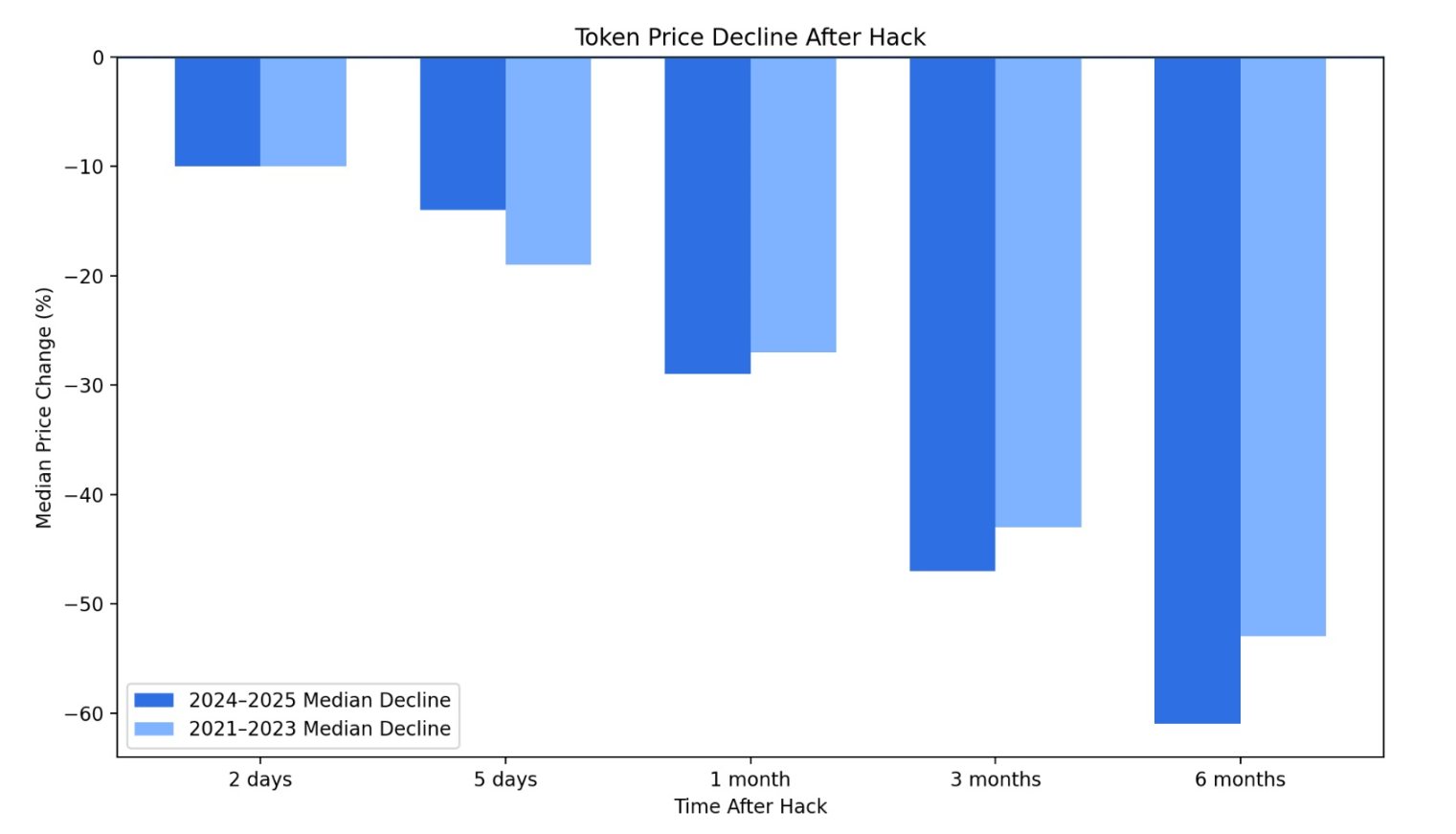
Chart shows the median token price decline for 82 hacked tokens in Immunefi's sample from 2024 and 2025 (Source: Immunefi)

To understand the full impact of a hack, we can no longer view token price as an isolated market indicator. For the vast majority of crypto projects, the token is the treasury, the foundation for fundraising, and the public report card of credibility. A prolonged暴跌 directly cripples the project's operational cycle, hiring ability, bargaining power in partnerships, and internal morale.

The report points out that projects that suffer attacks often lose their security lead within weeks and enter a recovery period of at least three months. Even if the timeline varies by project, the consequences are clear: projects with crashed tokens and damaged brands have almost no breathing room or chance for a turnaround.

Many markets can withstand a theft, a bad quarter, or even a reputation crisis. But the crypto industry often compresses all three into the same event: the attack empties the treasury → the token暴跌 publicly revalues the project → partners withdraw before the internal cleanup is even finished.

Recovery in this environment is extremely difficult, and致命 for teams that were not well-funded to begin with.

Interdependency makes the situation worse. Immunefi believes the DeFi ecosystem has become increasingly interconnected, forming longer, more fragile risk chains between cross-chain bridges, stablecoins, liquid staking, restaking, and lending markets.

Although some cases in the report require external verification, the overall trend is undeniable: today's crypto systems have more complex layers, meaning the impact of a single attack will extend far beyond the affected protocol itself.

Centralized platforms remain at the epicenter of explosions.

The report shows that out of the 191 attacks in 2024-2025, only 20 targeted centralized exchanges, but these 20 caused losses of $2.55 billion, accounting for 54.6% of the total losses.

This shifts the problem from smart contract vulnerabilities back to asset custody, key management, and over-concentrated infrastructure. For an industry that often sells itself on "decentralized risk resistance," most of the huge losses still occur on highly trusted, centralized nodes.

But this does not mean all hacked projects are doomed to fail. The industry has entered a new phase: a project's survival no longer depends on whether it can withstand an attack, but on whether it can withstand the six months *after* the attack.

Theft is just the beginning of the crisis. What truly determines whether a project has a future is the long, slow,持续的 secondary damage that follows the attack.


Twitter:https://twitter.com/BitpushNewsCN

Bitpush TG Discussion Group:https://t.me/BitPushCommunity

Bitpush TG Subscription: https://t.me/bitpush

Original link:https://www.bitpush.news/articles/7622471

Связанные с этим вопросы

QWhat is the main finding of Immunefi's '2026 On-Chain Security Status Report' regarding the impact of crypto hacks?

AThe main finding is that the initial theft is only part of the damage; the more severe problem is the devastating impact on a project's future, including prolonged token price declines, drained treasuries, halted hiring, and delayed development, which can lead to a slow, long-term collapse.

QAccording to the report, what was the median percentage drop in the price of hacked tokens after six months?

AThe median percentage drop in the price of hacked tokens after six months was 61%.

QWhat does the report reveal about the distribution of losses from crypto hacks between 2024 and 2025?

AThe report reveals a highly dangerous distribution: while the median attack loss decreased, the average loss was high, and a small number of extreme attacks accounted for the majority of the losses. The top 5 attacks represented 62% of all stolen funds, and the top 10 represented 73%.

QWhich type of platform was responsible for the majority of the financial losses from hacks in 2024-2025, despite having fewer incidents?

ACentralized exchanges were responsible for the majority of financial losses. Although only 20 attacks targeted CEXs, they resulted in losses of $2.55 billion, accounting for 54.6% of the total losses during that period.

QWhat key factor does the report suggest ultimately determines whether a project can survive a hack?

AThe report suggests that a project's survival is no longer determined by its ability to withstand the initial attack, but rather by its ability to withstand the subsequent six months of slow, prolonged secondary damage, including price collapse and reputational harm.

Похожее

BitMine добавляет 7 430 ETH и тратит $86 млн на выкуп акций – Почему?

Компания Bitmine на прошлой неделе значительно сократила закупки Ethereum (ETH), приобретя лишь 7430 ETH — это минимальный еженедельный объем с мая. Вместо наращивания криптовалютного резерва компания направила примерно 86 млн долларов на обратный выкуп 5,5 млн своих обыкновенных акций по средней цене 15,62 доллара, чтобы повысить акционерную стоимость. Несмотря на замедление темпов покупки, резерв Bitmine по-прежнему огромен и составляет 5 777 468 ETH (около 4,8% от общего объема эмиссии ETH). Компания близка к достижению своей долгосрочной цели — владению 5% всех ETH. Уже через 12 месяцев после запуска стратегии фонд почти достиг этого показателя. Кроме того, Bitmine разместила в стейкинге через свою платформу MAVAN около 4,92 млн ETH (85% своих активов). Это может приносить примерно 247 млн долларов годового дохода при текущей доходности в 2,67%, а после стейкинга всего резерва доход может вырасти до 290 млн долларов. Параллельно в статье отмечается, что пока Bitmine фокусируется на Ethereum, компания MicroStrategy Майкла Сэйлора продолжает агрессивно накапливать Bitcoin (BTC), несмотря на финансовое давление и недавние продажи части активов.

ambcrypto18 мин. назад

BitMine добавляет 7 430 ETH и тратит $86 млн на выкуп акций – Почему?

ambcrypto18 мин. назад

9,42 миллиона частных инвесторов бросились покупать акции Changxin Technology, кто же выиграл в лотерее?

Результаты размещения акций Changxin Technology привлекли огромное внимание инвесторов. Всего в онлайн-подписке для частных инвесторов участвовало около 9,4288 миллиона человек, было подано 816,92 миллиарда заявок на акции, сгенерировано примерно 7,7 миллиона выигрышных лотерейных номеров, а итоговая ставка онлайн-подписки составила около 0,4714%, что является рекордно высоким показателем для новых акций на рынке STAR. Из-за высокого спроса компания активировала механизм обратного перевода, увеличив количество акций, размещаемых онлайн, до 3,851 миллиарда. Среди институциональных инвесторов 285 организаций, управляющих 10907 счетами, подали заявки на сумму около 12,38 триллиона акций, получив в итоге 2,173 миллиарда акций при коэффициенте распределения около 0,1756%. Taikang Asset Management стал институциональным инвестором, получившим наибольшее распределение. Среди публичных фондов лидерами по объему размещения стали E Fund, Southern Fund и ICBC Credit Suisse. Основатель ведущей китайской компании в области больших моделей DeepSeek, Лян Вэньфэн, через свои хедж-фонды Ningbo幻方量化 и Zhejiang九章资产 получил самое большое распределение среди частных фондов — акций на общую сумму примерно 1,75 миллиарда юаней. Ожидается, что Changxin Technology официально выйдет на биржу 27 июля. По оценкам рынка, её стоимость после IPO может превысить 1 триллион юаней, а некоторые аналитики дают прогноз до 2-3 триллионов юаней. Однако недавняя коррекция на глобальном технологическом рынке может оказать определенное влияние на цену акций компании после листинга.

marsbit43 мин. назад

9,42 миллиона частных инвесторов бросились покупать акции Changxin Technology, кто же выиграл в лотерее?

marsbit43 мин. назад

Криптовалюта USCR стабилизируется на отметке $0,0022: Сможет ли мемкоин отыграть потери второго квартала?

Криптовалюта USCR, мемкоин, отслеживающий тему официальных крипторезервов США, пытается восстановиться после падения до двухмесячного минимума в $0.0022. В мае цена выросла на 65%, но в июне упала на 37%. Сейчас наблюдается потенциальный отскок, и если быкам удастся закрепиться выше ключевых скользящих средних, возможен рост до $0.0028 (уровень Фибоначчи) и далее до майского пика в $0.0036, что означает потенциал роста на 30-60%. Динамика USCR тесно связана с новостями о создании стратегического резерва биткойна в США. Майский рост совпал с увеличением вероятности этого события и внесением соответствующего законопроекта. Однако его рассмотрение застопорилось, а шансы на создание резерва к 2027 году, по данным Polymarket, упали до 18%, что давит на настроения. Несмотря на неопределённость, база держателей USCR остаётся значительной: 48 тысяч, сократившись лишь на 4 тысячи с начала 2026 года. Восстановление цены будет зависеть от позитивных новостей по законопроекту о биткойн-резерве.

ambcrypto1 ч. назад

Криптовалюта USCR стабилизируется на отметке $0,0022: Сможет ли мемкоин отыграть потери второго квартала?

ambcrypto1 ч. назад

«Богиня благотворительности» с 3 млн подписчиков целиком создана ИИ, поддельный детский дом, международный «фальшивый фонд» рухнул за одну ночь

**Шокирующий разоблачение: Астролябка «благотворительности» с 300 000 подписчиков оказалась масштабной аферой на основе ИИ** Австралийская инфлюенсерша Лили Джей, имевшая почти 3 миллиона подписчиков в Instagram, создала тщательно продуманную мошенническую схему под прикрытием своего «Фонда Лили Джей». Используя искусственный интеллект, она и ее команда генерировали фальшивые изображения и видео, изображающие строительство мечетей, раздачу хлеба в Газе и даже открытие детского дома в Уганде для привлечения пожертвований от преимущественно мусульманской аудитории. Расследование ABC News Verify выявило многочисленные подделки: видео с «открытием» детского дома полностью сгенерировано ИИ (включая детей, саму Лили и фонды), «награда» за гуманитарную деятельность оказалась фальшивкой с цифровым водяным знаком ИИ, а заявленные благотворительные проекты в Уганде и Газе не существуют. Фонд не зарегистрирован как официальная благотворительная организация, что позволяло избегать финансовой отчетности. После запросов ABC сайт фонда стал скрывать кнопки для пожертвований и предупреждения о своем неблаготворительном статусе для посетителей из Австралии, но оставил их для иностранных пользователей. Эксперты предупреждают, что эта афера — тревожный прецедент, демонстрирующий, как ИИ может эксплуатировать человеческое доверие и желание творить добро, создавая убедительные, но полностью вымышленные нарративы.

marsbit1 ч. назад

«Богиня благотворительности» с 3 млн подписчиков целиком создана ИИ, поддельный детский дом, международный «фальшивый фонд» рухнул за одну ночь

marsbit1 ч. назад

L2 «рекалибровка»: когда L1 становится собственным ролл-апом, каков финал Ethereum?

«L2 перекалибровка»: когда L1 становится собственным роллапом, каков финал Ethereum? Первоначально, роллапы (L2) рассматривались как основной путь масштабирования Ethereum, обеспечивая дешёвое и быстрое исполнение транзакций. Однако, с развитием самого L1 (повышение лимита газа, внедрение безсостоятельности и zkEVM) и объединением задач масштабирования, традиционное разделение между L1 как безопасным, но медленным «слоем урегулирования» и L2 как дешёвым «слоем исполнения» меняется. Вопрос теперь не только в увеличении пространства блоков, а в перераспределении ролей в системе с множеством исполняющих сред. Будущая роль L2 смещается от простого предоставления дешёвого газа к обеспечению уникальных функций, таких как оптимизация для конкретных приложений, приватность и гибкие модели управления. Таким образом, L2 станет скорее спектром исполняющих сред с разной степенью наследования безопасности Ethereum, чем единым техническим классом. Ключевой задачей становится решение фрагментации. Разделённая ликвидность и состояние пользователя ухудшают опыт. Усилия концентрируются на улучшении взаимодействия (интероперабельности) через системы на основе намерений (intents) и нативные протоколы, такие как Ethereum Interoperability Layer (EIL), чтобы Ethereum вновь «ощущался как единая цепь». Сокращение времени до финальности транзакций L1 также имеет решающее значение для доверия между цепями. Ещё более радикальная идея — с появлением систем доказательств (zkEVM) внутри L1 сама Ethereum может стать своего рода «собственным роллапом», где высокопроизводительные узлы исполняют транзакции, а валидаторы проверяют криптографические доказательства. Это размывает классические границы между слоями и открывает путь к архитектуре, где множество исполняющих доменов (специализированных L2) сосуществуют, разделяя общую безопасность, ликвидность и систему урегулирования Ethereum. В итоге, будущее Ethereum видится не как победа L1 над L2 или наоборот, а как экосистема взаимосвязанных исполняющих сред, которые, будучи «разобранными» для масштабирования, вновь объединяются в единое, безопасное и удобное для пользователя целое.

marsbit1 ч. назад

L2 «рекалибровка»: когда L1 становится собственным ролл-апом, каков финал Ethereum?

marsbit1 ч. назад

Торговля

Спот
活动图片