The Trillion-Dollar Stablecoin War: Binance Decides to Re-enter the Fray

marsbitОпубликовано 2025-12-24Обновлено 2025-12-24

Введение

The stablecoin market, with $27.6 trillion in on-chain transfers in 2024, has surpassed the combined volume of Visa and Mastercard. This marks a shift from a niche crypto product to a critical piece of global financial infrastructure. The article outlines the evolution of stablecoins. The 1.0 era was defined by first-mover advantage and passive monopolies. Tether's USDT dominates with a 60% market share, while Circle's USDC, despite its compliance focus, faced a crisis during the 2023 Silicon Valley Bank collapse, proving that network effect is the ultimate moat. Binance's journey reflects this competitive landscape. Its first stablecoin, the regulated BUSD, was shut down by U.S. regulators in 2023. It then pivoted to supporting FDUSD and has now taken a strategic stake in a new model with the launch of $U. Unlike traditional stablecoins, $U is a "stablecoin ETF" or "套娃" (nesting doll), backed by a basket of existing stablecoins: USDT, USDC, and the politically-connected USD1 from the Trump family. USD1's rapid growth, including a $2 billion investment into Binance from an Abu Dhabi fund, highlights a new dimension: stablecoins. The article argues that stablecoins are no longer just financial tools but vehicles for political capital and a new front in the battle for monetary influence, as evidenced by the U.S. passing the GENIUS Act to establish a federal regulatory framework. The "nesting doll" structure of $U aims to mitigate single-point risks (e.g., USDT's opacity, US...

In 2024, the total on-chain transfer volume of stablecoins reached $27.6 trillion, surpassing the combined total of Visa and Mastercard for the first time.

This figure was $300 billion five years ago and close to zero a decade ago.

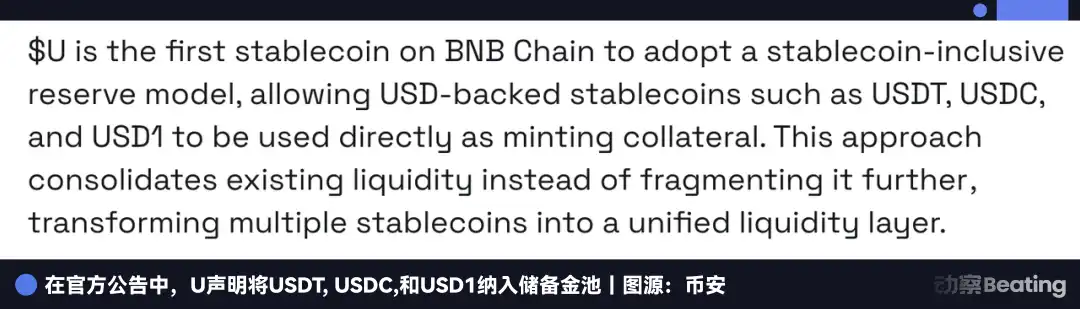
On December 18, a project named United Stables launched a new stablecoin, $U, in Dubai. Its reserves are not U.S. dollar cash or treasury bonds but a combination of three stablecoins: USDC, USDT, and USD1. Using stablecoins to collateralize stablecoins is known in the industry as "nesting."

Binance Wallet integrated immediately, with official endorsement from BNB Chain, and full support from PancakeSwap and Four.Meme.

This configuration sends a clear message in the crypto circle: Binance is personally entering the fray.

$U itself may be insignificant. But the trend it represents is clear: stablecoins are moving from wild growth to a state of rival regimes, and a new battle is beginning.

Stablecoin 1.0 Era: The Monopoly of First Movers

The essence of stablecoins is "on-chain dollars." Users deposit $1 with the issuer and receive 1 token, which can circulate on any blockchain globally, 24/7, with second-level settlement and fees of just a few cents.

Compared to Alipay or bank transfers, the core advantage of stablecoins is that they require no real-name verification, no bank account, and no regulatory approval. A wallet address is the only barrier to entry.

When Tether issued USDT in 2014, the entire crypto market's capitalization was less than $50 billion. So Tether seized the opportunity window: traditional banks generally refused to provide services to cryptocurrency companies. The only way to cash out profits after trading cryptocurrencies was to exchange crypto assets for USDT, locking in dollar-denominated gains.

USDT's rise was not just due to a superior product but also because users had no other choice. This "passive monopoly" has continued to this day. As of December 2025, USDT's market capitalization is approximately $199 billion, accounting for 60% of the stablecoin market.

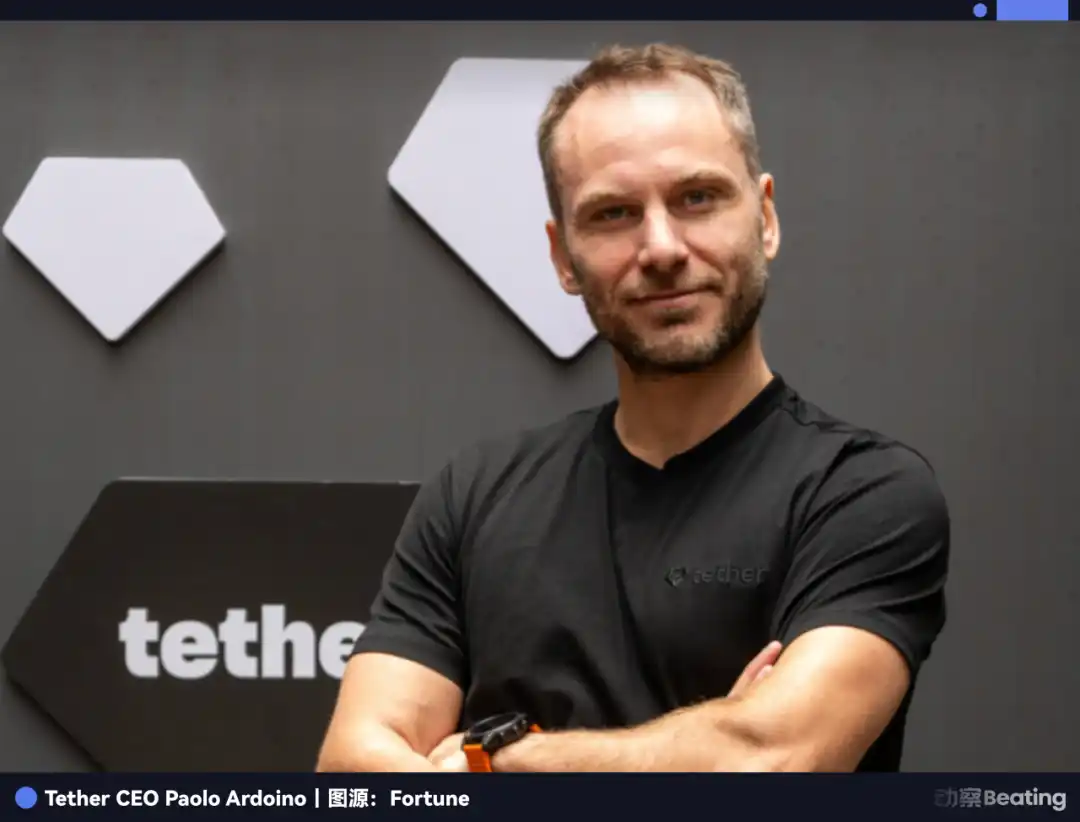
In 2018, Circle, in partnership with Coinbase, launched USDC, emphasizing compliance: monthly reserve audit reports, funds custodied with regulated financial institutions, and adherence to the U.S. securities regulatory framework. The subtext was that Tether's black-box model would eventually cause problems.

By 2022, USDC's market cap once approached 70% of USDT's. Wall Street bet that the compliant faction would ultimately prevail.

In March 2023, Silicon Valley Bank collapsed. Circle had $3.3 billion in reserves deposited there. USDC briefly depegged to $0.87—an asset promised to always equal $1 had lost 13% of its value.
The lesson the market drew was: compliance is a plus, but not a moat. Banks can fail, regulators can change course; the real barrier is network effects—when your user base and liquidity are large enough, you become the de facto standard.

The survival rule of the Stablecoin 1.0 era was simple: first-mover advantage trumps everything.

Binance's Three Pivots

Exchanges are the traffic hubs of the crypto world, and stablecoins are the unit of account for trading. Whoever controls the mainstream stablecoin holds pricing power. Binance cannot afford to give up this position.

In 2019, Binance partnered with Paxos, a New York-licensed trust company, to issue BUSD. This was a compliant stablecoin regulated by the New York Department of Financial Services, with a peak market cap of $16 billion, second only to USDT and USDC.

BUSD once accounted for 40% of Binance's trading volume. It was a core tool for Binance to establish its autonomous "monetary sovereignty."

In February 2023, the SEC issued a Wells Notice to Paxos, alleging that BUSD was an unregistered security. On the same day, the New York Department of Financial Services ordered Paxos to stop minting new BUSD. Nine months later, Binance founder CZ pleaded guilty in the U.S., and Binance paid a $4.3 billion fine.

$16 billion in stablecoin assets was reduced to zero under regulatory pressure.

Binance reacted quickly. Shortly after BUSD was halted, the Hong Kong company First Digital launched FDUSD,恰好 coinciding with the launch window of Hong Kong's virtual asset licensing system. FDUSD quickly became one of the main stablecoins on the Binance platform, although the two parties never publicly confirmed a partnership.

The move from BUSD to FDUSD was passive survival; the move from FDUSD to $U is active positioning.

The design logic of $U is fundamentally different from the previous two: it does not directly compete with USDT, USDC, or USD1 but incorporates them all into its reserve pool. In a sense, $U is a "stablecoin of stablecoins" or a "stablecoin ETF."
Binance's lesson is: stablecoins reliant on a single regulatory framework always have their lifelines held by others.

The Presidential Family Enters the Fray

The most noteworthy component in $U's reserves is USD1.

In March 2025, the Trump family issued the USD1 stablecoin through World Liberty Financial. According to public disclosures, Trump family-related entities hold 60% of the parent company's equity and receive 75% of the net income share. Trump himself serves as the "Chief Cryptocurrency Advocate," while his sons Eric and Donald Jr. serve as "Web3 Ambassadors."

By December 2025, the Trump family had already profited over $1 billion from the project.

Two months after its issuance, USD1 received its first major order: the Abu Dhabi sovereign wealth fund MGX invested $2 billion in Binance, using USD1 as the payment tool.

This was the largest cryptocurrency payment in history, instantly providing the nascent stablecoin with $2 billion in "practical endorsement."

As of December, USD1's market cap is approximately $2.7 billion, ranking seventh among stablecoins and becoming one of the fastest-growing.

Now, USD1 has been included in $U's reserves. This implies a hidden chain of interests: part of Binance's ecosystem trading volume is converted into usage scenarios for USD1; part of USD1's usage scenarios is converted into income for the Trump family.

The deeper game lies in the monetization of political capital. After Trump returned to the White House, the SEC suspended investigations into several crypto projects, including cases involving Sun Yuchen, a major investor in World Liberty Financial. Treasury Secretary Besant stated clearly at the White House Crypto Summit: "We will use stablecoins to maintain the dollar's status as the world's reserve currency."

Stablecoins are no longer just financial tools; they are becoming carriers of political resources.

The Logic of Nesting

Using stablecoins to collateralize stablecoins might seem redundant. But this design is based on three considerations.

Risk Diversification. USDT's hidden danger lies in its opaque reserves; USDC's隐患在于 its over-reliance on the U.S. banking system, as the Silicon Valley Bank incident warned; USD1's隐患在于 its deep binding with Trump's political fate. Holding any one alone means bearing its specific risk. Combining the three theoretically allows for risk hedging.

Liquidity Aggregation. The pain point of the stablecoin market is fragmented liquidity. USDT has its liquidity pools, USDC has its own, and funds are scattered across dozens of public chains and hundreds of DeFi protocols. $U attempts to connect these isolated pools, providing users with a unified liquidity entry point.

Narrative Upgrade. The competitive dimension of Stablecoin 1.0 was "who is more transparent" and "who is more compliant"—a rhetoric repeated for a decade. $U attempts to provide a new narrative framework: "settlement currency designed for the AI era," "supporting gasless signature transfers."

Of course, gasless transfers are part of the EIP-3009 standard, which existed in 2020, and USDC already supports it. So "AI-native" is more of a universal label; any on-chain stablecoin can be called by smart contracts and enable automatic machine-to-machine payments. $U's real differentiation lies not in technology but in its ecosystem and aggregated architecture.

Naturally, the nested structure also implies risk transmission: if one layer has a problem, the effects ripple through.

If USDT were to collapse one day, $U would not go to zero completely but would certainly承受 the impact: reserves shrinking, redemption pressure surging, depegging risk rising.

所谓 "Risk diversification" is more accurately "diversifying the intensity of impact from a single point of failure," ensuring that holders don't lose everything if any underlying asset fails. It's a bottom-protection mindset, not a risk-free design.

From Gray Zone to Great Power Game

2025 is the first year of stablecoin regulation.

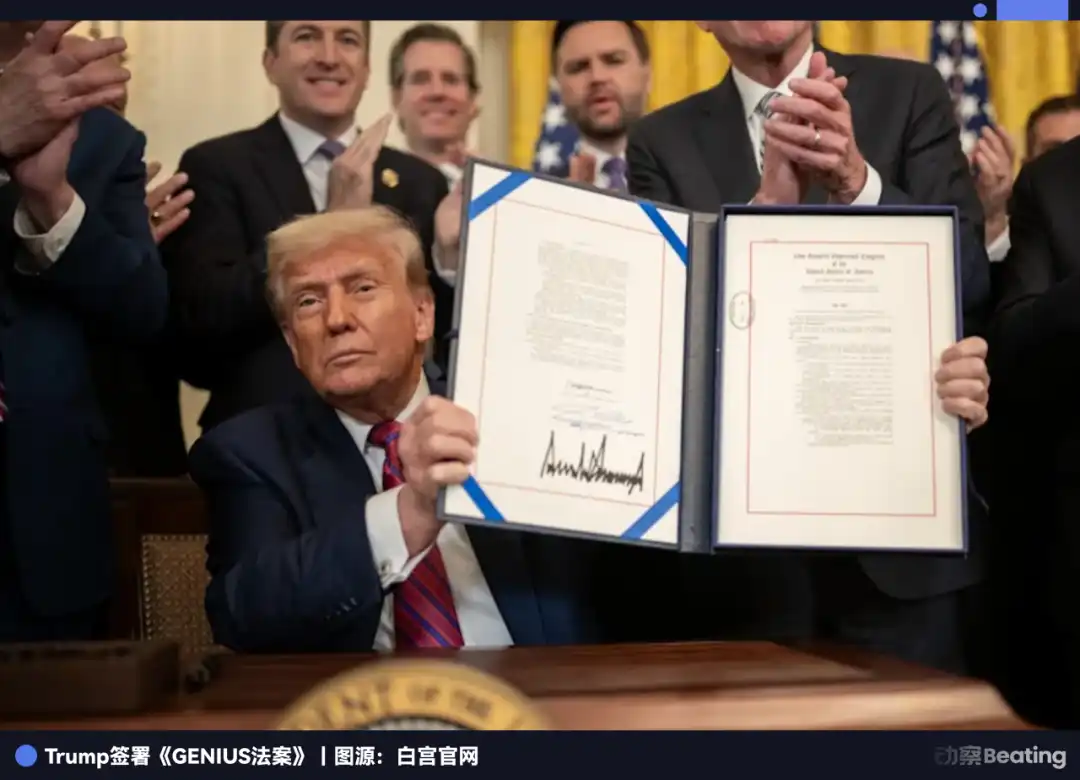
In June, Circle listed on the NYSE, with an IPO price of $31, closing at $69 on the first day, its market cap approaching $20 billion, becoming the "first stablecoin stock." In the same month, the U.S. Senate passed the GENIUS Act with 68 votes in favor, establishing a federal regulatory framework for stablecoins for the first time. The EU's MiCA regulations came into full effect, and Hong Kong, Japan, and Singapore相继 introduced licensing systems.

Over the past decade, stablecoins existed in a gray area, with regulators lacking grounds for intervention. Now, with an annual transfer volume exceeding the world's largest payment network, no government can continue to pretend not to see it.
Data shows: 34% of adults in Turkey hold USDT to hedge against the lira's depreciation; nearly 30% of remittances in Nigeria are completed via stablecoins; tech workers in Argentina普遍 use USDC to receive salaries, bypassing local currency inflation. In these countries, stablecoins are already the de facto "shadow dollar."

The foundation of dollar hegemony is not the Fed's money-printing ability but the inertia of global trade being denominated and settled in dollars. If stablecoins become the next-generation cross-border payment infrastructure, controlling stablecoins means controlling dollar hegemony in the digital age.

This is the underlying logic behind the Trump family's entry and the reason why the GENIUS Act passed with rare bipartisan consensus: in Washington, stablecoins are no longer a小众 issue for the crypto circle but a strategic resource concerning national interests.

The Imminent Battle

Whether $U will succeed is still uncertain. Its current circulating market cap is negligible compared to USDT's nearly $200 billion and USDC's nearly $80 billion.

But it represents a new paradigm in stablecoin competition.

Competition in the 1.0 era was about going it alone: Tether established a monopoly with first-mover advantage, Circle tried to leverage compliance to撬动 the market, and Binance fought for pricing power through BUSD. The core question was "who can survive."

Competition in the 2.0 era is about forming alliances. PayPal issued PYUSD, Ripple launched RLUSD, Robinhood teamed up with Galaxy Digital and Kraken to form the USDG alliance. Traditional financial giants, crypto-native players, sovereign capital, and political forces have all entered the arena.

The new core question becomes "who can tie more players together."

$U's strategy is to achieve aggregation through "nesting": not making enemies with any party, but turning everyone into its "underlying asset." Binance's intention is to build a "decentralized centralization": using an aggregated architecture to分散 regulatory risk while maintaining control over the core ecosystem.

This hundred-army battle has no final outcome. The regulatory balance is still swaying, technological boundaries are still expanding, and political variables are still accumulating.

The only certainty is: stablecoins have moved from being supporting actors in cryptocurrency to key infrastructure in the global financial system. An annual trading volume of $27 trillion is enough to make anyone who underestimates it pay the price.


Связанные с этим вопросы

QWhat is the total on-chain transfer volume of stablecoins in 2024, and how does it compare to Visa and Mastercard?

AIn 2024, the total on-chain transfer volume of stablecoins reached $27.6 trillion, surpassing the combined total of Visa and Mastercard for the first time.

QWhat is the unique feature of the new stablecoin $U launched by United Stables, and what is this structure called in the industry?

AThe unique feature of $U is that its reserves are not US dollars or treasury bonds but a combination of three other stablecoins: USDC, USDT, and USD1. This structure is referred to as a 'nested doll' or '套娃' in the industry.

QWhat was the major event in March 2023 that caused USDC to depeg, and what was the market's lesson from this incident?

AIn March 2023, the collapse of Silicon Valley Bank caused USDC to depeg, briefly dropping to $0.87. Circle had $3.3 billion in reserves held at the bank. The market learned that compliance is an advantage but not a moat; the real barrier is network effect—when a stablecoin has enough users and liquidity, it becomes the de facto standard.

QHow did the Trump family get involved in the stablecoin market, and which major transaction significantly boosted the credibility of their stablecoin USD1?

AThe Trump family entered the stablecoin market in March 2025 by issuing USD1 through World Liberty Financial. A major transaction that significantly boosted its credibility was the Abu Dhabi sovereign fund MGX's $2 billion investment in Binance, which was paid using USD1.

QWhat are the three main considerations behind the design of the 'nested doll' stablecoin $U, as mentioned in the article?

AThe three main considerations behind the design of $U are: 1) Risk diversification by combining multiple stablecoins to hedge against specific risks; 2) Liquidity aggregation to connect fragmented liquidity pools across different blockchains and DeFi protocols; 3) Narrative upgrade, positioning it as a settlement currency for the AI era and promoting features like gasless transfers.

Похожее

a16z: AI's 'Amnesia', Can Continuous Learning Cure It?

The article "a16z: AI's 'Amnesia' – Can Continual Learning Cure It?" explores the limitations of current large language models (LLMs), which, like the protagonist in the film *Memento*, are trapped in a perpetual present—unable to form new memories after training. While methods like in-context learning (ICL), retrieval-augmented generation (RAG), and external scaffolding (e.g., chat history, prompts) provide temporary solutions, they fail to enable true internalization of new knowledge. The authors argue that compression—the core of learning during training—is halted at deployment, preventing models from generalizing, discovering novel solutions (e.g., mathematical proofs), or handling adversarial scenarios. The piece introduces *continual learning* as a critical research direction to address this, categorizing approaches into three paths: 1. **Context**: Scaling external memory via longer context windows, multi-agent systems, and smarter retrieval. 2. **Modules**: Using pluggable adapters or external memory layers for specialization without full retraining. 3. **Weights**: Enabling parameter updates through sparse training, test-time training, meta-learning, distillation, and reinforcement learning from feedback. Challenges include catastrophic forgetting, safety risks, and auditability, but overcoming these could unlock models that learn iteratively from experience. The conclusion emphasizes that while context-based methods are effective, true breakthroughs require models to compress new information into weights post-deployment, moving from mere retrieval to genuine learning.

marsbit35 мин. назад

a16z: AI's 'Amnesia', Can Continuous Learning Cure It?

marsbit35 мин. назад

Can a Hair Dryer Earn $34,000? Deciphering the Reflexivity Paradox in Prediction Markets

An individual manipulated a weather sensor at Paris Charles de Gaulle Airport with a portable heat source, causing a Polymarket weather market to settle at 22°C and earning $34,000. This incident highlights a fundamental issue in prediction markets: when a market aims to reflect reality, it also incentivizes participants to influence that reality. Prediction markets operate on two layers: platform rules (what outcome counts as a win) and data sources (what actually happened). While most focus on rules, the real vulnerability lies in the data source. If reality is recorded through a specific source, influencing that source directly affects market settlement. The article categorizes markets by their vulnerability: 1. **Single-point physical data sources** (e.g., weather stations): Easily manipulated through physical interference. 2. **Insider information markets** (e.g., MrBeast video details): Insiders like team members use non-public information to trade. Kalshi fined a剪辑师 $20,000 for insider trading. 3. **Actor-manipulated markets** (e.g., Andrew Tate’s tweet counts): The subject of the market can control the outcome. Evidence suggests Tate’sociated accounts coordinated to profit. 4. **Individual-action markets** (e.g., WNBA disruptions): A single person can execute an event to profit from their pre-placed bets. Kalshi and Polymarket handle these issues differently. Kalshi enforces strict KYC, publicly penalizes insider trading, and reports to regulators. Polymarket, with its anonymous wallet-based system, has historically been more permissive, arguing that insider information improves market accuracy. However, it cooperated with authorities in the "Van Dyke case," where a user traded on classified government information. The core paradox is reflexivity: prediction markets are designed to discover truth, but their financial incentives can distort reality. The more valuable a prediction becomes, the more likely participants are to influence the event itself. The market ceases to be a mirror of reality and instead shapes it.

marsbit1 ч. назад

Can a Hair Dryer Earn $34,000? Deciphering the Reflexivity Paradox in Prediction Markets

marsbit1 ч. назад

Торговля

Спот
Фьючерсы

Популярные статьи

Что такое PONKE BNB

Ponke BNB: Новый подход в криптовалютной сфере Введение Ponke BNB, новичок на криптовалютной арене, был запущен в 2024 году и работает на платформе BNB Smart Chain (BEP20). Этот инновационный проект стремится создать уникальное и вовлеченное сообщество, сосредотачиваясь на устойчивом генерировании вознаграждений. По мере эволюции криптовалютного ландшафта, Ponke BNB нацелен на решение критических проблем, связанных с устойчивостью вознаграждений, что делает его проектом, за которым стоит следить как энтузиастам, так и инвесторам. Что такое Ponke BNB? В своей основе, Ponke BNB представляет собой криптовалюту, специально разработанную для экосистемы BNB Smart Chain. С огромным общим предложением в 370,000,000,000,000,000 токенов, стоит отметить, что в настоящее время нет токенов в обращении. Основная миссия Ponke BNB заключается в том, чтобы способствовать созданию устойчивой системы вознаграждений, которая смягчает проблемы, связанные с исчерпанием вознаграждений, что является распространенной проблемой во многих криптовалютах сегодня. Механика функциональности Ponke BNB сосредоточена на поощрении участия пользователей, одновременно предоставляя вознаграждения, которые могут выдержать испытание временем. Уникальная структура его системы вознаграждений направлена на обеспечение долговечности и стабильности, что позволяет решить важные рыночные проблемы. Кто создатель Ponke BNB? Несмотря на обширные исследования, личность создателя Ponke BNB остается неизвестной. Заметно отсутствие общедоступной информации о создателе проекта или его команде разработчиков. Эта анонимность, хотя и не редкость в криптовалютном пространстве, вызывает некоторые вопросы о прозрачности и подотчетности в управлении проектом. Кто инвесторы Ponke BNB? Подобно отсутствию четкости относительно его создателя, нет и публичной информации о каких-либо инвестиционных фондах или организациях, поддерживающих Ponke BNB. Это отсутствие данных об инвесторах часто порождает неуверенность среди потенциальных инвесторов, которые, как правило, предпочитают ясное понимание поддержки, стоящей за криптовалютами, с которыми они рассматривают возможность взаимодействия. Как работает Ponke BNB? Ponke BNB выделяется благодаря своей изобретательной двухуровневой системе устойчивого генерирования вознаграждений. Эта система построена для эффективной борьбы с проблемой исчерпания вознаграждений. Привлекая пользователей и создавая яркое сообщество, Ponke BNB стремится предоставить стабильную и приятную среду, акцентируя внимание на взаимодействии пользователей и вознаграждениях. Операционная основа Ponke BNB поощряет участие через различные активности и испытания, которые разработаны для стимуляции пользователей, обеспечивая при этом устойчивость системы вознаграждений. Проект нацелен на стимулирование сообщества и создание вовлекающей атмосферы, где участники могут чувствовать себя ценными и оцененными. Хронология Ponke BNB Эволюция Ponke BNB может быть кратко охарактеризована несколькими ключевыми моментами: 2024: Начало Ponke BNB на платформе BNB Smart Chain (BEP20) отметило значительный вход в рынок криптовалют. 2024: Выпускwhitepaper проекта и официального сайта предоставил исчерпывающую информацию о целях и задачах Ponke BNB, формируя основу для его ориентированного на сообщество подхода. Ключевые особенности Ponke BNB Ponke BNB основан на нескольких ключевых функциях, которые отличают его от других криптовалютных проектов: Устойчивая система вознаграждений Двухуровневая система вознаграждений разработана для содействия вовлечению, предотвращения исчерпания вознаграждений и обеспечения долговечности доходов для участников экосистемы Ponke BNB. Вовлечение сообщества Проект придает большое значение активному вовлечению сообщества, подстегивая участие через мероприятия, предназначенные для создания социального и коллаборативного окружения. Такой ориентированный на сообщество подход предоставляет пользователям возможность участвовать в формировании будущих направлений проекта. Интеграция с BNB Smart Chain Работая на платформе BEP20, Ponke BNB укреплен безопасностью и эффективностью, предоставляемой BNB Smart Chain. Пользователи получают выгоду от быстрых и экономически выгодных транзакций, что позиционирует Ponke BNB хорошо в более широкой криптовалютной экосистеме. Заключение В заключение, Ponke BNB — это развивающийся криптовалютный проект, который стремится занять свою нишу в растущем ландшафте цифровых валют. С акцентом на устойчивую систему вознаграждений и вовлечение сообщества, он представляет собой свежий взгляд в иначе волатильном секторе. Несмотря на неопределенности в отношении создателей и инвесторов проекта, Ponke BNB продолжает стремиться к прозрачности и инновациям. Поскольку рынок криптовалют продолжает развиваться, принципы устойчивости и динамика, ориентированные на сообщество, ставят Ponke BNB в обнадеживающее положение для будущих наблюдателей и участников.

509 просмотров всегоОпубликовано 2024.04.06Обновлено 2024.12.03

Что такое PONKE BNB

Как купить BNB

Добро пожаловать на HTX.com! Мы сделали приобретение Binance Coin (BNB) простым и удобным. Следуйте нашему пошаговому руководству и отправляйтесь в свое крипто-путешествие.Шаг 1: Создайте аккаунт на HTXИспользуйте свой адрес электронной почты или номер телефона, чтобы зарегистрироваться и бесплатно создать аккаунт на HTX. Пройдите удобную регистрацию и откройте для себя весь функционал.Создать аккаунтШаг 2: Перейдите в Купить криптовалюту и выберите свой способ оплатыКредитная/Дебетовая Карта: Используйте свою карту Visa или Mastercard для мгновенной покупки Binance Coin (BNB).Баланс: Используйте средства с баланса вашего аккаунта HTX для простой торговли.Третьи Лица: Мы добавили популярные способы оплаты, такие как Google Pay и Apple Pay, для повышения удобства.P2P: Торгуйте напрямую с другими пользователями на HTX.Внебиржевая Торговля (OTC): Мы предлагаем индивидуальные услуги и конкурентоспособные обменные курсы для трейдеров.Шаг 3: Хранение Binance Coin (BNB)После приобретения вами Binance Coin (BNB) храните их в своем аккаунте на HTX. В качестве альтернативы вы можете отправить их куда-либо с помощью перевода в блокчейне или использовать для торговли с другими криптовалютами.Шаг 4: Торговля Binance Coin (BNB)С легкостью торгуйте Binance Coin (BNB) на спотовом рынке HTX. Просто зайдите в свой аккаунт, выберите торговую пару, совершайте сделки и следите за ними в режиме реального времени. Мы предлагаем удобный интерфейс как для начинающих, так и для опытных трейдеров.

1.7k просмотров всегоОпубликовано 2024.05.07Обновлено 2025.04.02

Как купить BNB

Что такое BNB CARD

Понимание BNB Card: Революция цифровой идентичности в Web3 В быстро развивающемся мире блокчейн-технологий и криптовалют BNB Card или $BNBCARD выделяется как примечательный проект. Этот мем-токен с утилитарной направленностью, созданный сообществом, использует BNB Smart Chain (BSC) и стремится интегрировать мем-культуру с инновационными решениями цифровой идентичности. Поскольку все больше пользователей погружается в мир децентрализации, важно разобрать, что предлагает BNB Card, его операционные нюансы и потенциальное влияние на рынок. Что такое BNB Card ($BNBCARD)? В своей основе BNB Card представляет собой мем-токен с значительной утилитарной функцией. Он предназначен для расширения возможностей пользователей, позволяя создавать персонализированные цифровые идентификационные карты, которые являются как выразительными, так и функциональными. Проект включает несколько ключевых особенностей: Настраиваемые ID-карты: Пользователи имеют возможность разрабатывать цифровые ID-карты в стиле Binance, предоставляя им платформу для самовыражения и улучшенного взаимодействия в сообществе. Децентрализованная структура: Разработанный на BSC, BNB Card подчеркивает такие ключевые характеристики, как безопасность, прозрачность и суверенитет пользователей. Децентрализованный характер структуры позволяет проводить транзакции, которые являются как эффективными, так и безопасными. Модель, ориентированная на сообщество: Акцент на участии на grassroots-уровне, а не на лабораторно управляемых финансовых моделях создает увлекательную среду для пользователей. Используя врожденную вирусность мем-культуры, BNB Card способствует созданию мощного движения сообщества. Основная цель BNB Card заключается в демократизации инструментов цифровой идентичности в Web3, предлагая доступные решения, которые приносят пользу пользователям без обременений, обычно связанных с традиционными системами управления идентичностью. Создатели и инвесторы При исследовании идентичности BNB Card важно отметить, что нет единственного создателя, которому явно приписывается заслуга. Вместо этого проект кажется созданным сообществом, что подразумевает коллективные усилия, вдохновленные концепцией “Early Builder Card” от Binance. Такой органический подход к разработке является обычным явлением среди проектов в спектре мем-токенов, где развитие часто зависит от увлечения сообщества, а не от центральной власти. Что касается инвестиций, то отсутствие публично раскрытых институциональных спонсоров еще больше подчеркивает основание проекта на grassroots-уровне. Он процветает благодаря органической поддержке сообщества, что отражает обычную характеристику проектов, движимых мемами, которые часто вовлекают свою аудиторию через социальные каналы, а не через формальные инвестиционные пути. Как это работает BNB Card использует несколько механизмов, которые определяют его функционирование и инновационный дух: Утилита токена: Токен BNBCARD предоставляет пользователям доступ к набору инструментов для создания ID, а также предлагает платформу для управления сообществом. Токен служит связующим звеном, которое позволяет реализовать эти функции. Интеграция с блокчейном: Используя BSC, BNB Card обеспечивает совместимость с приложениями на основе Ethereum Virtual Machine (EVM). Эта интеграция предоставляет пользователям преимущества низких транзакционных сборов, улучшая доступность. DIY-экосистема: Центральным элементом привлекательности BNB Card является его подход “сделай сам” (DIY) к созданию цифровых идентификационных карт. Этот элемент участия побуждает пользователей заниматься творческим самовыражением, способствуя инклюзивной культуре, которая процветает за счет вклада и сотрудничества. Хронология Хронология имеет важное значение для понимания траектории BNB Card. Важные вехи в истории проекта включают: 18 марта 2025 года: BNB Card был добавлен на LBank, что стало значительным шагом в его пути на биржу и открыло двери для ликвидности и доступности для пользователей. 19 марта 2025 года: Произошел ключевой момент, когда токен испытал астрономический рост на 26,000% за 24 часа, привлекая внимание к своему потенциалу и энтузиазму сообщества. Текущие разработки: Проект постоянно расширяет свои партнерства с децентрализованными биржами (DEX), такими как PancakeSwap, что дополнительно улучшает ликвидность и вовлеченность пользователей. Инновации и дифференциация Понимание того, что отличает BNB Card, требует более глубокого изучения его инновационной структуры: Гибрид мем-утилиты: BNB Card успешно сочетает игривую привлекательность мем-культуры с практическими приложениями в управлении цифровой идентичностью. Этот нишевый подход эффективно охватывает широкую демографию, привлекая как технически подкованных пользователей, так и тех, кто только начинает знакомиться с криптовалютами. Децентрализованное управление: Работа без централизованного контроля позволяет проекту напрямую использовать мнения сообщества. Коллективный процесс принятия решений, поддерживаемый вовлечением сообщества, наделяет пользователей властью, обеспечивая, чтобы их голоса способствовали развитию и направлению проекта. Масштабируемость: BNB Card может значительно выиграть от обновлений дорожной карты 2025 года для BNB Chain, которые включают улучшения, такие как увеличение скорости транзакций и интеграция инструментов искусственного интеллекта. Эти улучшения выгодно позиционируют проект в условиях высокой конкуренции. Заключение BNB Card является символом новой волны решений цифровой идентичности в экосистеме Web3. Сочетая развлечение, вовлечение сообщества и практическую утилитарность, он приглашает пользователей активно участвовать в формировании своих цифровых личностей. Поскольку проект ориентируется на динамичный рынок криптовалют, его успех, вероятно, будет зависеть от поддержания сильной поддержки сообщества, одновременно адаптируясь к технологическим достижениям и потребностям пользователей. Интеграция децентрализации с мем-культурой служит не только средством для вовлечения пользователей, но и основой для развивающегося нарратива вокруг цифровой идентичности в эпоху блокчейна. В заключение, BNB Card не только иллюстрирует слияние креативности и утилитарности в крипто-пространстве, но и подчеркивает важность сообщества в определении будущего децентрализованных технологий.

501 просмотров всегоОпубликовано 2025.03.26Обновлено 2025.03.26

Что такое BNB CARD

Обсуждения

Добро пожаловать в Сообщество HTX. Здесь вы сможете быть в курсе последних новостей о развитии платформы и получить доступ к профессиональной аналитической информации о рынке. Мнения пользователей о цене на BNB (BNB) представлены ниже.

活动图片













