The Largest Market for Stablecoins Is Not Cross-Border Payments

比推Опубликовано 2026-03-09Обновлено 2026-03-09

Введение

Stablecoins are experiencing significant growth, with their circulating supply more than doubling and adjusted transaction volume tripling over the past two years. However, the nature of this growth is shifting. Data from Allium’s latest report indicates that stablecoins are increasingly being used as a payment rail rather than a savings or speculative asset. Key metrics show that transaction velocity has increased from 2.6x to over 6x, indicating that stablecoins are being used more frequently for transactions rather than held as stores of value. While consumer-to-consumer (C2C) transactions remain the largest category by volume, their growth has slowed. In contrast, consumer-to-business (C2B) and business-to-business (B2B) payments are growing rapidly—131% and 87% respectively—suggesting increased adoption in commercial use cases like subscriptions, invoices, and supply chain payments. Notably, the narrative that stablecoins are primarily used for cross-border remittances is contradicted by the fact that about 74% of transactions are domestic. The declining average transaction size further supports the idea that stablecoins are being used for routine, lower-value payments rather than large international transfers. This shift positions stablecoins as competitors to domestic payment systems like ACH, rather than as tools for global remittances. The maturation of stablecoin infrastructure is evident as usage moves beyond experimental peer-to-peer transfers toward consisten...

Author: Prathik Desai

Original Title: The Maturity Fingerprint

Compiled and Edited by: BitpushNews


Everyone believes stablecoins are growing. In just two years, their circulating supply has more than doubled, while adjusted transaction volume has more than tripled. Last month, the monthly adjusted transaction volume of stablecoins hit a record high. Some people scoff at these numbers, while Crypto Twitter (CT) celebrates.

But numbers alone are insufficient to explain the nature of this growth. Equally important is the context in which growth occurs—such as who is using stablecoins, for what purposes, and whether usage patterns are changing. Allium gave us a preview of their latest report on stablecoin infrastructure—'Stablecoins: The Rise of a New Payment Rail.' This is a very important report because the charts show that the use of stablecoins is shifting from enabling low-cost cross-border remittances to supporting general commerce and supplier payments between businesses.

Most current debates about stablecoins focus on whether they are financial products (like banks, Treasury wrappers, yield vehicles) or merely payment infrastructure. Policy-level debates about stablecoin interest assume that stablecoins primarily function as financial instruments. But the data in the report tells a different story: the recent composition of stablecoin activity increasingly resembles a payment rail rather than a savings product.

This mirrors the evolution pattern we saw with the Automated Clearing House (ACH) network: from initially replacing paper checks in payroll to becoming the backbone of general commerce, B2B payments, and consumer bill payments.

This article will combine data from Allium's stablecoin infrastructure report to explain why it changes our perspective on the direction of stablecoins.

The Differentiation of Velocity

Since January 2024, the circulating supply of stablecoins (total supply minus non-circulating supply) has grown by over 100%. During the same period, adjusted transaction volume (excluding wash trading, internal entity transfers, and round-tripping) increased by 317%.

In the accumulation phase of any new asset, supply growth typically outpaces usage growth. As the asset matures, usage growth outpaces supply growth. This is because asset holders are spending the asset more frequently. Here, since adjusted transaction volume is growing much faster than the circulating supply of stablecoins, it indicates that stablecoins are maturing from a store of value asset to a more popular medium of exchange or value transfer tool.

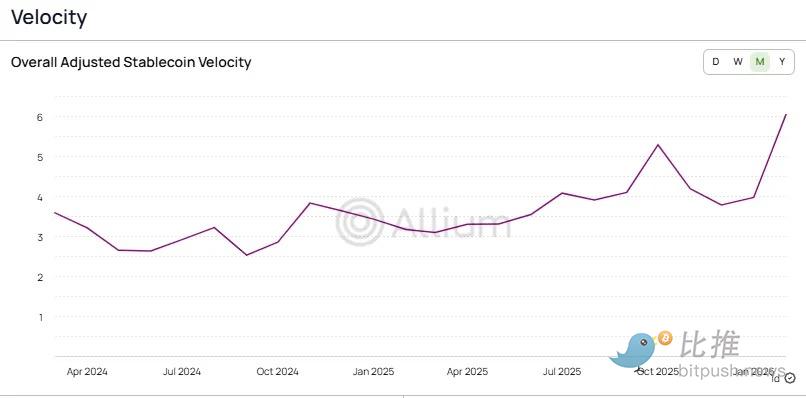
This shift is reflected in the velocity of stablecoins, calculated as adjusted transaction volume divided by circulating supply.

Allium

The velocity of stablecoins has increased from 2.6x to over 6x in the past two years, reflecting that each dollar of stablecoin supply is now turning over 2.3 times more actively than in January. Benchmarking this against traditional payment rails shows how mature stablecoin usage has become.

Another metric that establishes the maturity of stablecoin usage is the number of transactions. It is least affected by large-value noise. Therefore, when the growth in the number of payment transactions outpaces the growth in transaction value, it indicates that the average payment amount is decreasing. This behavior is typical of a payment rail gaining traction, rather than an experimental tool shuttling between exchanges.

This raises the question: who is making these payments, and what are they paying for?

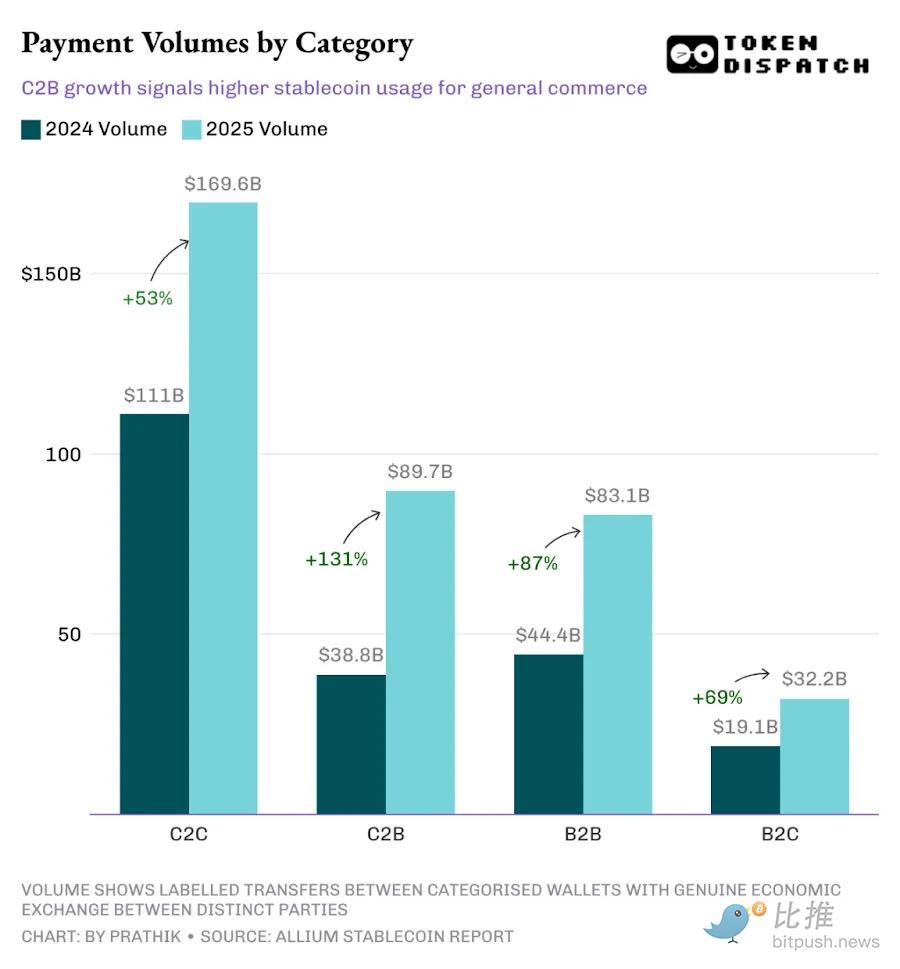
In 2025, the consumer-to-consumer (C2C) category remained the largest channel, ahead of consumer-to-business (C2B), business-to-business (B2B), and business-to-consumer (B2C). But its growth rate was the slowest among the four categories.

The slowdown in C2C growth further confirms the maturation of stablecoin usage, as person-to-person transfers are the simplest use case. They require no merchant integration, no invoicing tools, no APIs, and have minimal adoption barriers. This is the typical starting point for every new payment technology.

When India launched the Unified Payments Interface (UPI) a decade ago, retail users joined first, driven by cashback and other customer acquisition strategies. I remember using Google Pay (initially launched as Tez in India) to transfer money between my own accounts just because it gave me a one-dollar cashback. Only when commercial tools, reporting, and dedicated payment confirmation audio device systems (speakers) were introduced did stores and institutions join.

As infrastructure matures, commercial use cases begin to absorb market share. And this transformation seems to be happening.

The high growth in C2B indicates that more users are using stablecoins for general commerce, subscriptions, and merchant payments. Meanwhile, the growth in B2B indicates that commercial counterparts are beginning to adopt stablecoins in invoice processing, supply chain payments, and financial operations. Both growth rates (131% for C2B and 87% for B2B) exceed the overall payment growth rate of 76%, indicating that the share of commercial payment volume is expanding.

When you combine the growing C2B transaction volume with the decreasing average transaction value in C2B (from $456 to $256), it suggests a trend of people starting to use stablecoins for recurring purchases.

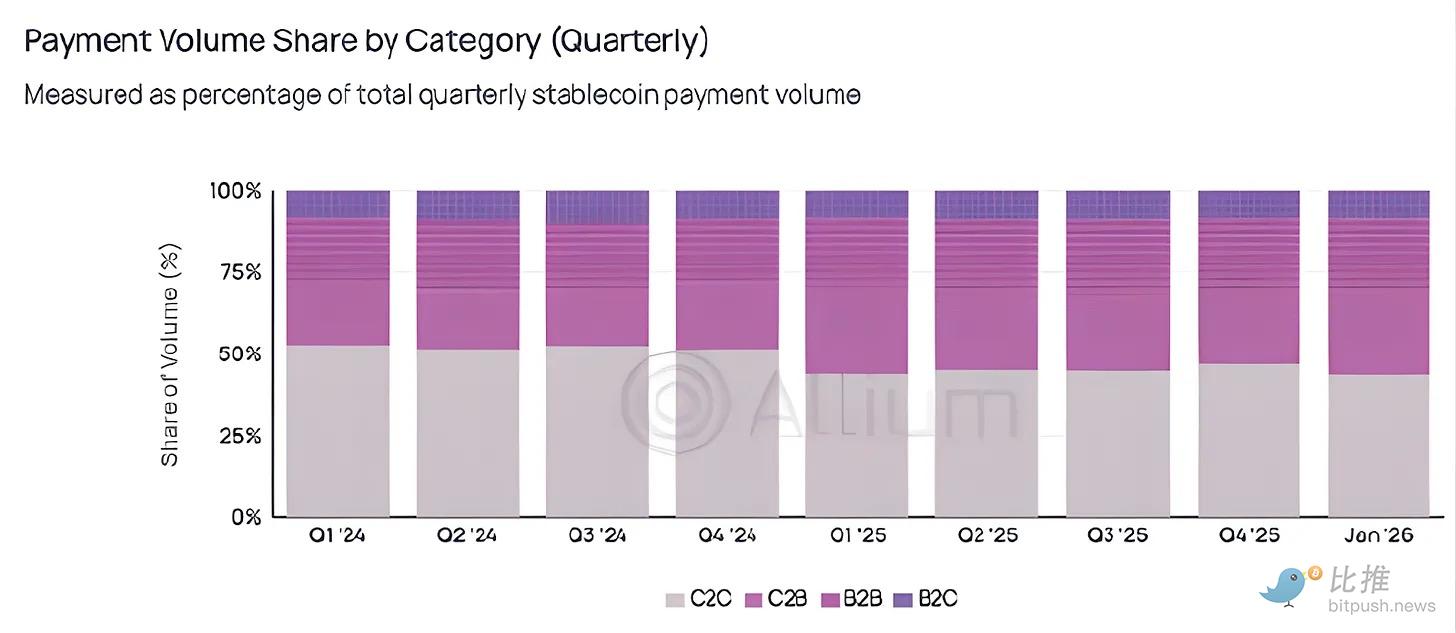
Although peer-to-peer (P2P) categories still dominate in absolute terms, they will soon cede ground. Quarterly share data makes this rotation even more undeniable.

Allium

After falling below the 50% mark in Q1 2025, C2C's share of total payment volume has never exceeded 50% again.

The world seems to be moving beyond the experimental phase of using stablecoins for low-risk, low-frequency peer-to-peer transfers, toward consistently using them for high-frequency payments.

When I first started tracking stablecoin adoption, a mainstream narrative supporting stablecoins was how they could enable cross-border remittances and potentially disrupt Western Union by allowing workers in developed economies to send money home. But the data tells a different story.

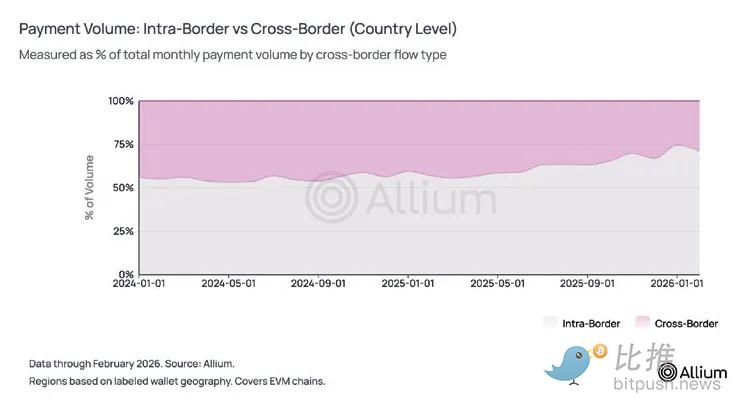
Currently, about three-quarters of stablecoin payments occur domestically. Over the past year, the share of cross-border payments at the country level has decreased from 44% to about 25-29%. At the regional level, 84% of payments remain within the same geographic region.

Allium

Based on all our previous charts, it is clear that stablecoins are not competing with SWIFT in the international settlement space. Instead, B2B metrics—including 74% domestic dominance, declining average transaction size, payroll, and growing invoice use cases—point to stablecoins competing with domestic payment rails like ACH.

For reference, ACH B2B payments grew about 10% in 2025, while stablecoin B2B payments grew 87% during the same period. I realize the absolute scales are not comparable, and we must consider the low base effect of stablecoins. However, this growth cannot be ignored.

Outlook

For a long time, I viewed cross-border remittances and peer-to-peer transfers as the main drivers of stablecoin adoption.

Imagine a son in India receiving dollars from his family in Dubai on a bank holiday without intermediaries taking 7% to 8% in fees—this narrative is indeed appealing. This story still holds today, but perhaps it is no longer the main storyline.

Interestingly, the narrative of domestic consumption scenarios has quietly and rapidly surpassed everything else. C2C's market share hasn't returned to 50% for over a year, a metric that never seemed to trend in crypto discussions. But it is this metric that marks stablecoins' transformation from a 'crypto product' to 'financial infrastructure'—enabling transactions between consumers and businesses, or between businesses themselves.

It's also worth noting that the payment transaction volume labeled by Allium is based on their analysis of wallets they can cover, identify, and tag. Although this data shows that payment transactions account for only 2% to 3% of the total adjusted stablecoin transaction volume, this should be considered a lower bound—as there are undoubtedly many wallets that Allium has not covered.

Moving forward, I will focus on two directions: whether the shares of C2B and B2B continue to rise, and whether the average transaction value can remain low in the coming quarters. If these trends persist even during a crypto market downturn, it will indicate that stablecoin payment infrastructure has truly begun to decouple from the speculative cycles of the crypto market.


Twitter:https://twitter.com/BitpushNewsCN

Bitpush TG Discussion Group:https://t.me/BitPushCommunity

Bitpush TG Subscription: https://t.me/bitpush

Original link:https://www.bitpush.news/articles/7618187

Связанные с этим вопросы

QWhat does the data from Allium's report indicate about the primary use case of stablecoins?

AThe data indicates that stablecoins are increasingly being used as a payment rail for general commerce and B2B payments, rather than primarily for cross-border remittances or as savings products.

QHow has the velocity of stablecoins changed over the past two years, and what does this signify?

AThe velocity of stablecoins has increased from 2.6x to over 6x in the past two years, signifying that stablecoins are maturing from a store of value asset into a more active medium of exchange or value transfer tool.

QWhich payment category has the slowest growth rate among C2C, C2B, B2B, and B2C, and what does this suggest?

AThe Consumer-to-Consumer (C2C) category has the slowest growth rate, suggesting that stablecoin usage is maturing beyond simple peer-to-peer transfers, which are the typical starting point for new payment technologies.

QWhat percentage of stablecoin payments are domestic, and how has this changed over the past year?

AApproximately 74% of stablecoin payments are domestic, and the share of cross-border payments at the country level has decreased from 44% to about 25-29% over the past year.

QWhat two trends should be monitored to determine if stablecoin payment infrastructure is decoupling from crypto market speculation cycles?

AThe two trends to monitor are whether the share of C2B and B2B payments continues to rise and whether the average transaction size remains low in the coming quarters, even during crypto market downturns.

Похожее

Borrowing Money from a Hundred Years Later, Building Incomprehensible AI

Tech giants like Alphabet, Amazon, Meta, and Microsoft are undergoing a radical financial transformation due to AI. Their traditional "light-asset, high-free-cash-flow" model is being dismantled by staggering capital expenditures on AI infrastructure—data centers, GPUs, and power. Combined 2026 guidance exceeds $700 billion, a 4.5x increase from 2022, causing free cash flow to plummet (e.g., Amazon's fell 95%). To fund this, they are borrowing unprecedented sums through long-dated, multi-currency bonds (e.g., Alphabet's 100-year bond). The world's most conservative capital—pensions, insurers—is now funding Silicon Valley's most speculative bet. This shift makes these companies resemble heavy-asset industrials (railroads, utilities) rather than software firms, threatening their premium valuations. Historically, such infrastructure booms (railroads, fiber optics) followed a pattern: genuine technology, overbuilding fueled by competitive frenzy, aggressive debt financing, and a crash triggered by financial conditions—not technology failure. The infrastructure remained, but many original builders and financiers did not survive. The core gamble is a "time arbitrage": using cheap debt today to build scale and lock in customers before AI capabilities commoditize. They are betting that AI revenue will materialize before debt comes due. Their positions vary: Amazon is under immediate cash pressure; Meta's path to monetization is unclear; Alphabet has a robust core business buffer; Microsoft has the shortest path from infrastructure to revenue. The contract is set: the most risk-averse global capital has lent its time to Silicon Valley, awaiting a future that is promised but uncertain.

marsbit27 мин. назад

Borrowing Money from a Hundred Years Later, Building Incomprehensible AI

marsbit27 мин. назад

The 'VVV' Concept Soars 9x in Half a Year, The New AI Narrative on Base Chain

"The article explores the 'VVV' concept as the new AI-focused narrative within the Base ecosystem, centered around the token $VVV of the privacy-focused, uncensored generative AI platform Venice, led by crypto veteran Erik Voorhees. Venice has seen significant growth in 2026, with its API users surging, partly attributed to exposure from OpenClaw. The platform now boasts over 2 million total users and 55,000 paid subscribers. Correspondingly, the $VVV token price has risen over 9x this year. Key to its performance are tokenomics designed for value accrual: reduced annual emissions, subscription revenue used for buyback-and-burn, and a unique staking mechanism. Staking $VVV yields $sVVV, which can be used to mint $DIEM tokens. Each staked $DIEM provides a daily $1 credit for using Venice's API services, creating tangible utility. The article also highlights other tokens associated with the 'VVV' narrative. $POD, the token of distributed AI network Dolphin (which co-developed Venice's default AI model), saw a massive price surge. $cyb3rwr3n, a project for a Venice credit auction market, gained attention due to perceived connections to Venice's team despite official denials. Finally, $SR of robotics platform STRIKEROBOT.AI rose after announcing a partnership with Venice for robot vision-language model development. Overall, the 'VVV' ecosystem combines AI platform growth, deflationary tokenomics, and innovative utility mechanisms, driving significant investor interest and price action in related tokens."

marsbit36 мин. назад

The 'VVV' Concept Soars 9x in Half a Year, The New AI Narrative on Base Chain

marsbit36 мин. назад

Anthropic and OpenAI Have Single-Handedly Severed the Logic of Pre-IPO Stock Tokenization

The pre-IPO stock token market is experiencing significant turmoil following strong statements from AI giants Anthropic and OpenAI. Both companies have updated their official policies, declaring that any transfer of their company shares—including sales, transfers, or assignments of share interests—without prior board approval is "invalid" and will not be recognized in their corporate records. This means buyers in such unauthorized transactions would not be recognized as shareholders and would have no shareholder rights. A major point of contention is the use of Special Purpose Vehicles (SPVs), which are legal entities commonly used by pre-IPO token platforms to pool investor funds and indirectly acquire shares from employees or early investors. The companies explicitly state they do not permit SPVs to acquire their shares, and any such transfer violates their restrictions. They warn that third parties selling shares through SPVs, direct sales, forward contracts, or stock tokens are likely engaged in fraud or are offering worthless investments due to these transfer limits. This stance directly threatens the core model of many pre-IPO token platforms, which rely on SPV structures. The announcement revealed additional risks within this model, such as complex "SPV-within-SPV" layering that obscures legal transparency, increases management fees, and creates a chain reaction risk of invalidation. Following the news, tokens like ANTHROPIC and OPENAI on platforms like PreStocks fell sharply (over 20%). The market reaction highlights a divergence: while asset-backed pre-IPO tokens plummeted, purely speculative pre-IPO futures contracts, which are bilateral bets on future IPO prices with no claim to actual shares, remained relatively stable as they are unaffected by the transfer restrictions. The industry is split on the implications. Some believe the fundamental logic of pre-IPO token trading is broken if leading companies reject SPV-held shares, potentially causing a domino effect. Others, like Rivet founder Nick Abouzeid, argue that buyers of such unofficial tokens always knowingly accepted the risk of non-recognition by the company. The statements serve as a stark risk warning and a corrective measure for a market where valuations for some AI-related pre-IPO tokens had soared to irrational levels, far exceeding recent funding round valuations.

marsbit1 ч. назад

Anthropic and OpenAI Have Single-Handedly Severed the Logic of Pre-IPO Stock Tokenization

marsbit1 ч. назад

Anthropic and OpenAI Personally Sever the Logic of Pre-IPO Crypto-Stocks

The pre-IPO token market has been rocked by strong statements from Anthropic and OpenAI. Both AI giants have updated official warnings, declaring that any sale or transfer of their company shares without explicit board approval is "invalid" and will not be recognized on their corporate records. This directly targets Special Purpose Vehicles (SPVs), the common legal structure used by pre-IPO token platforms. These platforms typically use an SPV to acquire shares from employees or early investors, then issue blockchain-based tokens representing a claim on the SPV's economic benefits. Anthropic and OpenAI's position means that if an SPV's share purchase lacked authorization, the underlying asset could be deemed worthless, nullifying the token's value. Anthropic explicitly warned that any third party selling its shares—via direct sales, forwards, or tokens—is likely fraudulent or offering a valueless investment. The crackdown highlights risks in the popular SPV model, including complex multi-layered "Russian doll" SPV structures that obscure legal ownership, add fees, and concentrate risk. If one layer is invalidated, the entire chain could collapse. Following the announcements, tokens like ANTHROPIC and OPENAI on platforms like PreStocks fell sharply (over 20%). In contrast, purely speculative pre-IPO prediction contracts remained stable, as they involve no actual share ownership. The move is seen as a corrective measure amid a market frenzy where some pre-IPO token valuations (e.g., Anthropic's token hitting a $1.4 trillion implied valuation) far exceeded recent official funding rounds. Opinions are split: some believe this undermines the core logic of pre-IPO token trading if top companies reject SPVs, while others argue buyers always assumed this legal risk when accessing unofficial channels. The statements serve as a stark warning and a potential catalyst for market de-leveraging and clearer boundaries.

Odaily星球日报1 ч. назад

Anthropic and OpenAI Personally Sever the Logic of Pre-IPO Crypto-Stocks

Odaily星球日报1 ч. назад

The Waged Worker Driven to Poverty by AI Subscriptions

"AI Membership: The Hidden Cost Pushing Workers Toward 'Poverty'" The widespread corporate push for AI adoption is creating a hidden financial burden for employees. Companies, from giants like Alibaba to small firms, are mandating AI use, often tying token consumption to KPIs, but frequently refuse to cover the costs. Workers are forced to pay for subscriptions out of pocket to stay competitive and avoid being replaced. Front-end developer Long Shen spends up to 2000 RMB monthly on tools like Cursor and ChatGPT Plus, seeing it as a necessary 3% salary investment to handle 90% of his coding tasks. While it boosted his performance and led to promotions, he now faces idle time at work, pretending to be busy. Designer Peng Peng navigates strict company firewalls by using personal devices and accounts for AI image generation tools like Midjourney, spending hundreds monthly without reimbursement, while her boss demands faster, more numerous revisions. The pressure creates workplace anxiety and suspicion. Programmer Li Huahua, after a friend's experience of raised KPIs following AI success, fears being branded a "traitor" for using it yet worries about falling behind if she doesn't. The dynamic allows management to demand results without understanding the tools or covering expenses, treating employees like AI "agents." While some, like entrepreneur Jin Tu, find high value in paid AI, building entire systems and winning competitions, for most, it's a trap. Free tools like Kimi and Doubao are introducing fees, closing off alternatives. The initial efficiency gains individual advantage, but as AI becomes ubiquitous, the personal edge disappears, workloads increase, and a cycle of dependency begins. Workers like Long Shen realize they cannot maintain AI-generated code without AI, making stopping harder than continuing to pay. The tool promising liberation is instead becoming a compulsory, costly chain in the modern workplace.

marsbit2 ч. назад

The Waged Worker Driven to Poverty by AI Subscriptions

marsbit2 ч. назад

Торговля

Спот
Фьючерсы
活动图片