The Hidden War Behind Stablecoins: Issuers, Applications, and Users—Who Will Be the 'Biggest Winner'?

marsbitОпубликовано 2026-02-17Обновлено 2026-02-17

Введение

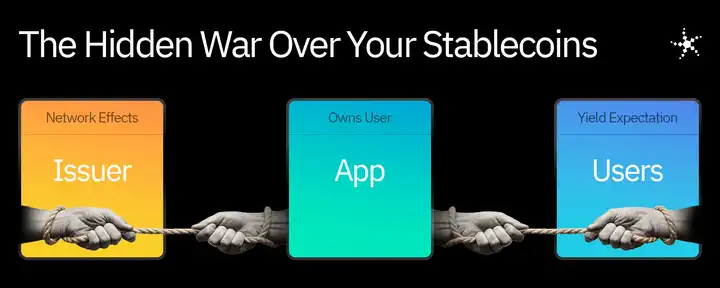
The article explores the intense competition among stablecoin issuers, applications, and users over the lucrative profits generated by stablecoins. Issuers like Tether and Circle earn significant risk-free returns by investing user funds in cash equivalents, creating a highly profitable business model. However, applications (wallets, exchanges, DeFi protocols) that control user relationships demand a share of these profits, leveraging their distribution power to negotiate revenue-sharing agreements or even launch their own branded stablecoins (e.g., Aave’s GHO or PayPal’s PYUSD via white-label services). Users, especially in developed markets, increasingly expect yield on their stablecoin holdings, pressuring applications to offer returns. This dynamic creates a three-way tug-of-war, with applications caught between profit-retentive issuers and yield-seeking users. The author suggests that users may ultimately benefit the most from this competition, gaining a larger share of the profits as the ecosystem evolves.

Author: Jonah Burian, Investor at Blockchain Capital

Compiled by: Felix, PANews

Summary: In this three-party game, users may ultimately be the beneficiaries and receive the majority of the profits.

In recent years, as stablecoin issuers have generated massive annual profits, the battle for benefits among issuers, application layers, and users has intensified. An investor from Blockchain Capital reveals the profit distribution mechanisms and evolving business logic of stablecoins. Below are the details.

Stablecoin issuers possess one of the most profitable business models on Earth, and these substantial profits have made them a target for various stakeholders. At Blockchain Capital, we have closely observed the three-way tug-of-war among issuers, application layers, and users as they compete for these profits.

We have invested in several major issuers (such as Tether, Circle, and Paxos) and also in applications trying to claim their share (such as Aave, Phantom, Polymarket, and RedotPay). Here are our observations.

Issuers Reap Significant Profits

Users send fiat currency to issuers, who then mint digital dollars on the blockchain. Behind the scenes, issuers invest this fiat in cash or cash equivalents, earning a risk-free interest rate. That’s the entire business. In contrast, banks take your deposits but must lend them out, manage credit risk, and maintain branches; insurers collect premiums but ultimately must pay claims. Stablecoin issuers essentially hold government bonds, generating cash flow without complexity or risk.

Issuer revenue grows with the increase in assets under management, while operational costs remain largely unchanged: this is a pure, unconstrained cash flow machine. Tether reports a team size of about 300 people and expects to achieve $10 billion in profits by 2025. This is arguably one of the best business models in history.

However, massive profits inevitably attract competition.

Applications Also Want a Share

Most users never interact directly with issuers; they access stablecoins through applications like Phantom, which control the user relationship.

Large exchanges, DeFi protocols, and well-known wallets have significant bargaining power over issuers. They can designate default stablecoins and integrate or deprecate them through single product decisions, exerting some control over fund flows. If tens of billions of dollars in stablecoins remain within an application, that app can demand a share of the float interest. The logic is simple: we are distributing your assets and anchoring user behavior, so you must share the profits, or we will steer users toward competing stablecoins.

This is already happening. The most typical example is the relationship between Coinbase and Circle. Early on, Coinbase was the primary distribution engine for USDC and negotiated a profit-sharing agreement. It is reported that Coinbase receives 100% of the interest income generated by USDC on its platform and 50% of the interest income from USDC outside the platform. Whether within or outside the portfolio, applications are increasingly adopting this strategy, actively negotiating for their share.

Creating Branded Stablecoins: Bypassing Issuers

Applications can also attempt to launch their own branded stablecoins or "wrappers," completely bypassing issuers. Instead of directly steering users to USDC or USDT, they offer a dollar balance backed by a combination of stablecoins and short-term notes. In this case, the distributor is partially involved in the issuance business. Aave’s GHO stablecoin is one such example.

However, applications often lack the resources or licenses required to build a full issuance infrastructure. Therefore, they opt for white-label solutions like "Issuer-as-a-Service." Paxos is currently the leading white-label provider, supporting PayPal’s PYUSD. This allows PayPal to profit from the float interest without negotiating with large issuer.

Issuer Leverage

Applications cannot fully control issuers. Established stablecoins like USDC and USDT have strong network effects. They are the reserve assets of the entire DeFi ecosystem and the base trading pairs for most transactions. Branded stablecoins may be less attractive to users due to lower liquidity and integration compared to other stablecoins.

Additionally, white-label stablecoins are not as "neutral" as USDT. A company competing with PayPal at the application layer may be reluctant to accept PYUSD, as doing so would fund a competitor. Similarly, this dynamic may have affected Circle’s early development, as exchanges like Binance may have been hesitant to fully promote USDC due to its close ties with rival Coinbase, which is why Binance instead defaulted to supporting USDT. Today, USDT trading volume on Binance is about five times that of USDC.

User Demand for Floating Returns

In developed markets, user expectations for returns put pressure on issuers and applications. When the risk-free interest rate is around 4%, users in the U.S. naturally ask why their digital dollars aren’t earning any yield. When one wallet offers returns and a competitor doesn’t, users flock to the former.

If this expectation becomes the norm, the application layer faces a dilemma. To remain competitive, we expect applications may have to return some of the profits to users, forcing them to negotiate more aggressively with issuers. If an application cannot secure a share, it will struggle to pay interest to users without incurring losses. As more products promote "stablecoin balance returns," the model where "all profits remain with the underlying issuer" will be difficult to sustain.
However, this pressure is not universal. In many overseas markets, the core value of dollar stablecoins lies in hedging against local inflation and foreign exchange controls, rather than pursuing returns. A user struggling to prevent their assets from halving in value each year may not care much about earning 4% interest. For global issuers with high penetration in these regions, user demand for returns is not as urgent as in the U.S. market. We believe this dynamic may benefit Tether, which has the largest overseas user base.

Conclusion

In summary, user expectations and issuer profits have placed applications in a difficult position. They are caught between users who expect returns and issuers who want to retain profits. The stablecoin architecture is evolving rapidly, and the distribution of profits is still being contested. My guess is: users may ultimately be the beneficiaries of this game and receive the majority of the profits.

Related reading: A Guide to Stablecoin Returns: Which of the 8 Types Is Best?

Связанные с этим вопросы

QWhat is the core business model of stablecoin issuers and why is it considered highly profitable?

AStablecoin issuers accept fiat currency from users and mint digital dollars on the blockchain. They invest this fiat in cash or cash equivalents, earning a risk-free interest rate. This model is highly profitable because their revenue scales with the growth of assets under management, while operational costs remain largely fixed, creating a powerful cash flow machine with minimal complexity or risk.

QHow do applications (like exchanges and wallets) attempt to capture a share of the profits from stablecoins?

AApplications, which control the user relationship, use their significant bargaining power to demand a share of the float income from issuers. They can dictate the default stablecoin and influence capital flows. Their logic is that they are distributing the issuer's assets and anchoring user behavior, so they deserve a share of the profits, or they will steer users to a competitor's stablecoin.

QWhat are two strategies applications might use to bypass traditional stablecoin issuers?

AApplications can either 1) launch their own branded stablecoin or 'wrappers' backed by a combination of stablecoins and short-term notes, or 2) use a white-label 'Issuer-as-a-Service' solution from a provider like Paxos, which allows them to profit from the float without negotiating with a major issuer.

QWhat leverage do major stablecoin issuers like USDT and USDC have over applications?

AMajor stablecoins like USDT and USDC have strong network effects; they are the reserve assets for the entire DeFi ecosystem and the base trading pairs for most transactions. Their brand recognition and liquidity are superior. Furthermore, a branded stablecoin from a competitor's application may not be seen as 'neutral' and could be rejected, as it would fund a rival.

QWhy does the author speculate that users might be the ultimate beneficiaries of the stablecoin profit struggle?

AThe author speculates that user expectations for yield, particularly in developed markets, will put pressure on applications. To remain competitive, applications will be forced to pass a portion of the earnings back to users. This dynamic, driven by competition for users, could ultimately result in users capturing the majority of the收益 (yield).

Похожее

Биткойн-майнинг-фермы превращаются в AI-фабрики

Биткойн-майнинг превращается в инфраструктуру для ИИ. Компании, ранее занимавшиеся майнингом, такие как Crusoe и CoreWeave, перепрофилируют свои центры обработки данных с криптовалют на искусственный интеллект. Их главный актив — не оборудование, а уже готовый доступ к большим объемам электроэнергии, земле и разрешениям на подключение к сетям, что критически важно для создания дата-центров под ИИ. На фоне снижения доходности от майнинга биткойнов и высокого спроса со стороны ИИ-компаний этот переход стал экономически оправданным. Крупные майнинговые компании, включая TeraWulf, Cipher Mining и IREN, уже заключили долгосрочные контракты на сотни миллиардов долларов с такими гигантами, как Anthropic, AWS и Microsoft. Люди и капитал из криптоиндустрии также активно перемещаются в сферу ИИ. Основатель OpenSea создал агрегатор ИИ-моделей OpenRouter, а бывший сотрудник Coinbase основал платформу для медиа-моделей Fal.ai. Крипто-капитал финансирует ИИ-инфраструктуру, как в случае с Voltage Park Джеда Маккалеба, и поддерживает эксперименты, такие как распределенная сеть для обучения моделей Psyche от Nous Research. Хотя успех не гарантирован, криптоиндустрия передает ИИ три ключевых ресурса: энергомощности, инженерные кадры и капитал, накопленный в предыдущем цикле.

链捕手14 мин. назад

Биткойн-майнинг-фермы превращаются в AI-фабрики

链捕手14 мин. назад

Криптоплатежи за пептиды с серого рынка выросли на 700% за год — Подробности

Согласно недавнему отчёту, в США наблюдается резкий рост использования криптовалют, в основном биткойна и стейблкоинов, для покупки пептидов на сером рынке. Эти соединения, продаваемые как средства для омоложения, наращивания мышц и похудения, часто находятся в правовой серой зоне. Из-за ужесточения банковских ограничений многие поставщики, особенно в Китае, начали принимать криптовалюты. По данным Chainalysis, в первом квартале 2026 года продавцы пептидов получили $32 млн в криптовалюте, что на 700% больше, чем годом ранее. Аналитики TRM Labs также отмечают подобный тренд. Эксперты подчёркивают, что современные покупатели — это часто обычные потребители, привлечённые доступностью и низкой ценой, а не участники теневых рынков. Этот всплеск использования криптовалют для кросс-бордерных платежей происходит на фоне общего снижения розничного участия на крипторынке в начале 2026 года.

ambcrypto47 мин. назад

Криптоплатежи за пептиды с серого рынка выросли на 700% за год — Подробности

ambcrypto47 мин. назад

human.tech запускает Clean SDK для приватных Web3-приложений

Компания human.tech представила Clean SDK — набор инструментов для разработки приложений в Web3, в которых по умолчанию соблюдаются конфиденциальность и прозрачная подотчетность. Этот комплект, выпущенный одновременно с версией 5 Aztec, предоставляет разработчикам готовые компоненты для внедрения в их приложения проверки личности с нулевым разглашением (zero-knowledge), скрининга санкционных списков и приватных транзакций, без необходимости самостоятельно работать с конфиденциальными пользовательскими данными или создавать инфраструктуру для соответствия нормативным требованиям. Clean SDK решает ключевую проблему Web3, сочетая приватность с подотчетностью. С помощью zero-knowledge доказательств и программируемой верификации приложения могут подтверждать легитимность пользователей и прохождение средств проверки на санкции, не раскрывая при этом личную информацию. Таким образом, разработчикам больше не нужно выбирать между конфиденциальностью пользователей и регуляторными требованиями. Первый продукт на основе SDK — приложение Shield (мост между Ethereum и Aztec), которое было запущено одновременно с ним. Shield позволяет пользователям и автономным агентам переводить активы в Aztec, сохраняя анонимность, но при этом криптографически доказывая, что за каждой операцией стоит уникальный реальный человек, а средства проверены. Аудит Nethermind в мае 2026 года подтвердил надежность смарт-контрактов Shield. Как отметил сооснователь human.tech Шади Эль Дамати, «приватность без подотчетности ведет к злоупотреблениям, а подотчетность без приватности превращается в слежку. Clean SDK устраняет этот ложный выбор». Комплект предлагает три основных метода верификации: скрининг санкций (Proof of Innocence), подтверждение личности человека (Proof of Personhood, в том числе через Human Passport) и верификация личности с нулевым разглашением для операций с высокой стоимостью (Proof of Clean Hands). Данные хранятся в зашифрованном виде вне блокчейна, а проверки происходят как при входе, так и при выходе средств. В целом, Clean SDK, предназначенный в первую очередь для разработчиков в экосистеме Aztec, призван стимулировать создание разнообразных приватных финансовых приложений и сервисов, которые обеспечивают видимую подотчетность с помощью криптографических доказательств, не требуя от разработчиков создания сложной инфраструктуры с нуля. Этот запуск отражает растущий спрос на институциональные решения, которые прозрачно балансируют между приватностью и соответствием требованиям.

TheNewsCrypto54 мин. назад

human.tech запускает Clean SDK для приватных Web3-приложений

TheNewsCrypto54 мин. назад

Высвобождение ликвидности на $100 млн? Новая политика Pump.fun тестирует «5-минутную накачку»

21 июля платформа Pump.fun объявила о запуске режима BOOST, ставшего новой стандартной механикой запуска токенов. Его цель — решить проблему «мёртвой ликвидности». Когда токен переходит с bonding curve в ликвидный пул PumpSwap, около 20% средств навсегда блокируются в LP, становясь недоступными. По оценкам платформы, это приводит к ежегодным потерям ликвидности на сумму более $1 млрд. Механика BOOST меняет это: вместо блокировки, эти 20% средств (например, ~17.6 SOL для SOL-пар) используются в первые 5 минут после миграции токена для его скупки по методу TWAP (средневзвешенная цена по времени). Все выкупленные токены немедленно сжигаются. Это создаёт кратковременный искусственный покупательский спрос и одновременно сокращает предложение токена. Режим автоматически применяется для всех токенов, мигрирующих после 21 июля. Ранее выпущенные токены и токены, запущенные через Mayhem (AI Agent Lab), не участвуют. Цель BOOST — оживить торговлю в критические первые минуты после выпуска, чтобы удержать трейдеров и повысить общий объём торгов на платформе. Однако критики отмечают риски: после 5-минутного «фейерверка» токен может резко обрушиться при крупных продажах, а упрощённый старт может поощрить выпуск более низкокачественных мем-токенов.

marsbit1 ч. назад

Высвобождение ликвидности на $100 млн? Новая политика Pump.fun тестирует «5-минутную накачку»

marsbit1 ч. назад

Продажа блочного пространства умерла: публичные блокчейны должны найти новый способ существования

Статья "Продажа блок-пространства мертва: публичным блокчейнам нужно найти новый путь" утверждает, что традиционная бизнес-модель публичных блокчейнов, основанная на продаже пространства в блоках, больше не работает. Из 14 криптокомпаний, заработавших более $200 млн за два года, только Hyperliquid является блокчейном, чей месячный доход ($58 млн) в 100 раз превышает доход Arbitrum ($430 тыс.). Чтобы выжить, блокчейны должны превращаться в продуктовые студии, агрегаторы приложений или вертикальные SaaS-решения, отходя от роли нейтральной инфраструктуры. В статье также разбираются три ключевых события: 1. **Взлом Ostium**: Атака на LP-пулы протокола привела к потере более 40% TVL ($23,7 млн) из-за уязвимости в офф-чейн инфраструктуре, поставляющей цены. Это подчеркивает критическую важность контроля для протоколов, работающих с офф-чейн активами. 2. **Будущее опционов**: Чтобы достичь массового принятия, мощные возможности опционов должны быть абстрагированы от сложной терминологии и представлены через понятные продукты: структурированные продукты, vaultы для получения дохода, бинарные опционы и прогнозные рынки. 3. **На радаре**: Отмечаются тренды, такие как фиксированные займы (Yearn's Flex), смена стратегии Base после неудач с социальными токенами, запуск перпетуальных контрактов на индекс доллара (Plether) и фокус Starknet на приватности и защите от квантовых угроз.

marsbit1 ч. назад

Продажа блочного пространства умерла: публичные блокчейны должны найти новый способ существования

marsbit1 ч. назад

Торговля

Спот
活动图片





