The Full Story of the Zcash Core Team's Exit: A Crypto Version of the OpenAI Drama

marsbitОпубликовано 2026-01-11Обновлено 2026-01-11

Введение

Zcash Core Team Departs to Form CashZ, Highlighting Crypto's Non-Profit vs. For-Profit Tension The core development team of Zcash (ZEC), Electric Coin Company (ECC), has collectively left the project's non-profit governance structure, Bootstrap, citing a "clear and persistent misalignment" with Zcash's core mission. ECC CEO Josh Swihart announced the team's departure and the immediate formation of a new for-profit startup, CashZ (CashZ.org), which will focus on commercializing a Zcash wallet to achieve mass adoption. The split stems from a fundamental disagreement on organizational structure. ECC argued that the non-profit Bootstrap model severely constrained funding, incentives, and execution efficiency, hindering scalability. Bootstrap's board, however, expressed concerns that the transition to a for-profit entity could introduce significant legal and political risks to the entire Zcash ecosystem. The situation has been compared to the OpenAI governance drama, representing a recurring industry conflict: the tension between the safety and ethics of a non-profit and the efficiency and scalability of a for-profit company. Following the news, Zcash's price fell approximately 20%, reflecting market unease. Despite the split, the new CashZ team insists the Zcash protocol itself remains unaffected and their mission to build "unstoppable private money" continues.

Author: The Rollup

Compiled by: Peggy, BlockBeats

Editor's Note: On January 8, Josh Swihart, CEO of Electric Coin Company (ECC), the core development team behind Zcash (ZEC), disclosed in a post that the ECC team had recently left the original organizational structure en masse and plans to establish a new company. The reason cited was that their parent governance body, Bootstrap (a non-profit organization responsible for governing ECC and supporting Zcash), had "clearly and persistently deviated" from Zcash's core mission.

ECC believes that the existing non-profit governance structure has severely constrained the project's expansion in terms of funding, incentives, and execution efficiency, leading to the collective departure. They now aim to continue advancing Zcash-related products under a for-profit model. However, the non-profit board Bootstrap, responsible for governance, argues that this transition path could introduce legal and political risks and is therefore unacceptable.

Amid this disagreement, on January 9, former ECC CEO Josh Swihart announced the establishment of a new for-profit startup, CashZ (CashZ.org), focusing on the productization and commercial implementation of Zcash wallets. The goal is to scale Zcash to "billions of users" through a sustainable profit model.

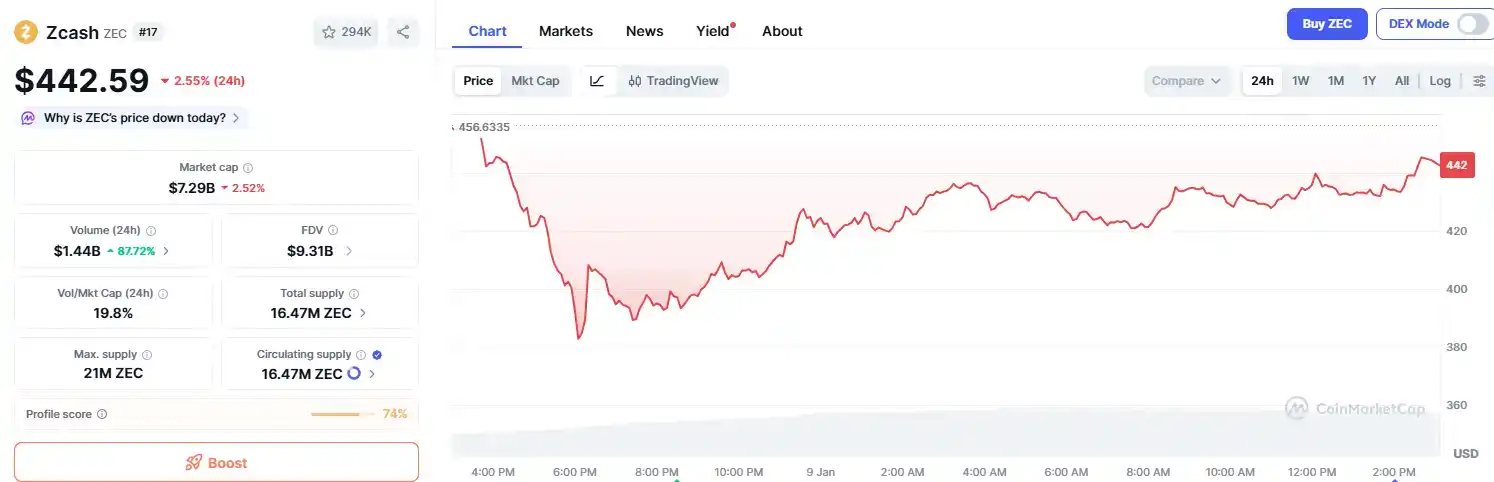
Following the news, Zcash's price dropped by approximately 20%, reflecting market unease over the core development team's collective departure.
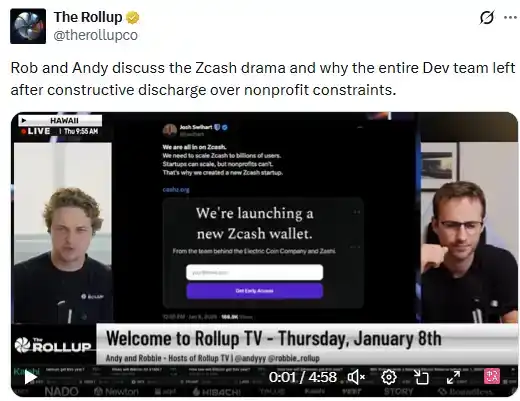
Regarding this governance controversy, the crypto podcast The Rollup offered a representative industry perspective. Co-founders and hosts Andy and Robbie reviewed the entire process of ECC's exit and the rapid establishment of CashZ during a live stream, arguing that this is not a project collapse but an inevitable structural adjustment. In their view, the root of the conflict lies not in technology or vision but in the tension between organizational form and scaling goals: when privacy protocols attempt to achieve mass adoption, non-profit governance structures often become the first bottleneck.
Based on this assessment, Andy and Robbie are relatively optimistic about CashZ's establishment. They believe that, without building a new public chain or issuing a new token, and instead continuing to develop wallet products based on the existing Zashi codebase, a for-profit startup may provide a more realistic growth path for Zcash. This "exit" resembles a reorganization focused on execution efficiency and scalability rather than an ecosystem split.

From a broader perspective, Zcash's controversy once again highlights a recurring industry theme: as crypto projects enter the "scaling and implementation" phase, conflicts between non-profit foundations and for-profit teams often become less about ideals and more about trade-offs between efficiency and risk control. Zcash may simply be the latest case.

Below is the original text:

The Birth of CashZ and the Team's Departure

Andy: Yes, Josh just posted that tweet. Our stance is clear: we are fully committed to Zcash. Zcash must scale to billions of users. Startups can achieve scaling, but non-profits cannot. This is precisely why we are establishing the new startup CashZ.
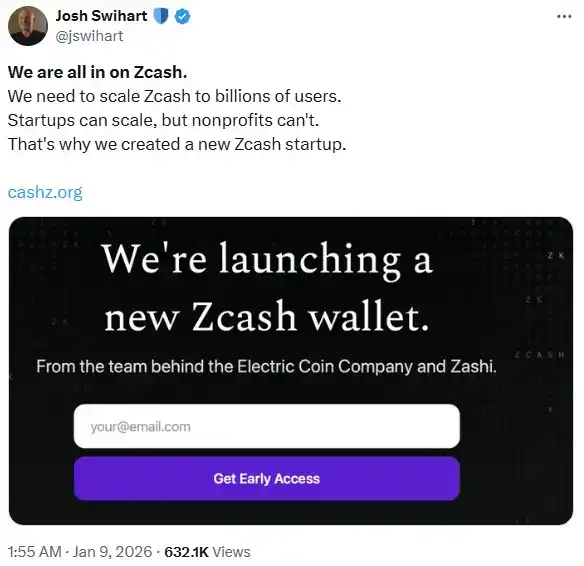
Rob: So they are actually building a completely new wallet.

Andy: Yes, but based on the same Zcash codebase, with the project codename CashZ. If you are a Zcash user, you just need to join the waitlist.

Josh also mentioned in yesterday's tweet that over the past few weeks, it has become very apparent: the majority of the board members of Bootstrap, the 501(c)(3) non-profit managing ECC—specifically Zaki, Manny, Christina Garman, Allan Fairless, and Michelle Lai—were named. This situation itself is quite out of control.

Mission Misalignment and "Constructive Discharge"

Andy: He pointed out in the tweet that all this stems from a clear misalignment with Zcash's core mission. After being handled by ZCAM (an entity related to Zcash community governance) in a "constructive discharge" manner, the entire ECC team chose to resign collectively.

In simple terms, the employment terms were unilaterally changed, making it impossible for us to perform our duties effectively and in accordance with professional ethics. We are indeed forming a new company, but we are still the same team, carrying the same mission—to build unstoppable private money. It is important to emphasize that the Zcash protocol itself remains unaffected.

Rob: He also included a link explaining what "constructive discharge" means. By definition, it refers to a situation where an employer creates a hostile or intolerable work environment, or uses other forms of pressure and coercion, forcing an employee to resign; legally, such a resignation may not be considered voluntary.

Andy: Yes, obviously, Zcash's price dropped by about 20% following this news.

Community Reaction and Controversy Surrounding Zaki Manian

Rob: Arthur has also started to "mock" the situation. No matter how you spin it, this doesn't look good. Balaji has always emphasized: Zcash can scale, must scale, and will scale.

And now, Zaki is clearly receiving the most blame. Some even accuse him of having "looted and destroyed" the Cosmos ecosystem and now messing up the Zcash team.

Andy: Oh my. Zaki has been in this industry for many years and has indeed done a lot of great work. At least on this point, I am willing to defend Zaki. Honestly, I don't know exactly what happened internally.

The For-Profit vs. Non-Profit Struggle (Analogous to OpenAI)

Andy: Zooko once said that these individuals, including Zaki, Allan, and Christina, all have very high integrity standards. Clearly, there is a fundamental misalignment in the ethical and moral understanding of Zcash's mission between the two sides.

Rob: This almost sounds like the disagreement that happened at OpenAI back then: one side believes that only for-profit organizations can truly achieve scaling and deliver sustained value; the other insists that the non-profit structure is the correct and safer choice.

Andy: Zaki later issued a statement expressing regret over this outcome. From Bootstrap's perspective, the board did discuss the possibility of introducing external investment and achieving "privatization" through alternative structures, and worked closely with legal advisors throughout the process to ensure any path complied with U.S. non-profit law.

However, it must be acknowledged that the institutional constraints faced by non-profit organizations are real, and navigating these limitations properly in a constantly changing environment is extremely complex.

Rob: It sounds like Zaki was actually also pushing to establish a startup.

The Final Reason for the Divergence

Andy: The opposing side believes that, in its current form, the proposed transaction scheme introduces new vulnerabilities for politically motivated attacks against Zcash, potentially even giving any donor grounds to file a lawsuit. Therefore, their core goal is to prevent systemic risk to the entire Zcash ecosystem. Some proposals initially put forward as "better for everyone" ultimately became the trigger for the split.

Rob: This is truly regrettable because, looking at the outcome, the positions of the two sides weren't that far apart. Both wanted to transition the original non-profit structure into some form of for-profit entity to generate sustained revenue, build, and scale Zcash. The reason they ultimately parted ways was simply an inability to agree on "how to safely accomplish this step."


Связанные с этим вопросы

QWhat was the main reason for the ECC team's departure from Bootstrap?

AThe ECC team left because they believed the non-profit governance structure of Bootstrap had 'clearly and persistently deviated' from Zcash's core mission, severely constraining the project's expansion in terms of financing, incentives, and execution efficiency.

QWhat is the name of the new for-profit company formed by the former ECC team, and what is its focus?

AThe new for-profit company is named CashZ (CashZ.org), and it focuses on the productization and commercialization of Zcash wallets, aiming to scale Zcash to 'billions of users' through a sustainable business model.

QHow did the market react to the news of the ECC team's departure?

AFollowing the announcement, the price of Zcash (ZEC) dropped by approximately 20%, reflecting market unease about the core development team's collective exit.

QWhat was the key point of disagreement between ECC and Bootstrap regarding the project's future structure?

AThe disagreement centered on how to safely transition to a for-profit model: ECC advocated for the change to improve scalability and efficiency, while Bootstrap was concerned about introducing legal and political risks that could expose Zcash to systemic vulnerabilities.

QHow was this situation compared to OpenAI in the crypto community's discussion?

AIt was compared to OpenAI's internal conflict, where one side believed only a for-profit organization could achieve scale and deliver value sustainably, while the other insisted that a non-profit structure was the correct and safer path.

Похожее

WeChat Agent Issues a 'Heroic Summons,' Half of the Internet Responds

WeChat AI Agent is on the horizon. The WeChat Open Platform has issued a guide for developers, offering them ways to integrate into the WeChat AI ecosystem. This will enable mini-programs to be discovered and invoked by the AI. Meituan has already announced its integration, allowing users to access services like food delivery through WeChat AI. Other platforms like Ctrip and Tongcheng have followed suit. Furthermore, WeChat is collaborating with major smartphone manufacturers to enable their native AI assistants to perform actions within WeChat, such as initiating calls or sending messages, through a controlled protocol called Agent-to-Agent (A2A). Reports indicate the WeChat AI Agent will be accessible by swiping right on the main interface. It aims to understand user intent within the rich context of chats, groups, and past interactions, then automatically call upon relevant mini-programs to complete tasks like ordering coffee or booking restaurants. This positions it as a potential "super app" with direct access to WeChat's vast ecosystem of services, social connections, and payment systems. Technically, this is a complex endeavor. It requires advanced natural language understanding, a "world model" to predict interactions within mini-programs (UI-Oceanus), multi-model orchestration for cost efficiency, and careful coordination with millions of third-party service providers. Tencent's development follows a "Co-Design" approach, where product teams and the Hunyuan model team collaborate closely, allowing capabilities honed in other AI products (like Yuanbao for chat, ima for search, WorkBuddy for office tasks) to be transferred to the WeChat Agent. Tencent is strategically opting for the A2A protocol over GUI-based automation (which it has blocked in the past), maintaining control over its ecosystem. To manage the immense scale and cost of serving 1.4 billion monthly active users, Tencent is deepening its ties with DeepSeek, known for its cost-effective training, to secure a low-cost inference backbone. The ultimate goal is to solve practical, everyday problems for users within the WeChat ecosystem, moving beyond technical benchmarks to deliver real utility, which Tencent sees as the key to winning in the long-term AI game.

marsbit20 мин. назад

WeChat Agent Issues a 'Heroic Summons,' Half of the Internet Responds

marsbit20 мин. назад

Humanity Loses $31 Million in Attack, Token Price Plummets 90% Due to a Single Private Key

On June 9th, the digital identity project Humanity Protocol suffered a major security breach resulting in over $31 million in losses. According to on-chain analyst Specter, hundreds of wallets holding the project's H token were drained. The attack was confirmed by founder Terence Kwok to be caused by the compromise of a foundation member's private key. As a precaution, users are advised to avoid interacting with Humanity's cross-chain bridge or liquidity pools. The incident caused the H token price to crash over 90%, from around $0.70 to a low of $0.052, wiping its market cap from $2 billion to approximately $35.7 million. The attacker allegedly minted 100 million new H tokens and is selling them for BNB. This breach adds to existing controversies surrounding Humanity Protocol. Founded in 2024, it aimed to verify human users via palm-print biometrics and zero-knowledge proofs. However, a leaked conversation in 2025 revealed that only about 1 million of its 9 million claimed Human IDs had completed biometric verification, suggesting 88% might be bots. Furthermore, the project has faced allegations of being a repackaged product from a Chinese access control vendor, raising privacy and authenticity concerns. Founder Terence Kwok's previous venture, Tink Labs, a hotel smartphone startup that raised $170 million, failed and entered bankruptcy in 2020 after burning through its funding. The current attack highlights the persistent critical issue of private key management in crypto. Unlike smart contract exploits, a private key compromise bypasses all on-chain security mechanisms. With no user compensation plan announced yet, this $31 million breach may be a final blow to the project's credibility, already weakened by previous controversies and a heavily depreciated token.

marsbit54 мин. назад

Humanity Loses $31 Million in Attack, Token Price Plummets 90% Due to a Single Private Key

marsbit54 мин. назад

MicroStrategy Will Not Die in This Downturn: Reflexivity, STRC Anchoring Back to Par, and the Self-Rescue Logic of "Sell Stock, Not Bitcoin"

This article analyzes the recent sharp decline in Bitcoin and MicroStrategy (MSTR), framing it as a targeted "reflexivity" attack. The trigger was MSTR using its cash reserves to buy back convertible notes, raising market concerns about a liquidity crisis. The playbook follows George Soros's principle: market expectations can shape reality. Fears that MSTR might be forced to sell BTC caused panic selling, lowering BTC's price and worsening MSTR's financial ratios, thus reinforcing the negative narrative. The author argues that MSTR's Structured Convertible (STRC), while falling in price, is a floating-rate security that will eventually return to par value (100). The price drop reflects the market demanding a higher yield due to perceived risk, but as a floating-rate instrument, its coupon can adjust, naturally pulling the price back to par over time. This is crucial for MSTR's continued ability to raise funds. The core thesis is that MSTR's best move to counter the attack is to **issue new equity (sell shares)**, not sell its Bitcoin holdings. While selling BTC would solve the immediate cash crunch, it would destroy the company's core investment thesis and premium. It would dilute the BTC per share, likely erase the market premium over its net asset value (mNAV > 1), and worsen its debt-to-asset ratio. Issuing shares while mNAV is high (e.g., 1.25x) allows MSTR to raise cash for reserves without harming shareholder value or the "perpetual accumulation" narrative. It improves the debt ratio and reassures STRC holders, breaking the negative reflexivity cycle. In conclusion, while MSTR could survive this episode even by selling BTC, doing so would fundamentally alter its investment proposition and weaken it for future cycles. The optimal, value-preserving strategy is to sell equity to rebuild reserves and maintain the long-term growth flywheel.

marsbit55 мин. назад

MicroStrategy Will Not Die in This Downturn: Reflexivity, STRC Anchoring Back to Par, and the Self-Rescue Logic of "Sell Stock, Not Bitcoin"

marsbit55 мин. назад

Торговля

Спот
Фьючерсы

Популярные статьи

Как купить S

Добро пожаловать на HTX.com! Мы сделали приобретение Sonic (S) простым и удобным. Следуйте нашему пошаговому руководству и отправляйтесь в свое крипто-путешествие.Шаг 1: Создайте аккаунт на HTXИспользуйте свой адрес электронной почты или номер телефона, чтобы зарегистрироваться и бесплатно создать аккаунт на HTX. Пройдите удобную регистрацию и откройте для себя весь функционал.Создать аккаунтШаг 2: Перейдите в Купить криптовалюту и выберите свой способ оплатыКредитная/Дебетовая Карта: Используйте свою карту Visa или Mastercard для мгновенной покупки Sonic (S).Баланс: Используйте средства с баланса вашего аккаунта HTX для простой торговли.Третьи Лица: Мы добавили популярные способы оплаты, такие как Google Pay и Apple Pay, для повышения удобства.P2P: Торгуйте напрямую с другими пользователями на HTX.Внебиржевая Торговля (OTC): Мы предлагаем индивидуальные услуги и конкурентоспособные обменные курсы для трейдеров.Шаг 3: Хранение Sonic (S)После приобретения вами Sonic (S) храните их в своем аккаунте на HTX. В качестве альтернативы вы можете отправить их куда-либо с помощью перевода в блокчейне или использовать для торговли с другими криптовалютами.Шаг 4: Торговля Sonic (S)С легкостью торгуйте Sonic (S) на спотовом рынке HTX. Просто зайдите в свой аккаунт, выберите торговую пару, совершайте сделки и следите за ними в режиме реального времени. Мы предлагаем удобный интерфейс как для начинающих, так и для опытных трейдеров.

1.4k просмотров всегоОпубликовано 2025.01.15Обновлено 2026.06.02

Как купить S

Sonic: Обновления под руководством Андре Кронье – новая звезда Layer-1 на фоне спада рынка

Он решает проблемы масштабируемости, совместимости между блокчейнами и стимулов для разработчиков с помощью технологических инноваций.

2.3k просмотров всегоОпубликовано 2025.04.09Обновлено 2025.04.09

Sonic: Обновления под руководством Андре Кронье – новая звезда Layer-1 на фоне спада рынка

HTX Learn: Пройдите обучение по "Sonic" и разделите 1000 USDT

HTX Learn — ваш проводник в мир перспективных проектов, и мы запускаем специальное мероприятие "Учитесь и Зарабатывайте", посвящённое этим проектам. Наше новое направление .

1.8k просмотров всегоОпубликовано 2025.04.10Обновлено 2025.04.10

HTX Learn: Пройдите обучение по "Sonic" и разделите 1000 USDT

Обсуждения

Добро пожаловать в Сообщество HTX. Здесь вы сможете быть в курсе последних новостей о развитии платформы и получить доступ к профессиональной аналитической информации о рынке. Мнения пользователей о цене на S (S) представлены ниже.

活动图片