The First Year of Computing Power Inflation: The Cheaper DeepSeek Gets, the Harder It Is to Stop This Round of Price Hikes

marsbitОпубликовано 2026-04-17Обновлено 2026-04-17

Введение

The year 2026 marks the beginning of "computing power inflation." While AI inference costs have dropped by over 80% in 18 months globally, China's three major cloud providers—Alibaba Cloud, Baidu AI Cloud, and Tencent Cloud—simultaneously announced price hikes of 20–30%. This reflects a deeper structural shift driven by Jevons Paradox: as unit costs fall (e.g., via models like DeepSeek-R1), demand explodes, especially with the rise of reasoning models and AI agents that consume 10–50x more tokens per task. Although DeepSeek open-sourced its model weights, it did not release its inference optimization stack, leaving a significant engineering efficiency gap between cloud providers and smaller players. The big three are leveraging this advantage to reposition: Alibaba focuses on high-margin premium clients, Baidu filters out low-value users, and Tencent capitalizes on ecosystem lock-in. Meanwhile, ByteDance’s Volcano Engine adopts a more moderate pricing strategy to capture displaced customers. Unexpectedly, the price surge is pushing large enterprises toward self-built computing solutions once their cloud bills exceed a certain threshold. While cloud providers aim to boost profitability, they risk driving away innovative startups and accelerating competition from GPU leasing and domestic hardware providers like Huawei. The涨价 trend is expected to persist for 2–3 years, fueled by rising token consumption from reasoning models, AI agent adoption, and NVIDIA export restrictions....

AI inference costs have dropped by over 80% in 18 months, yet China's three major cloud providers announced price hikes in the same week. This will be a structural price game lasting at least two to three years. This article attempts to answer a more important question: when will it end?

Tomorrow (April 18), Alibaba Cloud and Baidu AI Cloud will officially begin price adjustments. Three weeks later, Tencent Cloud will also usher in a new round of price increases. Globally, OpenAI and Anthropic have reduced API prices by over 80% in the past 18 months, and the emergence of DeepSeek-R1 has further led the outside world to believe that inference costs are about to hit zero.

As a result, China's three major cloud providers announced price increases of 20% to 30% in the same week.
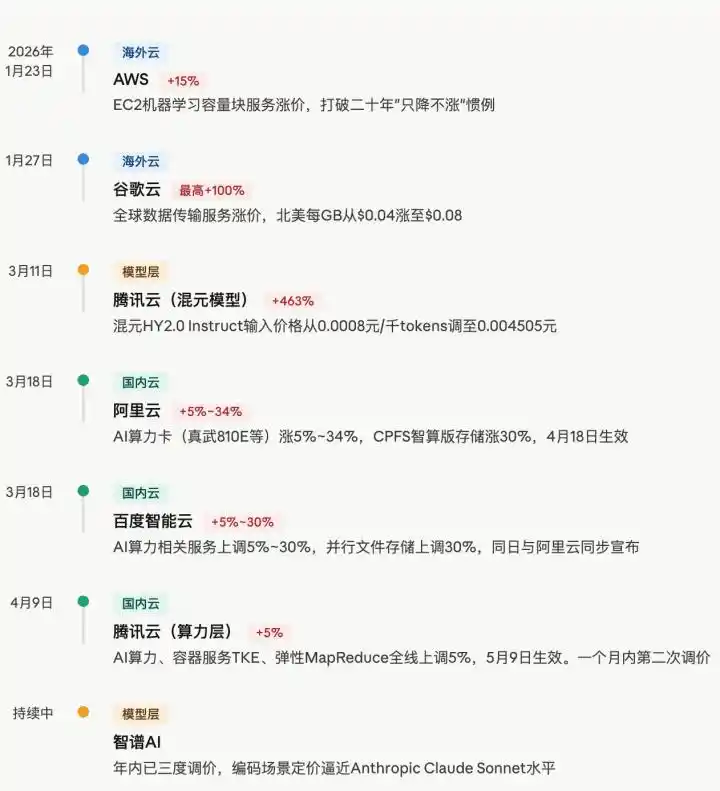
Figure | Timeline of global cloud computing price increase events in 2026

The media's initial reaction was "the price war is over, and the big players are starting to reap profits." This assessment is not wrong, but it stops at the most superficial interpretation. It explains why cloud providers are raising prices but does not answer the more critical question: Is this price hike a temporary correction or the starting point of a sustained trend? The answer lies in an economic paradox from 150 years ago.

01.

Jevons Paradox: The Cheaper It Gets, the More It Burns

In 1865, British economist William Jevons observed a counterintuitive phenomenon: after the efficiency of steam engines improved, the total coal consumption in the UK increased dramatically. The reduction in usage costs triggered an explosion in demand. This is the Jevons Paradox, which has accurately reappeared in the computing power market of 2026.

DeepSeek-R1 has indeed significantly reduced the cost per token for inference. But it has also opened a floodgate of demand: many enterprises that previously found "AI too expensive" have begun integrating AI into their business processes. Once integrated, token consumption expands at a nonlinear rate.

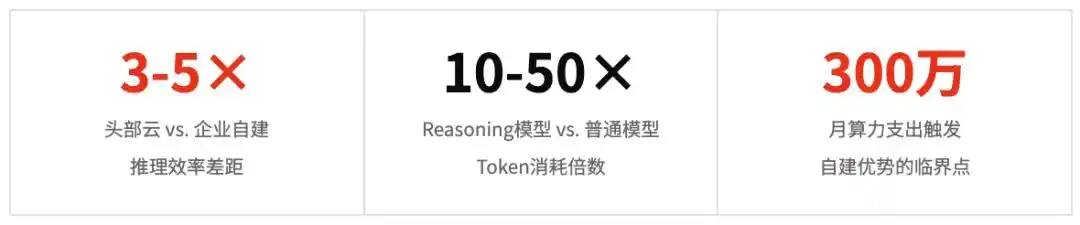
A more critical change is that AI applications have moved from "dialogue" to "doing things": Agents and Reasoning Models have entered the scene. A task that previously burned 1,000 tokens now burns 5,000 tokens with a reasoning chain, as Reasoning Models "think" on their own, consuming 10 to 50 times more than standard models.
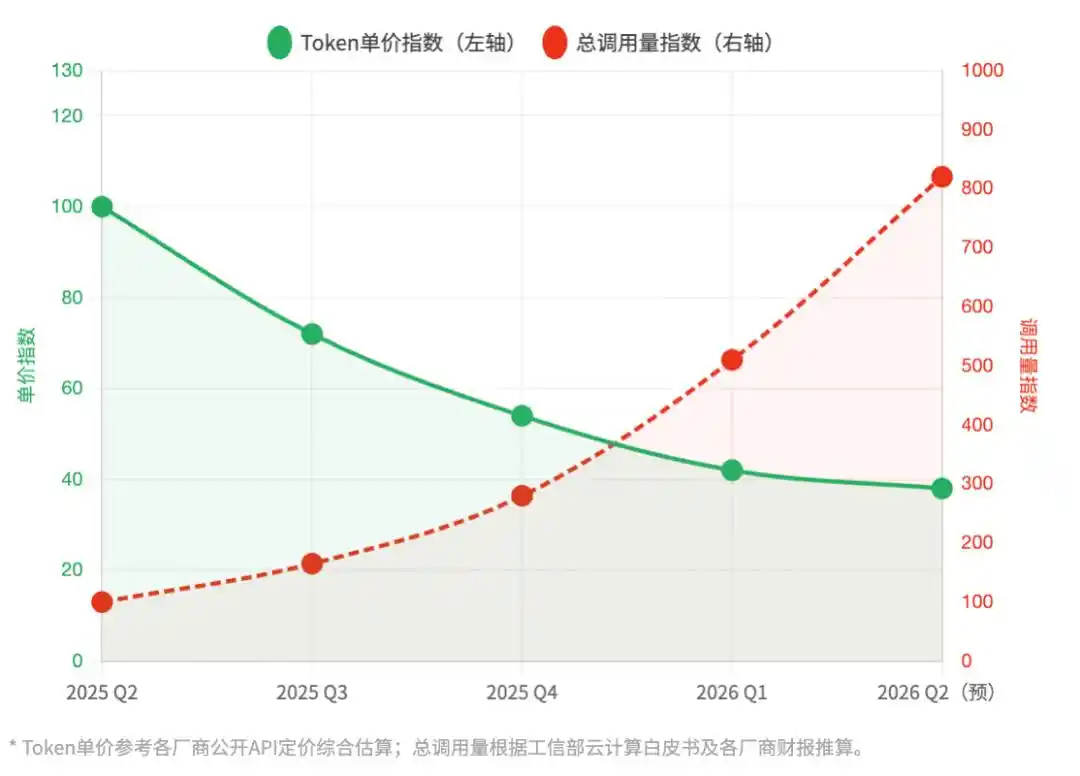
Figure | Before and after DeepSeek's release: Token unit price vs. total call volume trend

Note: 2025Q2 = Baseline 100 | Comprehensive estimate of inference APIs from major Chinese cloud providers

DeepSeek lowered the entry barrier but broke through the computing power ceiling. Each unit token is becoming cheaper, but each business task is becoming more expensive. This is the real foundation on which this round of price increases is built.

02.

Weights Open-Sourced, Inference Stack Not Open-Sourced

Another detail largely overlooked in reports: DeepSeek open-sourced the model weights but not its inference optimization stack. The difference between the two is like being given the design blueprints for an engine but not being told how to tune it for F1 performance.

What truly determines inference cost is not just the model architecture but the engineering capabilities hidden beneath the surface: the hit rate of speculative decoding, memory scheduling strategies for KV Cache, optimization separation between Prefill and Decode phases, and the network topology of ten-thousand-card clusters. These hard skills remain the moat of a few leading cloud providers.
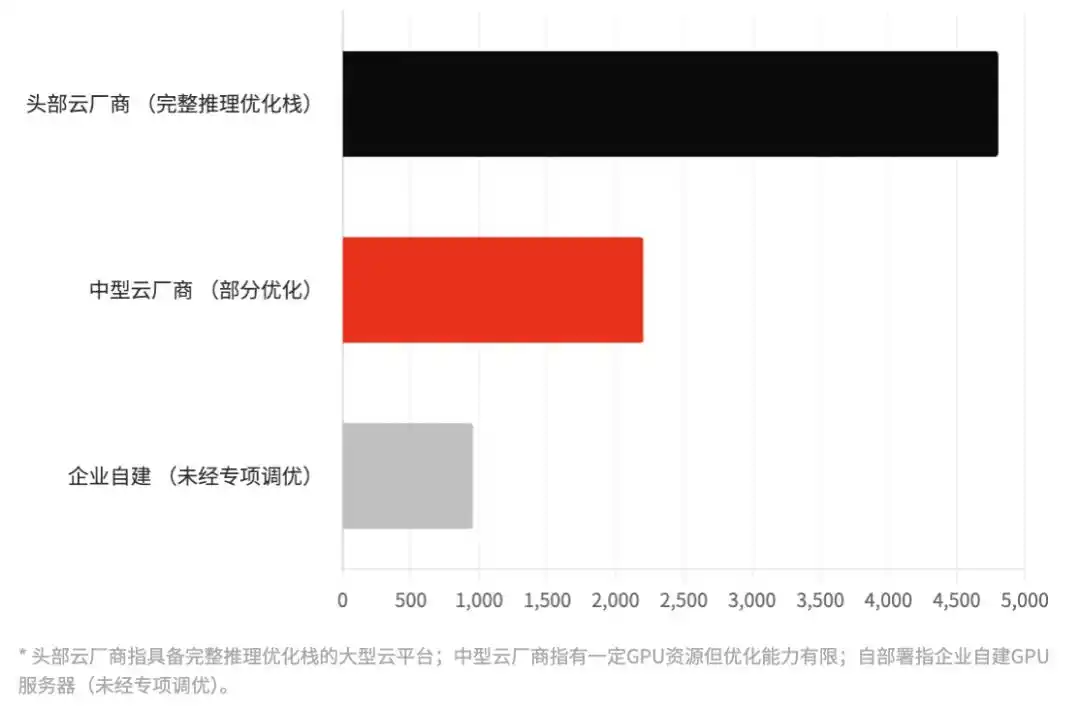
Figure | Actual efficiency gap in inference under equivalent model scale

Using DeepSeek-R1-67B as a benchmark, comparison of tokens processed per second (TPS) under different deployment conditions | Values are comprehensive industry estimates

Running the same DeepSeek-R1, the inference efficiency of leading cloud providers can be 3 to 5 times higher than that of self-built enterprise deployments. This means that with the same computing power investment, cloud providers can serve more concurrency, resulting in lower unit costs.

This efficiency gap is one source of the "premium" charged by cloud providers. It is a tangible engineering barrier. Therefore, this price increase is, to some extent, also about pricing their technical advantage.

03.

Battle of the Giants: The Ledgers and Ambitions of Four Major Players

In this wave of collective price adjustments, the stances of the four core giants vary, reflecting different commercial calculations.

Alibaba Cloud: Wu Yongming-style "Profit Quality" Defense. Alibaba's adjustment is the most resolute, with increases focused mainly on high-end GPU instances and storage (CPFS). Against the backdrop of Alibaba's full return to "efficiency first," Alibaba Cloud is no longer pursuing所谓的 "cloud market share first" but is instead aiming for "AI computing power profit margin first." The subtext is that Alibaba Cloud is establishing a "VIP computing power zone." If you cannot cover this 30% premium, you might not be on Alibaba's core target customer list.

Baidu AI Cloud: "User Filter." As the earliest player to bet big on large models, Baidu is facing pressure from the quantum leap in inference costs for its ERNIE model as call volumes scale. Therefore, Baidu's price hike is more like a "user reshuffle." It is actively weeding out small individual developers who only seek free benefits without creating commercial closed loops,转而全力服务对价格不敏感的B端大客户 (turning instead to fully serve large B-end customers who are price-insensitive). Baidu needs to prove through price adjustments that its AI growth no longer relies on subsidies but on "selling intelligence at a premium."

Tencent Cloud: "ROI Correction" After Ecosystem Lock-in. Tencent Cloud's move came three weeks later than Alibaba's, a typical "follow-the-leader strategy." Tencent's confidence lies in the deep integration with the WeChat ecosystem and Enterprise WeChat. When enterprise workflows are deeply embedded in Tencent's social/collaboration ecosystem, the migration cost is extremely high. Tencent Cloud's price increase is more like a "catch-up increase," used to correct the ROI sacrificed over the past two years to seize the ecosystem, making the AI business look more "respectable" in financial reports.

Volcano Engine: Strategic "Unbalanced Followership" and Talent Grab Plan. Volcano Engine (ByteDance) is the variable in this wave of price hikes. Although it has also adjusted some prices, the increases on many core APIs are significantly lower than those of Alibaba and Baidu. ByteDance is using this window period for "stock interception." Relying on the tremendous computing power absorption capacity brought by internal Douyin and TikTok, Volcano holds an extremely strong cost amortization card. While competitors are "driving away customers" to protect profits, Volcano is waiting for those who fall behind, attempting to use the price difference to achieve one last "installed base" overtake.

04.

The Biggest Surprise: Large Enterprises Start "Leaving"

This price increase has triggered an unintended counterforce: it has实质上坚定了大企业“自建算力”的决心 (substantially strengthened large enterprises' determination to "self-build computing power").

The cloud computing industry has a hidden rule: when the monthly bill exceeds a certain threshold, the financial model of "self-build vs. rent" flips. For banks, central state-owned enterprises, and large manufacturers, this threshold is roughly at a monthly cloud computing expenditure of 3 million to 5 million yuan.

In 2024, most large enterprises were below this threshold, making self-building uneconomical. In 2025, as AI projects rolled out, some enterprises began to touch the line. And this round of 20% to 30% price increases in 2026 has directly pushed a group of customers who were originally just on the line into the zone where they "must seriously consider self-building."
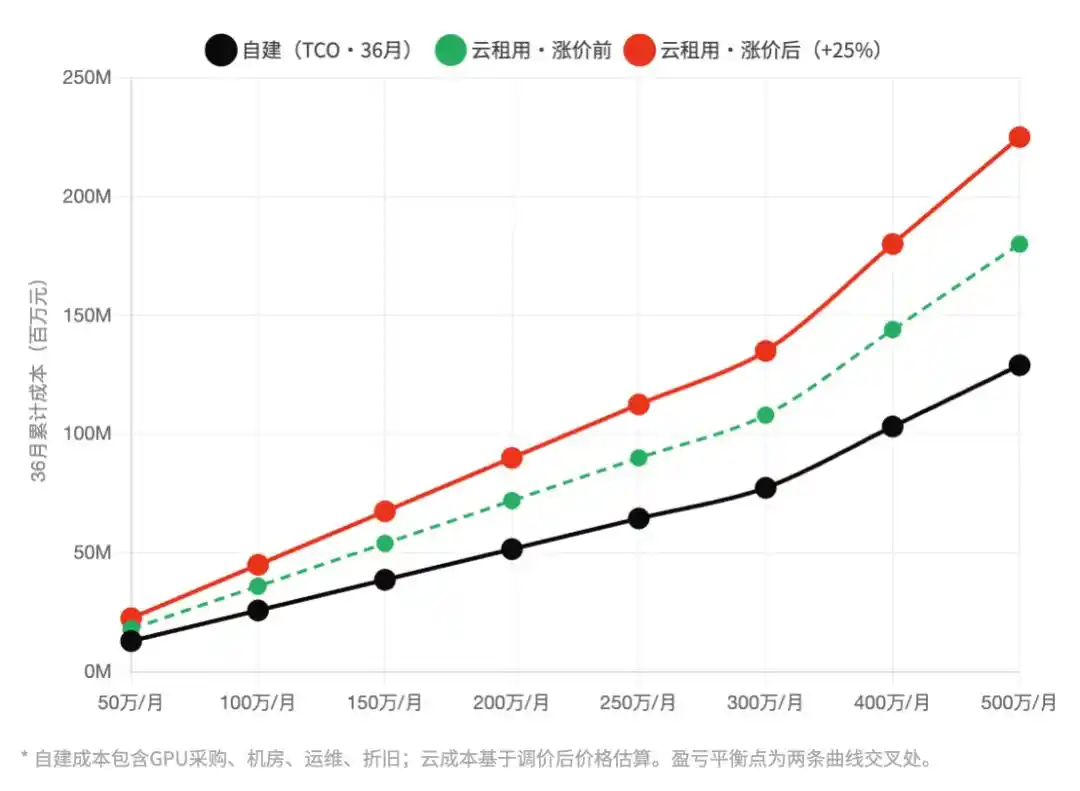
Figure | Cloud rental vs. self-build: Total Cost of Ownership (TCO) break-even point calculation

Horizontal axis: average monthly computing power expenditure (10k yuan/month), Vertical axis: 36-month cumulative cost (million yuan) | Comparison before and after price increase

The beneficiaries of this self-building wave are not the cloud providers' competitors but more peripheral players: GPU rental platforms saw inquiry volumes triple year-on-year in March; Huawei Ascend's delivery schedule for large customers has been extended to 6 months; integrators specializing in helping enterprises build "private inference clusters" have suddenly become highly sought after.

Cloud providers intended to raise prices to harvest high-end customers but inadvertently pushed away a group of large customers with self-building capabilities. This decision risk may be reassessed when the earnings season arrives.
05.

Who Wins? The Truth About Benefit Distribution

The price increases by the three cloud providers are seen by the media as "big players harvesting." But from the perspective of the entire industry chain, the distribution of real winners is much more complex.
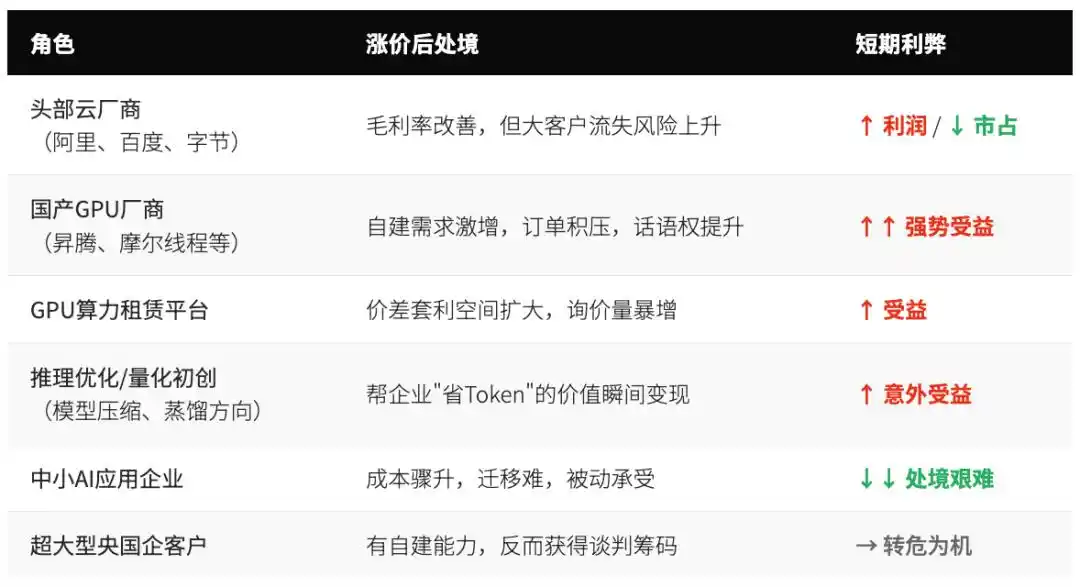
There is an ironic reality: the most hurt are the small and medium-sized AI startups full of innovative vitality. If they fall on a large scale due to costs, the cloud providers' own ecosystems will wither accordingly.

This is not without precedent. In the early 2010s, Amazon AWS's aggressive price increases on some services accelerated the shift of some developers to Google Cloud, indirectly helping GCP complete its early ecosystem accumulation. History does not repeat itself simply, but it rhymes.

06.

How Long Will the Era of Price Hikes Last?

Simply put, the essence of this round of price increases is a pressure release in China's AI computing power market amidst exploding demand and supply constraints. Squeezed from both sides, prices can only move upward. This is not entirely an active choice by cloud providers; in a sense, it is also a forced pricing correction.
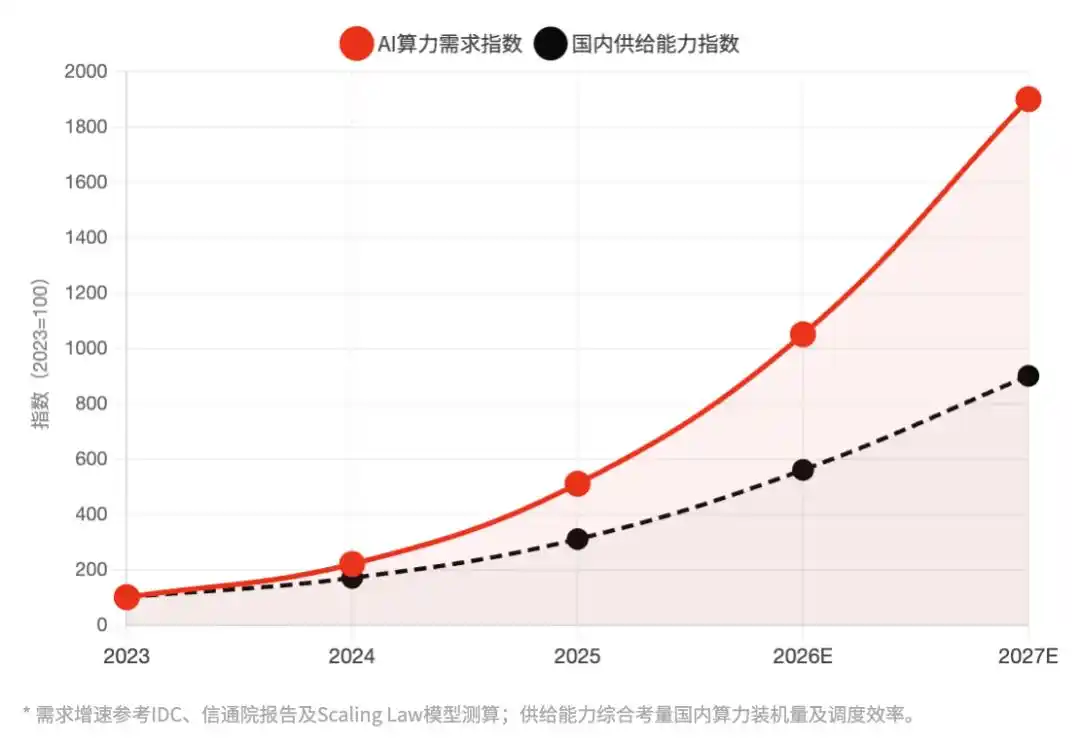
Figure | China's high-performance AI computing power: Demand growth rate vs. domestic supply capacity expansion rate Index: 2023 = 100 | The持续扩大的供需缺口 (continuously expanding supply-demand gap) is the underlying logic of this price increase

None of the three structural factors supporting this round of price increases will substantially disappear within 12 months: the quantum leap in token consumption brought by the adoption of Reasoning models, the accelerated large-scale deployment of AI Agents, and the supply constraints caused by Nvidia's export controls.

The B2B software market has a repeatedly verified规律 (rule): the Price Ratchet Effect. None of AWS's several price increases in the early 2010s were fully rolled back after supply improved. Google Cloud storage pricing has only seen one downward step since 2021, accompanied by tightened storage limits. Cloud providers understand this规律 (rule): this price increase is not just "harvesting during a window" but also about locking in a new price baseline.
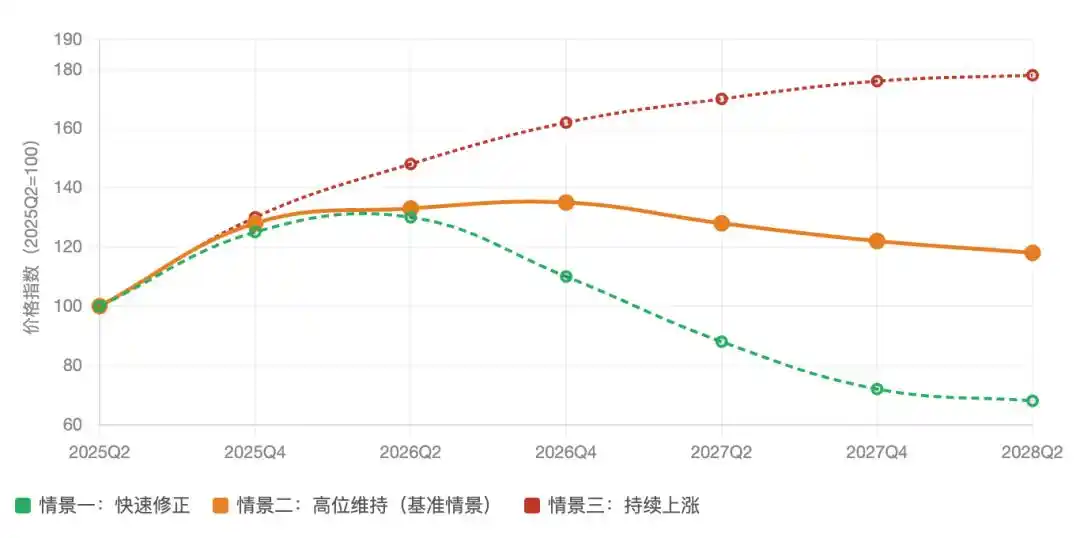
Computing power price index trend: Three scenario predictions (2025Q2–2028Q2)

2025Q2 = Baseline 100 | Comprehensive inference API average price index estimate, including price increase effects
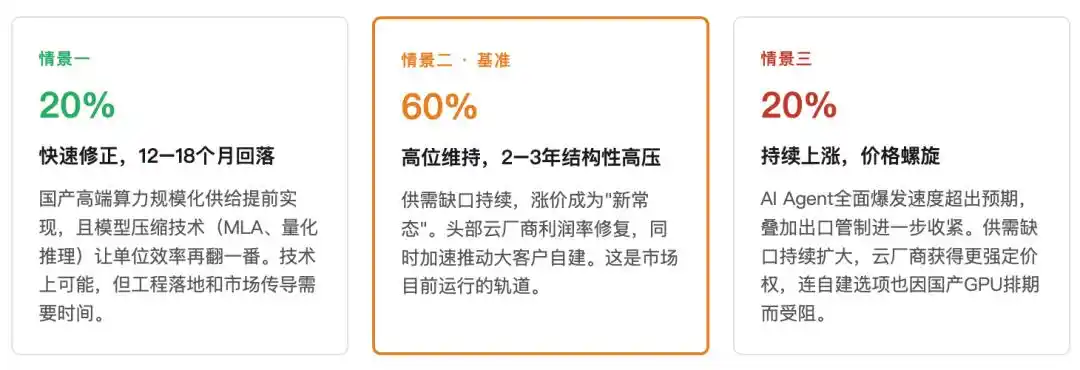
Therefore, before 2027, "computing power to zero" will not become a reality. The real factor determining the price inflection point depends on when the scheduling efficiency of domestic computing power can substantially catch up with Nvidia's H100. Judging from the current engineering progress, this point in time is most likely between 2027 and 2028.

And during this window, cloud providers have every reason to "raise prices first out of respect," because they know the window will not stay open forever.

07

Conclusion: A Structural Game on the Supply Side

What this round of price increases reveals is not the grand narrative of "AI commercialization's coming of age" but a more specific industrial reality: when an efficiency revolution and demand explosion occur simultaneously, prices may not fall but instead rise. The Jevons Paradox held true in the coal era, and it同样成立 (holds equally true) in the computing power era.

For small and medium-sized AI application companies, rather than arguing about who is harvesting, it is better to seriously calculate: in their own business scenarios, how many tokens are being consumed无效ly (ineffectively)?

Saving tokens is the hardest moat in this era.

This article is from the WeChat public account "EmphasizeNext" (ID: leo89203898), author: Wen Xin, editor: Xiao Bai


Связанные с этим вопросы

QWhat is the Jevons Paradox and how does it apply to the current AI computing market in China?

AThe Jevons Paradox, observed by British economist William Jevons in 1865, refers to the phenomenon where increased efficiency in resource use (like coal in steam engines) leads to higher overall consumption due to reduced costs triggering explosive demand. In the context of China's AI computing market in 2026, it explains why lower token inference costs (e.g., from models like DeepSeek-R1) have not reduced total spending but instead fueled a surge, as cheaper access encourages more extensive AI integration into business processes, especially with reasoning models and agents that consume 10-50 times more tokens per task.

QWhy did Chinese cloud providers like Alibaba Cloud and Baidu Intelligent Cloud raise prices despite falling AI inference costs?

AChinese cloud providers raised prices by 20-30% due to a combination of factors: the Jevons Paradox driving demand explosion beyond cost savings, their proprietary engineering advantages in inference optimization (e.g., speculative decoding, KV cache management) that justify premium pricing, and strategic shifts to focus on high-value enterprise clients while improving profitability. Additionally, supply constraints from NVIDIA export controls and the transition to AI agents requiring more tokens per task contributed to the pricing adjustment.

QHow does DeepSeek's approach to open-sourcing model weights but not inference optimization stacks impact the market?

ADeepSeek open-sourced model weights (e.g., for DeepSeek-R1) but kept its inference optimization stacks proprietary, creating a disparity where others have the model architecture but lack the engineering expertise to achieve high efficiency. This allows leading cloud providers to maintain a 3-5x efficiency advantage over self-deployed solutions, enabling them to serve more tokens per unit of compute and justifying price hikes as a way to monetize their technical barriers.

QWhat unintended consequence did the price hike by cloud providers trigger among large enterprises?

AThe price hike accelerated large enterprises' decisions to build their own computing infrastructure. For organizations with monthly cloud AI spending exceeding 3-5 million RMB, the increased costs pushed them past the threshold where self-building becomes financially viable. This led to a surge in demand for GPU leasing platforms, Huawei Ascend hardware, and integration services for private inference clusters, potentially reducing cloud providers' revenue from these high-value clients.

QWhat are the key structural factors sustaining the AI compute price increase, and when might a downturn occur?

AThe price increase is sustained by three structural factors: the adoption of reasoning models and AI agents drastically increasing token consumption per task, ongoing supply constraints from NVIDIA export controls limiting domestic GPU availability, and the price ratchet effect in B2B markets where hikes are fully reversed. A downturn is unlikely before 2027-2028, contingent on domestic compute alternatives (e.g., Huawei Ascend) achieving parity with NVIDIA H100 in scheduling efficiency, which would alleviate supply pressures and introduce competitive pricing.

Похожее

Обязательно ли ФРС повысит ставки в сентябре? Как это повлияет на криптовалюты и фондовый рынок?

За последнюю неделю рыночные ожидания повышения ставки ФРС в сентябре резко выросли с менее чем 50% до более чем 80%, что оказало давление на криптовалюты и связанные с ними акции. Ключевой причиной стал рост цен на нефть из-за эскалации геополитической напряженности вокруг Ормузского пролива, что усилило опасения по поводу инфляции. На июльском заседании ФРС сохранила ставку, но расклад голосов 9-3 в пользу сохранения показал усиление позиций сторонников ужесточения политики. Следующим важным ориентиром станут данные по инфляции (CPI) за июль, публикация которых 12 августа может существенно скорректировать ожидания. Для крипторынка, в частности для Bitcoin, усиление ожиданий повышения ставок создает краткосрочное давление, поскольку активы, не приносящие доход, становятся менее привлекательными. Однако исторически Bitcoin демонстрировал устойчивость, когда траектория повышения ставок уже была учтена рынком. Решающим фактором часто является не сам факт повышения, а изменение ожиданий относительно будущего цикла монетарной политики. Акции компаний, связанных с криптоиндустрией, такие как Coinbase и MicroStrategy, обычно демонстрируют более высокую волатильность в ответ на изменение ожиданий по ставкам. Для рынка акций в целом, особенно для технологического сектора с высокими оценками, рост стоимости заимствований может увеличить давление на мультипликаторы. Это совпадает с сезоном отчетности, когда инвесторы начали более пристально оценивать, приводят ли высокие капитальные затраты компаний на ИИ к реальному росту выручки и денежных потоков. Если ФРС повысит ставки в сентябре, толерантность рынка к "историям роста" за счет "сжигания денег" может снизиться, что усилит волатильность.

marsbitТолько что

Обязательно ли ФРС повысит ставки в сентябре? Как это повлияет на криптовалюты и фондовый рынок?

marsbitТолько что

Биткоин-майнеры массово сдаются, но их акции растут

Автор: Matt Crosby Хэшрейт сети Биткоин продолжает снижаться несколько месяцев подряд, а сложность майнинга зафиксировала одно из самых резких падений в истории. Обычно это означает, что майнеры отключают оборудование из-за нерентабельности. Однако в этот раз акции публичных майнинговых компаний демонстрируют один из лучших результатов за последние годы, в то время как цена BTC значительно снизилась. Исторически давление на майнеров и падение цены происходили синхронно, но сейчас наблюдается их расхождение, и рынок, возможно, ещё не полностью оценил долгосрочные последствия этого для хэшрейта. **Ключевые моменты:** * Хэшрейт сигнализирует об одной из самых продолжительных фаз капитуляции майнеров. * Сложность майнинга упала на 19,9% от пика, что является третьим самым глубоким снижением с эпохи ASIC-майнеров. * Акции майнинговых компаний значительно опередили BTC по доходности за год, несмотря на продажу тысяч биткоинов. * Доход от вознаграждения за блок в пересчёте на BTC достиг рекордно низкого суточного уровня. * Средний доход от комиссий за последние 28 дней даже не покрывает субсидию за один блок. Майнеры действительно капитулируют. Снижение сложности на 19,9% — это механизм протокола, работающий как задумано. Лишь два аналогичных периода были глубже, один из которых последовал за запретом майнинга в Китае. При этом акции крупнейших публичных майнеров выросли на 430% за год, тогда как BTC упал примерно на 46%. Это резкий отход от их традиционной роли "BTC с левериджем". Основной драйвер роста — нарратив об искусственном интеллекте (ИИ), который изменил корреляцию между этими активами. Доход майнеров от вознаграждения за блок (субсидии) в биткоинах достиг исторического минимума. Это следствие предсказуемого механизма халвинга, сокращающего эмиссию каждые четыре года. Хотя пока рост цены BTC компенсировал это снижение в долларовом выражении, показатель Puell Multiple (около 0,75) указывает, что текущий ежедневный доход (~$30 млн) ниже годового среднего (~$40 млн). В долгосрочной перспективе субсидию должны заменить комиссии. Однако сейчас они составляют лишь около $200 тыс. в день против $30 млн от субсидий. Среднесуточных комиссий за месяц не хватает даже на покрытие одного блока, в то время как сеть создаёт около 144 блоков в день. Эта фаза капитуляции отличается от предыдущих. Майнеры нашли более прибыльное применение своему оборудованию (ИИ) на фоне падения цены BTC, сокращения субсидий и стагнации комиссий. Хотя непосредственных рисков для безопасности сети нет, текущая ситуация highlights структурные вопросы激励机制 майнеров, которые в медвежьем рынке требуют большего внимания, чем в условиях бычьего тренда.

marsbitТолько что

Биткоин-майнеры массово сдаются, но их акции растут

marsbitТолько что

ФРС в сентябре точно повысит ставки? Как криптовалюты и американские акции справятся с давлением?

За последнюю неделю рыночные ожидания повышения ставки ФРС в сентябре резко выросли с менее чем 50% до более чем 80%, что оказало давление на крипторынок и связанные с ним акции. Ключевым фактором стала эскалация геополитической напряженности вокруг Ормузского пролива, что привело к росту цен на нефть и опасениям по поводу инфляции. Инфляционные данные за июль, которые будут опубликованы 12 августа, станут следующим важным ориентиром. Для криптоактивов, таких как биткоин, рост ожиданий повышения ставки создает краткосрочное давление, поскольку они по-прежнему демонстрируют черты рискованных активов, чувствительных к ликвидности. Однако исторически цена биткоина не всегда линейно реагировала на уже учтенные рынком действия ФРС. Акции компаний, связанных с криптовалютами, такие как Coinbase и MicroStrategy, обычно испытывают более сильную волатильность в условиях роста процентных ставок. На общий рынок акций, особенно на высокотехнологичные компании с высокими оценками, также может повлиять повышение стоимости заемного финансирования, что особенно актуально в сезон отчетности, когда инвесторы сосредоточены на окупаемости крупных капитальных затрат. Таким образом, сентябрьское решение ФРС остается неопределенным. Дальнейшая динамика будет зависеть от данных по инфляции, ситуации на нефтяном рынке и сигналов от представителей Федрезерва.

Odaily星球日报4 мин. назад

ФРС в сентябре точно повысит ставки? Как криптовалюты и американские акции справятся с давлением?

Odaily星球日报4 мин. назад

Забытое крупное событие на рынке: Совместное вмешательство США, Японии и Южной Кореи, «редкое» участие Минфина США, тихое «спасение рынка» Безентом?

Авторы: Ли Цзя, источник: Wall Street News На этой неделе США, Япония и Южная Корея провели крупнейшую за последние три десятилетия скоординированную валютную интервенцию. Действия были направлены против давления на обесценивание иены и воны, а также рассматриваются как важная мера США по стабилизации финансовых рынков союзников и предотвращению перелива рисков. В операции были задействованы как японские и южнокорейские власти, продававшие доллары для поддержки национальных валют, так и Министерство финансов США, которое впервые за почти 30 лет напрямую участвовало в поддержке иены, продавая евро и покупая иену через ФРС Нью-Йорка и инвестиционные банки. Такой подход позволил снизить давление на иену, не усиливая нагрузку на доллар. Интервенция последовала на фоне сильного давления на рынки Японии и Южной Кореи: индекс KOSDAQ упал до минимума с октября 2022 года, а курсы иены и воны значительно ослабли. Аналитики отмечают, что эта акция выходит за рамки простой стабилизации обменных курсов и представляет собой операцию по «спасению рынка» («Price Keeping Operation»), цель которой – поддержать стабильность активов в странах, являющихся ключевыми звеньями полупроводниковой и ИИ-цепочки поставок США, и предотвратить распространение финансового стресса. Таким образом, скоординированные действия трех стран направлены не только на валютные курсы, но и на сдерживание волатильности на ключевых союзных рынках для защиты стратегических технологических цепочек.

marsbit4 мин. назад

Забытое крупное событие на рынке: Совместное вмешательство США, Японии и Южной Кореи, «редкое» участие Минфина США, тихое «спасение рынка» Безентом?

marsbit4 мин. назад

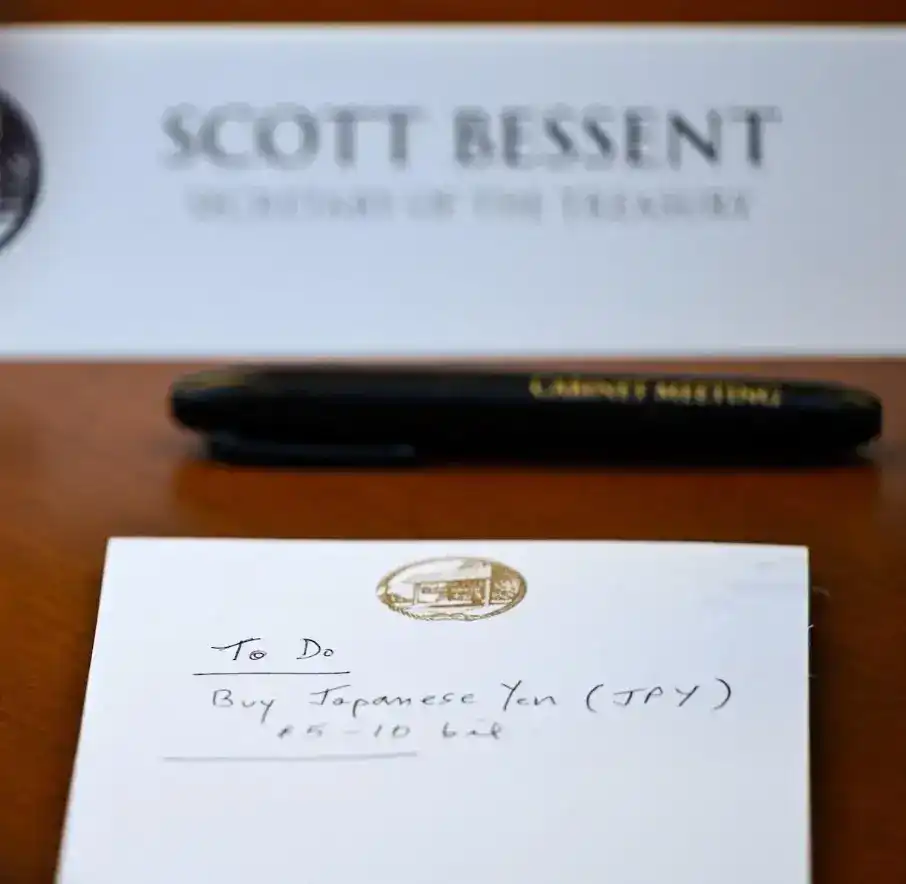
Совместное вмешательство США и Японии: новое «Соглашение Плаза», начало Бреттон-Вудской системы 2.0 и конец эры йеновых арбитражей

Мероприятие по совместной поддержке иены США и Японией, впервые за десятилетия, заставляет рынки переоценить глобальные модели движения капитала, долгое время зависевшие от дешевого финансирования в иенах. Аналитики полагают, что это может означать поворотный момент для торговли на разнице процентных ставок с использованием иены (йеновый кэрри-трейд) и привести к более глубокой перестройке глобальных финансовых потоков. Министр финансов США Бессент и президент Трамп подтвердили активное участие США. Бессент заявил о готовности к дальнейшим совместным интервенциям для коррекции «серьезной недооценки» иены. Трамп подчеркнул, что это демонстрация союзнических отношений, и ожидает финансовой выгоды для Вашингтона. Интервенция вызвала резкий рост курса иены до 157,40 за доллар. Анализ рынка указывает, что действия альянса выходят за рамки обычного управления валютным курсом. Если Японии для защиты иены придется продавать свои валютные резервы (включая казначейские облигации США), это может привести к переоценке долгосрочных доходностей американских госдолга и запустить реорганизацию глобальной ликвидности. Этот сдвиг потенциально сигнализирует о конце эры йенового кэрри-трейда, которая десятилетиями поддерживала глобальную ликвидность и низкие процентные ставки. Дополнительное давление на долгосрочные ставки создает изменение роли крупных технологических компаний, которые теперь активно выпускают облигации для финансирования инвестиций в ИИ, превращаясь из поглотителей сбережений в крупных заемщиков. Некоторые наблюдатели видят в этих событиях признаки формирования нового международного порядка в духе «Бреттон-Вудс 2.0» или нового «Соглашения Плаза». США, делая ставку на экономику предложения, стремятся к ускорению роста, в то время как Япония, возможно, стоит на пороге реструктуризации своей экономической и геополитической роли. Независимо от того, окажется ли интервенция разовой мерой или началом долгосрочной координации, она уже заставляет рынки пересматривать устоявшиеся модели глобальных капиталов.

marsbit43 мин. назад

Совместное вмешательство США и Японии: новое «Соглашение Плаза», начало Бреттон-Вудской системы 2.0 и конец эры йеновых арбитражей

marsbit43 мин. назад

Торговля

Спот
活动图片