The Era of Easy Money with Stablecoins Is Over, DeFi Native Stablecoins May Become the New Engine in Regulatory Gaps

marsbitОпубликовано 2026-04-09Обновлено 2026-04-09

Введение

The era of passive income from stablecoins is ending due to regulatory changes, particularly the proposed CLARITY Act in the U.S., which aims to restrict centralized exchanges (CEXs) like Coinbase from offering interest on stablecoin holdings such as USDC. This legislation, backed by banking industry lobbying, seeks to prevent stablecoins from functioning as "chain-based deposits" that compete with traditional banks by offering Treasury-like yields without banking regulations. However, the CLARITY Act carves out exceptions for rewards based on "identifiable activities," including platform engagement, transactions, and contributions to blockchain infrastructure. This creates an opportunity for DeFi-native stablecoins like USDe and USDS, which generate yields through mechanisms such as staking, derivatives hedging, and protocol revenue sharing—activities framed as active participation rather than passive income. As a result, centralized stablecoins may revert to their core roles in payments and settlements, while DeFi alternatives could thrive by offering compliant, activity-based yields, reshaping the stablecoin landscape into a dual structure of utility-focused and yield-generating assets.

Author: Jae, PANews

Many regulatory obstacles have emerged on the path to earning interest by holding USDC.

The yield logic of the stablecoin market is undergoing a restructuring from "easy money" to "earned rewards".

The CLARITY Act is taking aim at severing the passive income channels of CEXs (Centralized Exchanges), yet it preserves room for activity rewards for DeFi native stablecoins. According to the draft text disclosed in March, if this bill passes, it could mean: the days of users holding USDC on Coinbase to earn a 4% annualized yield are about to become history.

The old-era dividends of centralized stablecoins may be coming to an end, while DeFi native stablecoins like USDe and USDS have the opportunity to open up growth space in the gaps of regulation, ushering in a further expansion opportunity.

Banking Industry Spends $56.7 Million Lobbying to Block "On-Chain Deposits"

The GENIUS Act, which took effect in July 2025, for the first time established stablecoin issuance rules at the federal level, requiring 1:1 reserves and restricting issuers from directly paying interest, but it left a "distributor loophole": Platforms like Coinbase could, through revenue sharing with issuers like Circle, return U.S. Treasury yield to users in the form of "rewards". This is like banks not being able to directly pay interest on user deposits but being able to give users "red envelopes" through third parties—it's essentially the same thing.

In this gray area, stablecoins quietly broke through their positioning as payment tools, transforming into "on-chain deposits" with built-in yield.

The emergence of the CLARITY Act is precisely to plug this gap. The latest draft text disclosed in March shows that the ban has been extended from issuers to all "digital asset service providers," including CEXs, brokers, and their affiliated companies.

This restrictive trend reflects regulatory considerations regarding the conflict between the "monetary attributes" and "securities attributes" of stablecoins. In regulatory consensus, payment-oriented stablecoins are considered a "Narrow Bank" tool: their functional positioning is for payment and settlement, not as investment products for capital appreciation.

The stringent restrictions on yield distribution in the CLARITY Act are the result of a carefully orchestrated defense battle by the U.S. banking industry. To prevent stablecoins from offering competitive yields, the ABA (American Bankers Association) spent a whopping $56.7 million on lobbying.

The banking industry argues that if users can earn Treasury-like yields of 4%-5% by holding stablecoins, free from traditional banking regulation and deposit insurance constraints, then up to $1.5 trillion in low-cost retail deposits could flow out of the commercial banking system.

This "Deposit Flight" phenomenon is particularly fatal for U.S. community banks, as they heavily rely on retail deposits to support loans to farms, small and medium-sized businesses, and mortgage housing.

Estimates from Standard Chartered show that if stablecoin yields are not banned, the banking system could face a funding gap of $500 billion by 2028.

However, PANews believes that this calculation is based on several assumptions; the speed and scale of deposit migration will be influenced by multiple factors such as user habits, platform security, and regulatory transparency.

The overlap between stablecoin users and bank retail deposit users is relatively limited. The calculation of $1.5 trillion in deposit outflows is based on extreme assumptions, and the actual impact will likely be far lower.

Furthermore, stablecoins and bank deposits differ fundamentally in risk attributes and usage scenarios; the two may not be perfect substitutes.

Passive Yield Sentenced to "Death," Activity Rewards Leave a Narrow Door Open

The CLARITY Act does not impose a blanket ban on all rewards but sets "Identifiable Activity" screening criteria to legally avoid the "expectation of profit" judgment condition in the Howey Test.

The CLARITY Act explicitly prohibits interest payments based on "idle balances," which severely impacts the sharing model that Coinbase and Circle have maintained for years. For a long time, Coinbase has offered rewards as high as 3.5%-5% to its USDC holders, with the source of funds being the interest income from U.S. Treasuries in Circle's reserves.

Data shows that the correlation between USDC rewards and the 3-month U.S. Treasury yield is as high as 98.7%. By cutting this link, regulators are essentially stripping CEXs of their most attractive user growth weapon.

In contrast, the CLARITY Act preserves the legitimacy of incentives for "active behavior." According to Section 404(b)(2) of the bill, rewards generated from three types of activities are deemed compliant:

  1. Platform Activities: Loyalty programs, promotional lotteries, subscription discounts, etc.;
  2. Transactions and Consumption: Payments, transfers, cross-border remittance settlements, etc., made using stablecoins;
  3. On-Chain Infrastructure Contribution: Participating in protocol validation, staking, governance voting, or providing liquidity.

This classification creates a new legal logic: If the yield is not "given for free" but is earned by the user through undertaking specific risks or performing specific labor, then it is no longer a "deposit" but a form of "Payment for Service."

Strictly speaking, the path to earning yield with USDC is not completely blocked; users can still earn rewards by participating in activities using USDC. However, since participating in activities involves certain costs, compared to the previous "easy money" model, the yield obtained will inevitably incur损耗 (loss/wear and tear). The utility of USDC will also revert more to payment, settlement, and consumption.

This恰好 (precisely) creates a clear compliance path and growth opportunity for DeFi native stablecoins.

Derivatives Hedging and Protocol Profit-Sharing, DeFi Native Stablecoins Step on the Compliant "Escape Hatch"

While CEXs tread carefully in the "regulatory minefield," DeFi native stablecoins like USDe and USDS,凭借 (relying on) their截然不同的 (entirely different) yield logic, have stepped into the regulatory gap for compliance.

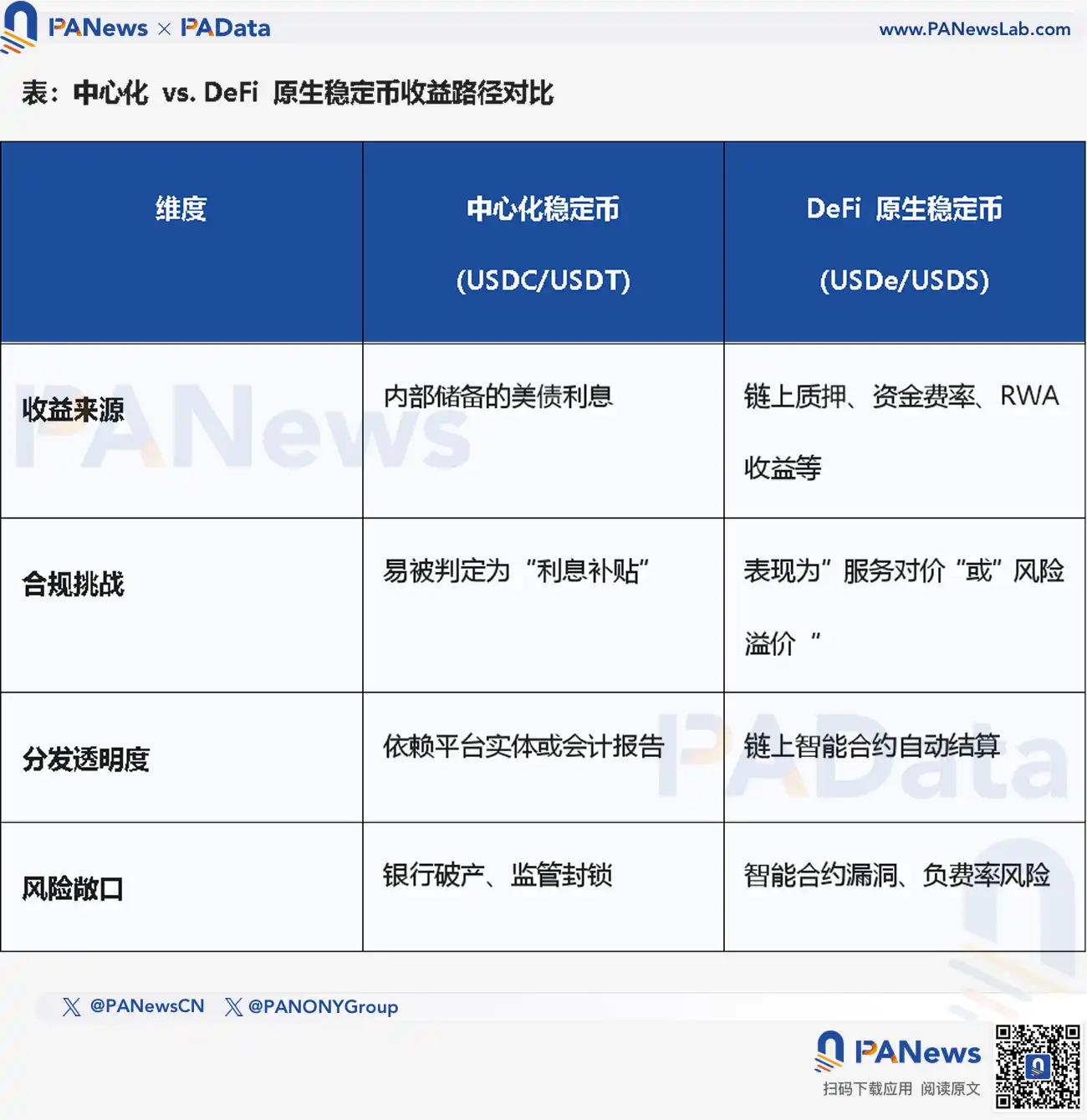
Taking USDe as an example, it抛弃 (abandons) bank dollar reserves and is supported by a "synthetic dollar" derivatives architecture, with the underlying logic being Delta neutral hedging.

USDe's yield comes from two separate activities, both of which can be interpreted under the CLARITY Act as "activity-based rewards":

  • Staking Layer Yield (Staking Yield): Earned by holding staking tokens like stETH, obtaining consensus layer rewards from the Ethereum network, which is explicitly listed in the bill as a compliant activity for "participating in validation or staking";

  • Derivatives Layer Yield (Funding Rates): By opening equivalent perpetual contract positions on exchanges. In a market with strong bullish sentiment, the funding fees paid by long positions to short positions constitute the main source of yield for USDe.

Under the framework of the CLARITY Act, the yield obtained by USDe holders is essentially a reward for users participating in the specific activity of "risk management and hedging operations," not interest paid by the protocol based on deposit balance.

Because USDe's yield is volatile and bears counterparty risk and smart contract risk, it will legally depart from the category of "bank deposit equivalents."

USDS represents another DeFi native force adapting to regulation.

Users deposit USDS into the Sky protocol, which deploys the deposits to other lending protocols or liquidity pools. In this process, the revenue or fees generated on Sky, as well as RWA (Real World Asset) yields, are distributed to users as returns.

Therefore, USDS incentivizes users through "protocol profit-sharing" rather than "interest payments." The provision in the CLARITY Act draft regarding rewards for "providing liquidity" also, to some extent, provides a legal shield for DeFi protocols adopting models similar to USDS.

The advancement of the CLARITY Act宣告着 (declares) the impending end of the era of wild growth for stablecoins. Under the spotlight of regulation, the market is moving towards a clear dual-track structure. There are no absolute winners, only survivors who adapt to the rules.

Centralized stablecoins like USDC will inevitably become "instrumentalized," returning to their本源 (origin) of payment and settlement.凭借 (Relying on) compliance, liquidity, ecosystem coverage, and cross-border transfer experience, they will become the preferred digital cash for most ordinary users and enterprises, with yield no longer being their competitive barrier.

DeFi native stablecoins like USDe may承接起 (take on) wealth management needs, becoming the "yield engine" of the crypto market. By deeply anchoring asset value to complex on-chain activities like Delta neutral hedging and liquidity mining, they巧妙地 (cleverly) circumvent the regulatory狙击 (sniper fire) aimed at "bank deposits."

The differentiation in the stablecoin track is an inevitable result of the market seeking optimal solutions within the compliance framework. For investors, understanding the deep logic behind this migration is more important than chasing high yields: future stablecoin yields will no longer belong to passive "holders" but to active "contributors" who participate in protocol activities.

This transformation is both a result of regulatory constraints and an opportunity for DeFi innovation to adapt to regulation.

Связанные с этим вопросы

QWhat is the main regulatory challenge facing stablecoins like USDC in the United States according to the article?

AThe main regulatory challenge is the proposed CLARITY Act, which aims to restrict passive income generation from holding stablecoins by prohibiting rewards based on idle balances, effectively ending the 'earn' programs offered by platforms like Coinbase for USDC holders.

QHow does the CLARITY Act differentiate between prohibited 'passive rewards' and allowed 'activity-based rewards'?

AThe CLARITY Act prohibits rewards based solely on idle balances (passive interest) but allows rewards for identifiable activities such as platform engagement (loyalty programs), transactions (payments, transfers), and on-chain contributions (staking, providing liquidity, governance).

QWhy are traditional banks lobbying against stablecoins offering competitive yields?

ATraditional banks, represented by the American Bankers Association (ABA), are lobbying to prevent stablecoins from offering competitive yields because they fear it could lead to significant deposit flight from the banking system, especially from community banks that rely on low-cost retail deposits for lending.

QHow do DeFi-native stablecoins like USDe and USDS generate yield in a way that may comply with the CLARITY Act?

AUSDe generates yield through staking rewards (e.g., from stETH) and funding rates from perpetual futures positions, which are classified as rewards for specific activities like validation and risk management. USDS uses protocol revenue sharing from deployments in lending or liquidity pools, framed as rewards for providing liquidity.

QWhat is the expected long-term impact of regulations like the CLARITY Act on the stablecoin market?

AThe regulations are expected to create a dual-track market: centralized stablecoins like USDC will become more utility-focused for payments and settlements, while DeFi-native stablecoins like USDe will serve as yield-generating engines for active participants in on-chain activities, aligning with regulatory frameworks for activity-based rewards.

Похожее

The Shutdown of Claude Mythos Revealed the True Cost of Renting AI to Me

The sudden shutdown of Claude Mythos this week starkly highlights a critical, often overlooked risk for founders: when your core capability relies entirely on someone else's platform, your fate is not in your own hands. The key question becomes: who truly owns the intelligence your product depends on? For years, the debate around open-source models focused on cost. Now, the evidence is clear: fine-tuned open-source models can achieve frontier-level quality for specific, mission-critical tasks at a fraction of the cost. However, the deeper issue is control. Relying on a third-party API is like renting; it works until the landlord changes the rules, raises the rent, or asks you to leave—as Mythos experienced. The lesson is not to stop using frontier models—they are incredible infrastructure. The goal is ownership. Ownership means starting with a powerful open-source model and shaping it around what makes your company unique: your data, workflows, domain expertise, and definition of "good." Over time, the model becomes less generic and more reflective of your business, creating durable value. The optimistic conclusion is that AI's future doesn't hinge on one superior model. There is no single frontier. The frontier includes proprietary models, models fine-tuned on company-specific knowledge, specialized models for narrow problems, and intelligent routers orchestrating model ensembles. The most interesting development is not models getting smarter, but intelligence becoming increasingly customizable. The winning companies will be those that transform intelligence into a unique, owned asset. Looking ahead, the vision is not one model dominating all, but many teams owning the part of the frontier that matters most to them.

marsbit26 мин. назад

The Shutdown of Claude Mythos Revealed the True Cost of Renting AI to Me

marsbit26 мин. назад

Tiger Research: U.S. Strategic Bitcoin Reserve - Should the Market Be Happy or Disappointed?

Tiger Research analyzes the evolution of U.S. legislative efforts regarding a strategic Bitcoin reserve, concluding the market impact is limited in the short term but potentially positive long-term. The core event was a March 2025 executive order by former President Trump, which designated confiscated Bitcoin as a strategic reserve and promised not to sell existing holdings (approx. 190k BTC). As it contained no mandate to purchase new Bitcoin, the market reacted negatively, with prices dropping 5.7%. Legislative history shows a significant retreat from initial ambitions. The 2024 "BITCOIN Act" proposed mandatory purchases of 1 million BTC over five years. Reintroduced in 2025, it stalled due to high fiscal costs, concerns over dollar hegemony, and opposition from the Treasury Secretary. The current frontrunner, the 2026 "American Retirement and Monetary Advancement (ARMA) Act," is a compromise. It lacks any purchase requirement, instead focusing on consolidating existing government-held Bitcoin and legally prohibiting its sale for at least 20 years. While ARMA has higher passage odds due to bipartisan support and no purchase mandate, its immediate market effect is neutral. It eliminates potential government selling pressure but creates no new demand. The long-term significance is that formally establishing Bitcoin as a national reserve asset in law could later reignite debates on mandatory purchases. Therefore, the path to a government buyer is longer than initially priced by the market, but the directional narrative remains intact.

marsbit28 мин. назад

Tiger Research: U.S. Strategic Bitcoin Reserve - Should the Market Be Happy or Disappointed?

marsbit28 мин. назад

US Stock Market Trend (June 16): SpaceX Rises 42% in Two Days, New Fed Chairman Takes Office Today

**U.S. Stocks Trend (June 16): SpaceX Soars 42% in Two Days, New Fed Chair Takes Office Today** Markets surged on Monday following former President Trump's social media announcement of a completed U.S.-Iran deal to reopen the Strait of Hormuz, pending a June 19 signing. The news triggered a broad risk-on rally: oil prices crashed, tech stocks soared, bond yields fell, and defensive sectors lagged. **Market Performance:** The Nasdaq jumped 3.07%, led by semiconductor stocks like Micron (+9.2%). The S&P 500 gained 1.65%, and the Dow rose 0.92% to a record high. However, the Russell 2000 small-cap index underperformed (+0.72%). SpaceX continued its hot streak, rising another 5% pre-market after disclosures of large buys by an Australian billionaire and Cathie Wood's ARK. Boeing also rallied on the transportation optimism. Conversely, energy stocks like Chevron fell over 3% on the oil price plunge, with other defensive sectors also selling off. The day's action showed a clear rotation of funds from energy/defensive plays into AI and tech narratives. **Macro & Outlook:** The VIX fear index fell 8.37%. Treasury yields declined, and WTI crude dropped over 5%. Attention now shifts to a packed schedule: the Bank of Japan is widely expected to hike rates to 1.0% on Tuesday. The Fed's June meeting concludes Wednesday, marking new Chair Wash's debut. While rates are expected to hold, his tone on stubborn inflation and the "dot plot" will be crucial for gauging the 2024 rate path. The formal Iran deal signing is set for Friday. **Trend Perspective:** While the peace deal is a genuine positive, Monday's explosive rally may have gotten ahead of itself, pricing in a swift resolution to inflation concerns. The shortened trading week faces a triple test: BoJ tightening, the Fed's policy stance, and deal implementation details. Tech and semiconductors, which led the surge, remain vulnerable to any disappointment from these key events. The real price discovery begins with the central banks' communications this week.

marsbit50 мин. назад

US Stock Market Trend (June 16): SpaceX Rises 42% in Two Days, New Fed Chairman Takes Office Today

marsbit50 мин. назад

Торговля

Спот
Фьючерсы

Популярные статьи

Как купить ERA

Добро пожаловать на HTX.com! Мы сделали приобретение Caldera (ERA) простым и удобным. Следуйте нашему пошаговому руководству и отправляйтесь в свое крипто-путешествие.Шаг 1: Создайте аккаунт на HTXИспользуйте свой адрес электронной почты или номер телефона, чтобы зарегистрироваться и бесплатно создать аккаунт на HTX. Пройдите удобную регистрацию и откройте для себя весь функционал.Создать аккаунтШаг 2: Перейдите в Купить криптовалюту и выберите свой способ оплатыКредитная/Дебетовая Карта: Используйте свою карту Visa или Mastercard для мгновенной покупки Caldera (ERA).Баланс: Используйте средства с баланса вашего аккаунта HTX для простой торговли.Третьи Лица: Мы добавили популярные способы оплаты, такие как Google Pay и Apple Pay, для повышения удобства.P2P: Торгуйте напрямую с другими пользователями на HTX.Внебиржевая Торговля (OTC): Мы предлагаем индивидуальные услуги и конкурентоспособные обменные курсы для трейдеров.Шаг 3: Хранение Caldera (ERA)После приобретения вами Caldera (ERA) храните их в своем аккаунте на HTX. В качестве альтернативы вы можете отправить их куда-либо с помощью перевода в блокчейне или использовать для торговли с другими криптовалютами.Шаг 4: Торговля Caldera (ERA)С легкостью торгуйте Caldera (ERA) на спотовом рынке HTX. Просто зайдите в свой аккаунт, выберите торговую пару, совершайте сделки и следите за ними в режиме реального времени. Мы предлагаем удобный интерфейс как для начинающих, так и для опытных трейдеров.

742 просмотров всегоОпубликовано 2025.07.17Обновлено 2026.06.02

Как купить ERA

Обсуждения

Добро пожаловать в Сообщество HTX. Здесь вы сможете быть в курсе последних новостей о развитии платформы и получить доступ к профессиональной аналитической информации о рынке. Мнения пользователей о цене на ERA (ERA) представлены ниже.

活动图片