The Dollar Teeters, ECB Economist Reveals the Truth About Bitcoin as a Safe Haven

marsbitОпубликовано 2026-01-20Обновлено 2026-01-20

Введение

European Central Bank Chief Economist Philip Lane warns that political pressure on the Federal Reserve could undermine the U.S. dollar's global standing by driving up U.S. term premiums and triggering a reassessment of dollar-denominated assets. This could destabilize global markets through key channels like real yields, dollar liquidity, and institutional credibility. While recent geopolitical tensions initially drove oil and inflation expectations higher, Lane highlights a deeper risk: a "governance discount" on U.S. assets that could cause term premiums to spike even without Fed rate changes. Bitcoin, highly sensitive to liquidity and discount rates, faces two potential macro scenarios: in a traditional "yield differential" paradigm, higher U.S. rates strengthen the dollar and pressure risk assets like Bitcoin; in a "credibility risk" paradigm, dollar weakness coupled with rising term premiums could position Bitcoin as a monetary escape valve. The crypto ecosystem’s reliance on dollar-backed stablecoins ties it directly to U.S. Treasury dynamics, meaning term premium shocks could affect stablecoin yields and on-chain liquidity. Key indicators to watch include term premiums, TIPS yields, inflation expectations, DXY movements, Bitcoin ETF flows, and options positioning. Lane’s warning underscores that a repricing of dollar risk could create a regime shift, with Bitcoin reacting more sharply than traditional assets.

Author: Gino Matos

Compiled by: Deep Tide TechFlow

Deep Tide Introduction: Against the backdrop of global macroeconomic volatility and escalating geopolitical tensions, Philip Lane, Chief Economist of the European Central Bank (ECB), has issued a rare warning: the "tussle" between the Federal Reserve and political forces could jeopardize the international status of the US dollar.

This article delves into how this political pressure is transmitted to global financial markets through the term premium and explains why, at this moment of a shaking credit system, Bitcoin might become the last safe haven for investors.

The author combines multi-dimensional data, including US Treasury yields, inflation expectations, and the stablecoin ecosystem, to break down the two截然不同的 (distinctly different) macro paradigms that Bitcoin may face in the future.

Full Text Below:

European Central Bank (ECB) Chief Economist Philip Lane issued a warning that most market participants initially viewed merely as European "housekeeping": while the ECB can currently maintain its easing path, the "tussle" around the Federal Reserve's mandate independence could lead to global market turbulence by pushing up US term premiums and triggering a reassessment of the dollar's role.

Lane's framing is crucial because it identifies several specific transmission channels that most significantly impact Bitcoin: real yields, dollar liquidity, and the credibility framework underpinning the current macro system.

The immediate trigger for the recent market cool-down was geopolitics. As concerns about a US strike on Iran subsided, the risk premium on crude oil weakened. At the time of writing, Brent crude fell to around $63.55, and West Texas Intermediate (WTI) fell to around $59.64, down about 4.5% from the high on January 14th.

This at least temporarily severed the chain reaction from geopolitics to inflation expectations to the bond market.

However, Lane's comments point to another risk: not a supply shock or growth data, but political pressure imposed on the Fed, which could force the market to reassess US assets based on governance factors rather than fundamentals.

The International Monetary Fund (IMF) has also emphasized in recent weeks that the Fed's independence is crucial, noting that a weakening of independence would have a "negative impact on credit ratings." This type of institutional risk often manifests in term premiums and foreign exchange risk premiums before it makes headlines.

The term premium is the component of long-term yield that compensates investors for uncertainty and duration risk, independent of expected future short-term rates.

As of mid-January, the New York Fed's ACM term premium remained around 0.70%, while the St. Louis Fed's (FRED) 10-year zero-coupon valuation was approximately 0.59%. On January 14th, the 10-year Treasury nominal yield was about 4.15%, the 10-year TIPS real yield was 1.86%, and the 5-year breakeven inflation expectation (January 15th) was 2.36%.

By recent standards, these figures are in a stable range. But Lane's core point is that this stability could quickly unravel if the market begins to price a "governance discount" into US assets. A term premium shock doesn't require the Fed to raise rates; it can occur when credibility is damaged, pulling long-end yields higher even if policy rates remain unchanged.
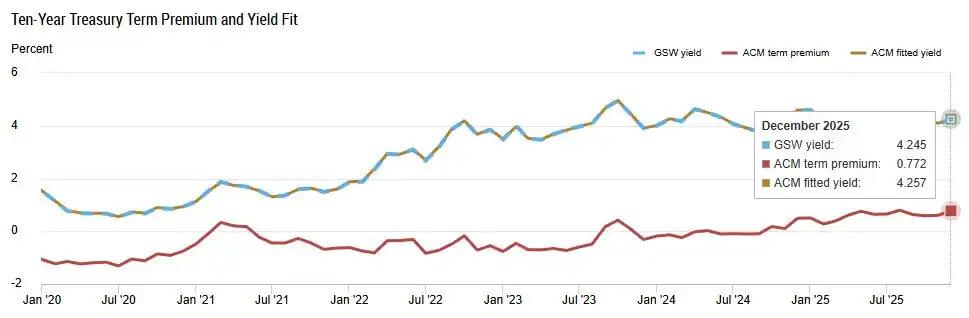
Caption: The 10-year US Treasury term premium rose to 0.772% in December 2025, its highest level since 2020, while the yield reached 4.245%.

The Term Premium Channel is the Discount Rate Channel

Bitcoin exists in the same "discount rate universe" as stocks and other duration-sensitive assets.

When the term premium rises, long-end yields climb, financial conditions tighten, and liquidity premiums compress. ECB research documents how the dollar exchange rate appreciates with Fed tightening across multiple policy dimensions, making US rates the core pricing kernel for global pricing.

Bitcoin's historical upward momentum has often come from the expansion of liquidity premiums: when real yields are low, discount rates are easy, and risk appetite is high.

A term premium shock reverses this dynamic without the Fed changing the federal funds rate. This is why Lane's argument is significant for cryptocurrencies, even though he was speaking to European policymakers at the time.

On January 16th, the US Dollar Index (DXY) was around 99.29, near the low end of its recent trading range. But the "reassessment of the dollar's role" mentioned by Lane opens up two截然不同的 (distinctly different) scenarios, not a single outcome.

In the traditional "yield differential" paradigm, higher US yields strengthen the dollar, tighten global liquidity, and pressure risk assets, including Bitcoin. Research shows that post-2020, cryptocurrency correlation with macro assets is stronger, and in some samples, it shows a negative correlation with the DXY.

But in the credibility risk paradigm, the outcome diverges: if investors demand a premium for US assets due to governance risk, the term premium could rise even as the dollar weakens or fluctuates. In this case, Bitcoin would trade more like a "release valve" or alternative monetary asset, especially if inflation expectations rise alongside credibility concerns.

Furthermore, Bitcoin is now more connected to equities, AI narratives, and Fed signals than in previous cycles.

According to Farside Investors data, Bitcoin ETFs saw net inflows again in January, totaling over $1.6 billion. Coin Metrics notes that open interest in spot options is concentrated near the $100,000 strike price expiring at the end of January.

This positioning means a macro shock could be amplified through leverage and Gamma dynamics, turning the abstract "term premium" concern mentioned into a concrete catalyst for market volatility.
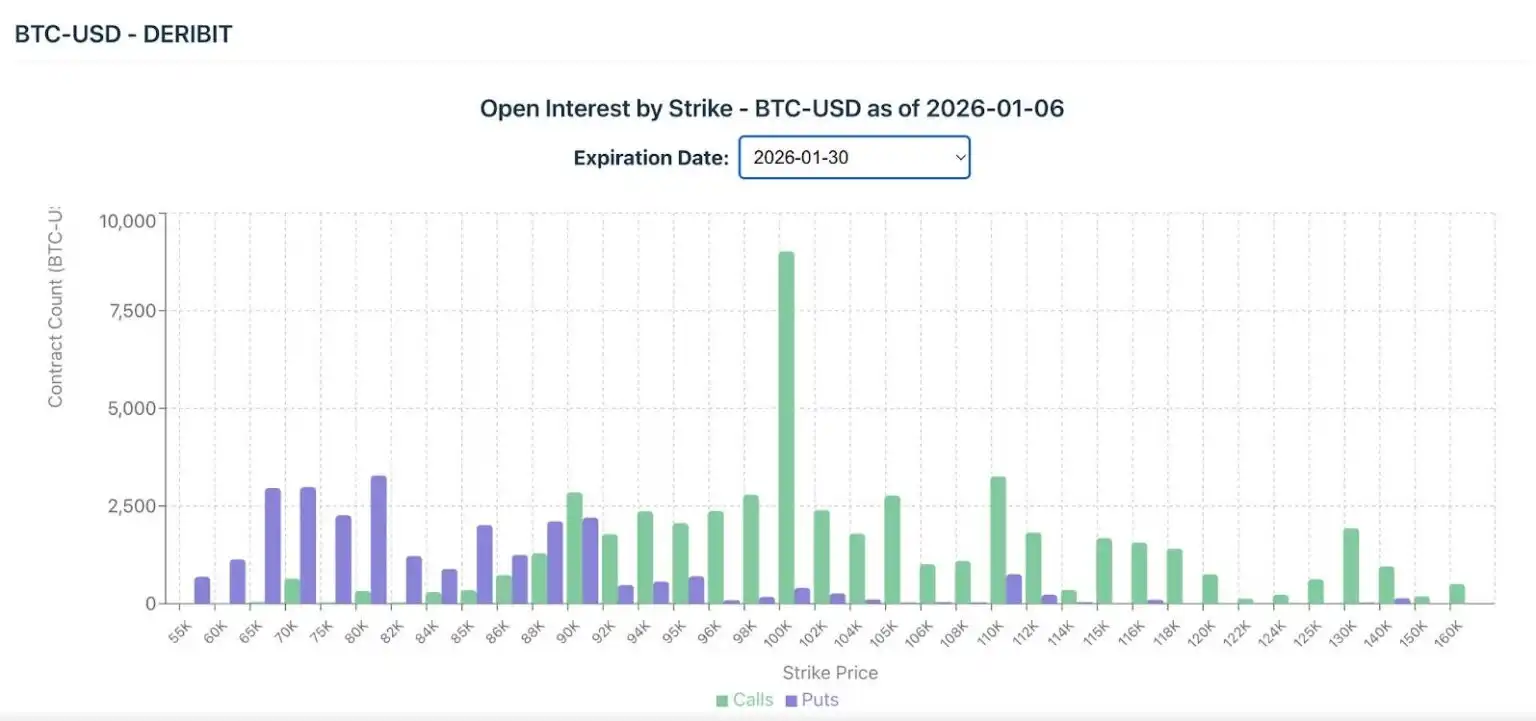
Caption: Open interest for Bitcoin options expiring January 30, 2026, shows over 9,000 call contracts concentrated at the $100,000 strike price.

Stablecoin Infrastructure Makes Dollar Risk "Crypto-Native"

A significant portion of the cryptocurrency trading layer operates on dollar-denominated stablecoins, which are backed by safe assets (typically US Treasuries).

Research from the Bank for International Settlements (BIS) links stablecoins to the pricing dynamics of safe assets. This means a term premium shock is not just some "macro vibe"; it directly permeates stablecoin yields, demand, and on-chain liquidity conditions.

When the term premium rises, the cost of holding duration increases, which could affect stablecoin reserve management and alter the liquidity available for risk trades. Bitcoin might not be a direct substitute for US Treasuries, but it exists in an ecosystem where Treasury pricing sets the benchmark for the definition of "risk-free."

Currently, the market sees about a 95% chance the Fed holds rates steady at its January meeting, with major banks pushing expected rate cuts into 2026.

This consensus reflects confidence in near-term policy continuity, thereby anchoring term premiums. But Lane's warning is forward-looking: if this confidence cracks, the term premium could jump 25 to 75 basis points within weeks, without any change in the funds rate.

A mechanical example: if the term premium rises 50 basis points and expected short-term rates hold steady, the 10-year nominal yield could drift from 4.15% towards 4.65%, with real yields repricing in sync.

For Bitcoin, this implies tighter financial conditions and brings downside risk through the same channels that squeeze high-duration stocks.

However, if triggered by a credibility shock causing dollar weakness, the risk profile becomes completely different.

If global investors begin reducing US asset holdings based on governance grounds, the dollar could weaken even as the term premium rises. In this scenario, Bitcoin's volatility would spike dramatically, and its direction would depend on whether the yield differential paradigm or the credibility risk paradigm dominates at that time.

While academia still debates Bitcoin's "inflation hedge" properties, the dominant channel in most risk regimes remains real yields and liquidity, not simply breakeven inflation expectations.

Philip Lane's argument forces us to consider both possibilities simultaneously. This is why a "dollar repricing" is not a one-way bet but a fork in the regime road.

Watchlist

The checklist for tracking this development is clear:

At the Macro Level:

  • Term Premiums
  • 10-year TIPS Real Yields
  • 5-Year Breakeven Inflation Expectations
  • US Dollar Index (DXY) Level and its Volatility

At the Crypto Level:

  • Bitcoin Spot ETF Flows
  • Options Open Interest around Key Strikes (e.g., $100,000)
  • Changes in Skew around Major Macro Events

These indicators link Lane's warning to Bitcoin's price action without speculating on the Fed's future policy decisions.

Lane's signal was initially sent to European markets, but the "pipes" he describes are the very logic that determines Bitcoin's macro environment. The oil premium has faded, but the "governance risk" he pinpointed remains.

If the market begins pricing in the Fed's political tussle, this shock will by no means be confined to the US. It will be传导 (transmitted) globally through the Dollar and the Yield Curve, and Bitcoin's reaction to such a shock is often sharper and earlier than that of most traditional assets.


Связанные с этим вопросы

QWhat warning did European Central Bank (ECB) chief economist Philip Lane issue regarding the US Federal Reserve?

APhilip Lane warned that the 'tussle' over the Federal Reserve's mandate independence could lead to global market turbulence by pushing up US term premiums and triggering a reassessment of the dollar's role.

QHow might a rise in term premiums affect Bitcoin according to the article?

AA rise in term premiums could tighten financial conditions, compress liquidity premiums, and create downward pressure on Bitcoin, as it exists in the same 'discount rate universe' as other duration-sensitive assets.

QWhat are the two different scenarios for Bitcoin if investors demand a premium for US assets due to governance risks?

AIn a credibility risk paradigm, Bitcoin could trade more like a 'release valve' or alternative monetary asset, especially if inflation expectations rise alongside governance concerns, potentially leading to volatility and a different risk profile compared to the yield differential paradigm.

QHow do stablecoins relate to US Treasury pricing and term premium shocks?

AStablecoins, which are largely dollar-denominated and backed by safe assets like US Treasuries, are linked to the pricing dynamics of these assets. A term premium shock could affect stablecoin yields, demand, and on-chain liquidity conditions.

QWhat key indicators should be monitored to assess the impact of Lane's warning on Bitcoin?

AKey indicators include term premiums, 10-year TIPS real yields, 5-year breakeven inflation expectations, the Dollar Index (DXY), Bitcoin spot ETF flows, options open interest around key strike prices like $100,000, and changes in skew around major macro events.

Похожее

На неделе с 3 по 9 августа стоит обратить внимание: Закон CLARITY, возможно, будет поставлен на голосование в Сенате; SpaceX и Circle опубликуют финансовые отчеты

**Важные события на следующей неделе (3–9 августа 2026 г.)** **Ключевые даты:** * **3 августа:** Публикация отчетов American Bitcoin за Q2. Полное закрытие сервисов DeFi-трекера Zapper и кошелька Ctrl Wallet. LayerZero прекратит поддержку ретрансляторов v1. Upbit прекратит торговлю токенами AQT и AERGO. * **4 августа:** Публикация финансовых отчетов SpaceX и Hut 8 за второй квартал 2026 года. * **5 августа:** Circle опубликует отчет за Q2. Начинается предварительное ценовое консультирование для IPO компании Unitree Tech (Ушу Цзишу) в Китае. * **6 августа:** Первая крупная разблокировка акций SpaceX — до 12% от общего капитала. * **7 августа:** Выход важных данных по рынку труда США (отчет о занятости за июль). Предельный срок для Сената США — получить 60 голосов в поддержку **Закона CLARITY** (билль о регулировании криптовалют и этике). Ожидается выпуск Grok 4.6 от xAI. * **8 августа:** Начало принудительной подачи сигналов в сети Bitcoin согласно предложению BIP-110. * **На неделе (дата уточняется):** Ожидается голосование полного состава Сената США по **Закону CLARITY**. Выход нового релиза XRP Ledger (v3.3.0) с новыми функциями, такими как конфиденциальные данные и пакетные транзакции. **Основные темы недели:** корпоративная отчетность (SpaceX, Circle), регулирование (CLARITY Act), рыночные события (разблокировка акций SpaceX, отчет по занятости в США) и обновления в технологиях блокчейна.

marsbit12 мин. назад

На неделе с 3 по 9 августа стоит обратить внимание: Закон CLARITY, возможно, будет поставлен на голосование в Сенате; SpaceX и Circle опубликуют финансовые отчеты

marsbit12 мин. назад

Акции упали сильнее, чем криптовалюты. Куда делись деньги?

Автор: Кэти,白话区块链 28-29 июля, Сеул. Индекс Kospi впервые в истории Южной Кореи два дня подряд срабатывал на приостановку торгов. Первый день: падение на 10.84%, второй день: -5.98%. SK Hynix, крупнейшая по весу акция, потеряла за два дня около 23%. Падение Nasdaq, глобальный обвал акций полупроводниковых компаний, массовые потери на кредитных ETF. За два дня откат Kospi от пика июня достиг 40%. Июль угрожает стать худшим месяцем в истории индекса. Все ранее перегретые сделки были перевернуты, как стол. Это не локальный негатив по одной акции, а глобальное принудительное снижение кредитного плеча. Самое парадоксальное: на этот раз больше всего на «криптовалютное» падение похожи именно акции. Спот: прибыль SK Hynix за второй квартал достигла рекордных 60.54 трлн вон, но из-за несоответствия прогнозу в 64.22 трлн акция подверглась жесткой распродаже. Хорошие новости не растут — это уже плохая новость. Производные инструменты пострадали еще сильнее. Кредитный ETF с плечом 2x на SK Hynix упал на 83% с пика, потеряв в стоимости более 1 трлн гонконгских долларов. Эмитент был вынужден изменить правила продукта. Неожиданно: Биткоин, известный высокой волатильностью, с 1 июля вырос почти на 15%, в то время как акции демонстрировали «криптовалютную» динамику. Это не паника всего рынка, а точечный сброс перегретых позиций. Триггеры: отчет SK Hynix и фактор Китая — крупнейшее IPO ChangXin Memory, направленное на расширение производства DRAM, создало конкуренцию для нарратива о дефиците памяти для ИИ. Дополнительное давление — нормализация политики Банка Японии и потенциальное сокращение кэрри-трейда в иенах. Эксперт Дэн Найлз считает, что это не крах логики ИИ, а «краткосрочное дно», вызванное принудительными ликвидациями мелких инвесторов и хедж-фондов. Промышленная логика не мертва — умерло кредитное плечо. Перетекли ли деньги из акций в Биткоин? Нет. «Устойчивость» Биткоина объясняется тем, что он уже прошел фазу распродаж раньше. В мае-июне американские спотовые BTC-ETF зафиксировали рекордный отток средств. К июлю продавать было уже нечего. Небольшой приток в июле — лишь частичное восстановление. Настоящие «защитные» деньги пошли в золото. Коэффициент корреляции между Биткоином и золотом упал до -0.88. Нарратив о «цифровом золоте» разбит: золото — для сохранения капитала, Биткоин — для роста. Деньги придут в криптоактивы при выполнении трех условий: смягчение глобального давления на ликвидность; снижение ставок ФРС без рецессии; принятие закона CLARITY, устраняющего регуляторные неопределенности. Пока Биткоин — не убежище, а актив, который раньше других прошел очистку. Но когда шторм утихнет и глобальный капитал снова начнет распределяться, Биткоин займет место в первых рядах очереди. Место уже зарезервировано.

marsbit12 мин. назад

Акции упали сильнее, чем криптовалюты. Куда делись деньги?

marsbit12 мин. назад

Диалог с Далио: Сейчас мы находимся в пузыре ИИ, 1% моего инвестиционного портфеля — это биткоин

Источник: интервью Рэя Далио, основателя Bridgewater Associates, для подкаста "The Diary Of A CEO". Далио, предсказавший кризис 2008 года, обсуждает "большой цикл" — концепцию, охватывающую долговые проблемы, растущее неравенство и геополитические сдвиги. Он указывает, что текущий ажиотаж вокруг ИИ демонстрирует классические признаки пузыря, который может лопнуть из-за высокой долговой нагрузки, роста процентных ставок и чрезмерной эмиссии акций, что способно привести к рецессии. Для защиты личного капитала в неопределенные времена Далио советует диверсификацию: вместо хранения наличных инвестировать в акции, золото, облигации. Сам он держит около 1% портфеля в биткоине, считая его "твердыми деньгами", но предпочитает физическое золото из-за его статуса резервного актива и независимости от технологических рисков. Говоря о влиянии ИИ, Далио отмечает, что технология заменяет не только физический труд, но и элементы мышления, что увеличит разрыв между капиталом и трудом. Ключевыми останутся человеческие качества — эмоции и интуиция, а успеха добьются те, кто научится работать в партнерстве с ИИ. На геополитической арене, по его мнению, мир движется к регионализации с центрами в виде США и Китая. Вовлечение США в конфликты, подобные иранскому, обнажает снижение их абсолютного влияния. Внутренние вызовы, такие как дебаты о налогах на богатство, риск капитального бегства и низкая производительность, также ставят под вопрос стабильность традиционных держав в текущей фазе цикла.

marsbit4 ч. назад

Диалог с Далио: Сейчас мы находимся в пузыре ИИ, 1% моего инвестиционного портфеля — это биткоин

marsbit4 ч. назад

7.2 трлн вон за один день: иностранные инвесторы установили рекорд чистых покупок в пятницу! Уолл-Стрит: встречный ветер в плане ликвидности на южнокорейском рынке уже утих

Капиталы возвращаются на южнокорейский рынок акций. 31 июля иностранные инвесторы осуществили чистые покупки акций KOSPI на рекордные 7,2 трлн вон за один день, что стало самым высоким показателем в истории. По данным Citigroup, эта цифра знаменует собой кардинальный разворот после месяцев масштабного оттока средств нерезидентов. В июле чистые продажи иностранными инвесторами значительно сократились до 9,8 трлн вон по сравнению с 48,4 трлн и 44,5 трлн вон в июне и мае соответственно. Одновременно внутренние пенсионные и инвестиционные фонды в июле вернулись к чистым покупкам на 1,0 трлн вон. Дополнительным фактором снижения волатильности стали новые правила Комиссии по финансовым услугам (FSC), ужесточившие с 31 июля доступ розничных инвесторов к ETF с плечом на отдельные акции. После введения норм торговый оборот таких инструментов упал примерно вдвое. Citigroup сохраняет целевую точку для KOSPI на уровне 10000 пунктов, отмечая ослабление давления со стороны движения капиталов. Аналитики видят поддержку рынку в устойчивости фундаментальных показателей сектора чипов памяти, низких оценках KOSPI, сильной экономике и благоприятной политике властей, включая возможные меры по поддержке ликвидности.

marsbit4 ч. назад

7.2 трлн вон за один день: иностранные инвесторы установили рекорд чистых покупок в пятницу! Уолл-Стрит: встречный ветер в плане ликвидности на южнокорейском рынке уже утих

marsbit4 ч. назад

Торговля

Спот
活动图片




