The Code Was Fine, But It Was Still Hacked: What Is the 'DVN Configuration Vulnerability' Behind the Biggest Hack of 2026?

marsbitОпубликовано 2026-04-19Обновлено 2026-04-19

Введение

Title: Code Was Secure, Yet $293M Stolen: The 2026 DVN Configuration Breach Explained On April 18, 2026, Kelp DAO’s restaking protocol was exploited, losing 116,500 rsETH (worth $293M at the time) due to a configuration flaw—not a smart contract vulnerability. The attacker used a forged cross-chain message to drain funds via LayerZero’s bridge, then dispersed the stolen rsETH across Aave V3, Compound V3, and Euler to borrow real assets, ultimately escaping with $236M in WETH. The root cause was a critical misconfiguration in Kelp’s LayerZero V2 setup: the protocol used a 1-of-1 Decentralized Verifier Network (DVN) threshold, meaning only one node approval was needed to validate cross-chain messages. The attacker compromised that single node, allowing unauthorized minting of rsETH on Ethereum. This configuration choice—permitted by LayerZero but highly risky—left zero fault tolerance. In contrast, protocols like ApeChain using multi-node validation (e.g., 2-of-3 or 5-of-9) remained secure. This incident highlights a blind spot in DeFi security audits: tools like Slither and Mythril scan code for logic flaws but ignore configuration parameters. The 2022 Nomad hack ($190M loss) also stemmed from a config error, bringing total losses from such issues to ~$482M—rivaling private key breaches. The Kelp exploit underscores the need for standardized config audits and higher baseline security in cross-chain designs.

On April 18, 2026, attackers drained 116,500 rsETH, worth approximately $293 million at the time, from the cross-chain bridge of Kelp DAO's liquid restaking protocol within hours. The entire process was unusually efficient—from forging cross-chain messages to dispersing the stolen funds across three lending protocols, Aave V3, Compound V3, and Euler, to borrow real assets. The attackers exited the same day with $236 million in WETH. Aave, SparkLend, and Fluid promptly froze all rsETH markets.

This was the largest DeFi attack incident of 2026 to date.

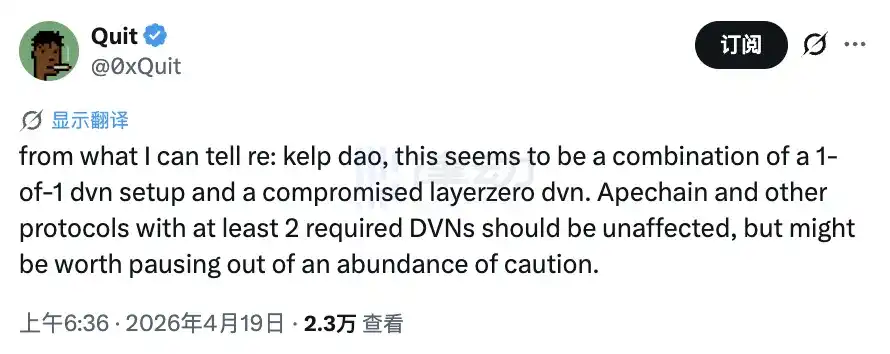
But one thing set this attack apart from most hacking incidents. Kelp DAO's smart contract code had no vulnerabilities. Security researcher @0xQuit, who participated in the investigation, wrote on X, "From what I've gathered so far, this is the result of two issues叠加: a 1-of-1 DVN configuration and the DVN node itself being compromised." LayerZero's official statement also did not mention contract code, framing the issue as an "rsETH vulnerability" rather than a "LayerZero vulnerability."
$293 million, not found in a single line of code. It was hidden in a configuration parameter filled in incorrectly during deployment.

The general logic of DeFi security auditing is: find the contract, read the code, find the vulnerability. This logic works quite smoothly when dealing with code logic vulnerabilities; tools like Slither and Mythril have mature detection capabilities for known patterns like reentrancy attacks and integer overflows. LLM-assisted code auditing, heavily promoted in recent years, also has some capability against business logic vulnerabilities (such as flash loan arbitrage paths).
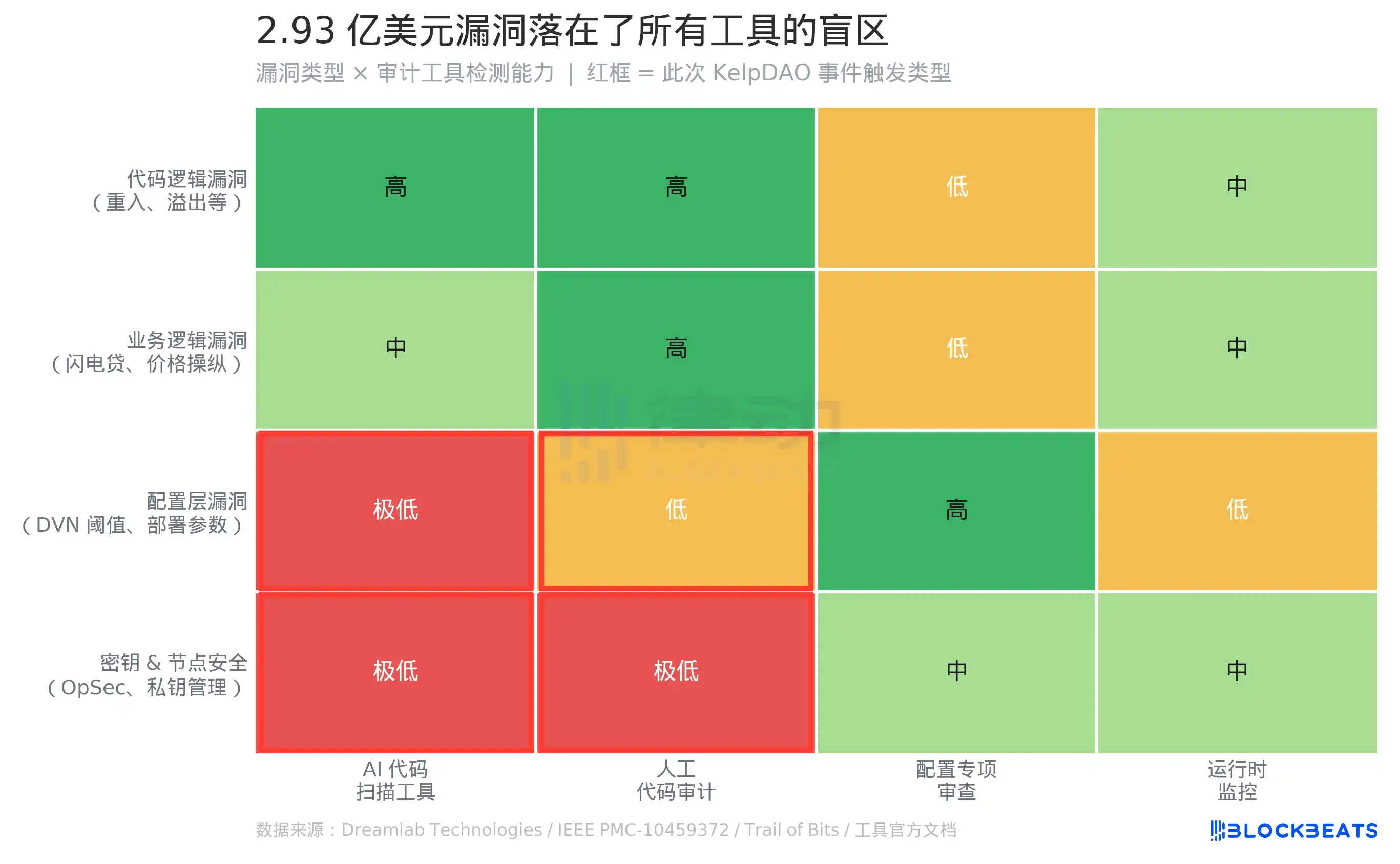
But two rows in this matrix are red.

Configuration-layer vulnerabilities are a structural blind spot in tool-based auditing. The problem with Kelp DAO was not in the .sol files, but in a parameter written during protocol deployment—the DVN threshold. This parameter determines how many validator nodes need to confirm a cross-chain message before it is deemed legitimate. It doesn't enter the code, doesn't enter Slither's scan range, and doesn't enter Mythril's symbolic execution path. According to comparative research by Dreamlab Technologies, Slither and Mythril detected 5/10 and 6/10 vulnerabilities in the tested contracts, respectively, but this achievement is based on the premise that "the vulnerability is in the code." According to IEEE research, even at the code level, existing tools can only detect 8%-20% of exploitable vulnerabilities.

From the perspective of current auditing paradigms, there is no tool that can "detect whether the DVN threshold is reasonable." To detect such configuration risks, what is needed is not a code analyzer, but a specialized configuration checklist: "Number of DVNs used by the cross-chain protocol ≥ N?", "Is there a minimum threshold requirement?" Such questions currently have no standardized tool coverage, nor even widely accepted industry standards.

Also in the red zone are key and node security. @0xQuit's description mentioned the DVN node being "compromised," which falls under operational security (OpSec), beyond the detection boundaries of any static analysis tool. Neither any first-tier auditing firm nor AI scanning tools have the ability to predict whether a node operator's private key will be leaked.

This attack triggered both red zones in the matrix simultaneously.
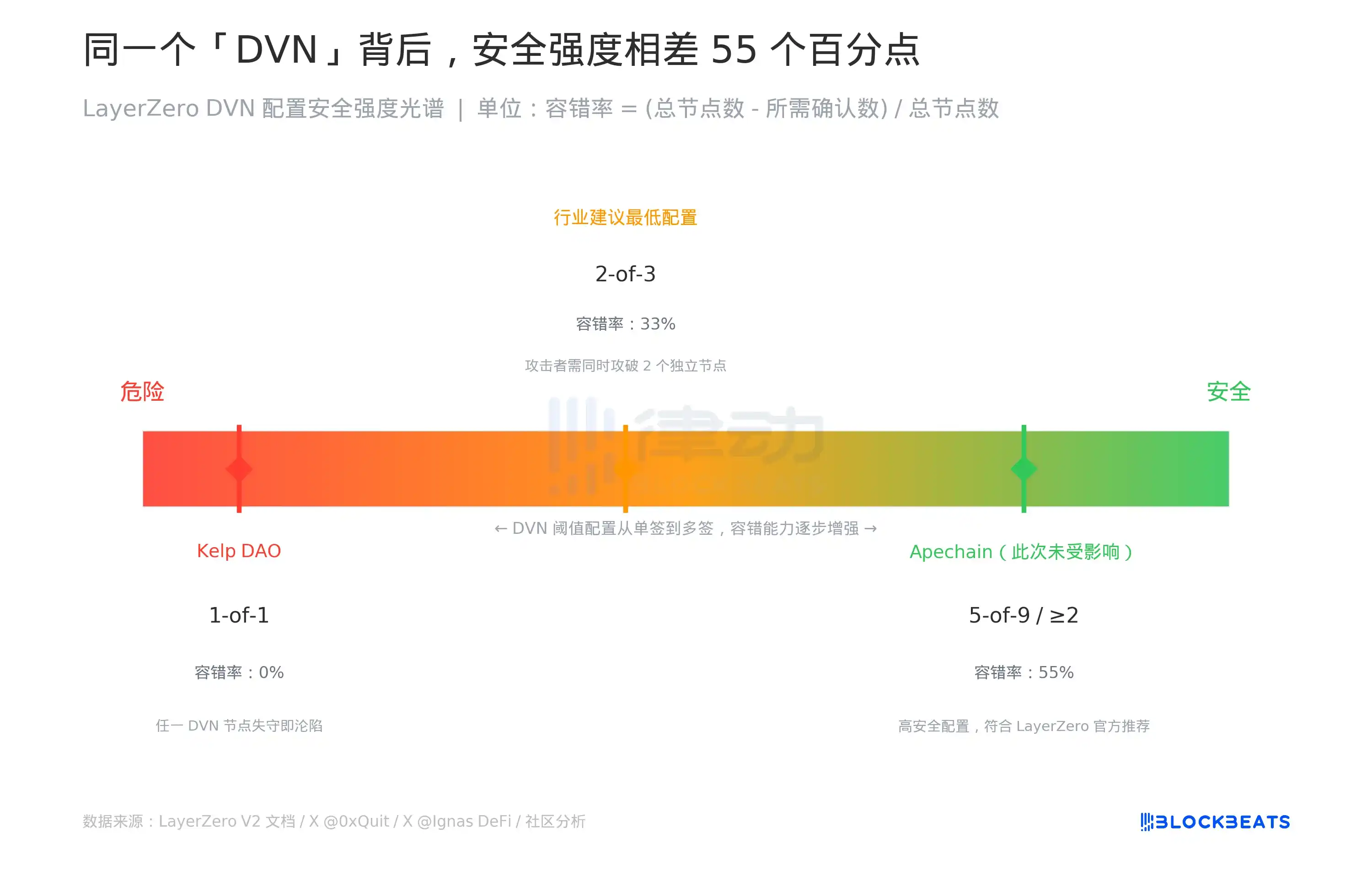
DVN is LayerZero V2's cross-chain message verification mechanism, short for Decentralized Verifier Network. Its design philosophy is to give security decision-making power to the application layer: each protocol integrated with LayerZero can choose how many DVN nodes need to confirm simultaneously before allowing a cross-chain message to pass.

This "freedom" creates a spectrum.

Kelp DAO chose the far left end of the spectrum: 1-of-1, requiring confirmation from only one DVN node. This meant a fault tolerance of zero; the attacker only needed to compromise that one node to forge any cross-chain message. In contrast, Apechain, also integrated with LayerZero, configured more than two required DVNs and was unaffected in this incident. LayerZero's official statement used the wording "all other applications remain secure," the subtext of which is: security depends on which configuration you chose.

The normal industry recommendation is at least 2-of-3, requiring an attacker to compromise two independent DVN nodes simultaneously to forge a message, increasing fault tolerance to 33%. High-security configurations like 5-of-9 can achieve 55% fault tolerance.

The problem is, external observers and users cannot see this configuration. Both might be called "powered by LayerZero," but behind it could be 0% fault tolerance or 55% fault tolerance. Both are called DVN in the documentation.

Veteran crypto investor Dovey Wan, who experienced the Anyswap incident, wrote directly on X: "LayerZero's DVN is actually 1/1 validator...... All cross-chain bridges should immediately conduct a comprehensive security review."
In August 2022, a vulnerability was discovered in the Nomad cross-chain bridge. Someone copied the first attack transaction, made slight modifications, found it also worked—so hundreds of addresses successively began copying, draining $190 million within hours.

Nomad's post-mortem wrote that the vulnerability source was "initializing the trusted root to 0x00 during a routine upgrade." This was a configuration error that occurred during the deployment phase. The Merkle proof verification logic was fine, the code itself was fine; the problem was an initial value filled in incorrectly.

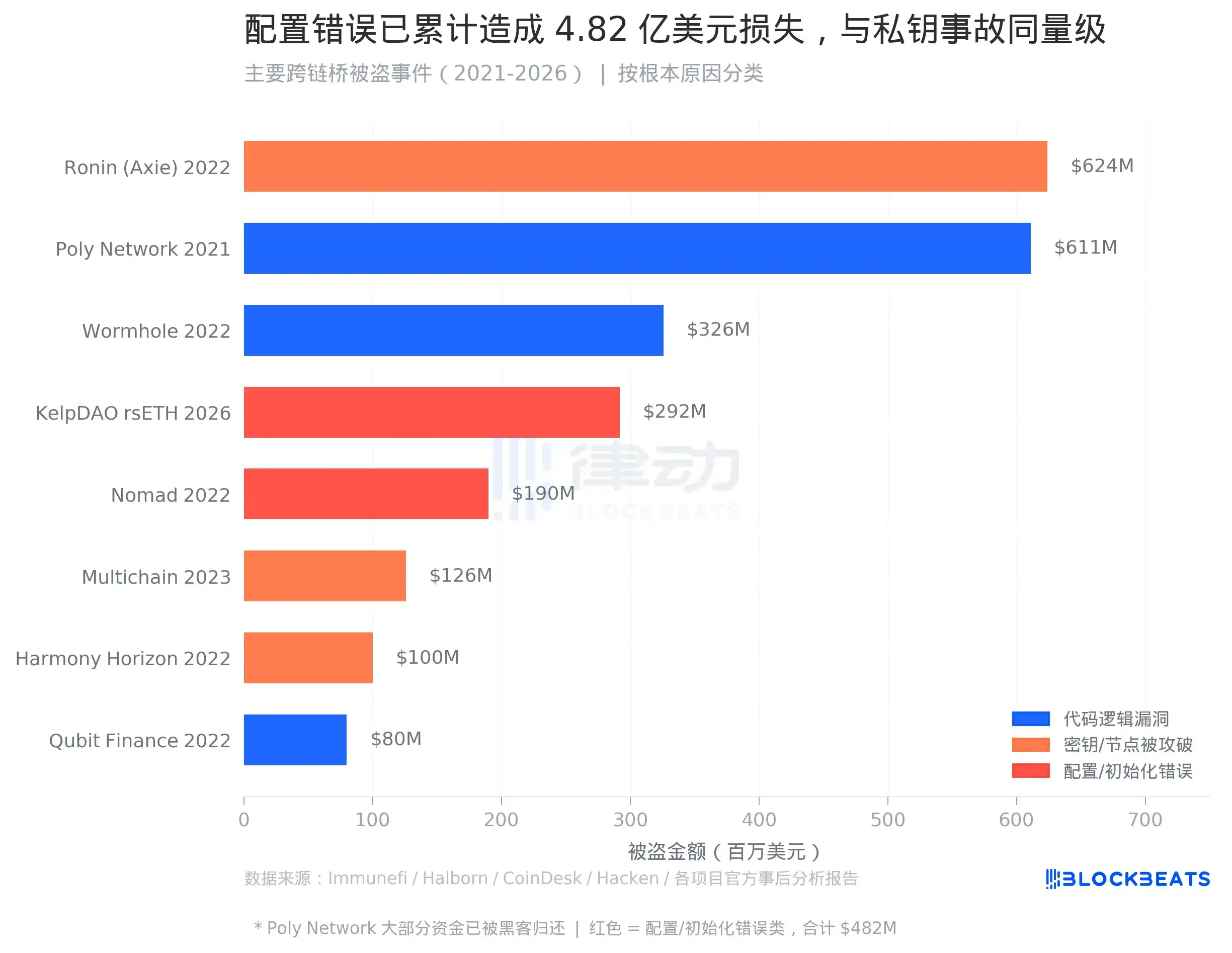
This time, combined with Nomad, configuration/initialization class vulnerabilities have caused approximately $482 million in losses. In the entire history of cross-chain bridge thefts, this category's scale is now comparable to key leak class (Ronin $624 million, Harmony $100 million, Multichain $126 million, totaling approximately $850 million).

But the product design of the code auditing industry has never been targeted at this category.

The most discussed topics in the industry are still code logic vulnerabilities. Wormhole's $326 million hack due to signature verification bypass, Qubit Finance's $80 million theft due to fake deposit events. These cases have complete vulnerability analysis, CVE number analogies, reproducible PoCs, suitable for the training and optimization of auditing tools. Configuration-layer problems are not written in the code and struggle to enter this production cycle.

A noteworthy detail is that the triggering methods of the two configuration-class events were completely different. Nomad accidentally filled in a wrong initial value during a routine upgrade, a mistake. Kelp DAO's 1-of-1 was an active configuration choice—the LayerZero protocol did not prohibit this option, and Kelp DAO did not violate any protocol rules. A "compliant" configuration choice and a "mistaken" initial value ultimately led to the same consequence.
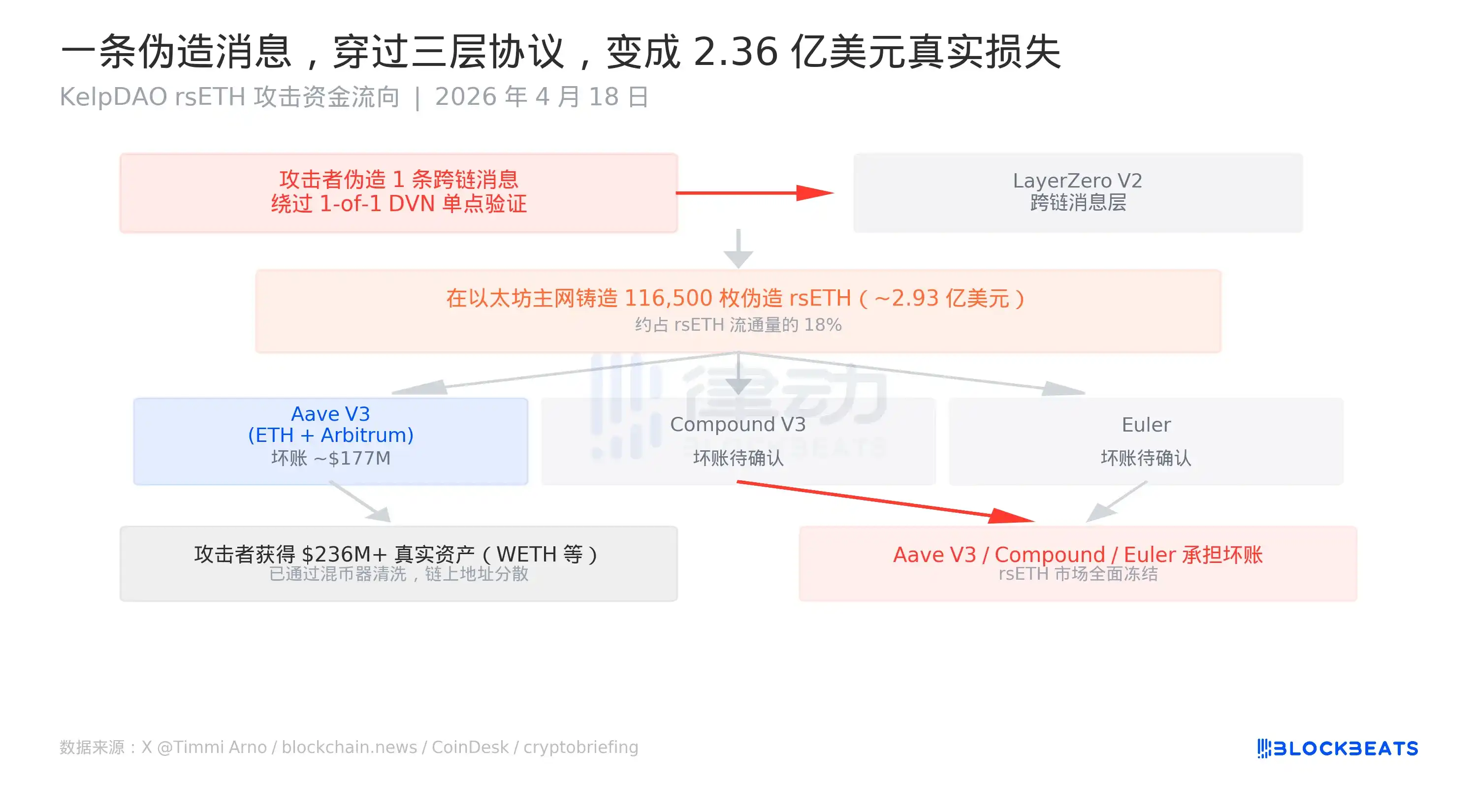
The execution logic of this attack was simple: a forged cross-chain message told the Ethereum mainnet that "equivalent assets have been locked on another chain," triggering the minting of rsETH on the mainnet. The minted rsETH itself had no actual backing, but its on-chain record was "legitimate" and could be accepted as collateral by lending protocols.

The attacker then dispersed the 116,500 rsETH into Aave V3 (Ethereum and Arbitrum), Compound V3, and Euler, borrowing over $236 million in real assets. According to multiple reports, Aave V3 alone faced an estimated bad debt of approximately $177 million. Aave's safety module, Umbrella, has a WETH reserve of about $50 million available to absorb bad debt, covering less than 30%, with the remaining portion to be borne by aWETH stakers.

This bill ultimately fell on those who just wanted to earn a little WETH interest.

LayerZero officials, as of writing, are still jointly investigating with the security emergency response organization SEAL Org, stating they will release a post-mortem report with Kelp DAO after obtaining all information. Kelp DAO stated it is conducting "active remediation."

The $293 million vulnerability was not in the code. The phrase "audit passed" did not cover the location of that parameter.


Связанные с этим вопросы

QWhat was the root cause of the Kelp DAO hack in April 2026, and why was it unusual?

AThe root cause was a configuration vulnerability, specifically a 1-of-1 DVN (Decentralized Verifier Network) threshold setting chosen by Kelp DAO, combined with the compromise of that single DVN node. It was unusual because the smart contract code itself had no vulnerabilities; the flaw was entirely in a deployment configuration choice.

QWhat is a DVN in the context of LayerZero V2, and what security risk did Kelp DAO's configuration introduce?

AA DVN (Decentralized Verifier Network) is LayerZero V2's mechanism for verifying cross-chain messages. It allows applications to choose how many independent DVN nodes must confirm a message for it to be considered valid. Kelp DAO's configuration of a 1-of-1 threshold meant it had zero fault tolerance. An attacker only needed to compromise that one specific node to forge any cross-chain message, creating a critical single point of failure.

QHow do configuration vulnerabilities like the one at Kelp DAO differ from code logic vulnerabilities, and why are they hard to detect with standard auditing tools?

AConfiguration vulnerabilities exist in deployment parameters and initial settings (e.g., DVN threshold), not in the smart contract code itself. Standard auditing tools like Slither and Mythril are designed to scan .sol files for code logic flaws (e.g., reentrancy attacks) but are structurally blind to configuration choices made outside the code during deployment. There are no widely adopted standardized tools or industry norms for auditing these types of risks.

QWhat was the financial impact of the attack on the broader DeFi ecosystem, particularly on lending protocols?

AThe attacker stole 116,500 rsETH (worth ~$293M at the time) by forging a cross-chain message. They then used this unbacked rsETH as collateral to borrow over $236 million in real assets (WETH) from Aave V3, Compound V3, and Euler. Aave V3 faced an estimated $177 million in bad debt, which its safety module could not fully cover, meaning losses were ultimately borne by aWETH stakers.

QHow does the Kelp DAO incident compare to the 2022 Nomad hack, and what do they reveal about a growing category of DeFi risks?

ABoth the Kelp DAO (2026, $293M) and Nomad (2022, $190M) hacks were caused by configuration/initialization vulnerabilities, not code bugs. Together, they represent nearly $4.82 billion in losses from this category. This highlights a significant blind spot in DeFi security, as traditional code audits are not designed to catch misconfigurations or poor parameter choices made during protocol deployment, making them a major and growing risk class alongside key leaks and code exploits.

Похожее

a16z: От компании к DAO, DUNA может стать следующей организационной формой

Автор: a16z crypto Компиляция: Deep Tide TechFlow Основная задача бизнеса на протяжении веков остаётся неизменной: как организовать сотрудничество незнакомых людей с разными ролями, асимметричной информацией и интересами для достижения общей цели? История бизнеса — это история поиска новых организационных форм. Компания стала великим прорывом для индустриальной эпохи, но цифровые технологии и интернет-протоколы снижают потребность в традиционных иерархических структурах. Существующее законодательство не предназначено для нового мира децентрализованных сетей. DAO (децентрализованные автономные организации), хотя и являются перспективной формой, сталкиваются с правовыми проблемами: отсутствием юридического признания, что подвергает участников неограниченной ответственности, и неопределённостью в регулировании, особенно в свете теста Хоуи в США. В качестве решения предлагается DUNA (Децентрализованная Некорпоративная Некоммерческая Ассоциация) — новая правовая форма, уже принятая в нескольких штатах США. DUNA предоставляет группе людей юридическое лицо и ограниченную ответственность, позволяя децентрализованным сообществам легально владеть активами, заключать контракты и вести деятельность, не полагаясь на централизованное управление. Она заполняет правовой вакуум для интернет-нативных организаций, не решая всех проблем управления, но давая им законный статус. Эволюция организационных форм — от семейных предприятий и компаний до LLC и DUNA — расширяет инструменты для координации людей. DUNA представляет собой следующий шаг, позволяющий анонимным, географически разбросанным участникам блокчейн-сетей сотрудничать как единое юридическое лицо, минимизируя личные риски и открывая новую главу в организации коллективных действий.

marsbit4 мин. назад

a16z: От компании к DAO, DUNA может стать следующей организационной формой

marsbit4 мин. назад

Отчет о токенизированных активах реального мира (RWA) за середину 2026 года: рыночная капитализация токенизированных акций удвоилась за год, но 90% прав – пустышка

**Отчет о RWA на блокчейне за середину 2026 года: капитализация токенизированных акций удвоилась за год, но 90% прав — пустышка** В июле 2026 года стоимость распределенных токенизированных акций достигла $1,89 млрд, почти удвоившись с марта. Однако рост сконцентрирован вокруг немногих инструментов (SECZ, FGRS, STRCx дали ~49% прироста) и платформ (Ondo, xStocks, Securitize контролируют 85% рынка). Рынок расколот: офшорные продукты (Ondo, xStocks) обеспечивают ликвидность и доступность в DeFi, но предлагают слабые юридические права на базовый актив. Регулируемая инфраструктура США (например, через Nasdaq) обеспечивает юридическую определенность, но страдает от низкой ликвидности и ограниченного распределения. Ни один продукт не сочетает полноценные права собственности, широкое распределение, ликвидность и независимое ценовое образование. Общие данные по RWA ($36,8 млрд распределенных активов) требуют осторожной интерпретации из-за изменений в методологии учета. Рынок токенизированных акций расширяется технически, но остается фрагментированным в правовом поле, где разные токены, отслеживающие одну акцию, представляют собой отдельные юридические обязательства.

marsbit53 мин. назад

Отчет о токенизированных активах реального мира (RWA) за середину 2026 года: рыночная капитализация токенизированных акций удвоилась за год, но 90% прав – пустышка

marsbit53 мин. назад

Внимание, пользователи биткоина! Сегодняшний взлом может быть масштабнее, чем вы думали. Вот что нужно делать

Компания Coinkite, производитель аппаратных биткоин-кошельков Coldcard, обнаружила критическую уязвимость в процессе генерации сид-фраз на устройствах Coldcard Mk3 с прошивкой версий 4.0.1–5.0.3. Все биткоин-адреса, созданные из этих сид-фраз, потенциально скомпрометированы. Компания настоятельно рекомендует пользователям немедленно перевести средства на новый, безопасный кошелёк, создав новую сид-фразу. Просто сменить устройство недостаточно — старую сид-фразу использовать нельзя. Это предупреждение следует на фоне масштабной атаки 30 июля, в ходе которой автоматизированный инструмент за 41 минуту опустошил 1196 кошельков, похитив около 1082 BTC (на тот момент ~$70,2 млн). Исследователи связывают эту атаку с обнаруженной уязвимостью, так как она произошла за 30 часов до публичного раскрытия проблемы Coinkite. Украденные средства пока остаются на четырёх адресах без движения.

cryptonews.ru2 ч. назад

Внимание, пользователи биткоина! Сегодняшний взлом может быть масштабнее, чем вы думали. Вот что нужно делать

cryptonews.ru2 ч. назад

Биткоин в августе: эксперты ждут проверки диапазона, а не быстрого разворота

Биткоин в августе, по мнению аналитиков, скорее всего, останется в состоянии проверки ключевых ценовых уровней, а не совершит резкий разворот к росту. Несмотря на восстановление в июле, сохраняется риск снижения ниже $60 тыс. Основными факторами давления остаются сложная макроэкономическая обстановка: высокие ставки в США, устойчивая инфляция и сильный доллар, что ограничивает аппетит к рисковым активам, включая криптовалюты. Эксперты отмечают, что август исторически слаб для крипторынка. Институциональный спрос остается вялым, о чем свидетельствуют чистые оттоки из биткоин-ETF. Рынок продолжает торговаться в узком диапазоне, преимущественно между $60 и $65 тыс. Прогнозы на месяц в основном сдержанные. Базовый сценарий (вероятность 50%) предполагает движение в коридоре $58–68 тыс. Негативный (30%) — снижение к $50–55 тыс. Позитивный (20%) — рост к $71–75 тыс. Ключевыми уровнями являются поддержка в районе $60–61 тыс. и сопротивление около $67 тыс., преодоление которого могло бы изменить текущий нисходящий тренд. Эксперты советуют инвесторам рассматривать текущие уровни как возможность для постепенного долгосрочного накопления, но быть готовыми к повышенной волатильности. Более существенные движения рынка ожидаются не раньше четвёртого квартала. Внимание рекомендуется уделять не только цене биткоина, но и динамике ставок, инфляции, потокам в ETF и общему настроению на рынке рисковых активов.

cryptonews.ru3 ч. назад

Биткоин в августе: эксперты ждут проверки диапазона, а не быстрого разворота

cryptonews.ru3 ч. назад

Аппаратный кошелек Coldcard взломан: хакеры вывели 594 биткоина за 25 минут

Аппаратные кошельки Coldcard от компании Coinkite были скомпрометированы из-за критической уязвимости, существовавшей пять лет. Ошибка в коде, допущенная в марте 2021 года, отключила защищенный генератор случайных чисел, что привело к созданию предсказуемых seed-фраз на основе серийного номера и системного времени. Это позволило злоумышленникам 30 июля 2026 года вывести около 594,5 BTC (примерно $40 млн) с 500 адресов всего за 25 минут, просто перебирая возможные варианты в офлайне. Компания Coinkite подтвердила уязвимость всех устройств, работавших на скомпрометированных прошивках (Mk2-Mk5, Q), и исключила финансовые компенсации. Для защиты средств владельцам необходимо: обновить прошивку до безопасных версий, сгенерировать новую seed-фразу на обновленном устройстве и полностью перевести все активы на новые адреса. Использование BIP-39 парольной фразы может снизить риски, но не заменяет необходимость смены ключа. Инцидент подчеркивает, что даже специализированное аппаратное обеспечение требует постоянного независимого аудита, особенно в криптографических функциях. Открытый исходный код не гарантирует быстрого обнаружения подобных ошибок, как показали пять лет невыявленной уязвимости и аналогичные случаи в прошлом.

cryptonews.ru3 ч. назад

Аппаратный кошелек Coldcard взломан: хакеры вывели 594 биткоина за 25 минут

cryptonews.ru3 ч. назад

Торговля

Спот
活动图片