The "Big Short" Prototype Makes a Major Bet: Shorting Nvidia, Going Long on Software Stocks 'Scared Away' by AI

marsbitОпубликовано 2026-05-10Обновлено 2026-05-10

Введение

'The Big Short' Legend Michael Burry Doubles Down on AI Bet: Shorts Nvidia, Buys Beaten-Down Software Stocks As the Nasdaq hits record highs and Nvidia's market cap nears $5.3 trillion, Michael Burry—famed for his 2008 subprime mortgage bet—is making a major contrarian move. He is significantly expanding his bearish wagers against the AI frenzy while buying traditional software stocks he believes have been unfairly punished. Burry's latest portfolio adjustments, revealed in his Substack column, include maintaining and increasing put options on Nvidia and Palantir. He has also initiated new short positions on Palantir and expanded bearish bets on the semiconductor ETF (SOXX), the Nasdaq 100 ETF (QQQ), and Oracle. Simultaneously, he is buying shares of software companies like Adobe, Autodesk, Salesforce, and Veeva Systems. He argues these stocks have been sold off due to "AI disruption" fears and technical selling pressure from private credit funds, not deteriorating fundamentals. Their valuations have fallen to multi-year lows. This creates a complete hedge: short the perceived "AI winners" and long the oversold "AI losers." Burry believes the current AI infrastructure spending boom mirrors the late-1990s internet bubble, with inflated demand projections and questionable accounting practices by large cloud customers extending GPU depreciation schedules. While his Palantir short is currently profitable, his Nvidia put options are deeply underwater as the stock trades near ...

Author: Claude, Shenchao TechFlow

Shenchao Intro: As the Nasdaq continues to hit record highs and Nvidia's market cap approaches $5.3 trillion, Michael Burry, the hedge fund manager who famously shorted the subprime mortgage market during the 2008 financial crisis and became the real-life subject of the movie "The Big Short," is doubling down on his contrarian bets.

He is not only maintaining his bearish bets on Nvidia and Palantir but also expanding his short positions to include a semiconductor ETF and Nasdaq ETF. Simultaneously, he is buying traditional software stocks that have been battered by the AI narrative, constructing a complete portfolio betting on the "AI bubble repricing."

The Nasdaq Index hit consecutive all-time highs this week, closing at approximately 26,247 points on May 8th, with the S&P 500 also reaching a record the same day. The Philadelphia Semiconductor Index has risen about 55% since the second quarter began, and Nvidia's stock price neared its record high of $217.80, with its market cap exceeding $5.2 trillion. The AI-driven tech stock frenzy is at its most feverish stage.

Yet, at the moment of peak market euphoria, an investor known for his contrarian bets is heavily wagering in the opposite direction.

According to a Foreign Policy Journal report on May 7th, Michael Burry, the hedge fund manager whose prediction of the 2008 subprime crisis was adapted into the film "The Big Short," disclosed his latest portfolio adjustments this week in his Substack column "Cassandra Unchained":

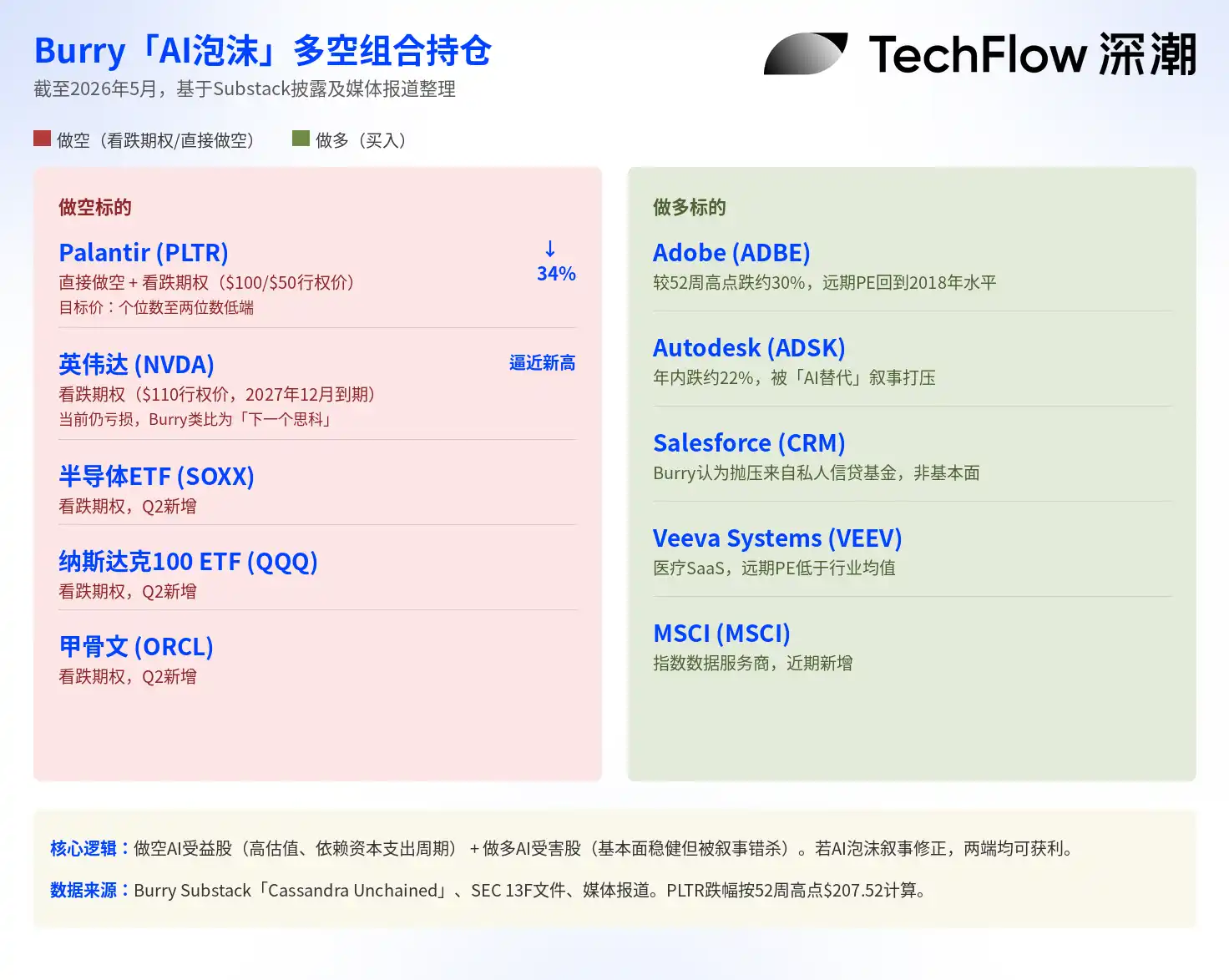
He not only maintains his put options on Nvidia and Palantir but also added a direct short position on Palantir and expanded his bearish bets on the semiconductor ETF (SOXX), Nasdaq 100 ETF (QQQ), and Oracle.

At the same time, he began buying a batch of traditional software companies marginalized by the AI boom, such as Adobe, Autodesk, Salesforce, and Veeva Systems, on the grounds that their stock price declines stem from panic selling rather than fundamental deterioration.

Thus, a complete Big Short-style hedge portfolio has emerged, with the core logic being shorting AI beneficiaries and going long on AI victims.

Starting from the $1.1 Billion Bet Last November

Burry's shorting of the AI sector began in the third quarter of 2025.

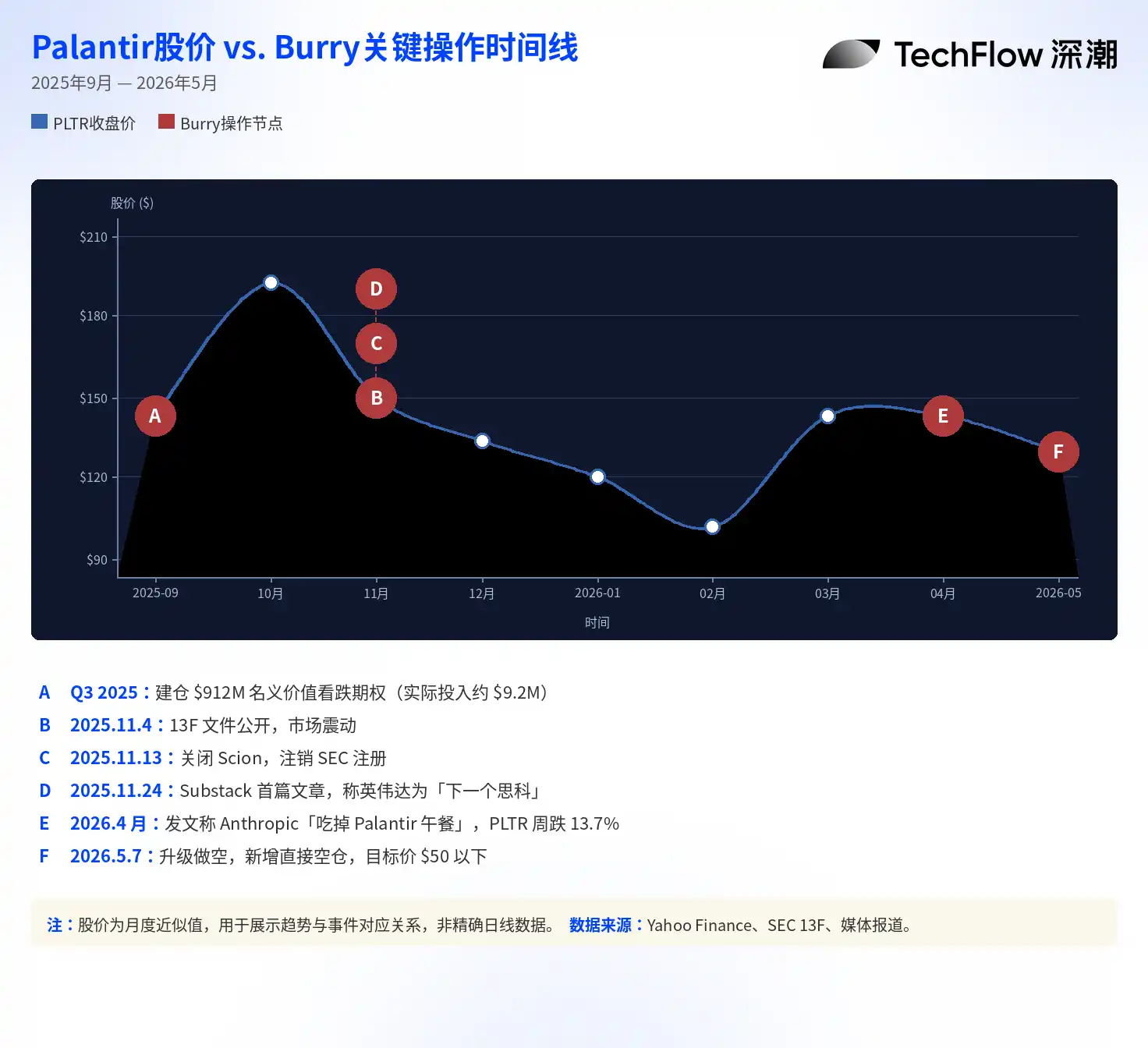
At that time, the 13F filing of his hedge fund Scion Asset Management showed he had purchased put options on Palantir with a notional value of approximately $912 million and put options on Nvidia with a notional value of about $187 million. The news, disclosed last November, sent shockwaves through the market, putting pressure on Palantir and Nvidia's stock prices.

However, Burry later clarified on platform X that his actual capital outlay was about $9.2 million, not the widely reported $912 million—the latter being the notional value of the option contracts, a difference of nearly a hundredfold. This detail is crucial: the notional value in 13F filings is often misinterpreted as the actual capital invested, thereby exaggerating the scale of the trade.

Soon after the disclosure, Burry announced the closure of Scion Asset Management and the deregistration from the SEC, ending his career of managing external capital.

He then transitioned to being a personal investor and started a column named "Cassandra Unchained" on Substack (Cassandra being the Greek prophetess who foretold the truth but was never believed), where he continues to publish market analyses.

The Palantir Short Is Already Profitable, Burry Says "Not Done Falling"

Judging by the trade results, Burry's Palantir bet is currently profitable. Palantir's stock price has fallen from around $161 when he entered to the current approximately $137, down about 34% from its 52-week high of $207. Even though the company just released strong Q1 2026 earnings (revenue up 85% year-over-year), its stock price actually fell following the report.

Burry has not taken profits from this. According to his Substack disclosure, he currently holds put options expiring in December 2026 with a $100 strike price, and put options expiring in June 2027 with a $50 strike price, indicating he expects Palantir to fall more than 60% from current levels within the next year. He explicitly stated in a post that Palantir's fair valuation is merely in the "single digits to low double digits."

In April this year, Burry posted on Substack stating that Anthropic is "eating Palantir's lunch," pointing out that this AI safety company's revenue growth has exceeded a $300 billion annualized rate, and its more user-friendly, lower-cost AI integration tools are replacing Palantir's complex enterprise deployment solutions. Following the post, Palantir's stock price fell 13.7% within a week. Burry later deleted the post. Wedbush analyst Dan Ives dismissed the view as "fictional narrative," and Palantir CEO Alex Karp had previously publicly stated he "couldn't understand" Burry's short position.

The Nvidia Short Is Still Losing, But Burry Insists "AI Is a Bubble"

In contrast to the victory on Palantir, Burry's situation with Nvidia is completely different.

Nvidia's stock price closed at around $215 on May 8th, nearing its record high of $217.80, with a market cap of approximately $5.3 trillion. It is reported that Burry's held Nvidia put options have a strike price of $110 and expire in December 2027, currently in a deep loss position. However, he has not reduced the position; instead, he added to it in his recent portfolio adjustments.

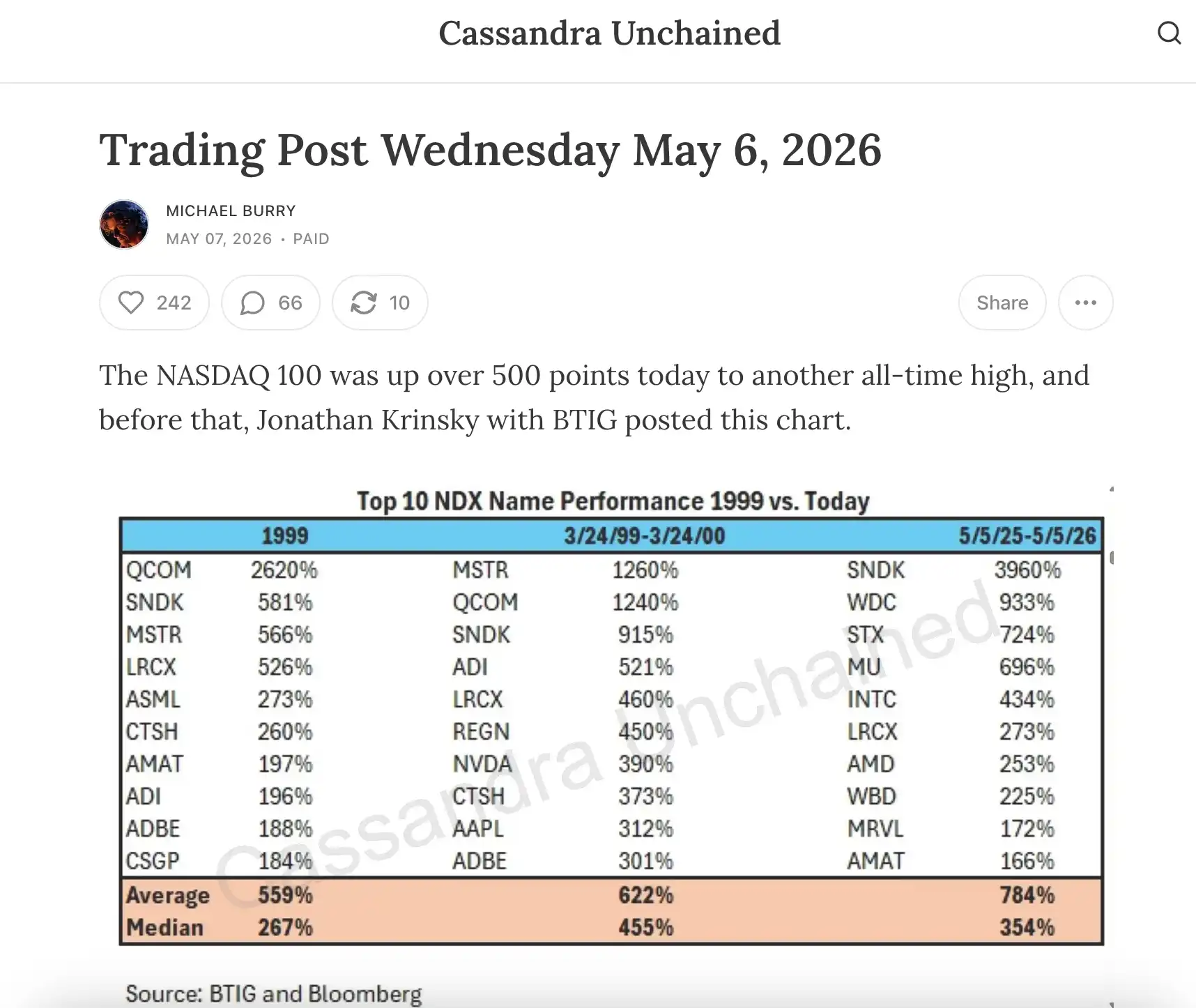
The core logic behind Burry's short on Nvidia is "overbuilding of AI infrastructure." In his first Substack article last November, he compared the current AI investment frenzy to the late 1990s dot-com bubble, likening Nvidia to Cisco from that era. Cisco's stock rose 3,800% between 1995 and 2000, briefly becoming the world's most valuable company before plummeting over 80% after the dot-com bubble burst.

Burry's key arguments include: Hyperscale customers like Microsoft, Google, Meta, Amazon, and Oracle are extending the depreciation period of GPUs to flatter their financial statements. According to his estimates, these accounting practices will cumulatively understate approximately $176 billion in depreciation expenses between 2026 and 2028, artificially inflating profits across the industry. Furthermore, he believes the massive capital expenditure on current AI infrastructure is based on overly optimistic demand forecasts, mirroring the situation when telecom companies frantically laid fiber optic cables around 2000.

This view prompted a direct rebuttal from Nvidia. According to CNBC, Nvidia privately distributed a seven-page memo to Wall Street sell-side analysts, addressing Burry's allegations point by point, specifically citing Burry's posts on platform X as sources of information that needed refuting. Nvidia stated in the memo that its customers set GPU depreciation at four to six years based on actual useful life, and early products (like the A100 released in 2020) still maintain high utilization rates. Burry responded, "I am not saying Nvidia is Enron," but stood by his analysis.

Going Long on Software Stocks Pressured by AI: A Complete Bubble Hedge Portfolio

The most notable aspect of Burry's portfolio adjustments may not be the shorting itself, but rather his long positions.

He recently purchased shares of Adobe, Autodesk, Salesforce, Veeva Systems, and MSCI, among others. The common characteristic of these companies is: their business fundamentals remain solid, but their stock prices have plummeted due to the market narrative of "being disrupted by AI" and forced selling by private credit funds.

Adobe is currently down about 30% from its 52-week high, Autodesk has fallen about 22% year-to-date, and both stocks' forward P/E ratios have retreated to levels seen in 2018-2019.

Burry explained on Substack that he "does not believe the technical selling pressure from private credit and software debt is sufficient to impact these stocks in the long run." In other words, he believes the market has excessively punished companies labeled "AI losers" while excessively rewarding those labeled "AI winners"—and he is betting on the correction of this mispricing.

Looking at both the short and long sides together, Burry has constructed a classic long-short hedge portfolio: If the AI bubble narrative bursts, highly-valued beneficiaries like Nvidia and Palantir will be the first to suffer, while mispriced traditional software stocks may see valuation recovery. Even if the overall market declines, this structure could potentially achieve positive returns.

In the letter to investors when he closed Scion, Burry admitted, "My judgment on the value of securities has been out of sync with the market for quite some time." This statement was both self-reflection and his typical declaration.

At the peak of the AI frenzy, he has chosen to stand on the opposite side of the crowd.

Связанные с этим вопросы

QWhat is the core investment strategy described in the article that Michael Burry is implementing against the AI sector?

AMichael Burry is implementing a long-short hedge fund strategy. He is shorting stocks perceived as direct AI beneficiaries (like Nvidia and Palantir) and going long on traditional software stocks that have been sold off due to the AI narrative (like Adobe, Autodesk, Salesforce). He believes the AI 'winners' are overvalued and the 'losers' are undervalued, betting on a market correction.

QAccording to the article, what was a major point of clarification Burry made regarding his initial large bearish bets on Palantir and Nvidia?

ABurry clarified that the reported $9.12 billion and $1.87 billion figures were the *notional values* of the options contracts, not the actual capital he invested. His actual investment was only about $9.2 million, a fraction of the widely reported amounts.

QWhat is Michael Burry's main argument for why Nvidia and the broader AI infrastructure boom might be overvalued?

ABurry argues that the current AI investment boom resembles the internet and telecom bubbles. His core thesis is 'AI infrastructure overbuilding.' He claims major cloud customers are artificially extending the depreciation schedules for GPUs to inflate profits, and that the massive capital expenditure is based on overly optimistic demand forecasts, similar to the fiber optic cable overbuild in the early 2000s.

QDespite Palantir reporting strong Q1 2026 earnings, why does Burry maintain his bearish position on the stock?

ABurry maintains his bearish position because he believes Palantir's valuation remains unjustifiably high. He holds long-dated put options with strike prices significantly below the current stock price ($100 and $50), indicating he expects the stock to fall more than 60% from current levels. He argues Palantir's reasonable valuation is in the 'single to low double digits' and that it faces competitive threats from companies like Anthropic.

QWhat significant career change did Michael Burry make after his initial AI bearish bets became public, and what platform does he now use to share his market views?

AAfter the initial bets, Michael Burry closed his hedge fund, Scion Asset Management, and deregistered with the SEC, ending his career of managing external money. He transitioned to being a personal investor and now shares his market analysis on a Substack newsletter titled 'Cassandra Unchained.'

Похожее

Gensyn AI: Don't Let AI Repeat the Mistakes of the Internet

In recent months, the rapid growth of the AI industry has attracted significant talent from the crypto sector. A persistent question among researchers intersecting both fields is whether blockchain can become a foundational part of AI infrastructure. While many previous AI and Crypto projects focused on application layers (like AI Agents, on-chain reasoning, data markets, and compute rentals), few achieved viable commercial models. Gensyn differentiates itself by targeting the most critical and expensive layer of AI: model training. Gensyn aims to organize globally distributed GPU resources into an open AI training network. Developers can submit training tasks, nodes provide computational power, and the network verifies results while distributing incentives. The core issue addressed is not decentralization for its own sake, but the increasing centralization of compute power among tech giants. In the era of large models, access to GPUs (like the H100) has become a decisive bottleneck, dictating the pace of AI development. Major AI companies are heavily dependent on large cloud providers for compute resources. Gensyn's approach is significant for several reasons: 1) It operates at the core infrastructure layer (model training), the most resource-intensive and technically demanding part of the AI value chain. 2) It proposes a more open, collaborative model for compute, potentially increasing resource utilization by dynamically pooling idle GPUs, similar to early cloud computing logic. 3) Its technical moat lies in solving complex challenges like verifying training results, ensuring node honesty, and maintaining reliability in a distributed environment—making it more of a deep-tech infrastructure company. 4) It targets a validated, high-growth market with genuine demand, rather than pursuing blockchain integration without purpose. Ultimately, the boundaries between Crypto and AI are blurring. AI requires global resource coordination, incentive mechanisms, and collaborative systems—areas where crypto-native solutions excel. Gensyn represents a step toward making advanced training capabilities more accessible and collaborative, moving beyond a niche controlled by a few giants. If successful, it could evolve into a fundamental piece of AI infrastructure, where the most enduring value in the AI era is often created.

marsbit3 ч. назад

Gensyn AI: Don't Let AI Repeat the Mistakes of the Internet

marsbit3 ч. назад

Why is China's AI Developing So Fast? The Answer Lies Inside the Labs

A US researcher's visit to China's top AI labs reveals distinct cultural and organizational factors driving China's rapid AI development. While talent, data, and compute are similar to the West, Chinese labs excel through a pragmatic, execution-focused culture: less emphasis on individual stardom and conceptual debate, and more on teamwork, engineering optimization, and mastering the full tech stack. A key advantage is the integration of young students and researchers who approach model-building with fresh perspectives and low ego, prioritizing collective progress over personal credit. This contrasts with the US culture of self-promotion and "star scientist" narratives. Chinese labs also exhibit a strong "build, don't buy" mentality, preferring to develop core capabilities—like data pipelines and environments—in-house rather than relying on external services. The ecosystem feels more collaborative than tribal, with mutual respect among labs. While government support exists, its scale is unclear, and technical decisions appear driven by labs, not state mandates. Chinese companies across sectors, from platforms to consumer tech, are building their own foundational models to control their tech destiny, reflecting a broader cultural drive for technological sovereignty. Demand for AI is emerging, with spending patterns potentially mirroring cloud infrastructure more than traditional SaaS. Despite challenges like a less mature data industry and GPU shortages, Chinese labs are propelled by vast talent, rapid iteration, and deep integration with the open-source community. The competition is evolving beyond a pure model race into a contest of organizational execution, developer ecosystems, and industrial pragmatism.

marsbit5 ч. назад

Why is China's AI Developing So Fast? The Answer Lies Inside the Labs

marsbit5 ч. назад

3 Years, 5 Times: The Rebirth of a Century-Old Glass Factory

Corning, a 175-year-old glass company, is experiencing a dramatic revival as a key player in AI infrastructure, driven by surging demand for high-performance optical fiber in data centers. AI data centers require vastly more fiber than traditional ones—5 to 10 times as much per rack—to handle high-speed data transmission between GPUs. This structural demand shift, coupled with supply constraints from the lengthy expansion cycle for fiber preforms, has created a significant supply-demand gap. Nvidia has invested in Corning, along with Lumentum and Coherent, in a $4.5 billion total commitment to secure the optical supply chain for AI. Corning's competitive edge lies in its expertise in producing ultra-low-loss, high-density, and bend-resistant specialty fiber, which is critical for 800G+ and future 1.6T data rates. Its deep involvement in co-packaged optics (CPO) with partners like Nvidia further solidifies its position. While not the largest fiber manufacturer globally, Corning's revenue from enterprise/data center clients now exceeds 40% of its optical communications sales, and it has secured multi-year supply agreements with major hyperscalers including Meta and Nvidia. Financially, Corning's optical communications revenue has surged, doubling from $1.3 billion in 2023 to over $3 billion in 2025. Its stock price has risen nearly 6-fold since late 2023. Key future catalysts include the rollout of Nvidia's CPO products and the scale of undisclosed customer agreements. However, risks include high current valuations and potential disruption from next-generation technologies like hollow-core fiber. The company's long-term bet on light over electricity, maintained even through the telecom bubble crash, is now being validated by the AI boom.

marsbit5 ч. назад

3 Years, 5 Times: The Rebirth of a Century-Old Glass Factory

marsbit5 ч. назад

Торговля

Спот
Фьючерсы

Популярные статьи

Неделя обучения по популярным токенам (2): 2026 может стать годом приложений реального времени, сектор AI продолжает оставаться в тренде

2025 год — год институциональных инвесторов, в будущем он будет доминировать в приложениях реального времени.

1.8k просмотров всегоОпубликовано 2025.12.16Обновлено 2025.12.16

Неделя обучения по популярным токенам (2): 2026 может стать годом приложений реального времени, сектор AI продолжает оставаться в тренде

Обсуждения

Добро пожаловать в Сообщество HTX. Здесь вы сможете быть в курсе последних новостей о развитии платформы и получить доступ к профессиональной аналитической информации о рынке. Мнения пользователей о цене на AI (AI) представлены ниже.

活动图片