Telegram Takes Direct Control of TON, Social Traffic Reshapes Public Chain Narrative

Odaily星球日报Опубликовано 2026-05-11Обновлено 2026-05-11

Введение

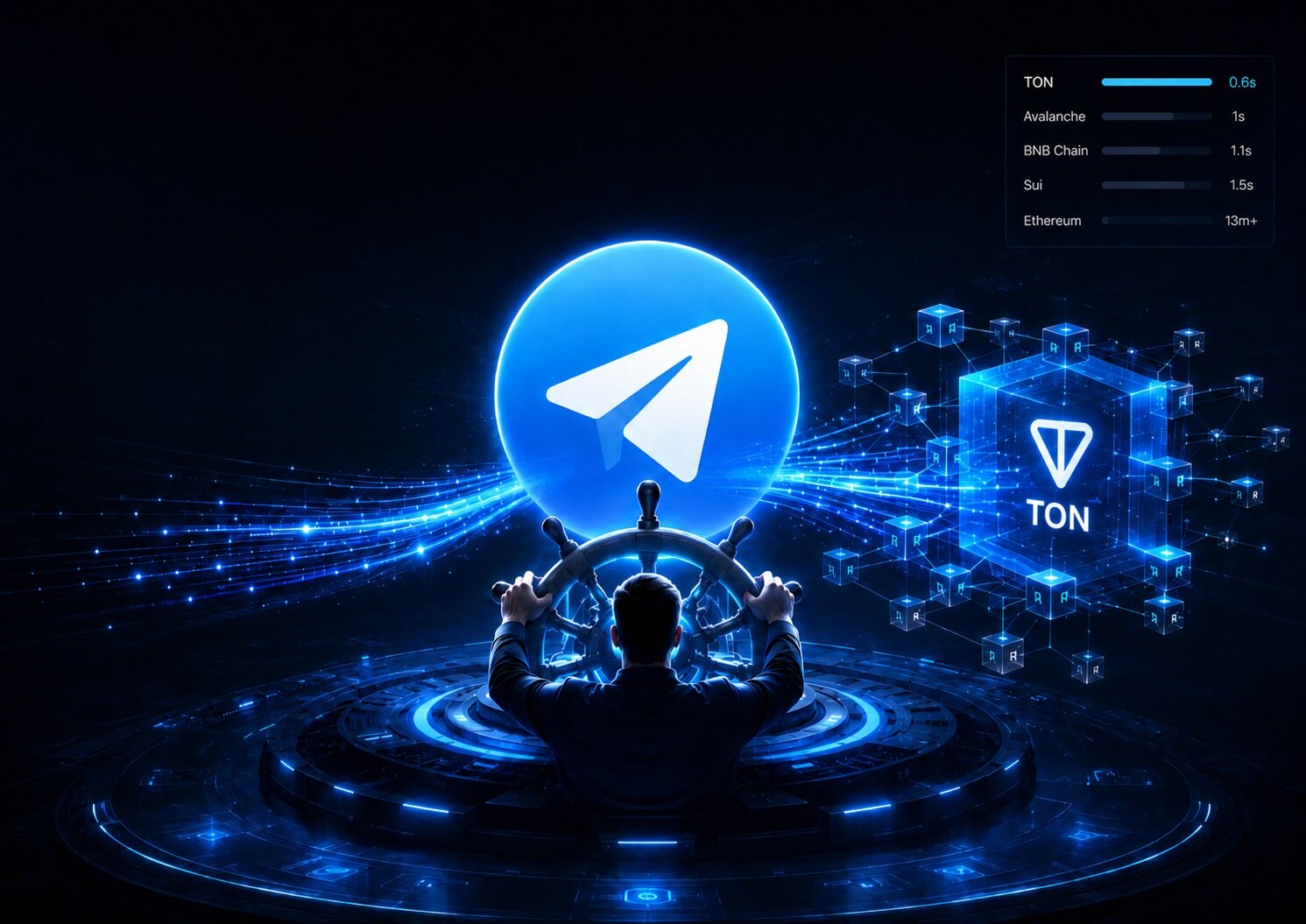
Telegram's founder, Pavel Durov, has announced a major shift in the development of The Open Network (TON). Telegram will now become the core driver of TON, replacing the TON Foundation and becoming its largest validator. The focus will be on technical upgrades over the next few weeks, including slashing network fees by six times to near-zero and improving finality time to 0.6 seconds. This move signifies a deeper integration between Telegram and TON, moving beyond just providing a user base. The goal is to transform Telegram's vast social traffic and built-in features—like Mini Apps, payments, and bots—into sustainable, on-chain usage scenarios. The reduced fees and faster speeds are crucial for enabling the small, frequent transactions typical of social interactions. While this promises stronger execution and product alignment, it raises questions about centralization. Durov argues Telegram's involvement will attract more validators, enhancing decentralization, but the outcome remains to be seen. Additionally, TON's high annual staking reward of 18.8% aims to retain capital within the ecosystem. The key challenge for TON is no longer just leveraging Telegram's entry point, but becoming an invisible, seamless infrastructure layer within Telegram's daily use. Its success hinges on converting viral attention into lasting, embedded utility.

Original | Odaily Planet Daily(@OdailyChina)

Author | Asher(@Asher_ 0210)

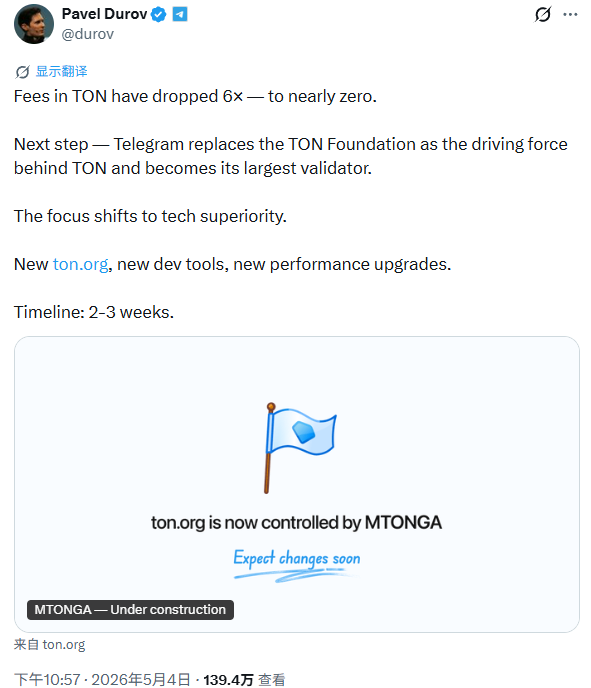
On May 4th, Pavel Durov, the founder of Telegram, stated on platform X that TON network fees have been reduced sixfold, now nearly zero. More crucially, he announced that Telegram will replace the TON Foundation to become the new core driver of the TON network and its largest validator. TON's upcoming focus will shift to technical advantages, including a new ton.org, new developer tools, and performance upgrades, all within the next 2 to 3 weeks.

Telegram Founder: TON Fees Reduced 6x, Telegram to Become Largest Validator

Previously, the relationship between TON and Telegram was more like a strong binding with weak leadership. Telegram provided the entry point, while the Foundation and community were responsible for driving progress, maintaining a certain distance. But this time, Telegram is not just continuing to bring users to TON; it's starting to enter more fundamental positions like validator, technical roadmap, and development tools. TON is no longer just a chain adjacent to the Telegram ecosystem; it's being reintegrated into Telegram's product system.

TON Never Lacked an Entry Point; It Lacked Turning That Entry into Usage Scenarios

Past market discussions about TON often revolved around Telegram's user scale. But for a public chain, having an entry point does not equal having an ecosystem, and having user reach does not equal having long-term usage. The unique aspect of TON is its inherent connection to a high-frequency social platform, where Mini Apps, wallets, channels, bots, games, and payments already exist within Telegram. This means TON doesn't have to start from scratch to find users like most Layer1s. However, if these scenarios cannot translate into sustained on-chain interactions, Telegram's traffic can only bring waves of short-term hype.

Projects like Notcoin and Dogs have already proven that Telegram can quickly generate viral spread. Simple gameplay combined with social connections can indeed attract a massive number of users into crypto applications in a short time. But such explosions come and go quickly. TG mini-games and airdrops can bring attention but can hardly sustain a long-term ecosystem alone.

Therefore, the fee reduction, speed improvements, developer tools, and validator role emphasized by Pavel Durov this time point not to a single technical upgrade, but to TON addressing its most crucial missing piece — turning Telegram's entry point into sustainable usage scenarios. When fees are low enough, confirmation speeds are fast enough, and developer integration is simple enough, actions like channel tipping, Mini App tasks, game rewards, creator revenue, ad revenue sharing, bot calls, and small group payments have the potential to evolve from product features into on-chain activities.

TON doesn't need to repeat the story of "backed by Telegram." What it truly needs to prove is whether the high-frequency behaviors within Telegram can be supported by TON.

Fee Reduction and Speed Boost Are for Smaller, Higher-Frequency Transactions

The fee reduction by TON this time cannot be understood merely as a regular public chain cost optimization. Viewed within the context of Telegram, it genuinely addresses whether small, high-frequency interactions can be viable.

Potential on-chain behaviors within Telegram are mostly not large transfers but more fragmented daily operations. The amount per transaction is small, but the frequency is high. If users have to perceive fees, wait for confirmations, and repeatedly handle wallet interactions with every button click, such scenarios would struggle to truly take off.

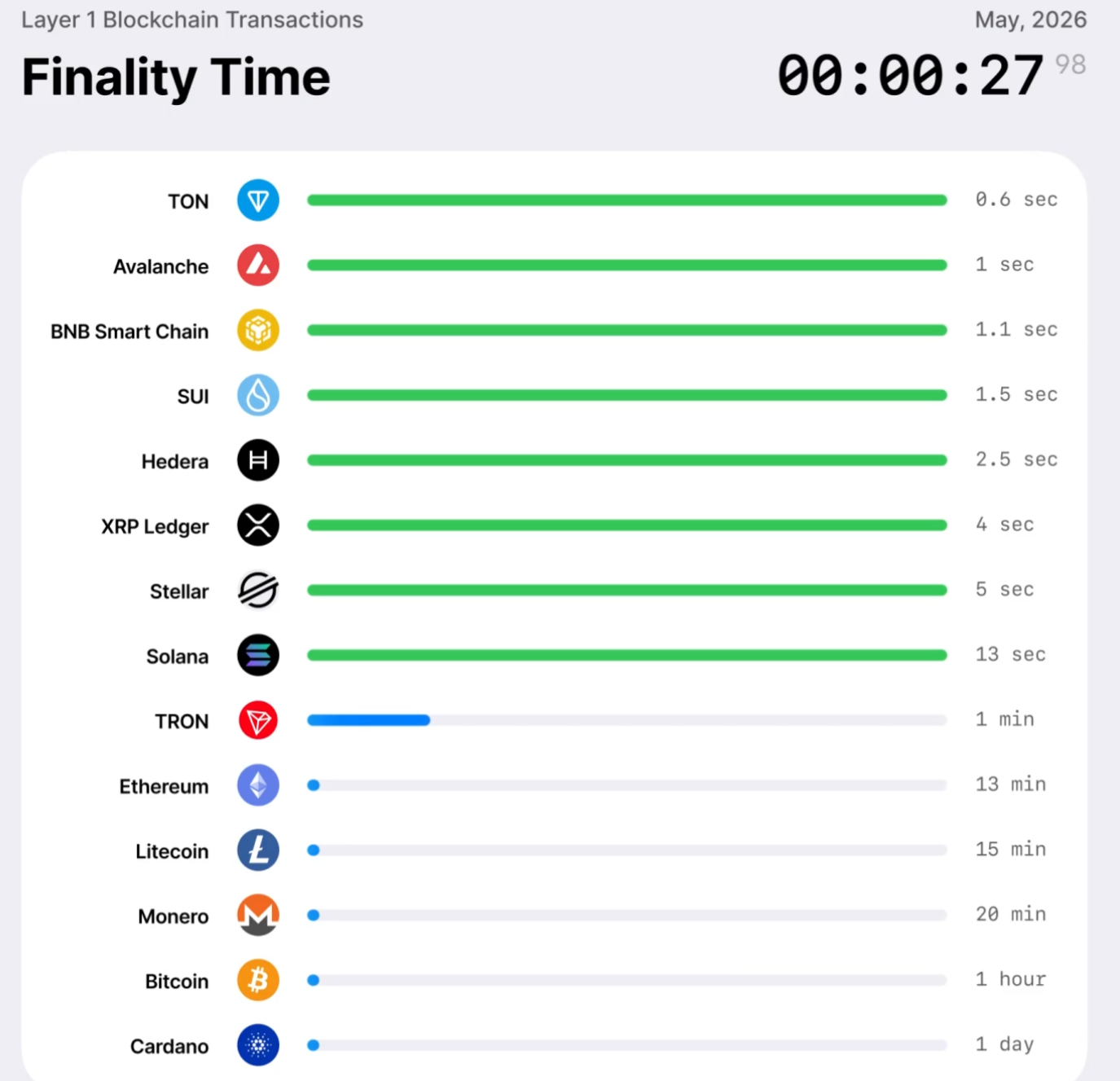
Therefore, fee reduction and speed improvement must be considered together. Near-zero fees lower the barrier to entry; reducing final confirmation time to 0.6 seconds lowers the perception of waiting. For Telegram, the chain shouldn't be an extra layer perceived by users; it should be hidden behind product actions like sending messages, clicking buttons, and balance changes as much as possible.

Comparison of "Finality Time" Among Mainstream Public Chains

This is also where TON differs from many Layer1s. It's not solely about making DeFi transactions faster or transfers cheaper; it's about embedding the chain into Telegram's daily usage. Only when costs, wait times, and wallet operations are sufficiently minimized can TON potentially evolve from a Telegram-related public chain into an underlying network directly accessible by the Telegram application layer.

From Entry Point to Validator, Telegram Begins Delving into TON's Core

Telegram becoming TON's largest validator is the most significant step in this change. It signifies that Telegram is no longer just providing TON with an entry point and brand endorsement; it's entering the network's security and operational mechanisms. Previously, TON was driven by the Foundation and community, which offered greater openness but a more dispersed pace. Now, with Telegram directly involved, products, wallets, Mini Apps, payments, and developer tools have the opportunity to be realigned under a single vision.

Efficiency will increase, but so will controversy. Telegram replacing the TON Foundation as the primary driving force and becoming the largest validator will inevitably lead to renewed discussions about TON's centralization risks. In response, Pavel Durov stated that Telegram's participation would attract more large-scale participants into the validator pool, thereby enhancing decentralization. This logic isn't unfounded, but the outcome matters more than the statement.

The truly important aspects going forward are whether the validator structure can become more diverse, whether governance information is sufficiently transparent, whether the Foundation and community still have independent space, and whether ecosystem projects can continue to develop without depending on Telegram's will.

Therefore, Telegram's return isn't purely positive news; it's a trade-off. For TON to enter the mainstream application layer, it needs Telegram's strong execution capability. But the more prominent Telegram becomes, the more TON needs to prove it's not merely an internal settlement chain serving Telegram.

High Staking Rewards Retain More Value for TON

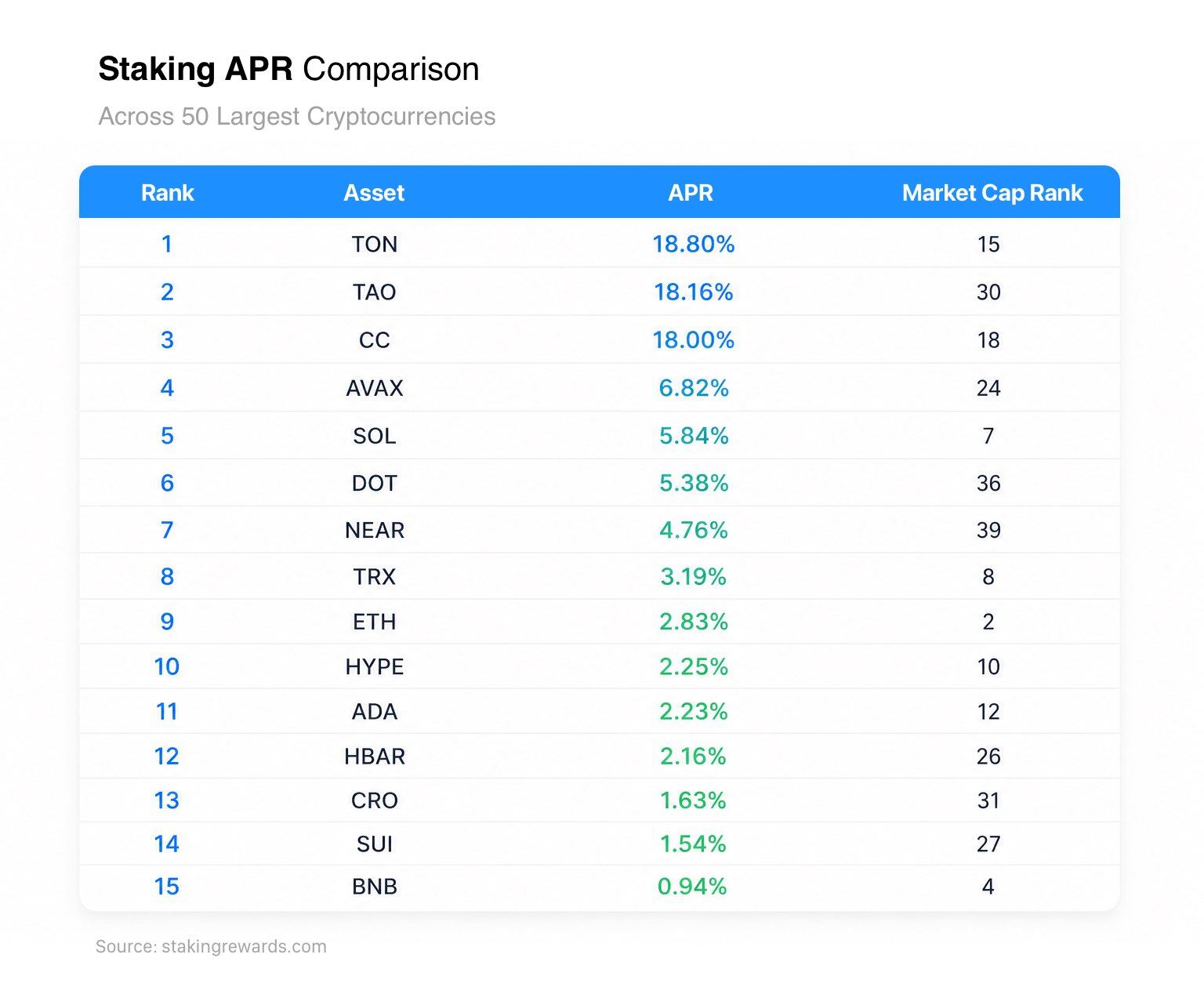
Pavel Durov subsequently emphasized that TON ranks first in annual staking rewards among the top 50 cryptocurrencies by market cap, with a high rate of 18.8%. Compared to fee reductions and speed improvements, high staking rewards are more likely to stir capital sentiment, giving TON an additional reason for holding in the eyes of the market.

TON Annual Staking Reward Ranks First Among Top 50 Cryptocurrencies

This also makes TON's story somewhat more complete. It doesn't just rely on Telegram's user entry to attract attention or improve experience through technical upgrades; it's also using staking rewards to keep capital within the ecosystem. The simultaneous emergence of entry point, performance, validator role, and yield gives this change more weight than a single positive factor.

Of course, high yield itself is not the end goal; it's more like buying TON a longer observation period. If subsequent developer tools and performance upgrades are delivered, and more capital is locked into the network, it could form a positive feedback loop with real usage. For TON, the value of staking rewards isn't just about increasing holding returns; it's about making the market willing to continue waiting for it to truly convert Telegram's entry advantage.

TON Returning to Telegram Is Not the Finish Line, But a More Difficult Hurdle

The key for TON going forward is not to continue leveraging Telegram for traffic, but to truly become part of Telegram's application ecosystem. If Telegram's chatting, payments, applications, creator economy, and automated interactions are gradually handled by TON, then TON's competitors would not just be other Layer1s, but all networks attempting to become the next-generation application infrastructure.

TON isn't just retelling the social traffic story; it's beginning to attempt to turn social traffic into on-chain order. The entry point is just the beginning; usage is the answer. Telegram can bring TON to the forefront, but whether it stays depends ultimately on TON's ability to become that layer of infrastructure operating behind user perception, within application mechanics.

If past TON was proving how close it was to Telegram, now it must prove how deeply it can integrate into Telegram's daily usage. True mainstream adoption isn't making users aware they're using a chain; it's making the chain an integral part of the application experience.

TON's opportunity lies here, and so does its pressure.

Связанные с этим вопросы

QWhat are the key changes announced by Telegram regarding the TON network according to the article?

AThe article states that Telegram founder Pavel Durov announced that TON network fees have been reduced sixfold, to near-zero levels. Crucially, Telegram will replace the TON Foundation as the network's core driver and become its largest validator. The focus will shift to technical advantages like a new ton.org, new developer tools, and performance upgrades over the next 2-3 weeks.

QHow does the article explain the previous relationship between TON and Telegram, and what is the significance of the new change?

APreviously, the relationship was described as 'strongly bound but weakly led.' Telegram provided the entry point, while the Foundation and community drove development, with a layer of separation. The new change signifies that Telegram is moving beyond just providing users and is now entering more foundational layers like validation, technical direction, and development tools. TON is being reintegrated into Telegram's product system.

QAccording to the article, why are the fee reduction and speed increase on TON particularly important in the context of Telegram?

AThe fee reduction and speed increase are crucial for enabling small-scale, high-frequency transactions within Telegram's ecosystem. Potential on-chain activities in Telegram, such as tipping, mini-app rewards, and group payments, involve small, frequent amounts. Near-zero fees lower the usage barrier, and a faster finality time (0.6 seconds) reduces the perception of waiting, allowing the blockchain to operate seamlessly behind user actions.

QWhat potential concern does the article raise about Telegram becoming the largest validator for TON?

AThe article raises concerns about increased centralization risk. Telegram replacing the TON Foundation as the main driving force and becoming the largest validator could lead to debates about TON's decentralization. While Pavel Durov argued this would attract more large participants to the validator pool, the article emphasizes the need to judge by results—such as validator diversity, transparent governance, and the independent space for the community—rather than just statements.

QWhat is the 'harder challenge' TON faces now, as described in the article's conclusion?

AThe article concludes that the harder challenge is for TON to move beyond leveraging Telegram for traffic and truly become an integral part of Telegram's application ecosystem. It must prove it can integrate deeply into daily Telegram use—like chat, payments, apps, and automated interactions—becoming the underlying infrastructure for application experience. True mainstream adoption means users don't perceive they are using a blockchain; the chain is just part of the app.

Похожее

AI Relay Stations Spark Heated Debate on Zhihu: Behind Cheap Tokens, What Are Users Really Worried About?

A discussion on Zhihu about "AI relay stations" shifted the niche developer topic of "cheap tokens" into broader user awareness. Users moved beyond simply questioning the legitimacy of these services to focus on practical concerns: Where do cheap tokens truly come from? Is the model being accessed the real one? Can relay stations see prompts, code, and API keys? For occasional users, are the risks worth it? The core debate centered less on price and more on trust. A primary worry is model authenticity—the risk of "model swapping," where users paying for a premium model might be routed to a cheaper one, creating an information asymmetry. Others argued that cost comparisons matter; while cheaper than official pay-as-you-go APIs, relay stations may not be the lowest-cost option versus subscriptions, domestic models, or free tiers, making user needs assessment crucial. Speculation about token sources ranged from legitimate bulk discounts to gray-area methods like account sharing or exploiting regional pricing. This opacity makes risk assessment difficult for users. Data security emerged as a critical concern, especially for enterprise use. When processing sensitive information like code, contracts, or client data, the inability to verify a relay station's data handling, retention, or access policies poses significant compliance and confidentiality risks. The evolving consensus suggests relay stations can be used cautiously for low-sensitivity, disposable tasks (e.g., summarizing public info, simple translation). However, they should not be the default for sensitive, professional, or production workflows involving proprietary data, Agents, or automated systems. Recommendations include avoiding large prepayments, not relying on a single service, using test prompts to monitor quality, anonymizing data where possible, and keeping official channels as backups. Ultimately, the discussion framed tokens not just as a billing unit but as a measure of real cost encompassing price, model integrity, data security, and service stability. The popularity of relay stations highlights user demand for affordable access, but the debate underscores a key trade-off: the savings from cheap tokens may come at the price of trust, transparency, and control over one's data and AI experience.

marsbit10 мин. назад

AI Relay Stations Spark Heated Debate on Zhihu: Behind Cheap Tokens, What Are Users Really Worried About?

marsbit10 мин. назад

In-Depth Research Report on TradFi: The Convergence Wave of Crypto and Traditional Finance

In 2026, the crypto industry is undergoing a profound infrastructure-level transformation—TradFi assets are migrating on-chain at an unprecedented pace. According to CoinGecko's Q1 2026 report, the total value locked (TVL) of tokenized real-world assets (RWA) has surpassed $31 billion, a nearly 4x increase from $7.8 billion at the beginning of 2025, with the sector’s aggregate market capitalization reaching $19.3 billion. Among these, the market cap of tokenized stocks surged from $2 million to $486 million, with Q1 spot trading volume reaching $15.1 billion—a single quarter already surpassing the entire second half of 2025. RWA perpetual contract Q1 trading volume reached a staggering $524.8 billion, far exceeding the $313 billion for all of 2025. Meanwhile, BlackRock's BUIDL fund has reached $2.3 billion in scale and has filed for two new tokenized funds, signaling that the world's largest asset manager's tokenization strategy is evolving from pilot to product suite expansion. HTX, as a core participant in the crypto exchange sector, officially launched TradFi perpetual futures products including NVDA, AAPL, MSFT, META, and SPY in 2026, enabling crypto users to gain 24/7 trading access to core U.S. equities. Boston Consulting Group predicts that global tokenized asset scale could reach $16 trillion by 2030, while McKinsey offers a conservative estimate of approximately $2 trillion. The on-chain migration of TradFi assets is no longer a "future narrative" but a structural transformation unfolding in real time, as crypto exchanges evolve from single crypto asset trading platforms toward "multi-asset-class trading infrastructure."

HTX Learn13 мин. назад

In-Depth Research Report on TradFi: The Convergence Wave of Crypto and Traditional Finance

HTX Learn13 мин. назад

Blocked Its Own Treasure, WeChat AI Steps Up

Tencent's stock surged over 10% on June 2nd amid reports that WeChat, with 1.43 billion monthly users, is finalizing tests for a native AI Agent. The reported feature, accessible by swiping right from the main interface, allows users to issue commands in natural language. The AI then decomposes tasks and automatically calls upon relevant Mini Programs within WeChat to complete actions like ordering food, booking tickets, or making payments, creating a closed-loop service execution system. This strategic shift follows the internal conflict and subsequent "blocking" of Tencent's standalone AI app, Yuanbao, by WeChat for violating sharing rules during a 2026 Spring Festival promotion. The incident highlighted a lack of internal consensus and exposed the weakness of competing in the standalone AI assistant arena against rivals like ByteDance's Doubao (345M MAU) and Alibaba's Qianwen. The new WeChat AI Agent aims to leverage WeChat's unique assets—its massive user base, standardized Mini Program APIs, WeChat Pay, and identity system—to move from simple content generation to actual task execution. Analysts note this changes the competitive landscape from model benchmarks to which AI can connect to more real-world services. However, success depends on key variables: the capability of Tencent's underlying Hunyuan model, managing massive inference costs, and redesigning incentives for Mini Program developers whose traffic might be bypassed. The move is seen as an attempt to keep user service intent within WeChat's ecosystem as AI begins to redefine how users access services.

marsbit1 ч. назад

Blocked Its Own Treasure, WeChat AI Steps Up

marsbit1 ч. назад

ByteDance Adopts Arm CPUs, Jensen Huang: So Sad I Didn't Buy Arm

**Summary:** At Computex 2026, Arm CEO Rene Haas announced that ByteDance and Oracle have adopted Arm's self-designed Arm AGI data center CPU. The company expects significant revenue growth from this product, projecting $20 billion in demand for the 2027/2028 fiscal years. Haas noted that restricting AI-capable CPUs from the US to China is nearly impossible due to their widespread applications. Arm's stock has surged dramatically this year, notably rising 16% after NVIDIA's Arm-based Vera CPU and RTX Spark announcements. A highlight was the informal, humorous on-stage conversation between Haas and NVIDIA CEO Jensen Huang. Huang joked about NVIDIA's failed attempt to acquire Arm and playfully lamented selling his Arm shares. Both executives showed a clear sense of camaraderie and shared regret over the missed merger. Key technical topics were discussed: 1. **AI PC Design:** Huang explained NVIDIA's RTX Spark superchip (with a 20-core Arm CPU) is designed for future AI agents that will autonomously run and use tools on PCs, blending local and cloud processing. 2. **Agent vs. OS:** Huang emphasized the operating system remains crucial, as AI agents rely on its APIs and tools to function. 3. **Growth Constraints:** He identified the shift to "useful AI" that generates profitable tokens as a primary driver for immense, almost limitless, computational demand. Haas outlined Arm's strategy across PC and data centers. For PCs, Arm collaborates with partners like NVIDIA and MediaTek, offering its compute subsystem (CSS) for custom SoCs. In data centers, its Arm AGI CPU (built on TSMC's 3nm process) has gained major partners including OpenAI, Meta, and now ByteDance and Oracle. Arm presented a multi-year roadmap for its in-house CPU line. The article concludes that while GPUs dominated the AI training race, the explosion of AI agents is shifting significant focus to CPUs for inference, state management, and tool orchestration. The industry is trending towards vertical integration, with companies like cloud providers designing chips and chip/IP firms offering full solutions, all competing to deliver more efficient computing per watt.

marsbit1 ч. назад

ByteDance Adopts Arm CPUs, Jensen Huang: So Sad I Didn't Buy Arm

marsbit1 ч. назад

Торговля

Спот
Фьючерсы

Популярные статьи

Как купить TON

Добро пожаловать на HTX.com! Мы сделали приобретение TONCOIN (TON) простым и удобным. Следуйте нашему пошаговому руководству и отправляйтесь в свое крипто-путешествие.Шаг 1: Создайте аккаунт на HTXИспользуйте свой адрес электронной почты или номер телефона, чтобы зарегистрироваться и бесплатно создать аккаунт на HTX. Пройдите удобную регистрацию и откройте для себя весь функционал.Создать аккаунтШаг 2: Перейдите в Купить криптовалюту и выберите свой способ оплатыКредитная/Дебетовая Карта: Используйте свою карту Visa или Mastercard для мгновенной покупки TONCOIN (TON).Баланс: Используйте средства с баланса вашего аккаунта HTX для простой торговли.Третьи Лица: Мы добавили популярные способы оплаты, такие как Google Pay и Apple Pay, для повышения удобства.P2P: Торгуйте напрямую с другими пользователями на HTX.Внебиржевая Торговля (OTC): Мы предлагаем индивидуальные услуги и конкурентоспособные обменные курсы для трейдеров.Шаг 3: Хранение TONCOIN (TON)После приобретения вами TONCOIN (TON) храните их в своем аккаунте на HTX. В качестве альтернативы вы можете отправить их куда-либо с помощью перевода в блокчейне или использовать для торговли с другими криптовалютами.Шаг 4: Торговля TONCOIN (TON)С легкостью торгуйте TONCOIN (TON) на спотовом рынке HTX. Просто зайдите в свой аккаунт, выберите торговую пару, совершайте сделки и следите за ними в режиме реального времени. Мы предлагаем удобный интерфейс как для начинающих, так и для опытных трейдеров.

3.1k просмотров всегоОпубликовано 2024.03.29Обновлено 2026.06.02

Как купить TON

Обсуждения

Добро пожаловать в Сообщество HTX. Здесь вы сможете быть в курсе последних новостей о развитии платформы и получить доступ к профессиональной аналитической информации о рынке. Мнения пользователей о цене на TON (TON) представлены ниже.

活动图片