# Сопутствующие статьи по теме USDC

Новостной центр HTX предлагает последние статьи и углубленный анализ по "USDC", охватывающие рыночные тренды, новости проектов, развитие технологий и политику регулирования в криптоиндустрии.

When AI Starts Paying with USDC, Circle's Victory and the Custodial Challenge of Funds

The article discusses the rise of AI agents as independent economic entities, highlighting that 99% of their payments are made using USDC, positioning Circle as a key beneficiary. Over a nine-month period, AI agents conducted 140 million transactions totaling $43 million, with an average transaction size of $0.31. This shift signifies AI's transition from conceptual to real economic activity, raising questions about financial infrastructure and asset management for autonomous agents. Circle’s three-layer infrastructure—stablecoin issuance, efficient on-chain settlement, and integration with traditional finance—enables seamless micro-payments. However, as AI agents accumulate capital, they will need to manage idle funds, creating opportunities for Real World Asset (RWA) tokenization. Projects like Ondo Finance are making RWA assets machine-readable and programmable, allowing AI agents to automate investments in tokenized treasury bonds or other low-risk assets. The integration of payment and asset management systems could enable AI agents to optimize operational efficiency by automatically investing surplus USDC into yield-generating RWA products. However, challenges remain, including data authenticity, model and liquidity risks, regulatory disparities, and technical security. The article concludes that while Circle provides the "payment nervous system" for AI economies, RWA must evolve to serve as the "energy storage system," ensuring AI agents can manage assets as efficiently as they execute transactions.

比推03/12 04:31

When AI Starts Paying with USDC, Circle's Victory and the Custodial Challenge of Funds

比推03/12 04:31

Circle Doubles in a Month: What Is the Market Betting On?

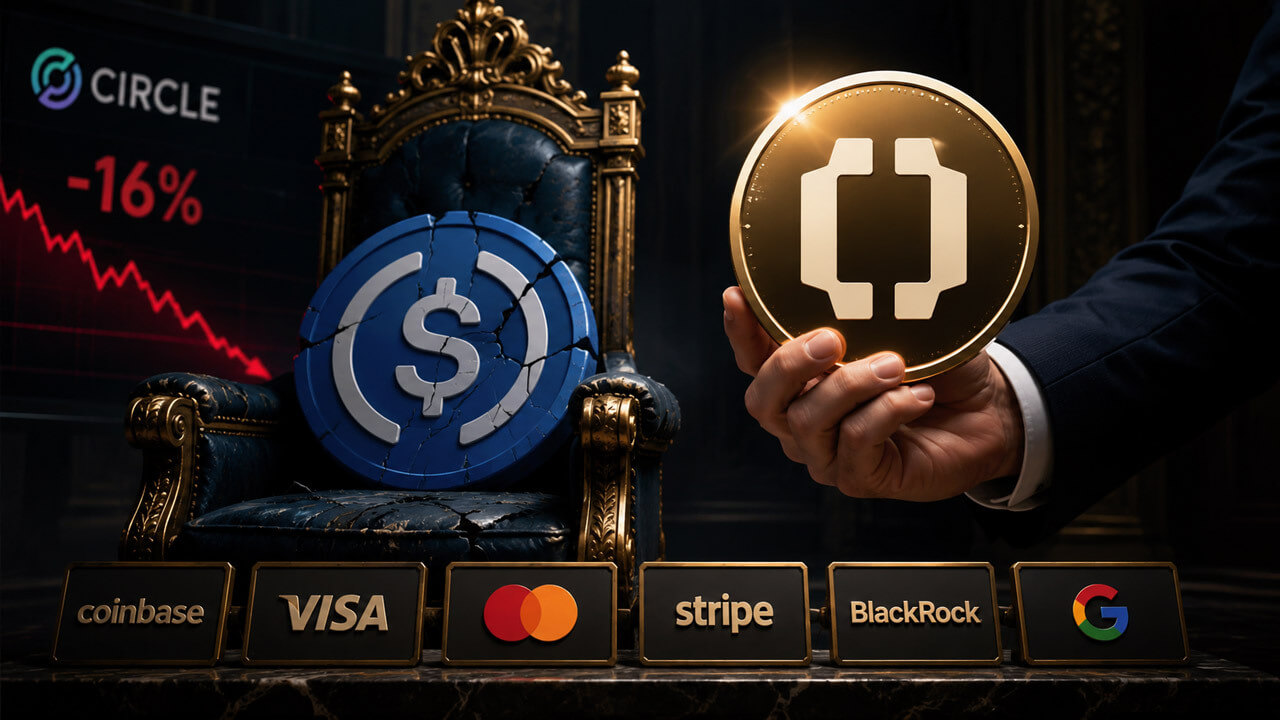
Circle's stock (CRCL) has experienced significant volatility, doubling in February 2025 after a sharp post-IPO decline. This surge occurred while Bitcoin fell 40%, indicating a decoupling from the broader crypto market. The key driver is a fundamental shift in how the market values Circle and its USDC stablecoin. Previously viewed as a cyclical crypto play, USDC's growth accelerated during the bear market, with its circulating supply rising 72% to a record $753 billion. This growth is increasingly driven by traditional finance and global payments, not speculative crypto trading. Major partnerships with Visa, Mastercard, JPMorgan, and Intuit are embedding USDC into mainstream payment infrastructure. The passage of the GENIUS Act in July 2025 provided a federal regulatory framework, creating a moat for compliant issuers like Circle and helping USDC gain market share against USDT. USDC also surpassed Tether in on-chain transaction volume. A major future growth narrative centers on AI Agent payments. Circle and others are developing infrastructure for machine-to-machine transactions, offering 24/7 settlement at a fraction of the cost of traditional systems. While current non-interest revenue from these new use cases remains under 5% of total revenue, the potential market is vast, with predictions of a multi-trillion-dollar stablecoin and AI Agent economy by 2030. Circle's $23 billion valuation largely bets on this future narrative becoming reality.

marsbit03/12 01:09

Circle Doubles in a Month: What Is the Market Betting On?

marsbit03/12 01:09

After the Rise of Stablecoin Status, Old Partners Circle and Stripe Compete for Each Other's Turf

Stablecoin Ecosystem Shift: Former Partners Circle and Stripe Now Compete as Boundaries Blur The stablecoin industry, once characterized by clear divisions of labor, is undergoing a significant transformation. Circle, the issuer of the USDC stablecoin, and Stripe, the global payment processor, were long-time partners. Circle focused on the "issuance layer," minting digital dollars, while Stripe managed the "payment layer," integrating them into commercial flows. This dynamic is changing as both companies strategically expand into each other's domains, driven by the maturation of the stablecoin market into a potential trillion-dollar financial infrastructure. Circle is moving beyond its role as a mere issuer. Its new strategy involves building a comprehensive payment network to capture more value from the circulation of USDC. Key initiatives include the Arc blockchain, the Cross-Chain Transfer Protocol (CCTP) for liquidity, and the Circle Payments Network (CPN), an open standard payment coordination network. This shifts Circle from a stablecoin supplier to an infrastructure builder. Conversely, Stripe is moving downward from the payment layer to control the underlying financial rails. Its acquisition of stablecoin infrastructure firm Bridge, which recently received preliminary approval for a U.S. trust bank charter, is a critical step. Stripe is also co-developing the Tempo blockchain and acquired wallet infrastructure company Privy, aiming to master the entire stack from issuance to settlement. The result is that these former allies are now on a collision course in the middle of the stablecoin value chain. The competition is evolving from a race for market share in stablecoin supply to a broader contest over who will control the fundamental networks and rails through which digital dollars flow. This signals the industry's transition from a crypto-native experiment to a full-scale rebuild of financial infrastructure.

Odaily星球日报03/09 05:01

After the Rise of Stablecoin Status, Old Partners Circle and Stripe Compete for Each Other's Turf

Odaily星球日报03/09 05:01

活动图片