# Сопутствующие статьи по теме Forecasting

Новостной центр HTX предлагает последние статьи и углубленный анализ по "Forecasting", охватывающие рыночные тренды, новости проектов, развитие технологий и политику регулирования в криптоиндустрии.

If We Gathered the Most Accurate Gold Forecasters in History, Could We Crack the Future Price of Gold?

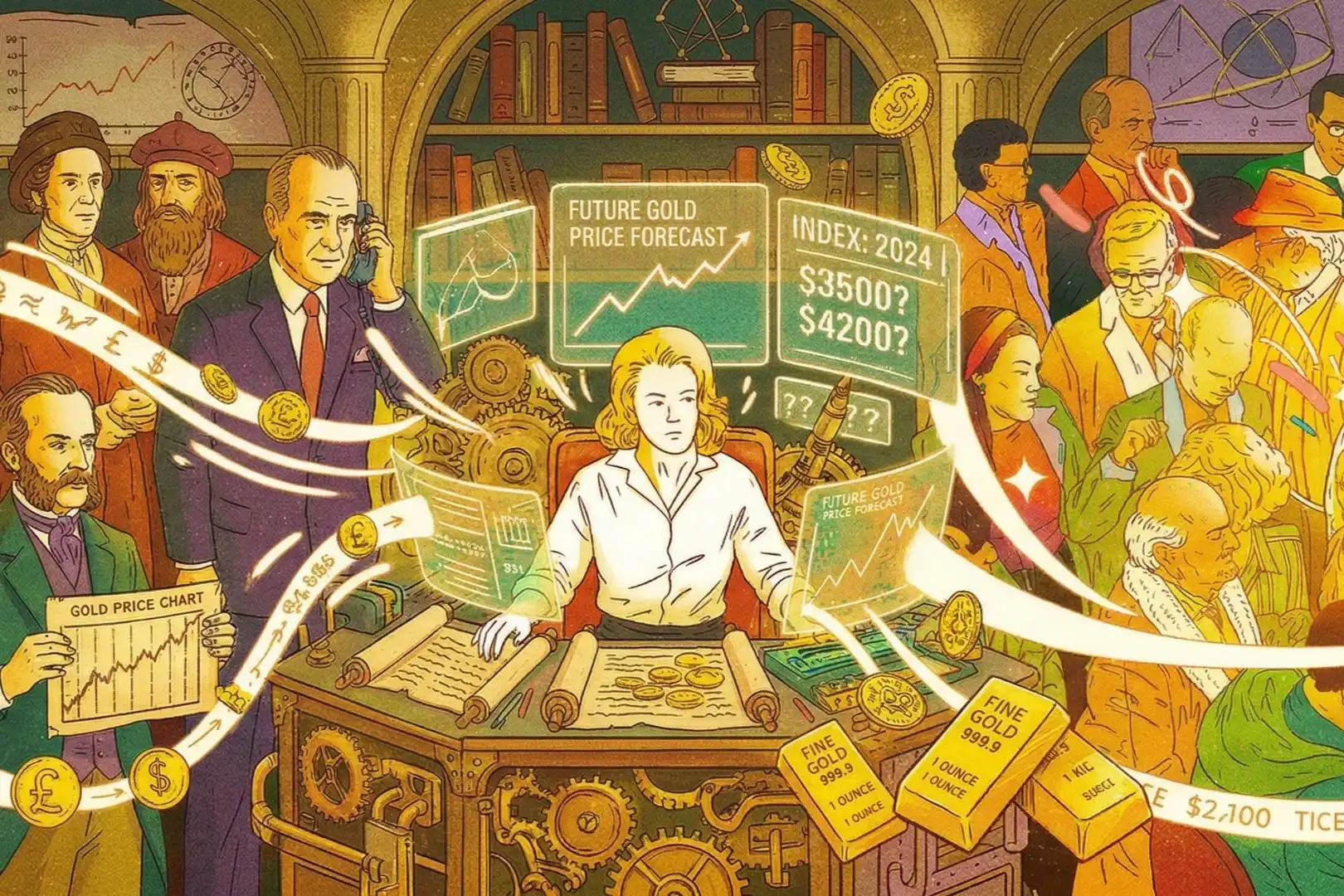
The article investigates whether assembling the most historically accurate gold price forecasters could unlock future price movements. The author analyzes three groups: top Wall Street institutions (e.g., LBMA, Goldman Sachs, JPMorgan), prominent gold bulls (e.g., Peter Schiff, Jim Rickards), and analysts famed for precise calls (e.g., Nouriel Roubini, Ben McMillan). The findings reveal significant flaws. Institutions consistently exhibit "lagging predictions," adjusting forecasts too slowly and underestimating bull market magnitudes. Pundits perpetually predict extreme price targets (e.g., $35,000) without precise timing, often being early or wrong. Even "prophetic" forecasters have mixed records; Roubini missed the entire 2009-2012 bull market, and Ray Dalio has a history of erroneous crisis predictions. The analysis notes that the current environment mirrors 2011, where extreme predictions clustered near the market top. Today, forecasts from the same experts range wildly from $5,400 to $35,000. The conclusion is that no consistently accurate forecaster exists. Predictions are often right by chance, not skill. The author ultimately rejects seeking a "wealth password" and instead advocates for a Dalio-inspired approach: avoiding precise price predictions, acknowledging uncertainty, and using portfolio allocation (e.g., 5-15% in gold) for long-term risk management.

marsbit04/03 10:26

If We Gathered the Most Accurate Gold Forecasters in History, Could We Crack the Future Price of Gold?

marsbit04/03 10:26

If We Gathered the Most Accurate Gold Forecasters in History, Could We Crack the Future Price of Gold? I've Compiled a Decade of the Most Accurate Gold Analysis

This analysis investigates whether compiling the most accurate historical predictions on gold prices from top analysts, institutions, and famed forecasters can unlock future price movements. After examining over a decade of data, the findings reveal that no single expert or entity consistently predicts gold prices accurately. Key observations include: - **Wall Street institutions** (e.g., LBMA, Goldman Sachs, JPMorgan) often exhibit "lagging predictions," adjusting targets only after trends are established, frequently underestimating actual price moves. - **Prominent gold bulls** (e.g., Peter Schiff, Jim Rogers) persistently advocate for higher prices over long horizons but lack timing precision, leading to extended periods of underperformance. - **"Prophetic" forecasters** (e.g., Nouriel Roubini, Ben McMillan) have moments of accuracy but also significant misses or limited track records, undermining their reliability. The study notes a pattern similar to the 2011 gold peak: extreme bullish predictions often cluster near market tops, followed by sharp corrections. Current forecasts for gold range widely from $5,400 to $35,000, reflecting high disagreement even among experts. The conclusion is that there is no consistent "most accurate" predictor for gold prices. Relying on expert consensus or individual forecasts proves chaotic and unreliable. Instead, the author advocates for a strategy akin to Ray Dalio’s: avoiding precise price predictions, embracing uncertainty, and using portfolio allocation (e.g., 5-15% in gold) for long-term risk management.

marsbit04/02 12:42

If We Gathered the Most Accurate Gold Forecasters in History, Could We Crack the Future Price of Gold? I've Compiled a Decade of the Most Accurate Gold Analysis

marsbit04/02 12:42

Kalshi's First Research Report Released: How Collective Intelligence Outperforms Wall Street Think Tanks in Predicting CPI

Kalshi Research's inaugural report demonstrates that prediction markets consistently outperform Wall Street consensus forecasts in predicting the U.S. year-over-year CPI inflation rate. The study, covering over 25 monthly CPI releases from February 2023 to mid-2025, shows Kalshi’s market-implied forecasts had a 40.1% lower mean absolute error (MAE) than consensus predictions across all environments. The advantage was most pronounced during economic "shocks." For large surprises (over 0.2 percentage points), Kalshi's forecasts were 50% more accurate a week before the data release, improving to 60% more accurate the day before. For medium surprises (0.1-0.2 percentage points), the advantage was similarly 50%, rising to 56.2% closer to the release. Crucially, a divergence of over 0.1 percentage points between the market forecast and consensus served as a strong signal, with an 81.2% probability that a shock would occur. When the two forecasts disagreed, the market prediction was more accurate 75% of the time. The report attributes this "Shock Alpha" to three factors: the "wisdom of crowds" aggregating diverse information, superior incentive structures that reward accuracy over conformity, and more efficient information synthesis, even with the same public data. This suggests prediction markets provide a valuable, differentiated signal for investors and policymakers, especially during periods of high uncertainty.

Odaily星球日报12/24 04:00

Kalshi's First Research Report Released: How Collective Intelligence Outperforms Wall Street Think Tanks in Predicting CPI

Odaily星球日报12/24 04:00

活动图片