# Сопутствующие статьи по теме B2B

Новостной центр HTX предлагает последние статьи и углубленный анализ по "B2B", охватывающие рыночные тренды, новости проектов, развитие технологий и политику регулирования в криптоиндустрии.


Preferred Entry-Level License for Encrypted Payments: Canada MSB

An Introduction to Preferred Crypto Payment Licenses: Canada's MSB Canada's MSB license, regulated by FINTRAC under the PCMLTFA, is increasingly being evaluated by crypto payment projects seeking long-term, stable compliance, rather than just an initial regulatory tool. Unlike the U.S. MSB, which is often used for its speed and lower initial cost, the Canadian MSB represents a substantive regulatory commitment from the outset. It requires a fully built AML/CTF system before launch, imposes ongoing KYC and reporting obligations, and involves real enforcement risk. This license is not a simplified alternative but a clear compliance choice suited for projects focused on B2B payments, cross-border settlements, stablecoin transactions, and long-term operational stability. It offers advantages like higher acceptance from compliant banks, a unified national regulatory framework avoiding state-by-state complexities, and greater tolerance for well-defined business models. Ideal candidates are businesses where compliance is integral to credibility, such as B2B crypto platforms, stablecoin payment solutions, and financial infrastructure projects. The core distinction is between seeking speed and initial validation (U.S. MSB) versus pursuing stable, long-term compliance (Canada MSB). Ultimately, the Canadian MSB forces a fundamental question: is the project prepared to operate crypto payments as a legitimate financial service?

marsbit01/21 08:42

Preferred Entry-Level License for Encrypted Payments: Canada MSB

marsbit01/21 08:42

Alibaba Invested in a Latin American Stablecoin Company, Why VelaFi?

VelaFi, a financial infrastructure platform focused on Latin America and bridging fiat and crypto, has raised $20 million in a Series B round, bringing its total funding to over $40 million. Notably, the investment round included participation from Alibaba Investment, a subsidiary of Alibaba Group. Alibaba's investment is strategic, as VelaFi's stablecoin-based infrastructure enables instant, low-cost cross-border settlements. This addresses key pain points of high fees and slow processing times, aligning with Alibaba's goals for its AliExpress and B2B platforms in emerging markets. The funding was co-led by XVC and Ikuyo, with participation from other firms. VelaFi, part of Galactic Holdings and led by CEO Maggie Wu, was formerly known as TruBit Business. It has expanded from Latin America into the U.S. and Asia, serving hundreds of enterprise clients and processing billions in transaction volume. VelaFi's core B2B model focuses on two main services: providing regulated on/off ramps for converting between local fiat and stablecoins, and facilitating cross-border payments by converting one local currency directly into another (e.g., Mexican Pesos to Brazilian Reals). It achieves this by integrating with local instant payment systems like Mexico's SPEI and Brazil's PIX, using stablecoins as a settlement layer to create a faster, more efficient alternative to traditional banking channels.

marsbit01/14 10:40

Alibaba Invested in a Latin American Stablecoin Company, Why VelaFi?

marsbit01/14 10:40

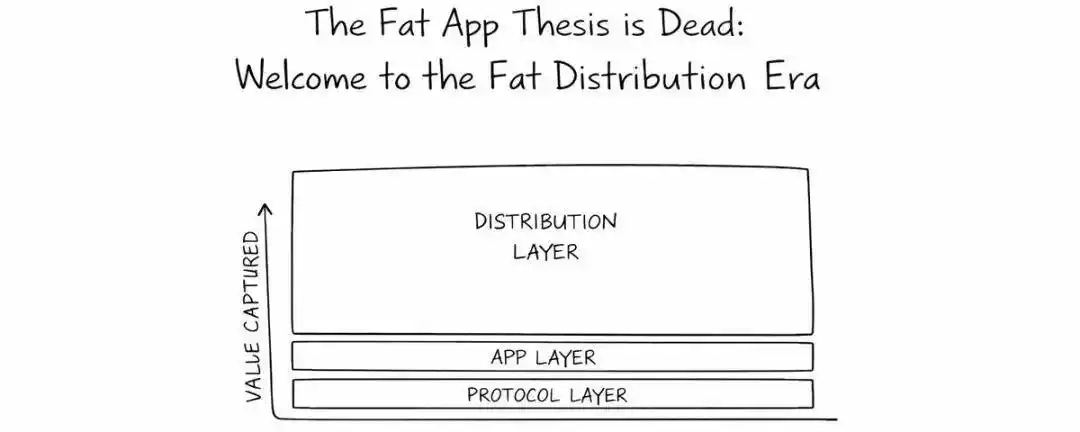
"Fat Apps" Are Dead, Welcome to the Era of "Fat Distribution"

The article "Fat Apps Are Dead, Welcome to the Era of Fat Distribution" argues that crypto applications are becoming commoditized infrastructure, shifting value from the applications themselves to the distribution channels and front-end interfaces that control user access. The author traces the evolution of value accumulation theories in crypto, from the 2016 "Fat Protocol" thesis (value accrues to base layers like Ethereum) to the 2022 "Fat App" thesis (value accrues to applications like Uniswap that built liquidity and user experience). By 2025, the thesis has shifted again. Excessive investment in infrastructure has led to diminishing returns; technical improvements (e.g., minor reductions in oracle costs or interest rate optimizations) are now imperceptible to end-users. Users prioritize familiar interfaces over marginally better backend performance. Consequently, applications like Aave and Morpho are increasingly focusing on B2B partnerships, embedding their services as backends within other platforms (e.g., traditional fintech apps like Robinhood). The author posits that convincing an existing platform to integrate a feature is far easier than onboarding millions of new users to complex, native crypto workflows. A case study illustrates this: Coinbase directs its users' borrowing activity to Morpho on Base, even though competitors offer better rates, because the seamless, integrated user experience within the Coinbase app is more valuable to customers than optimizing for cost. The article concludes that while some apps will remain B2C, the new competitive moat is no longer liquidity or crypto-native UX, but rather control over distribution. The platforms that own the front-end and user relationships will capture the majority of the value.

marsbit12/19 07:55

"Fat Apps" Are Dead, Welcome to the Era of "Fat Distribution"

marsbit12/19 07:55

活动图片