Stop Grinding Mindlessly, the Best Airdrops Are Often 'Unexpected Encounters'

marsbitОпубликовано 2026-01-20Обновлено 2026-01-20

Введение

The article argues that the most valuable crypto airdrops are often "unexpected" and not the result of grinding tedious, predefined tasks. Instead, the best strategy is to build a genuine on-chain footprint by actively using protocols you believe in. Past examples like TIA, DYM, and Monad rewarded active users on various chains and in top protocols, not just those who farmed points. Publicized criteria for points programs are often exploited by Sybil attackers, diluting rewards and leading to burnout and disappointment when expectations aren't met. In contrast, retroactive airdrops with hidden criteria have less competition, as incentive-chasers avoid uncertain rewards. The core logic is that projects value real, high-value on-chain activity over low-value, repetitive Sybil behavior. By focusing on authentic engagement rather than farming, users can build a strong on-chain reputation, avoid being filtered out as a Sybil, and be pleasantly surprised by future airdrops.

Author: FIP Crypto

Compiled by: Deep Tide TechFlow

Deep Tide Intro: In the current landscape of airdrop frenzy and rampant points systems, many investors are experiencing "grinding fatigue." This article proposes a counterintuitive airdrop strategy: the best airdrops aren't "grinded" for; they are encountered unexpectedly through genuine on-chain interactions.

By analyzing cases like Monad, ZKsync, and Base, the author reveals the core logic behind retrospective airdrops—project teams value on-chain footprints that generate real value more than mechanical Sybil behavior. If you feel your airdrop returns are being diluted, this article will teach you how to build a genuine on-chain reputation for efficient, low-pressure earning.

Main Text:

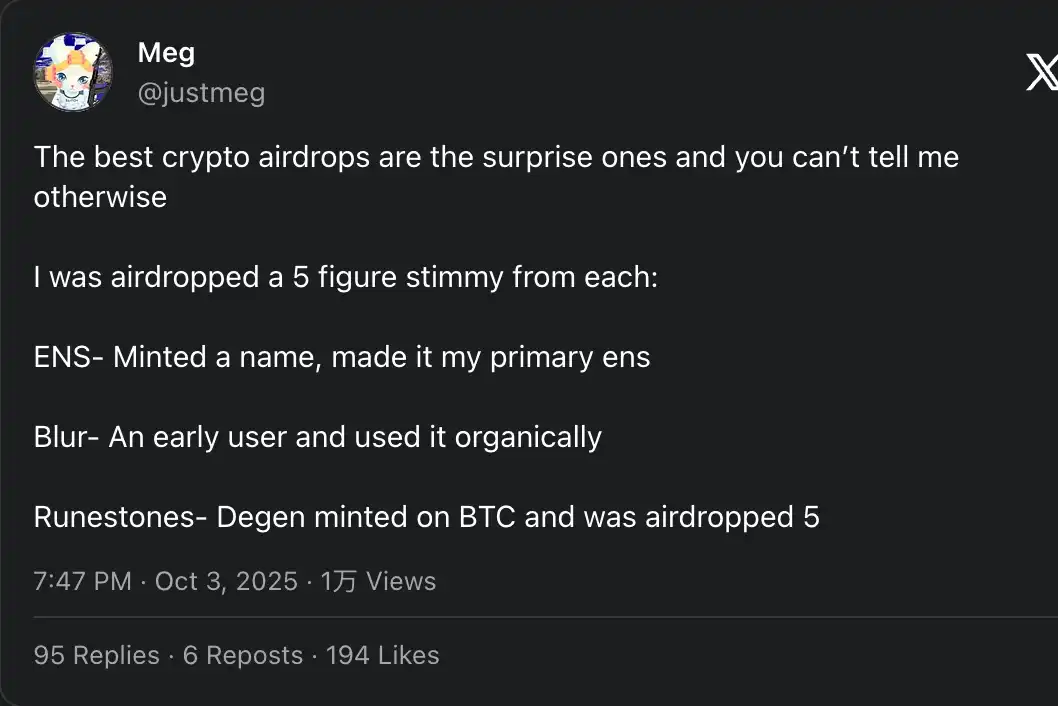
Not all airdrops require endless "grinding," and the ones that don't are often the highest quality.

I've tried various types of airdrops, and many left me utterly exhausted.

But I realized the smartest way to get airdrops is actually not to deliberately "farm" them.

Here is the strategy I currently employ, aimed at "accidentally" getting the highest rewards with minimal effort:

We Get Rewarded for Being Active On-Chain

Not every project does this, but some projects distribute airdrops to active on-chain users.

Here are some examples of past retrospective airdrops:

  • TIA and DYM: Rewarded stakers in the Cosmos ecosystem and active L2 users.
  • AVAIL: Rewarded active L2 users, including Starknet users.
  • PENGU: Rewarded wallets with strong activity records on Ethereum and Solana.
  • MegaETH: SBT eligibility was based on our on-chain contributions.
  • Monad: Rewarded significant traders and depositors in top Ethereum and Solana protocols (they defined this as users who provided substantial value on-chain).

Following @Zeneca's airdrop philosophy, as long as we keep an open mind and explore new things on-chain, airdrops will come naturally.
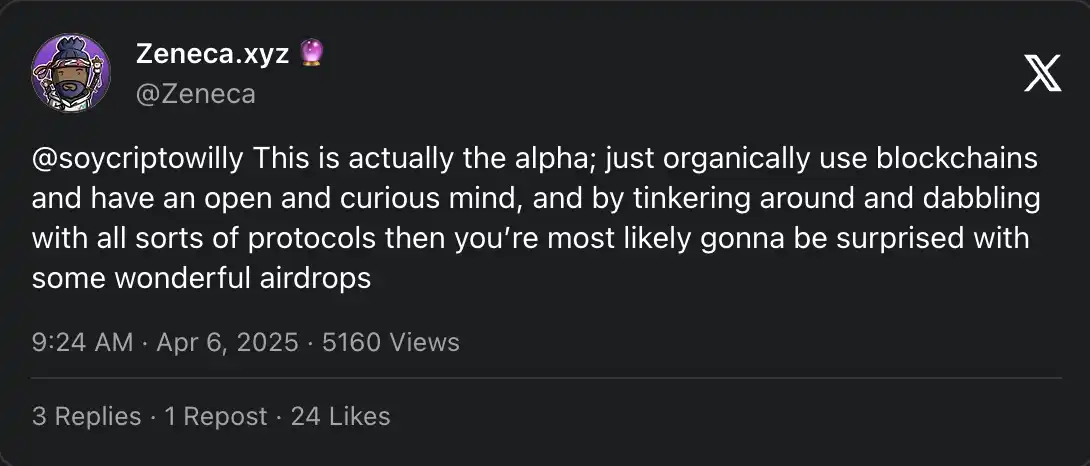
Our footprint makes us eligible for various airdrops simply by interacting with protocols we like.
No One Knows the Criteria

Points programs with clear criteria are boring because the project team directly tells you how to grind them.

One of the most "notorious" projects is MarginFi, which ran a points program for months (or even years?) without ever revealing any token details.

But this is the trap of any points program:

No one promises you anything, and the activity can go on forever.

They can change the rules at any time; that's the game we're playing.

If the sole purpose is to hard-grind a project for an airdrop, many people get frustrated.

When our expectations for airdrop returns are too high:

We are setting ourselves up for massive disappointment.

These programs are also heavily manipulated by Sybils, which further dilutes the allocation.

Meanwhile, retrospective airdrops do not publicly share their criteria.

We can compare the criteria used by two different L2s:

  • ZKsync used Time-Weighted Average Balance (TWAB), but only announced it after the snapshot.
  • Scroll used Marks points across multiple campaigns.

Both used similar factors (liquidity) to determine eligibility.

But Scroll didn't perform well except for favoring whales, while ZKsync was quite lucrative if you had the right strategy.

Many are still angry about missing ZKsync eligibility, but in reality, we could have qualified even with a small amount of capital.

We Have Less Competition

When there's so much uncertainty, no one likes to farm airdrops.

The ideal scenario is like Base or Arbitrum:

Actively denying they will issue a token, until they change their minds and decide to issue one.
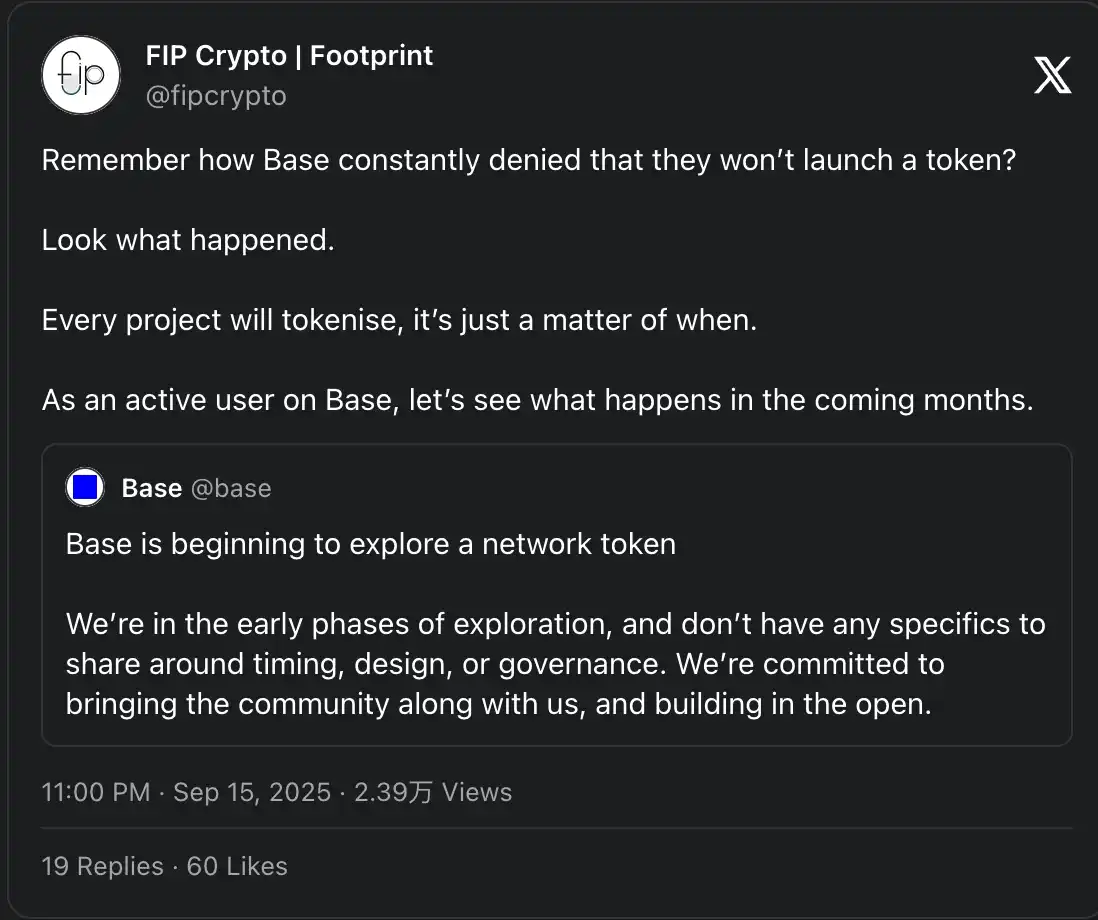
Therefore, fewer wallets actively participate because those solely chasing incentives won't join.

Or they might drop out halfway, as it doesn't make sense from a Return on Investment (ROI) perspective to farm this project.

Optimism's 5th airdrop was a huge surprise for me; it turned out only 54,723 wallets were eligible.
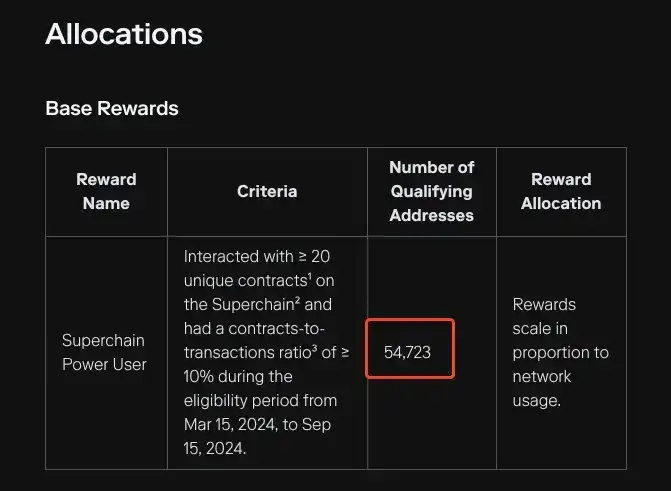
Many will adopt a wait-and-see attitude, questioning if it's worth interacting without guarantees.

But the real reward comes from uncertainty:

We risk our time and capital based on our convictions, which could be a failure or a highly rewarding investment.

Even if we fail, it helps us further optimize our strategy and understand what to avoid in the future.

We Don't Get Burned Out

I've been asked countless times which are the best projects to farm.

We are always looking for the next farm, and after the token dump, the next one.

But sometimes, the best way to play airdrops is to use products you enjoy.

Who would have thought that staying active on Aave or Uniswap would make us eligible for a Monad airdrop?
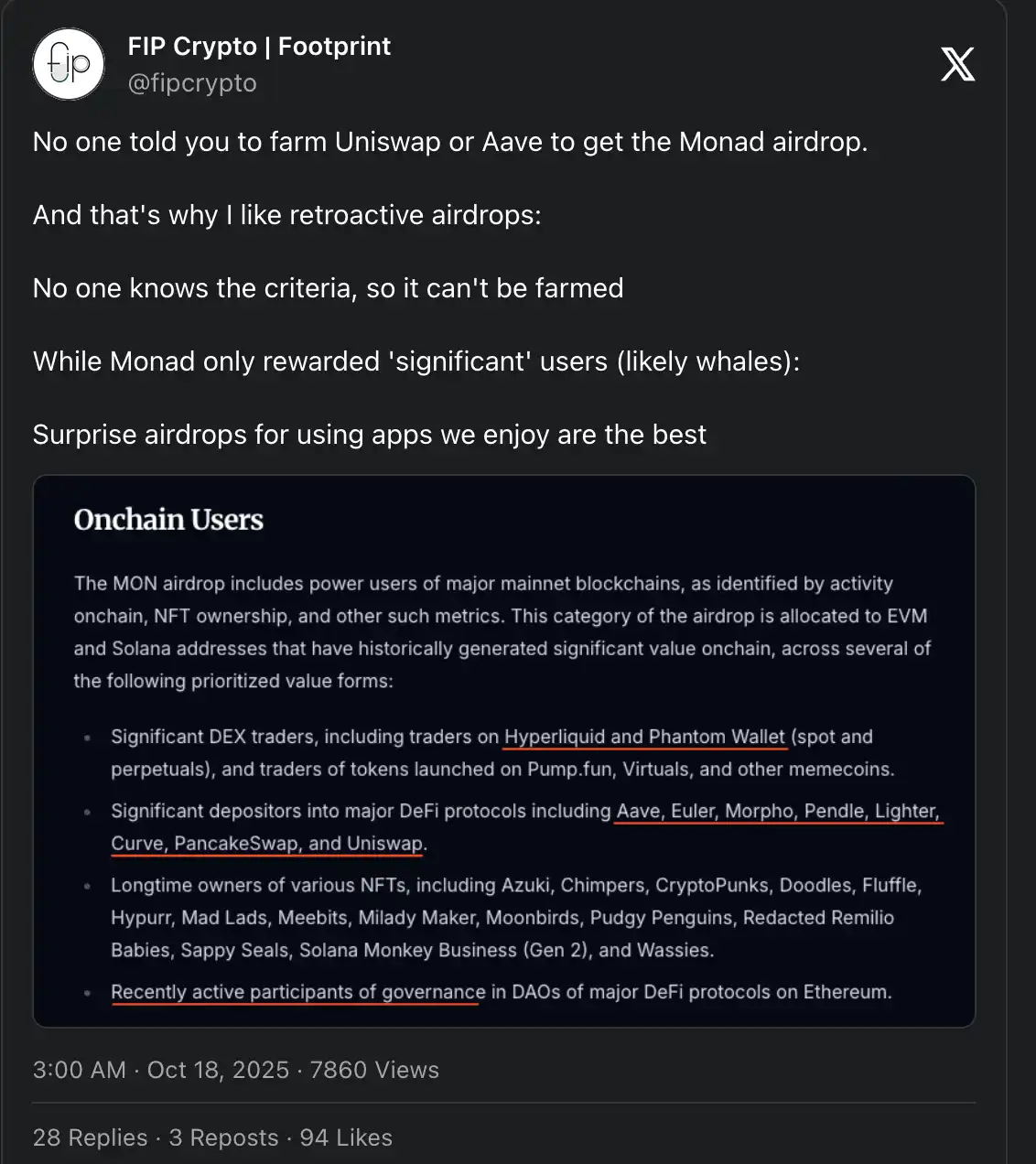
I've been burned out multiple times from constantly searching for the next Alpha.

But if we can get rewarded based on our on-chain footprint:

The real Alpha is interacting with protocols we enjoy using and profiting from in the process.
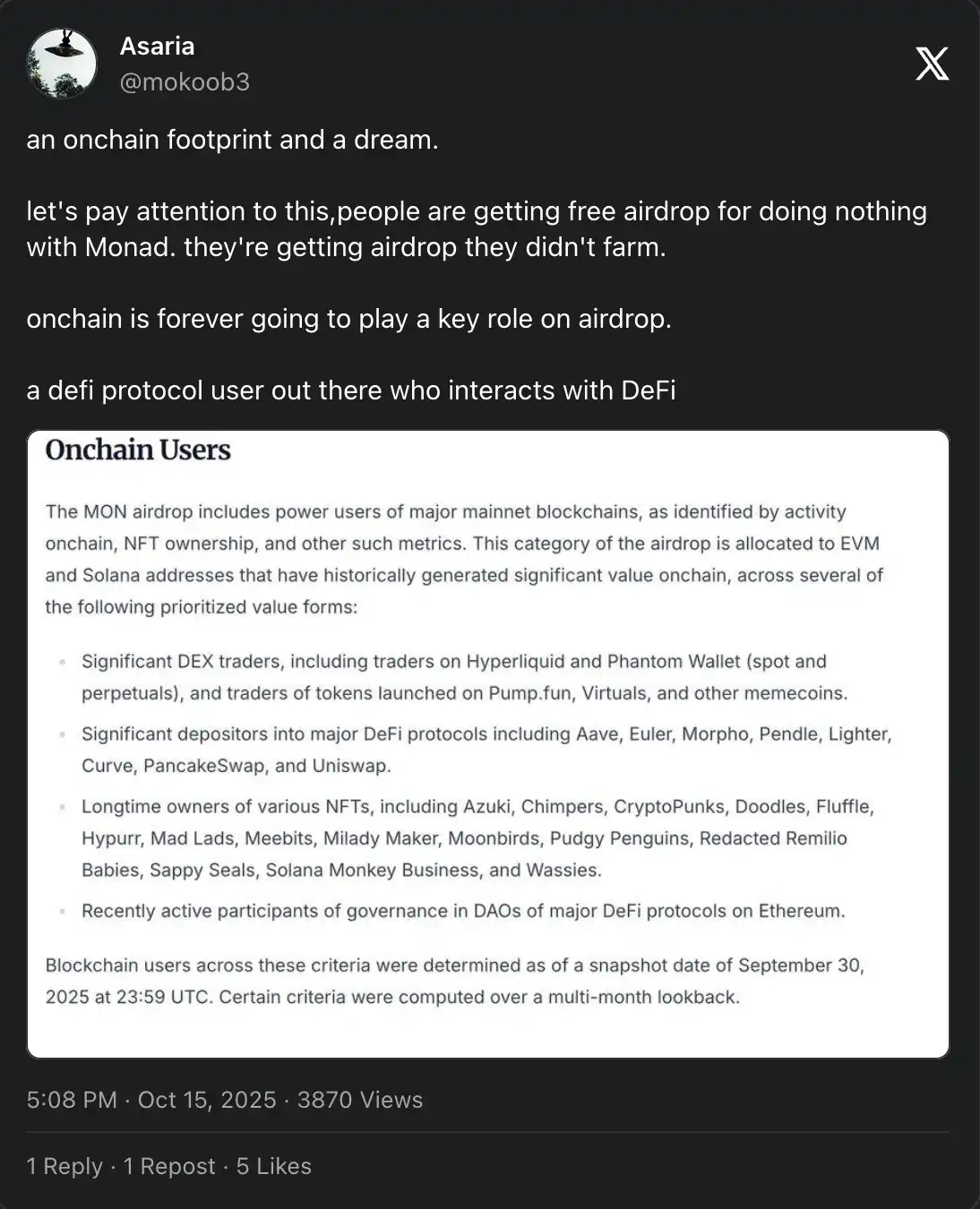
Focusing too much on the end result leads to disappointment.

Receiving surprise airdrops keeps us motivated to continue exploring on-chain.

Sybil Attacks Can't Game the System

Sybil farms mimic real users by performing the most basic operations to gain eligibility.

There will always be Sybils trying to extract value from projects.

But projects using retrospective criteria can adjust rules to filter out Sybils.

Of course, these are never perfect:

  • Real users get falsely filtered out.
  • Some Sybils get allocations.

It's hard to balance between the two; someone always gets left out.

On our end, we can try our best not to be filtered out as Sybils.

It all starts with this principle:

Value is the Primary Criterion

Retrospective airdrops are distributed based on the value your wallet provides.

Monad described it as "addresses that have historically generated significant value on-chain across different forms of value."

If we do the same low-value tasks as Sybils:

We get flagged and lose eligibility.

Project teams don't want to reward farmers who repeatedly make the same low-value swaps.

Instead, they reward high-value contributions.

But there are no strict rules for this; project teams decide which behaviors they want to reward.

So, to be eligible, we just need to find applications we like and use them consistently.

Our footprint will be recognized by other projects, and we'll get rewarded for using applications we enjoy.

Building a Strong On-Chain Social Footprint

The on-chain footprint has been declared dead by many, but I still believe it plays a key role in future airdrops.

Even though airdrops now heavily lean towards social distributions:

The on-chain footprint still forms the foundation of trust for your social reputation.

Others can easily tell if you're faking it or genuinely participating, so there's no point in trying to lie.

You just need to talk about what you've done on-chain to increase your "surface area for luck."

Связанные с этим вопросы

QWhat is the core argument of the article regarding the best strategy to receive airdrops?

AThe article argues that the best airdrops are not obtained through deliberate, repetitive 'farming' but are instead 'unexpectedly' received through genuine, valuable on-chain activity and interaction with protocols one genuinely likes and uses.

QAccording to the author, what is a key advantage of public points programs for airdrops?

AA key disadvantage of public points programs is that they are heavily manipulated by Sybil attacks, which dilutes the rewards for genuine users, and the projects can change the rules at any time with no guarantee of a token distribution.

QHow do retrospective airdrops, like the one from Monad, differ from public points programs?

ARetrospective airdrops do not publicly share their criteria beforehand. They are distributed based on the value a wallet's historical on-chain activity provided, rewarding genuine users rather than low-value, repetitive actions common in Sybil farming.

QWhy does the author suggest that having less competition is beneficial for receiving airdrops?

ALess competition arises when a project's token distribution is uncertain (e.g., Base, Arbitrum initially denying a token). This discourages users who are only motivated by guaranteed incentives, leaving more rewards for those who interact with the protocol based on genuine belief.

QWhat is the recommended way to build a strong on-chain reputation to qualify for future airdrops?

AThe recommended way is to establish a genuine on-chain footprint by actively exploring and consistently using new protocols and applications that you genuinely like, as this valuable activity is what project teams look to reward.

Похожее

The Largest IPO in History Ignites Heated Debate: Is SpaceX Worth $1.77 Trillion?

SpaceX's potential IPO is priced at $135 per share, aiming to raise $75 billion and valuing the company at approximately $1.77 trillion, which would make it the largest IPO in history. This valuation has sparked intense debate among investors. Bullish analysts, including major underwriters Goldman Sachs and Morgan Stanley, argue the valuation is justified by SpaceX's long-term potential. They see it not just as a rocket company but as a future leader in space infrastructure, with key growth drivers being Starlink satellite internet, low-cost rocket launches, and future AI-related ventures. They project revenues reaching hundreds of billions to trillions of dollars by 2030-2040. ARK Invest's model suggests a 2030 enterprise value could reach $2.5 trillion. Bearish analysts from independent research firms like Morningstar, PitchBook, and New Constructs contend the IPO price is excessively high, already pricing in unrealistic future growth. Using DCF and sum-of-the-parts models, they estimate fair value between $780 billion and $1.7 trillion, significantly below the IPO target. They highlight risks such as the speculative nature of AI projections, over-dependence on Elon Musk, high growth expectations, and corporate governance concerns. Trefis set a target price of just $79 per share. While both sides acknowledge SpaceX's unique position in commercial space, the core disagreement centers on whether the $135 share price offers a reasonable margin of safety or is overly optimistic. Despite the valuation controversy, reported strong demand for the IPO indicates significant market interest.

marsbit48 мин. назад

The Largest IPO in History Ignites Heated Debate: Is SpaceX Worth $1.77 Trillion?

marsbit48 мин. назад

After the Passage of the GENIUS Act and the CLARITY Act, What Is the Correct Architecture for On-Chain Yield?

The article discusses the evolution of on-chain credit, distinguishing three markets: overcollateralized crypto lending, unsecured lending (largely unsuccessful), and asset-backed credit (ABC). ABC, backed by identifiable real-world collateral with legal recourse, is identified as the fastest-growing category and the only one credibly addressing adverse selection—the core problem in credit where the riskiest borrowers self-select. Current growth in on-chain Real World Assets (RWAs), particularly tokenized private credit funds (e.g., Maple Finance, Centrifuge), is substantial but often merely "wraps" existing fund structures, inheriting their risks rather than solving adverse selection at the protocol level. The regulatory landscape is a key driver, with the US GENIUS Act (prohibiting stablecoin issuers from paying yield) and the proposed CLARITY Act (closing loopholes on indirect yield) set to redefine permissible yield-bearing products. This makes vaults (like ERC-4626) the critical architecture—they become the primary compliant vehicle for delivering yield, functioning as issuance, disclosure, distribution, and recovery mechanisms. The author's thesis is that the correct post-GENIUS/CLARITY architecture involves building ABC solutions where credit assessment, structure, and recovery are encoded directly into the smart contract vault layer, moving beyond mere tokenized fund wrappers to solve adverse selection fundamentally and ensure regulatory compliance.

Foresight News1 ч. назад

After the Passage of the GENIUS Act and the CLARITY Act, What Is the Correct Architecture for On-Chain Yield?

Foresight News1 ч. назад

TechFlow Intelligence Bureau: Anthropic's New Model Fable Sparks Controversy by Restricting Biosafety Research, US CPI Soars to 4.2%, a Three-Year High

**Summary of TechFlow Intelligence Report:** The newsletter covers several key tech and finance developments. In AI, Anthropic's new Fable model faced backlash for secretly limiting biomedical research capabilities and enforcing a 30-day data retention policy, prompting the company to promise more transparent adjustments. In a related story, Anthropic's founder revealed his departure from OpenAI was due to dishonesty from Sam Altman, not safety concerns. Meanwhile, OpenAI is considering significant price cuts to compete with Anthropic, potentially sparking a price war. In crypto/Web3, BlackRock filed a new amendment for a yield-generating Bitcoin ETF, while Bank of America's CEO warned that stablecoin yields could drain trillions from traditional banks. U.S. Senator Cynthia Lummis advocated for the U.S. to officially accumulate Bitcoin reserves. In hardware, Nvidia released the DiffusionGemma-2-6B image model optimized for efficient inference, and AMD promoted its unified memory architecture to challenge Nvidia's dominance. TSMC's CFO hinted at possible price increases due to soaring AI chip demand. A major legal ruling in Germany held Google legally responsible for inaccurate information generated by its AI Overviews feature. Google Chrome also moved to fully block ad-blocker workarounds like uBlock Origin. Macroeconomic headlines included U.S. CPI rising to 4.2% (a 3-year high) and Iran's complete closure of the Strait of Hormuz, raising oil price and inflation fears. South Korean markets saw continued volatility with massive foreign capital outflow. Other notable stories: Microsoft expanded its Copilot AI assistant "Mico" globally; a study found r/wallstreetbets users' stock picks outperformed Wall Street; a fully autonomous drone killed a human soldier for the first time, raising AI ethics concerns; and a Chinese hospital used brain-computer interface technology to help a blind person "see." The overarching theme connects debates over AI boundaries and responsibility (Anthropic's restrictions, Google's liability, lethal autonomous drones) with real-world economic and geopolitical turmoil (inflation, Strait of Hormuz closure, market instability), highlighting the tense interplay between technological advancement and global chaos.

marsbit1 ч. назад

TechFlow Intelligence Bureau: Anthropic's New Model Fable Sparks Controversy by Restricting Biosafety Research, US CPI Soars to 4.2%, a Three-Year High

marsbit1 ч. назад

Alibaba's Yet Another New Business Division: What Signal Does It Send?

Alibaba has established a new "Token Foundry" business unit, merging its Tongyi large model division and Future Life Lab. Led directly by Group CEO Wu Yongming, this marks the company's third significant AI organizational reshuffle in 2026, following the creation of the Alibaba Token Hub (ATH) and a Group Technology Committee. The move signals a strategic shift from consolidating AI resources to accelerating productization and commercialization. The "Token Foundry" name reflects Alibaba's ambition to become a foundational supplier in the AI era, focusing on model development and commercial application. Key teams, including those behind the high-performing HappyHorse video generation model, have been integrated into the new unit. Concurrently, Zhou Jingren, architect of the Qwen model series, has been appointed Group Chief Scientist to lead a new AI Future Research Institute, focusing on long-term technological breakthroughs like Agent capabilities. This restructuring creates a clear four-layer AI architecture within Alibaba: the research institute for frontier exploration, Token Foundry for core models and commercialization, MaaS for platform services, and business units like Qianwen (C端) and Wukong (B端) for end-user applications. The adjustments align with a global trend among tech giants like Google and Microsoft to centralize AI leadership under the CEO and deeply integrate research with business units. The urgency is driven by a narrowing competitive window. Alibaba has announced its AI business is now entering a commercialization phase, with AI-related revenue seeing triple-digit growth for eleven consecutive quarters. The company faces intense competition in the MaaS (Model-as-a-Service) sector from rivals like ByteDance and Tencent. The Token Foundry initiative represents Alibaba's effort to streamline execution and enhance competitiveness in this critical, fast-evolving landscape.

marsbit2 ч. назад

Alibaba's Yet Another New Business Division: What Signal Does It Send?

marsbit2 ч. назад

Торговля

Спот
Фьючерсы
活动图片