Solana under ‘industrial scale’ DDoS attack: Co-founder says it’s ‘bullish’

cointelegraphОпубликовано 2025-12-16Обновлено 2025-12-16

Введение

Solana has been hit by a large-scale distributed denial-of-service (DDoS) attack, with traffic reportedly peaking near six terabits per second (Tbps), as stated by co-founder Anatoly Yakovenko and others in the ecosystem. Yakovenko described the attack as "bullish," suggesting that the attacker spent as much as the chain generates in revenue. Despite the massive scale, the network reportedly showed no significant signs of stress, such as latency or delays. This is not the first time Solana has faced such issues; the network has a history of downtimes, including several in 2022 due to bugs and transaction overloads. However, downtime incidents have decreased in recent years. In comparison, Bitcoin has maintained over 99.99% uptime, with only two major downtime events since 2009. The article highlights Solana’s ongoing challenges with stability despite improvements, contrasting its performance with Bitcoin’s reliability.

Solana co-founder Anatoly Yakovenko and several accounts tied to the network’s ecosystem said this week that Solana has been hit by a large distributed denial-of-service attack, with some posts citing traffic that peaked near six terabits per second (Tbps).

Yakovenko wrote in a Dec. 9 X post that Solana was under a six Tbps distributed denial-of-service (DDoS) attack. Earlier today, Solana Labs co-founder and president Raj Gokal suggested the attack was still ongoing. Cointelegraph was unable to independently verify the attack or its scale.

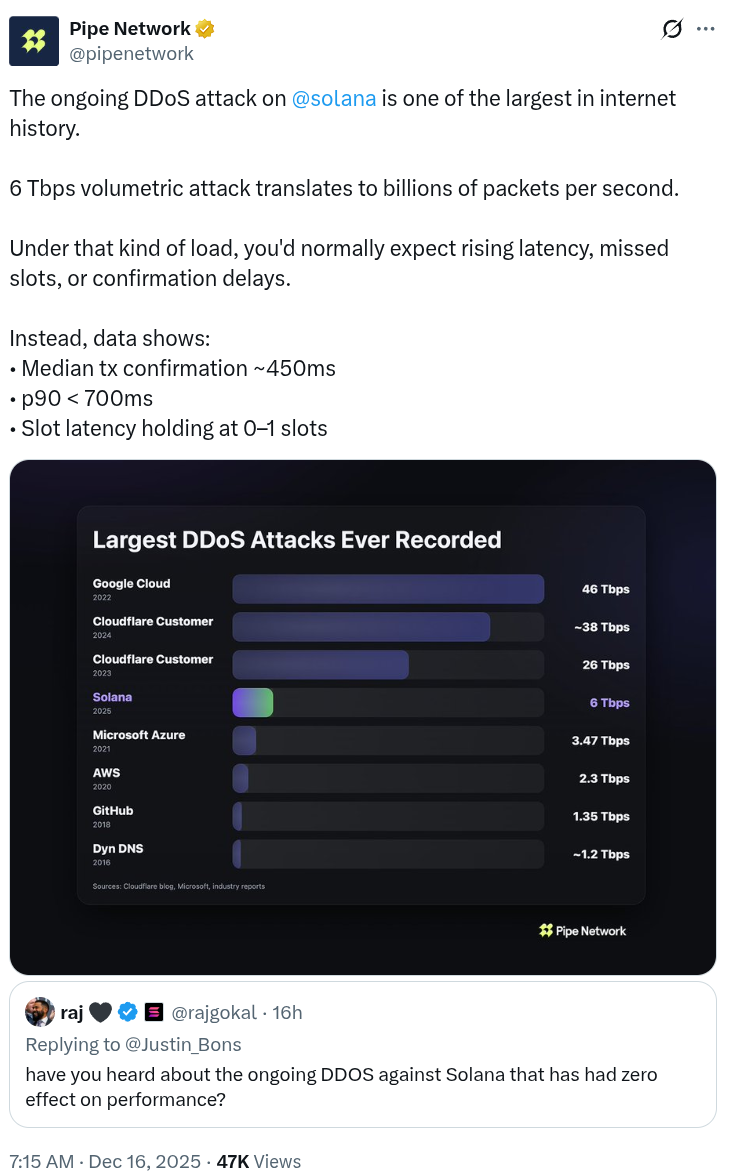
On Monday, the CEO of Solana-based decentralized physical infrastructure network (DePIN) project Pipe Network, David Rhodus, pointed out that the shared metric puts the attack at an “industrial-scale.” In a Monday update, Pipe Petwork also claims that the attack is “one of the largest in internet history” since six Tbps “translates to billions of packets per second.”

A “bullish” attack, co-founder says

A DDoS attack involves many devices flooding a target with traffic to overwhelm it and knock it offline or slow it down. A chart shared by Pipe Network suggests that Solana has faced the fourth-largest DDoS attack ever reported. Still, in 2025 alone, Cloudflare reported a 29.7 Tbps attack, KrebsOnSecurity reported a 6.3 Tbps attack, and Gcore disclosed a six Tbps attack, with none appearing on Pipe Network’s chart.

Yakovenko wrote in a Dec. 9 post that the attack is bullish, also suggesting that “someone is spending as much as the chain makes in revenue to send it.” Similarly, Pipe Network highlights that “under that kind of load, you’d normally expect rising latency, missed slots, or confirmation delays” while the network is not showing any significant signs of stress.

Source: Pipe Network

Solana Labs had not answered Cointelegraph’s request for comment by publication.

Related: Coinbase fixes Solana transaction backlog after 48-hour delay

Solana outage history and fixes

Solana has a history of multiple downtimes, some of which are tied to DDoS-like causes. In December 2020, a block propagation bug halted the network operation. Back in September 2021, Solana’s mainnet saw a 17-hour downtime as Grape Protocol’s launch of its onchain initial DEX offering (IDO) on the crowdfunding platform Raydium AcceleRaytor overwhelmed the network, much like a DDoS would.

In 2022, Solana saw three downtime instances. First, it experienced seven hours of downtime due to transaction spam from bot accounts, then the network saw four and a half hours of downtime due to a bug that caused a consensus failure. Again in 2022, Solana experienced 8.5 hours of downtime due to a bug in the fork choice rules, resulting in consensus failure.

This is where the network stability seemed to pick up slightly. Cointelegraph was able to locate only one instance of downtime in 2023, when, in late February, a fault in Solana’s deduplication logic led to almost 19 hours of downtime. In 2024, the network again saw only one downtime instance when it went down for nearly five hours due to a bug causing an infinite recompile loop.

Related: Solana users hit by delays after Trump memecoins debut

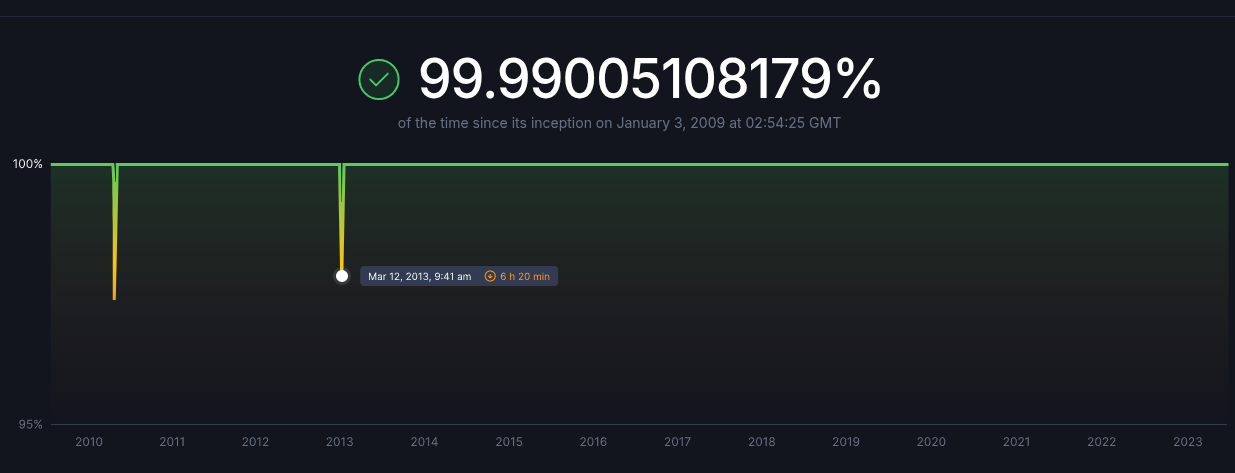
Despite the clear downtrend, this is a lot of downtime for blockchain standards. Bitcoin (BTC), the world’s first blockchain, currently has an uptime of over 99.99%, with the last downtime incident taking place in 2013.

Bitcoin has seen only two downtime incidents since its first block was mined in January 2009. The first one took place in August 2010, when a value-overflow bug was exploited, briefly creating nearly 184.47 billion BTC until a patch reversed the issue. The second one happened in March 2013, when a bug split the network between Bitcoin Core 0.7 and 0.8. The 2013 event did not create new Bitcoin.

Bitcoin uptime chart. Source: BitBo

Похожее

Huang Renxun Dramatically 'Saves' South Korean Stock Market

In early June, South Korea's stock market experienced a sharp decline, with the KOSPI index dropping over 5% and triggering a trading halt. Amid this volatility, NVIDIA CEO Jensen Huang's visit to Seoul provided a dramatic boost to market sentiment. During his trip, Huang held a dinner meeting with SK Group Chairman Chey Tae-won and SK Hynix CEO Kwak Noh-Jung. He announced that NVIDIA's new Vera CPU would utilize SK Hynix DRAM and confirmed a multi-year technical collaboration between the two companies. This partnership aims to co-develop next-generation memory for NVIDIA's AI infrastructure roadmap, covering products from data center supercomputers to personal AI devices. Huang also publicly commented that AI company stocks were attractively priced. A key announcement was that NVIDIA's upcoming Vera Rubin AI supercomputer systems will use HBM4 memory, with supply qualifications granted to all three major suppliers: SK Hynix, Samsung Electronics, and Micron Technology. Despite this multi-sourcing strategy, Huang warned that the industry-wide chip shortage, affecting everything from wafers to packaging, is expected to persist for several years due to relentless demand from global AI factory construction. The collaboration extends beyond memory supply. SK Hynix will employ NVIDIA's AI platforms and Omniverse digital twin technology to enhance its own semiconductor design, simulation, and manufacturing processes, aiming for more autonomous factory operations. This visit builds upon a prior October 2025 agreement for SK Group to build a large-scale AI data center using over 50,000 NVIDIA GPUs. Huang's itinerary also included meetings with other Korean giants like Hyundai, LG, and Samsung, indicating NVIDIA's broader strategy to deepen ties with South Korea's tech industry.

链捕手2 ч. назад

Huang Renxun Dramatically 'Saves' South Korean Stock Market

链捕手2 ч. назад

When Inference Becomes a Scarce Resource, Who Captures the Value?

When Inference Becomes the Scarce Resource, Who Captures the Value? The core AI bottleneck has shifted from model training to inference (runtime execution). While concerns persisted about an "AI compute gap"—initially a $200B, now a $600B problem—the market is now recognizing that the solution and value lie in the inference layer. Nvidia's financial restructuring around "serving tokens" and Cerebras's successful IPO highlight this shift. Inference is a recurring, usage-based cost, estimated to be 10-50x larger than the one-time training market, especially with the rise of agentic AI. The inference stack spans six layers: silicon (e.g., Nvidia), bare metal (e.g., CoreWeave), GPU rental/aggregation, deployment/optimization, model APIs, and end applications. Most companies operate in one layer. However, Hyperbolic uniquely spans three layers (GPU rental, deployment, and model APIs) without owning any hardware. It aggregates fragmented GPU supply from multiple cloud providers into a standardized pool, offering developers the cheapest available compute through intelligent routing. Its multi-cloud aggregation creates a data moat and a flywheel: more supply leads to better pricing data and liquidity, attracting more developers and providers. In contrast, applications like Venice operate at the top of the stack, reselling privacy-wrapped inference but remaining dependent on and constrained by the underlying compute costs they purchase. As inference demand explodes, value accrues not just to consumer applications but increasingly to the aggregation and routing layer that captures their cost of revenue. The coming potential GPU oversupply reinforces this dynamic. While hardware owners may suffer from depreciation, asset-light aggregators like Hyperbolic benefit from price arbitrage, routing workloads to the cheapest available capacity. The ultimate winner in the inference economy may not be the entity with the most GPUs, but the one that can most efficiently discover, aggregate, and route the world's fragmented compute.

链捕手2 ч. назад

When Inference Becomes a Scarce Resource, Who Captures the Value?

链捕手2 ч. назад

Торговля

Спот
Фьючерсы

Популярные статьи

Как купить S

Добро пожаловать на HTX.com! Мы сделали приобретение Sonic (S) простым и удобным. Следуйте нашему пошаговому руководству и отправляйтесь в свое крипто-путешествие.Шаг 1: Создайте аккаунт на HTXИспользуйте свой адрес электронной почты или номер телефона, чтобы зарегистрироваться и бесплатно создать аккаунт на HTX. Пройдите удобную регистрацию и откройте для себя весь функционал.Создать аккаунтШаг 2: Перейдите в Купить криптовалюту и выберите свой способ оплатыКредитная/Дебетовая Карта: Используйте свою карту Visa или Mastercard для мгновенной покупки Sonic (S).Баланс: Используйте средства с баланса вашего аккаунта HTX для простой торговли.Третьи Лица: Мы добавили популярные способы оплаты, такие как Google Pay и Apple Pay, для повышения удобства.P2P: Торгуйте напрямую с другими пользователями на HTX.Внебиржевая Торговля (OTC): Мы предлагаем индивидуальные услуги и конкурентоспособные обменные курсы для трейдеров.Шаг 3: Хранение Sonic (S)После приобретения вами Sonic (S) храните их в своем аккаунте на HTX. В качестве альтернативы вы можете отправить их куда-либо с помощью перевода в блокчейне или использовать для торговли с другими криптовалютами.Шаг 4: Торговля Sonic (S)С легкостью торгуйте Sonic (S) на спотовом рынке HTX. Просто зайдите в свой аккаунт, выберите торговую пару, совершайте сделки и следите за ними в режиме реального времени. Мы предлагаем удобный интерфейс как для начинающих, так и для опытных трейдеров.

1.4k просмотров всегоОпубликовано 2025.01.15Обновлено 2026.06.02

Как купить S

Sonic: Обновления под руководством Андре Кронье – новая звезда Layer-1 на фоне спада рынка

Он решает проблемы масштабируемости, совместимости между блокчейнами и стимулов для разработчиков с помощью технологических инноваций.

2.3k просмотров всегоОпубликовано 2025.04.09Обновлено 2025.04.09

Sonic: Обновления под руководством Андре Кронье – новая звезда Layer-1 на фоне спада рынка

HTX Learn: Пройдите обучение по "Sonic" и разделите 1000 USDT

HTX Learn — ваш проводник в мир перспективных проектов, и мы запускаем специальное мероприятие "Учитесь и Зарабатывайте", посвящённое этим проектам. Наше новое направление .

1.8k просмотров всегоОпубликовано 2025.04.10Обновлено 2025.04.10

HTX Learn: Пройдите обучение по "Sonic" и разделите 1000 USDT

Обсуждения

Добро пожаловать в Сообщество HTX. Здесь вы сможете быть в курсе последних новостей о развитии платформы и получить доступ к профессиональной аналитической информации о рынке. Мнения пользователей о цене на S (S) представлены ниже.

活动图片