Solana Recovery Narrative Strengthens as RWA Market Hits $1.15B and Regulation Turns Positive

bitcoinistОпубликовано 2026-02-05Обновлено 2026-02-05

Введение

Solana's (SOL) recent price decline below $100 has not diminished its broader recovery narrative. Despite a 25% drop from recent highs, key support near $95–$100 is holding, with technical indicators suggesting potential for a rebound toward $150 or higher. On-chain fundamentals are strengthening, with Total Value Locked reaching a record 73.4 million SOL ($7.5 billion) and daily transactions exceeding 100 million. The real-world asset (RWA) market on Solana has grown to $1.15 billion, supported by its low-cost, high-throughput infrastructure. Standard Chartered adjusted its 2026 SOL price target to $250 but raised its 2030 forecast to $2,000, citing Solana's advantages in micropayments, stablecoin transfers, and improving regulatory clarity.

Solana’s (SOL) recent price weakness has not erased the broader recovery narrative forming around the network. While SOL continues to trade below the psychologically important $100 level after a sharp pullback from January highs, on-chain data and institutional forecasts suggest the blockchain’s long-term positioning is improving.

Related Reading: Elon Musk Revives ‘Dogecoin To The Moon’ With Hint For 2027

Growing real-world asset (RWA) activity, record network usage, and a more constructive regulatory backdrop are increasingly shaping analysts’ views of Solana’s next phase.

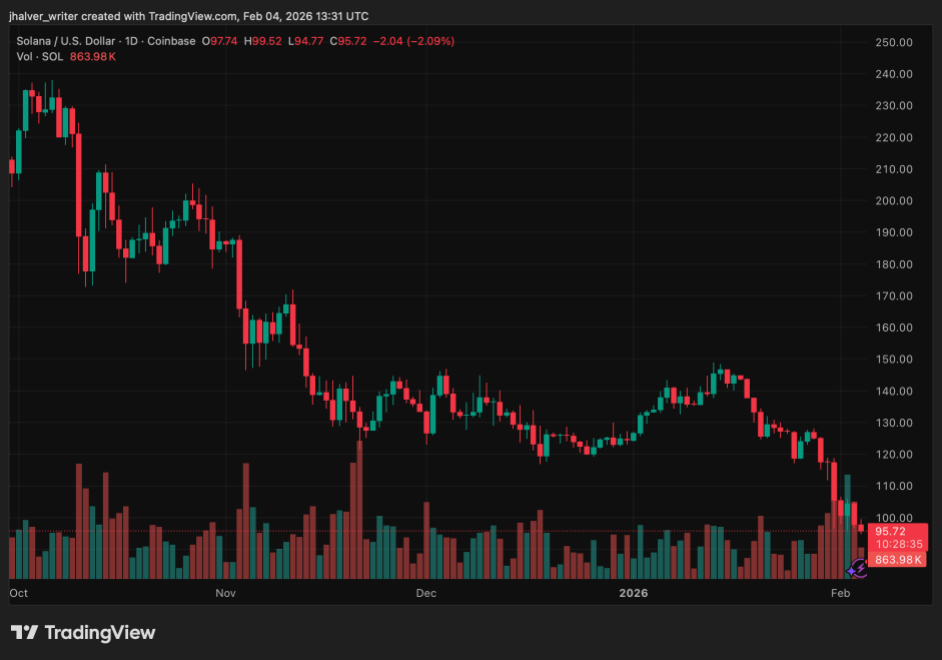
SOL's price trends to the downside on the daily chart. Source: SOLUSD on Tradingview

Price Pressure Persists, But Key Support Holds

SOL has fallen roughly 25% from recent highs near $127, slipping below $100 amid broader crypto market risk-off sentiment. Technical indicators still reflect caution, with bearish momentum dominating short-term charts and some analysts warning of a possible drop toward the $85 area if support near $95 fails.

That said, the $95–$100 zone has repeatedly acted as a major demand area in past market cycles. The daily relative strength index has dipped into oversold territory, a condition that has previously coincided with local bottoms for SOL.

Several technical analysts note that a sustained defense of this range could open the door to a recovery toward the $150 region, with more optimistic scenarios extending toward $215–$260 if resistance levels are reclaimed.

Network Activity And RWA Growth Support The Thesis

Despite price volatility, Solana’s on-chain fundamentals continue to strengthen. Total value locked recently reached an all-time high of 73.4 million SOL, equivalent to roughly $7.5 billion, marking an 18% weekly increase.

On the other hand, daily transactions have surged above 100 million, hitting multi-year highs, while decentralized exchange volumes are also at their strongest levels in months.

Beyond DeFi metrics, the real-world asset market on Solana has expanded rapidly, with tokenized RWAs on the network now estimated at around $1.15 billion. This growth aligns with Solana’s positioning as a low-cost, high-throughput settlement layer, particularly for stablecoins and tokenized financial products.

Faster, more stablecoin-friendly turnover and consistently low transaction fees have made the network increasingly attractive for high-volume use cases.

Standard Chartered Sees Long-Term Upside

Standard Chartered has reinforced this longer-term view, cutting its end-2026 SOL price target to $250 from $310 due to near-term volatility, while raising its 2030 forecast to $2,000.

The bank cited Solana’s dominance in micropayments, stablecoin transfers, and emerging real-world applications as key drivers behind its long-range projections.

According to the bank, Solana’s ability to process large transaction volumes at minimal cost gives it an advantage as regulation around digital assets becomes clearer and more supportive.

Related Reading: Ethereum Active Addresses Near All-Time High Despite Price Plunge

While short-term price action remains uncertain, the combination of rising network usage, expanding RWA activity, and improving regulatory clarity continues to underpin Solana’s recovery narrative.

Cover image from ChatGPT, SOLUSD chart on Tradingview

Связанные с этим вопросы

QWhat are the key factors supporting Solana's recovery narrative despite recent price weakness?

AThe key factors supporting Solana's recovery narrative are growing real-world asset (RWA) activity (now at $1.15B), record network usage (daily transactions above 100M), and a more constructive regulatory backdrop.

QWhat is Standard Chartered's long-term price forecast for SOL by the year 2030?

AStandard Chartered has raised its long-term price target for SOL to $2,000 by the year 2030.

QWhat technical price level is identified as a major demand area and crucial support for SOL?

AThe $95–$100 zone is identified as a major demand area that has acted as crucial support in past market cycles.

QWhat recent milestone did Solana's Total Value Locked (TVL) achieve?

ASolana's Total Value Locked (TVL) recently reached an all-time high of 73.4 million SOL, equivalent to roughly $7.5 billion.

QAccording to the bank, what are the key drivers behind Solana's long-range growth projections?

AAccording to Standard Chartered, the key drivers are Solana's dominance in micropayments, stablecoin transfers, and emerging real-world applications, enabled by its ability to process large transaction volumes at minimal cost.

Похожее

How to Do Research Well: Deliberately Practice the Real Skills That Matter

No one truly teaches you how to do research. You're often given a desk, a pre-selected problem, and vague instructions to "create something new." Consequently, many people reverse-engineer the job based on visible outputs—papers, posts, announcements—learning only how to *appear* like a researcher rather than how to *become* one. True research capability is built from stacking small, trainable skills, nearly all of which can be developed through deliberate practice. **Pick Your Own Problem:** Most researchers absorb problems from advisors or trends, lacking the underlying reasoning. Choosing a problem you genuinely care about, as John Schulman advises, leads to original work. Develop "taste" like a muscle: predict experiment outcomes, guess paper results from methods, and track which findings remain important over time. **Upgrade Your Inputs:** Relying on shared reading lists (arXiv hot lists, filtered group chats) leads to unoriginal conclusions. Undervalued old literature often holds crucial insights (e.g., MoE, LSTM, backpropagation). Richard Sutton's "The Bitter Lesson" or Claude Shannon's 1952 talk on creative thinking are more predictive than lengthy modern surveys. Breadth matters as much as depth: draw from neuroscience, mechanism design, hardware knowledge, and honest statistics. Read papers directly, especially appendices and limitations sections. **Write Everything Down:** As Paul Graham noted, writing exposes flaws in seemingly mature ideas. Writing is the cheapest defense against self-deception. Following Feynman's principle, Darwin programmatically wrote down facts contradicting his theory to combat memory bias. Maintain a detailed log of hypotheses, setups, predictions, results, and updated understandings. Reviewing past logs fosters essential humility.

marsbit54 мин. назад

How to Do Research Well: Deliberately Practice the Real Skills That Matter

marsbit54 мин. назад

Following US Ban on Fable 5, Zhipu AI's Stock Soars 47%

On June 15th, shares of Zhipu AI surged dramatically on the Hong Kong stock market, peaking at a 47.6% gain before closing 32.82% higher. This sharp increase was directly triggered by two recent industry events. On June 12th, Anthropic announced it was suspending global access to its latest flagship models, Claude Fable 5 and Claude Mythos 5, to comply with a U.S. government export control order. The next day, Zhipu AI announced it would open access to its latest open-source flagship model, GLM-5.2, under the permissive MIT license. The Anthropic incident highlighted a critical issue beyond raw model capability: the risk of sudden, unpredictable loss of access to advanced AI models, especially for developers and enterprises deeply integrated with them. This has shifted industry and market focus toward factors like stability, sustainable access, and controllability. Zhipu's move, promoting "frontier intelligence for all," positions its openly available model as a reliable and accessible alternative. The GLM-5.2 model emphasizes "Long Horizon Task" capabilities with a 1M context window, targeting complex, multi-step coding and engineering workflows where maintaining context is crucial. Analysts note this event exposes the risk of dependency on closed-source models subject to single jurisdictional controls, potentially accelerating a shift toward domestic base models and localized deployments. The market's reaction signals a new valuation dimension in AI: providers who can offer stable, long-term, and sustainably accessible AI capabilities are gaining strategic importance.

marsbit1 ч. назад

Following US Ban on Fable 5, Zhipu AI's Stock Soars 47%

marsbit1 ч. назад

Fully Entering the AI Era: Alipay Bets on Conversation, WeChat Holds Fast to Social

In May 2026, Alipay announced over 300 million AI payment transactions. Shortly after, WeChat opened its mini-programs for AI integration, sparking controversy by requiring developer source code access. This highlights their diverging approaches to AI integration. Alipay is testing "Project Treasure," an optional AI-native interface replacing traditional app grids with a conversational window. Users can command complex tasks (e.g., "book a ride and order coffee") handled end-to-end by AI. This shift follows an abandoned standalone AI app, focusing instead on enhancing its existing user base. For unmodified mini-programs, Alipay's AI uses "screen-reading" to simulate user interactions, bypassing the need for developer overhaul. It also introduced "Token Pay" for micro-transactions and "AI Wallets" for autonomous agent spending. WeChat, prioritizing its core social function, is taking an embedded approach. Its AI agent will operate within existing contexts like group chats and official accounts, assisting without a separate interface. To enable this, WeChat offers developers two paths: granting source code access for direct AI control ("Automatic Mode") or manually encapsulating services into standardized "Skills." Both place significant burden on developers. Key differences emerge in handling legacy services: WeChat demands developer cooperation (code or labor), while Alipay's screen-reading offers immediate, if potentially less stable, compatibility. Alipay's 3 billion AI transactions demonstrate user acceptance of AI-driven commercial actions. The divergent strategies may reshape mini-program ecosystems—Alipay passively "AI-fying" services, WeChat potentially favoring resource-rich developers—and set competing technical standards. Ultimately, the competition centers on where users entrust the command to "help me get things done."

marsbit1 ч. назад

Fully Entering the AI Era: Alipay Bets on Conversation, WeChat Holds Fast to Social

marsbit1 ч. назад

Торговля

Спот
Фьючерсы

Популярные статьи

Обсуждения

Добро пожаловать в Сообщество HTX. Здесь вы сможете быть в курсе последних новостей о развитии платформы и получить доступ к профессиональной аналитической информации о рынке. Мнения пользователей о цене на SOL (SOL) представлены ниже.

活动图片