Solana Price Prediction: ETF Inflows Fuel SOL Push Toward $90 Barrier

bitcoinistОпубликовано 2026-02-26Обновлено 2026-02-26

Введение

Solana (SOL) is stabilizing after recent selling pressure, with its price rebounding from the $75–$76 support level and climbing back above $80. A key catalyst for this recovery is renewed institutional interest, as U.S. spot Solana ETFs recorded $3.78 million in net inflows on February 24, bringing cumulative inflows to over $900 million. Derivatives markets also show improving sentiment, with rising open interest and long positions outweighing shorts. Despite this positive momentum, SOL faces significant resistance between $85 and $88. A break above this zone could push the price toward $90–$94. However, risks remain due to declining on-chain activity, reduced network engagement, and recent ecosystem concerns, including a major hack. The outlook depends on whether institutional inflows and technical stability can offset these weaknesses. Holding the $80–$83 support level is crucial for further gains.

Solana (SOL) is attempting to stabilize after weeks of selling pressure, with price action now centered around a critical technical zone that could determine its next directional move.

Related Reading: MoneyGram Joins Cardano’s Midnight As Federated Mainnet Validator

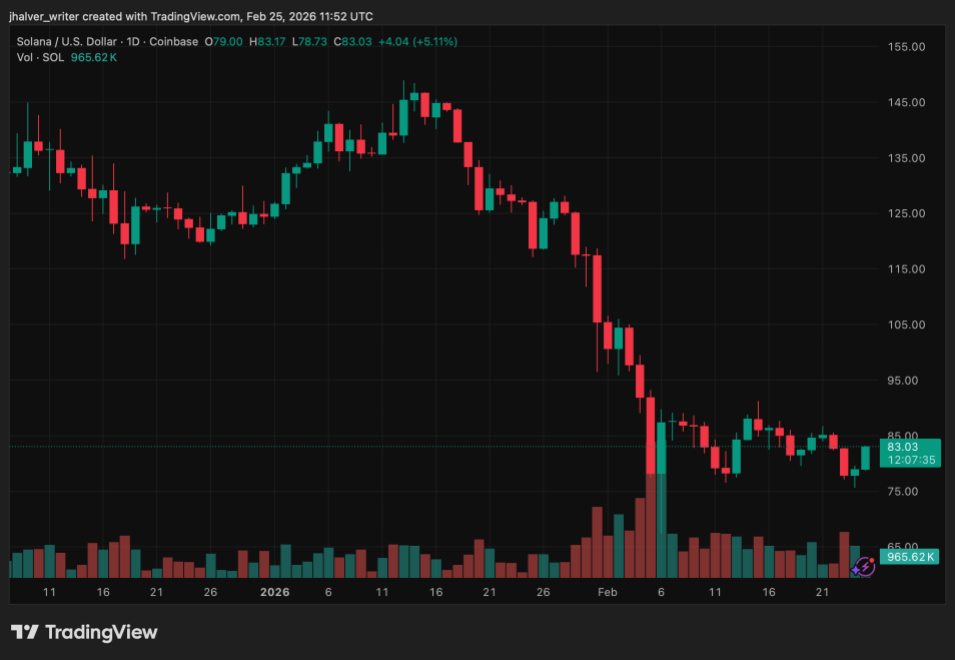
After falling from recent highs near $86, the Solana price rebounded from support around $75–$76 and climbed back above $80, drawing renewed attention from traders and institutional investors watching for signs of a broader recovery.

Recent market data shows Solana price in a consolidation phase, where improving derivatives positioning and fresh ETF inflows are beginning to offset weak sentiment caused by declining network activity and external market shocks.

SOL's price trends to the downside on the daily chart. Source: SOLUSD on Tradingview

ETF Inflows Signal Institutional Re-Engagement

A key catalyst behind the latest recovery has been renewed institutional demand. U.S. spot Solana ETFs recorded approximately $3.78 million in net inflows on February 24, reversing a stretch of outflows that had coincided with price weakness.

Cumulative inflows into Solana-linked ETFs have now surpassed $900 million, suggesting continued interest from regulated market participants despite volatility.

Derivatives markets also show improving sentiment. OI has risen while long positions increasingly outweigh shorts, indicating traders are adding exposure rather than exiting positions. Short liquidations following the rebound from $76 helped remove near-term selling pressure, allowing price to reclaim the $80 region.

Technically, SOL is holding above key short-term averages and the 50% Fibonacci retracement of its recent decline. Momentum indicators such as the RSI moving above neutral levels suggest buyers are regaining control in the short term.

Solana Price Key Resistance Levels Between $85 and $90

Despite improving momentum, resistance remains concentrated between $85 and $88, a zone that previously rejected multiple recovery attempts. A confirmed close above this band could open a path toward $90–$94, where higher-timeframe resistance and trend indicators converge.

Chart patterns are also drawing attention. Analysts point to a potential triple-bottom formation near $75, often interpreted as a reversal structure if followed by strong volume. However, failure to maintain support above $79–$80 could expose Solana price downside levels near $77 and potentially $74 again.

Risks Persist After Ecosystem and Activity Declines

The recovery comes amid ongoing ecosystem concerns, including a platform shutdown following a major hack and declining on-chain activity. Falling active addresses and total value locked signal weaker engagement.

Related Reading: Odds Of Crypto Market Structure Bill Passing This Year Fall To 40% On Polymarket

Currently, Solana’s outlook now depends on whether institutional inflows and technical stability can offset soft network metrics. Holding $80–$83 as support could open a move toward $90, while failure may keep price consolidation in place.

Cover image from ChatGPT, SOLUSD chart from Tradingview

Связанные с этим вопросы

QWhat is the key catalyst behind Solana's latest price recovery mentioned in the article?

ARenewed institutional demand, particularly U.S. spot Solana ETFs recording approximately $3.78 million in net inflows on February 24, which reversed a stretch of outflows.

QWhat is the critical technical resistance zone for Solana's price according to the analysis?

AResistance remains concentrated between $85 and $88. A confirmed close above this band could open a path toward $90–$94.

QWhat potential bullish chart pattern are analysts pointing to for Solana near the $75 level?

AAnalysts point to a potential triple-bottom formation near $75, which is often interpreted as a reversal structure if followed by strong volume.

QWhat are some of the ecosystem concerns that persist for Solana despite the price recovery?

AOngoing ecosystem concerns include a platform shutdown following a major hack and declining on-chain activity, such as falling active addresses and total value locked, which signal weaker engagement.

QWhat is the significance of the $79–$80 level for Solana's price action?

AHolding above $79–$80 as support is crucial. It could open a move toward $90, while failure to maintain this support could expose downside levels near $77 and potentially $74 again.

Похожее

It Took Me a Year to See the Hard Truth About Agent Payments

**Title: It Took Me a Year to See the Hard Truth About Agent Payments** Over the past year, I've worked on infrastructure for the Agent economy, engaging with major players like Stripe, Visa, Coinbase, and numerous startups. The findings reveal a stark reality: genuine, widespread demand for Agent-based payments does not yet exist. **Key Observations:** * **Agent-to-Merchant (Shopping):** The user experience for AI shopping often falls short, especially for visual product discovery. While AI excels at understanding needs, conversational interfaces can't yet replace browsing and comparing multiple products visually. Current merchant interest is largely defensive ("Agent Engine Optimization") for a future that hasn't arrived. High-frequency, low-friction purchases (like food delivery) are potential fits, but lack open APIs and face high AI inference costs. Simpler, more affordable, or cross-language interactions for complex UIs are a niche opportunity but require massive consumer distribution to scale. * **Agent-to-API (Developer Tools):** Developer payment needs for APIs (computing, data, models) are already met through subscriptions and prepaid credits. The core challenge is not payment friction but supplier economics: most large SaaS providers prefer enterprise contracts over micropayments for API calls. Protocols like MPP and x402 suit the long-tail of smaller services but cater to a developer market historically reluctant to pay for these tools. Major infrastructure needs at the top of the stack are already being addressed. * **Agent-to-Agent (Machine Commerce):** This is a long-term vision with almost no current transaction volume. While a future with high-speed, high-frequency, multi-party machine-to-machine transactions would require novel infrastructure, it remains theoretical. The market is not here yet. * **Agent-to-Finance:** This is the only category with clear, present demand. Financial professionals and DeFi users already pay for tools, and AI augmentation is a natural evolution. Autonomous AI agents can enable entirely new financial strategies. However, competition is fierce from established, regulated incumbents who can more easily layer AI onto their existing products. **The Core Insight:** Companies, especially giants with long time horizons, are building defensively for a potential future of mass machine commerce. For them, early investment is a low-cost hedge. For startups, the current market reality is different. The primary challenge isn't just moving money between agents (payments). The larger, unsolved problem is **orchestration** – coordinating work between agents and humans, verifying outcomes, and then settling. Payment is just a part of settlement, which is just a part of orchestration. Companies that solve the orchestration problem will subsume payments, not the other way around. After a year of building, we see the real, growing, and underserved market opportunity lies in this broader domain of orchestration.

链捕手1 мин. назад

It Took Me a Year to See the Hard Truth About Agent Payments

链捕手1 мин. назад

Claude Opus 4.8 Finds a $4.5 Billion Bug: The AI Era is Mass-Producing Hackers

A researcher discovered a critical "infinite mint" vulnerability in the Zcash cryptocurrency's Orchard protocol using Claude Opus 4.8, leading to a swift fix but also a 50% market drop, erasing billions in value. This incident highlights a new era where powerful, accessible AI models are dramatically lowering the barrier to finding software vulnerabilities. Previously, the security community feared specialized models like Claude Mythos Preview, capable of finding decades-old zero-day exploits. The Zcash case, however, involved a publicly available, general-purpose model. This shift makes advanced security auditing—and attack capabilities—accessible to far more people, not just experts. The mass democratization of vulnerability discovery brings a dual challenge: a flood of low-quality, AI-generated false reports that overwhelm maintainers, and the real, rapid uncovering of deep, dangerous bugs. Open-source projects, often understaffed and unfunded, are particularly vulnerable to this "attention DDoS." The article cites examples like curl shutting down its bug bounty program due to the unsustainable workload. Our perceived digital safety has often been luck, relying on the high cost and effort required to find deeply hidden flaws in complex systems, as seen with historical vulnerabilities like Heartbleed or Baron Samedit. AI changes this cost structure, effectively "mass-producing flashlights" to illuminate every corner of our codebase. While large companies operate extensive security chains involving external white-hat hackers and massive defensive operations, the global cybersecurity workforce faces a severe shortage, especially of experienced personnel capable of analyzing complex threats and coordinating fixes. The core dilemma emerges: AI makes *finding* bugs cheap and scalable, but *fixing* them remains a slow, expensive, and human-intensive process. The article concludes that AI won't destroy the internet but acts as a bright light, revealing that our digital existence is not inherently secure but is precariously maintained by ongoing human effort. The true cost in the AI era may not be discovery, but whether there will be enough people left willing and able to do the hard work of repair.

marsbit34 мин. назад

Claude Opus 4.8 Finds a $4.5 Billion Bug: The AI Era is Mass-Producing Hackers

marsbit34 мин. назад

Codex Goal Mode Usage Guide: How to Make AI Continuously Pursue a Specific Objective

"Codex Goal Mode: How to Make AI Work Continuously Toward a Specific Goal" OpenAI's Codex "goal mode" (/goal) transforms the AI from a reactive code assistant into a proactive execution agent capable of working autonomously for hours or even days to achieve a defined objective. To maximize its effectiveness, follow these key principles: 1. **Define Clear, Verifiable Exit Criteria:** The goal prompt should be a concise, measurable success condition, not a lengthy specification. Use quantifiable metrics like "reduce build time by 30%" or "achieve 100% test parity." 2. **Provide Initial Guidance and Tools:** Direct Codex toward likely problem areas and specify available tools (e.g., browsers, testing environments) to prevent it from exploring unproductive paths. 3. **Enable Progress Measurement:** Equip Codex with ways to track advancement, such as creating comparison tools for visual tasks or evaluation sets, ensuring it can gauge its own progress. 4. **Use a Realistic Execution Environment:** For tasks like performance optimization, provide access to environments that closely mimic production (e.g., similar configs, databases) to yield valid results. 5. **Be Cautious with Visual Goals:** Avoid vague "pixel-perfect" instructions. Instead, supplement visual references with functional checklists or design system specifications to prevent Codex from obsessing over minor details. 6. **Implement Progress Tracking:** For long-running tasks, have Codex commit code to draft PRs, update progress documents, or send Slack updates to maintain visibility into its work. 7. **Review and Consolidate Results:** Once the goal is met, instruct Codex to review its work, clean up ineffective experimental code, and reflect on what strategies succeeded or failed. Ultimately, using goal mode shifts the developer's role from writing prompts to managing a persistent engineering agent—defining objectives, establishing metrics, configuring environments, and conducting final reviews.

marsbit1 ч. назад

Codex Goal Mode Usage Guide: How to Make AI Continuously Pursue a Specific Objective

marsbit1 ч. назад

From Ethereum to AI's 'CROPS': What Exactly Is This 'Slow Variable' That Vitalik Has Repeatedly Emphasized?

Recently, Vitalik Buterin has frequently emphasized the concept of "CROPS," first outlined in the Ethereum Foundation's March mandate as core principles guiding its focus: Censorship Resistance, Capture Resistance, Open Source, Privacy, and Security. CROPS represents Ethereum's commitment to providing foundational capabilities for user sovereignty—enabling asset ownership, identity expression, and coordination without reliance on centralized platforms or surrendering ultimate control. This framework is gaining new urgency with the rise of AI, particularly AI agents managing digital assets and automating transactions. While AI offers convenience, it risks centralizing user data, intent, and control if dependent on opaque, centralized services. Vitalik argues for "CROPS AI"—AI that is open, privacy-preserving, secure, and capable of local execution to maintain user agency. He highlights convergence between "CROPS Ethereum access layers" and "CROPS AI," such as using zero-knowledge proofs for private remote LLM calls and Ethereum RPC reads, ensuring users can access services without exposing sensitive information. Ultimately, CROPS is not just an abstract ideal but a practical guide for Ethereum's development and AI integration. It addresses the critical long-term question: as digital systems grow more powerful, how can users retain control over their privacy, assets, and autonomy? In an AI-driven era, these principles may define Ethereum's enduring value—prioritizing verifiable, secure, and user-centric design over short-term optimizations like speed and cost alone.

marsbit1 ч. назад

From Ethereum to AI's 'CROPS': What Exactly Is This 'Slow Variable' That Vitalik Has Repeatedly Emphasized?

marsbit1 ч. назад

Торговля

Спот
Фьючерсы

Популярные статьи

Как купить PUSH

Добро пожаловать на HTX.com! Мы сделали приобретение Push Protocol (PUSH) простым и удобным. Следуйте нашему пошаговому руководству и отправляйтесь в свое крипто-путешествие.Шаг 1: Создайте аккаунт на HTXИспользуйте свой адрес электронной почты или номер телефона, чтобы зарегистрироваться и бесплатно создать аккаунт на HTX. Пройдите удобную регистрацию и откройте для себя весь функционал.Создать аккаунтШаг 2: Перейдите в Купить криптовалюту и выберите свой способ оплатыКредитная/Дебетовая Карта: Используйте свою карту Visa или Mastercard для мгновенной покупки Push Protocol (PUSH).Баланс: Используйте средства с баланса вашего аккаунта HTX для простой торговли.Третьи Лица: Мы добавили популярные способы оплаты, такие как Google Pay и Apple Pay, для повышения удобства.P2P: Торгуйте напрямую с другими пользователями на HTX.Внебиржевая Торговля (OTC): Мы предлагаем индивидуальные услуги и конкурентоспособные обменные курсы для трейдеров.Шаг 3: Хранение Push Protocol (PUSH)После приобретения вами Push Protocol (PUSH) храните их в своем аккаунте на HTX. В качестве альтернативы вы можете отправить их куда-либо с помощью перевода в блокчейне или использовать для торговли с другими криптовалютами.Шаг 4: Торговля Push Protocol (PUSH)С легкостью торгуйте Push Protocol (PUSH) на спотовом рынке HTX. Просто зайдите в свой аккаунт, выберите торговую пару, совершайте сделки и следите за ними в режиме реального времени. Мы предлагаем удобный интерфейс как для начинающих, так и для опытных трейдеров.

856 просмотров всегоОпубликовано 2024.03.29Обновлено 2026.06.02

Как купить PUSH

Обсуждения

Добро пожаловать в Сообщество HTX. Здесь вы сможете быть в курсе последних новостей о развитии платформы и получить доступ к профессиональной аналитической информации о рынке. Мнения пользователей о цене на PUSH (PUSH) представлены ниже.

活动图片