Solana ETFs Are Beating Bitcoin On Relative Flows Despite SOL Crash

bitcoinistОпубликовано 2026-03-06Обновлено 2026-03-06

Введение

Despite a 57% crash in SOL's price since their July launch, spot Solana ETFs have attracted approximately $1.45 billion in inflows. Bloomberg analyst Eric Balchunas called this a case of extremely unlucky timing but highlighted the resilience of these flows as a key positive signal. He noted that 50% of the assets come from serious institutional investors (13F filers), indicating a high-quality demand base. Balchunas made a striking comparison: when adjusted for market cap, these inflows are equivalent to $54 billion for Bitcoin—double what Bitcoin ETFs saw at a similar stage, even though Bitcoin's price was rising at that time. This suggests exceptionally strong relative demand for Solana products. While Bitcoin ETFs still dominate in absolute size with nearly $94.6 billion in assets, the persistent inflows into Solana ETFs during a severe price decline point to "sticky" institutional capital rather than short-term speculation. The analyst also cautioned against drawing broad conclusions from short-term price action, a point applicable to both Bitcoin and Solana. At the time of writing, SOL traded at $87.26.

Spot Solana ETFs have pulled in roughly $1.45 billion since launching in July even as SOL fell 57% over the same stretch, a combination Bloomberg ETF analyst Eric Balchunas called “about as unlucky timing as you’ll ever see in ETFs.” For crypto markets, the takeaway is not just the headline flow number, but what it may say about the depth and quality of institutional demand.

Spot Solana ETFs Beat Bitcoin ETFs

Balchunas argued that the resilience of those inflows matters as much as their size. “Solana is down 57% since the spot ETFs launched in July ... yet they managed to not only accumulate $1.5b in flows but not really give any of it up,” he wrote on X. He added that “50% of the assets are from 13F filers = serious inv base. Both really good signs for future IMO.”

The chart he shared shows cumulative Solana ETF flows climbing from about $410 million on Oct. 23, 2025, to $1.45 billion by March 2, 2026. The steepest acceleration came in late October through November, when cumulative inflows jumped sharply toward the $1 billion mark before continuing to grind higher into early March. Even with some flattening near the end of the period, the broader pattern is one of persistent net intake rather than hot-money churn.
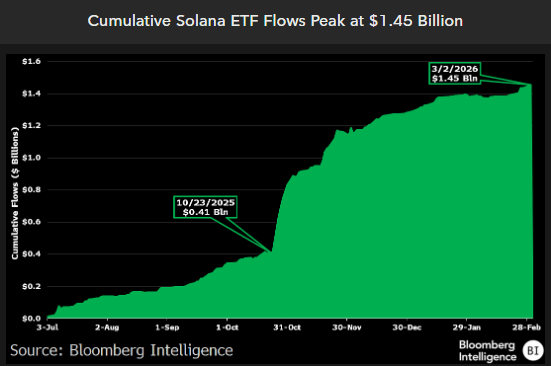
Cumulative Solana ETF flows | Source: X @EricBalchunas

Balchunas’ more provocative point was the relative comparison with Bitcoin. “The other thing about these flows, if we adjust for the size of solana vs bitcoin mkt cap, it’s the equiv of $54b in net new flows, which is about DOUBLE where bitcoin was at the same point,” he wrote. “And bitcoin was up a ton at that time vs down 57%. Anyhow, pretty impressive numbers given size and condition of the underlying mkt.”

That comparison goes to the heart of the thesis. Absolute flows still heavily favor Bitcoin, whose US spot ETF complex sits near $94.6 billion in assets, according to the table Balchunas posted separately. BlackRock’s IBIT alone accounts for roughly $57.1 billion, while Fidelity’s FBTC and Grayscale’s GBTC hold about $13.9 billion and $11.5 billion, respectively. On Wednesday, the group took in another $461.77 million, with IBIT contributing $306.58 million.
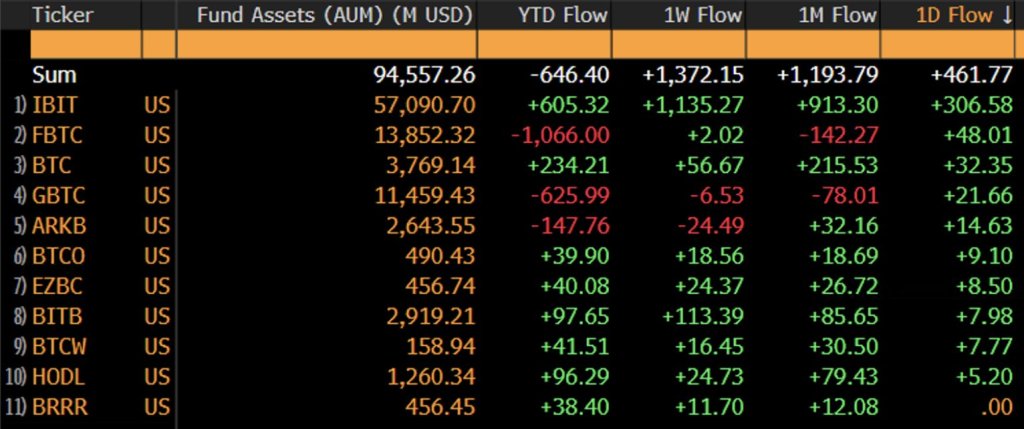
Bitcoin ETF data | Source: X @EricBalchunas

But Balchunas used that same Bitcoin flow snapshot to make a broader point about the risks of drawing sweeping conclusions from short windows of market action. After noting that Bitcoin had risen 12% since the Iran strike while gold fell, he posed a deliberately overstated question: “So does that mean gold has failed as a safe haven and may be devoid of any purpose and vice-versa for btc?” He then answered it himself in the next post.

“I don’t actually think this btw, just trying to point out the problem with making these types of damning judgements of an asset based on a short term window of price action,” Balchunas wrote. “Gold has my respect as asset as does bitcoin. Bitcoin’s surge may have little to do w geopolitics but rather the Jane St bogeyman going away and vibe change. And ppl selling gold may just be taking profits, some may be looking for next run in btc, wth knows.”

The same logic applies to Solana. A 57% drawdown would usually be the sort of backdrop expected to choke off ETF demand, not sustain it. Instead, the Solana products appear to have attracted sticky capital and, at least in Balchunas’ framing, done so at a pace that compares favorably with Bitcoin once market-cap context is applied.

At press time, Solana traded at $87.26.
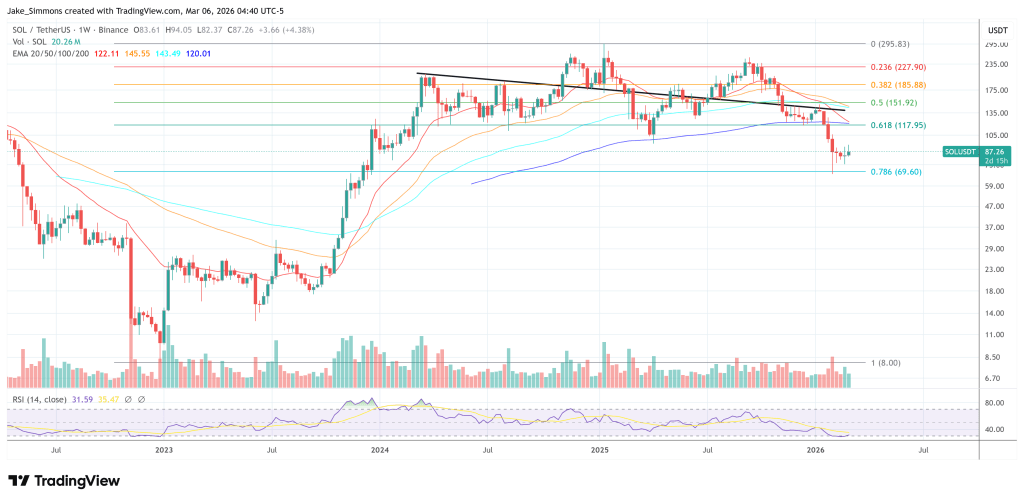
SOL must reclaim the 200-week EMA, 1-week chart | Source: SOLUSDT on TradingView.com

Похожее

Why Do You Always Lose Money on Polymarket? Because You're Betting on News, While the Pros Read the Rules

Why do you always lose money on Polymarket? Because you bet on news, while the pros study the rules. This article explains how top traders ("che tou") profit by meticulously analyzing market rules, not just predicting events. Polymarket, a prediction market platform, often sees disputes over event outcomes due to ambiguous rule wording. For instance, a market asking "Who will be the leader of Venezuela by the end of 2026?" was misinterpreted by many who bet on Delcy Rodríguez, assuming she held power. However, the rules specified "officially holds" as the formally appointed, sworn-in individual. Since Nicolás Maduro was still recognized as president officially, he won the market—even being in prison. To resolve such disputes, Polymarket uses a decentralized arbitration system via UMA protocol. The process involves: 1. Proposal: Anyone can propose a market outcome by staking 750 USDC, earning 5 USDC if unchallenged. 2. Dispute: A 2-hour window allows challenges with a 750 USDC stake; successful challengers earn 250 USDC. 3. Discussion: A 48-hour period on UMA Discord for evidence and debate. 4. Voting: UMA token holders vote in two 24-hour phases (blind then public). Outcomes require >65% consensus and 5M tokens voted; otherwise, four re-votes occur before Polymarket intervention. 5. Settlement: Results are final and automatic. Unlike traditional courts, Polymarket’s system lacks separation between arbitrators and stakeholders—voters often hold market positions, creating conflicts of interest. This leads to herd mentality in discussions and non-transparent outcomes without explanatory rulings, preventing precedent formation. Thus, success on Polymarket hinges on deep rule interpretation, not just event prediction, exploiting gaps between reality and contractual wording.

marsbit1 ч. назад

Why Do You Always Lose Money on Polymarket? Because You're Betting on News, While the Pros Read the Rules

marsbit1 ч. назад

DeepSeek Funding: Liang Wenfeng's 'Realist' Pivot

DeepSeek, a leading Chinese AI company, has initiated its first external funding round, aiming to raise at least $300 million at a valuation of no less than $10 billion. This move marks a significant shift from its founder Liang Wenfeng’s previous idealistic stance of rejecting external capital to maintain independence. Despite strong financial backing from its parent company, quantitative trading firm幻方量化 (Huanfang Quant), which provided an estimated $700 million in revenue in 2025 alone, DeepSeek faces mounting challenges. Key issues include a 15-month gap in major model updates, delays in its flagship V4 release, and the loss of several core researchers to competitors offering significantly higher compensation. The company is also undergoing a strategic pivot by migrating its infrastructure from NVIDIA’s CUDA to Huawei’s Ascend platform, a move aligned with China’s push for technological self-reliance amid U.S. export controls. However, DeepSeek lags behind rivals like智谱AI and MiniMax—both now publicly listed—in areas such as product ecosystem, multimodal capabilities, and commercialization. The funding round, though relatively small in scale, is seen as a way to establish a market-validated valuation anchor, making employee stock options more competitive and facilitating talent retention. It also signals DeepSeek’s transition from a pure research-oriented organization to a commercially-driven player in the global AI ecosystem.

marsbit2 ч. назад

DeepSeek Funding: Liang Wenfeng's 'Realist' Pivot

marsbit2 ч. назад

Торговля

Спот
Фьючерсы

Популярные статьи

Тест по Bitcoin Биткоина

HTX Learn: Изучите Bitcoin halving и Заработаете Токены USDT

3.0k просмотров всегоОпубликовано 2024.04.16Обновлено 2024.04.16

Тест по Bitcoin  Биткоина

Что такое $BITCOIN

ЦИФРОВОЕ ЗОЛОТО ($BITCOIN): Комплексный анализ Введение в ЦИФРОВОЕ ЗОЛОТО ($BITCOIN) ЦИФРОВОЕ ЗОЛОТО ($BITCOIN) — это проект на основе блокчейна, работающий в сети Solana, который стремится объединить характеристики традиционных драгоценных металлов с инновациями децентрализованных технологий. Хотя он носит имя Биткойн, часто называемого “цифровым золотом” из-за его восприятия как средства хранения ценности, ЦИФРОВОЕ ЗОЛОТО является отдельным токеном, предназначенным для создания уникальной экосистемы в ландшафте Web3. Его цель — позиционировать себя как жизнеспособный альтернативный цифровой актив, хотя детали его применения и функциональности все еще развиваются. Что такое ЦИФРОВОЕ ЗОЛОТО ($BITCOIN)? ЦИФРОВОЕ ЗОЛОТО ($BITCOIN) — это токен криптовалюты, специально разработанный для использования в блокчейне Solana. В отличие от Биткойна, который выполняет широко признанную роль хранения ценности, этот токен, похоже, сосредоточен на более широких приложениях и характеристиках. Примечательные аспекты включают: Инфраструктура блокчейна: Токен построен на блокчейне Solana, известном своей способностью обрабатывать высокоскоростные и недорогие транзакции. Динамика предложения: ЦИФРОВОЕ ЗОЛОТО имеет максимальное предложение, ограниченное 100 квадриллионами токенов (100P $BITCOIN), хотя детали о его обращающемся предложении в настоящее время не раскрыты. Утилита: Хотя точные функциональные возможности не описаны, есть указания на то, что токен может быть использован для различных приложений, потенциально связанных с децентрализованными приложениями (dApps) или стратегиями токенизации активов. Кто создатель ЦИФРОВОГО ЗОЛОТА ($BITCOIN)? На данный момент личность создателей и команды разработчиков, стоящих за ЦИФРОВЫМ ЗОЛОТОМ ($BITCOIN), остается неизвестной. Эта ситуация типична для многих инновационных проектов в области блокчейна, особенно тех, которые связаны с децентрализованными финансами и феноменом мем-криптовалют. Хотя такая анонимность может способствовать культуре, ориентированной на сообщество, она усиливает опасения по поводу управления и ответственности. Кто инвесторы ЦИФРОВОГО ЗОЛОТА ($BITCOIN)? Доступная информация указывает на то, что у ЦИФРОВОГО ЗОЛОТА ($BITCOIN) нет известных институциональных спонсоров или значительных венчурных капиталовложений. Проект, похоже, функционирует по модели пирингового взаимодействия, сосредоточенной на поддержке и принятии сообществом, а не на традиционных путях финансирования. Его активность и ликвидность в основном сосредоточены на децентрализованных биржах (DEX), таких как PumpSwap, а не на устоявшихся централизованных торговых платформах, что еще больше подчеркивает его подход, ориентированный на grassroots. Как работает ЦИФРОВОЕ ЗОЛОТО ($BITCOIN) Операционные механизмы ЦИФРОВОГО ЗОЛОТА ($BITCOIN) можно подробно описать на основе его дизайна блокчейна и характеристик сети: Механизм консенсуса: Используя уникальный механизм доказательства истории (PoH) Solana в сочетании с моделью доказательства доли (PoS), проект обеспечивает эффективную валидацию транзакций, что способствует высокой производительности сети. Токеномика: Хотя конкретные дефляционные механизмы не были подробно описаны, большое максимальное предложение токенов подразумевает, что оно может быть предназначено для микротранзакций или нишевых случаев использования, которые еще предстоит определить. Интероперабельность: Существует потенциал для интеграции с более широкой экосистемой Solana, включая различные платформы децентрализованных финансов (DeFi). Однако детали относительно конкретных интеграций остаются неуточненными. Хронология ключевых событий Вот хронология, которая подчеркивает значимые вехи, касающиеся ЦИФРОВОГО ЗОЛОТА ($BITCOIN): 2023: Первоначальное развертывание токена происходит в блокчейне Solana, отмеченное его адресом контракта. 2024: ЦИФРОВОЕ ЗОЛОТО приобретает видимость, когда оно становится доступным для торговли на децентрализованных биржах, таких как PumpSwap, позволяя пользователям обменивать его на SOL. 2025: Проект наблюдает спорадическую торговую активность и потенциальный интерес к инициативам, возглавляемым сообществом, хотя на данный момент не зафиксировано никаких значительных партнерств или технических достижений. Критический анализ Сильные стороны Масштабируемость: Основная инфраструктура Solana поддерживает высокие объемы транзакций, что может повысить полезность $BITCOIN в различных сценариях транзакций. Доступность: Потенциально низкая цена торговли за токен может привлечь розничных инвесторов, способствуя более широкому участию благодаря возможностям дробного владения. Риски Отсутствие прозрачности: Отсутствие публично известных спонсоров, разработчиков или процесса аудита может вызвать скептицизм относительно устойчивости и надежности проекта. Волатильность рынка: Торговая активность сильно зависит от спекулятивного поведения, что может привести к значительной волатильности цен и неопределенности для инвесторов. Заключение ЦИФРОВОЕ ЗОЛОТО ($BITCOIN) является интригующим, но неоднозначным проектом в быстро развивающейся экосистеме Solana. Хотя он пытается использовать нарратив “цифрового золота”, его отход от установленной роли Биткойна как средства хранения ценности подчеркивает необходимость более четкого различения его предполагаемой утилиты и структуры управления. Будущее принятие и усвоение, вероятно, будут зависеть от решения текущей непрозрачности и более четкого определения его операционных и экономических стратегий. Примечание: Этот отчет охватывает синтезированную информацию, доступную на октябрь 2023 года, и с тех пор могут произойти события.

99 просмотров всегоОпубликовано 2025.05.13Обновлено 2025.05.13

Что такое $BITCOIN

Fractal Bitcoin: масштабирование Биткоина с помощью рекурсивной системы

Fractal Bitcoin — масштабное Layer-1-решнение, созданное на базе кода Биткоина, позволяющего достигать бесконечного масштабирования с помощью рекурсивного подхода.

2.2k просмотров всегоОпубликовано 2025.06.30Обновлено 2025.06.30

Fractal Bitcoin: масштабирование Биткоина с помощью рекурсивной системы

Обсуждения

Добро пожаловать в Сообщество HTX. Здесь вы сможете быть в курсе последних новостей о развитии платформы и получить доступ к профессиональной аналитической информации о рынке. Мнения пользователей о цене на BTC (BTC) представлены ниже.

活动图片