Solana ETF Draws $39 Million Inflow in Single Week, Highest Since February, Futures Open Interest Surges 30%, Traders Target $120

marsbitОпубликовано 2026-05-12Обновлено 2026-05-12

Введение

Solana ETF sees its strongest weekly inflow since February, attracting $39.23 million with Bitwise's BSOL ETF accounting for 92% of the total. This marks a potential reversal of a six-month downtrend in monthly inflows. Simultaneously, SOL futures open interest surged 29.5% in the first half of May, reaching $6.4 billion, indicating significant new capital entering the derivatives market. Spot buying pressure also increased, with the Cumulative Volume Difference (CVD) rising sharply. On the fundamental side, Solana's largest-ever consensus upgrade, Alpenglow, has launched on a community testnet, aiming to drastically reduce transaction finality times. Mainnet deployment could occur next quarter. Analysts note that after a four-month consolidation period, short-term traders have largely exited, leaving conviction holders in control of the supply. This shift in holder structure means any renewed trading volume is more likely to push prices upward. A technical Adam & Eve bottom pattern suggests a price target of $120. However, short-term momentum has shown signs of cooling near the $95-$96 resistance level. Risks remain, including potential pressure from exchange sell orders if ETF inflows weaken again and the threat of cascading liquidations from highly leveraged positions.

Author: Claude, Deep Tide TechFlow

Deep Tide Introduction: Solana spot ETFs recorded a net inflow of $39.23 million last week, their strongest weekly performance since February, with Bitwise's BSOL capturing 92% of the share. Futures open interest surged 29.5% in the first two weeks of May to $6.4 billion, with spot and derivatives buying activity amplifying simultaneously.

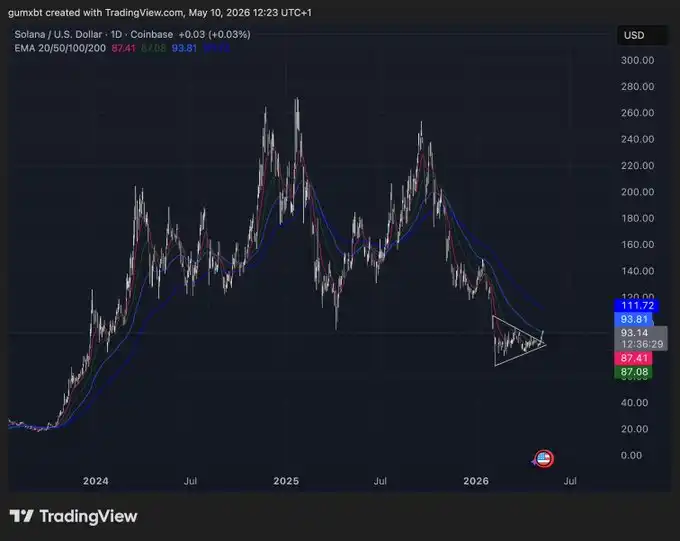
Technically, an Adam & Eve bottom pattern has emerged, pointing to a target of $120. Concurrently, Solana's largest-ever consensus upgrade, Alpenglow, went live on the community testnet on May 11, with co-founder Yakovenko indicating mainnet deployment could happen as early as next quarter. Capital flows, derivatives, and on-chain fundamentals are all emitting bullish signals simultaneously.

SOL is experiencing a multi-dimensional signal convergence.

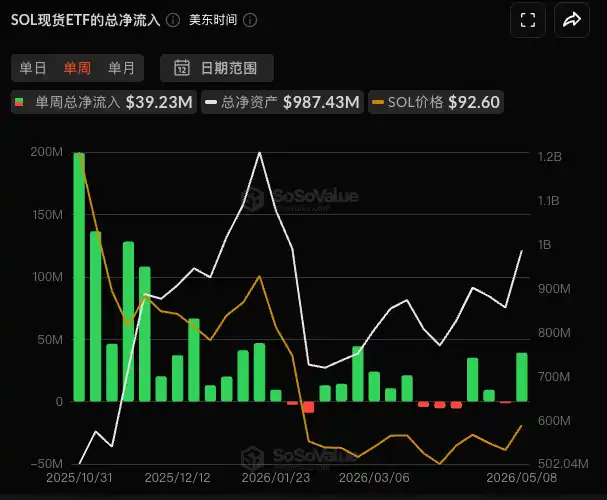
According to a Cointelegraph report on May 11, Solana spot ETFs recorded a net inflow of $39.23 million last week, their strongest weekly performance since February. During the same period, the SOL price rose about 15% in seven days to around $97, while futures open interest grew by nearly $1.5 billion in half a month.

The on-chain holder structure is also quietly shifting: traders and hot money gradually exited during the four-month consolidation, and strong holders have regained control of the token supply. Any increase in volume after the sharp contraction will tend to push prices upward.

Signals from multiple independent data sources are lighting up simultaneously.

ETF Fund Flows Reverse Six-Month Downtrend, Bitwise BSOL Captures Over 80% Share

According to SoSoValue data, Solana spot ETFs saw a net inflow of $39.23 million last week, with Bitwise's staking ETF BSOL contributing $36 million, accounting for approximately 92%; Fidelity's FSOL saw an inflow of about $1.8 million. Since its launch, BSOL has accumulated approximately $861 million, representing 81% of the total cumulative inflow (approximately $1.06 billion) into all SOL spot ETFs.

The significance of this figure needs to be understood within a longer timeline. Citing SoSoValue data, BeInCrypto reported that monthly inflows into Solana ETFs have declined for six consecutive months after hitting a peak of $419 million last November: $148 million in December, $105 million in January, $63 million in February, $45.44 million in March, and only $39.93 million in April, the lowest monthly performance since the products launched. The weekly inflow in the first two weeks of May has already approached April's full-month level. If the current pace continues, it will mark the first reversal of the six-month downtrend.

As of publication, the total net asset value of all SOL spot ETFs is approximately $938 million, with SOL accounting for about 1.82% of ETF net assets, and historical cumulative net inflows exceeding $1 billion.

Futures Open Interest Surges 30% in Half a Month to $6.4 Billion, Spot Buying Volume Also Expands

The signal from the derivatives market is equally clear.

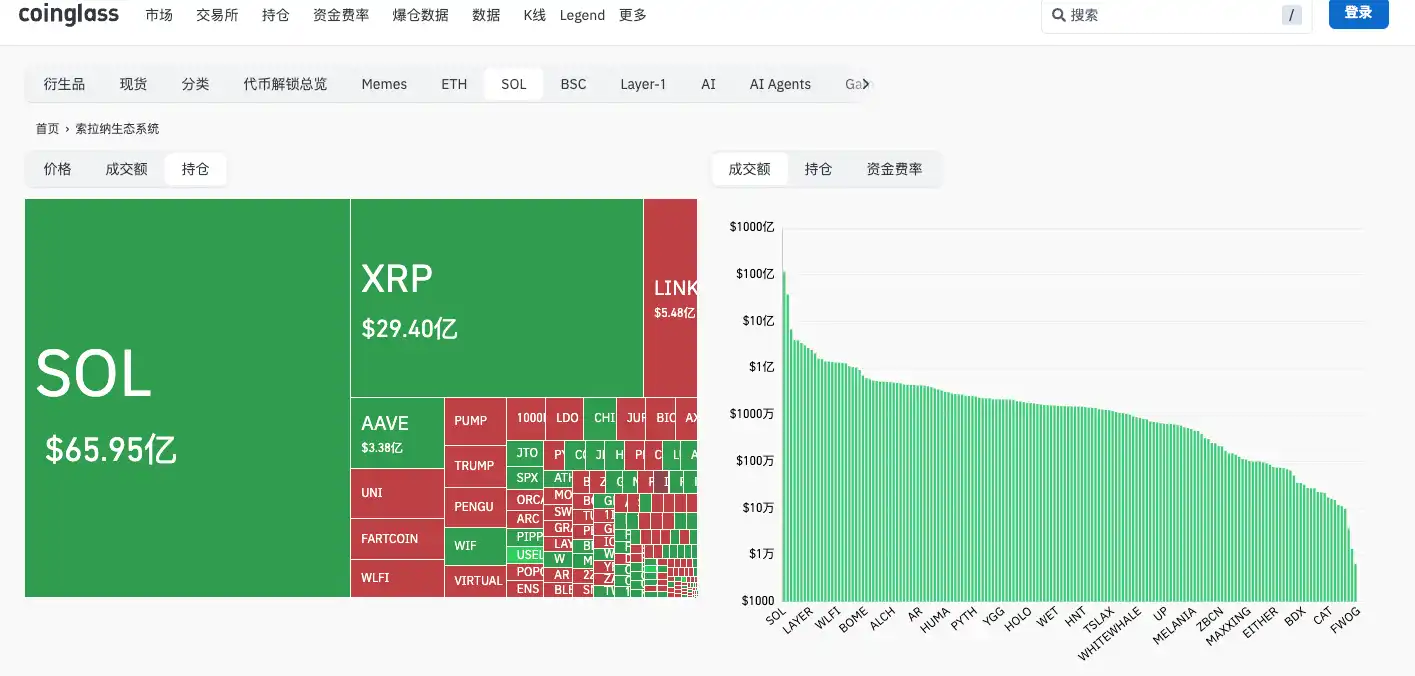
According to Coinglass data, SOL futures open interest climbed from $4.94 billion on May 1st to $6.4 billion, a 29.5% increase within half a month, representing an increment of approximately $1.5 billion. This is not merely increased leverage from existing players, but direct evidence of new capital entering the market.

Spot market buying activity is also cooperating. According to velo.chart data, the spot Cumulative Volume Delta (CVD, measuring the net difference between active buying and selling in the market) rose from $163 million to nearly $250 million over five days; futures CVD has been rising steadily since May 5th, expanding to approximately $594 million. Buyers are absorbing selling liquidity in both the spot and futures markets simultaneously.

The funding rate remains around 0.065%, indicating that longs are still paying to maintain their positions, but it hasn't reached overheated levels. However, after SOL reached the $95 to $96 range, the spot and futures CVD have started to flatten, suggesting short-term momentum has cooled somewhat.

Alpenglow Launches on Testnet, Solana's Largest-Ever Consensus Upgrade Enters Countdown

Beyond capital flows and technicals, fundamentals are also providing a catalyst.

According to a CoinDesk report on May 11, Solana's core development team Anza announced that the network's largest-ever consensus upgrade, Alpenglow, has gone live on a community test cluster. This upgrade will replace the current Proof-of-History and TowerBFT systems with the new Votor and Rotor protocols, aiming to compress transaction finality time from the current ~12.8 seconds to around 150 milliseconds—a speedup of nearly 100 times.

In a community vote last September, 98.27% of stakers voted in favor of the proposal, with a participation rate of 52%. Solana co-founder Anatoly Yakovenko stated at the Consensus conference in Miami last week that if testing goes smoothly, Alpenglow could launch on the mainnet as early as next quarter.

Silent Shift in Holder Structure, Healthier Token Distribution After 'Tourists Depart'

Crypto KOL gum pointed out on platform X that SOL is breaking out from a four-month consolidation period, but the underlying reason for this breakout is not just technical. He believes SOL is breaking out now, rather than a month ago, because it acts as a barometer for the entire crypto market's risk appetite, and its current price action is pricing in a 'return of risk'.

More crucially, it's about the token distribution structure. gum notes that during the four-month consolidation, short-term traders and hot money have abandoned SOL and exited, leading to a sharp decline in trading volume. Strong holders (conviction holders) have regained control of the token distribution. With this distribution structure, any reasonable recovery in trading volume will tend to push momentum in an upward direction.

Reference: KOL Perspective: Why SOL is Poised for a Rise at This Price Point?

Risk Warning: Short-term Momentum Shows Signs of Cooling

It's important to note that buying intensity for SOL in the $95 to $96 range has already begun to weaken, with spot and futures CVD flattening over the past 24 hours. The Adam & Eve pattern still requires daily close confirmation; failure to hold above $95 could lead to a pullback towards the $89 to $91 support zone.

Furthermore, a previous BeInCrypto analysis pointed out that if ETF inflows in May fail to stabilize or even continue to decline, SOL could face selling pressure from exchanges. The rapid buildup of high-leverage positions also means that any price retracement could amplify volatility through cascading liquidations. The liquidity vacuum left after meme-coin-driven retail frenzy subsides is another recurring risk pattern historically.

Multiple signals from capital flows, derivatives, and technicals are all pointing in the same direction, but the market is never short of precedents for moving in the opposite direction when 'signals align'. The $120 technical target is clearly visible, but every step from $95 to $120 will require real buying volume to materialize.

Связанные с этим вопросы

QWhat was the net inflow for Solana spot ETFs in the recent week, and why is this figure significant?

ASolana spot ETFs recorded a net inflow of $39.23 million in the recent week. This is significant because it represents the strongest weekly performance since February, potentially marking a reversal of a six-month consecutive decline in monthly inflows.

QAccording to the article, how much did Solana futures open interest increase in the first two weeks of May, and what does this signify?

ASolana futures open interest increased by 29.5% in the first two weeks of May, reaching $6.4 billion, with an increase of approximately $1.5 billion. This signifies that new capital, not just leverage from existing players, is entering the market.

QWhat is the Alpenglow upgrade for Solana, and what is its primary goal?

AAlpenglow is Solana's largest-ever consensus upgrade. It aims to replace the current Proof-of-History and TowerBFT systems with new Votor and Rotor protocols, with the primary goal of reducing transaction finality time from about 12.8 seconds to roughly 150 milliseconds.

QHow has the holder structure of SOL changed during its four-month consolidation, according to the KOL gum?

AAccording to KOL gum, during the four-month consolidation, short-term traders and 'tourist capital' gradually exited SOL. This led to a sharp decline in trading volume, allowing 'conviction holders' or strong holders to regain control of the token distribution.

QWhat are some of the key risk factors mentioned for SOL's price in the near term?

AKey near-term risk factors include: buying pressure weakening in the $95-$96 range; the need for the Adam & Eve technical pattern to be confirmed with a daily close above $95; potential for a pullback to the $89-$91 support zone if that fails; pressure from exchange sell-offs if ETF inflows don't stabilize; and the risk of cascading liquidations due to rapid high-leverage accumulation.

Похожее

SpaceX, OpenAI, Anthropic: The Three AI Giants Racing for IPO, Which One Is Worth Betting On?

SpaceX, OpenAI, and Anthropic are poised for historic IPOs within weeks, potentially raising a combined $180 billion—a sum exceeding the entire internet bubble's fundraising. The hosts of the Limitless Podcast argue this isn't just individual company financing but an unprecedented capital concentration for AI infrastructure, driven by an insatiable need for compute, data centers, power, and chips. SpaceX's IPO is notable for reportedly changing market index rules to allow faster inclusion, potentially funneling trillions in passive retirement funds into its stock, despite its unproven space-based data center business model. In contrast, Anthropic demonstrates explosive growth, with ARR reportedly hitting $45 billion and approaching profitability, fueled by strong enterprise adoption of products like Claude Code. Google's separate $80 billion raise highlights the immense capital pressure, even for giants. The discussion acknowledges bubble risks but leans optimistic. The hosts contend the massive spending is building essential physical infrastructure for the next technological era. A key bottleneck isn't capital but the real-world limits of chip manufacturing and construction speed. As long as demand for AI compute outstrips supply, this investment cycle represents a foundational build-out rather than a purely financial bubble. All three companies are seen as foundational bets on the future, with Anthropic often cited as the most immediately compelling due to its proven revenue trajectory.

marsbit1 ч. назад

SpaceX, OpenAI, Anthropic: The Three AI Giants Racing for IPO, Which One Is Worth Betting On?

marsbit1 ч. назад

From 'Old Guys' to 'New Favorites': How AI Is Revaluing Old Infrastructure from Dell to Nokia?

From "Vintage Tech" to "New AI Darlings": How AI Revalues Old Infrastructure One year ago, tech giants like Dell, Nokia, Cisco, and Western Data were seen as slow-growth, low-valuation stories, far from the AI spotlight dominated by players like Nvidia. Now, these legacy tech stocks are gaining market attention, sparking debate on whether this is genuine industry revaluation or a temporary narrative. As AI moves from model parameters to real-world data centers, the market is recognizing companies with proven delivery and infrastructure capabilities. This shift marks a change in the AI investment thesis: from pure model and GPU focus to the complex systems engineering required for deployment. Companies like Dell, HPE, and Corning are being revalued not for being "sexy" AI innovators, but for their decades of accumulated expertise in supply chains, enterprise delivery, and infrastructure—assets that have become critical in the AI buildout phase. The revaluation is unfolding across three key infrastructure lines: 1. **Servers & System Integration:** Dell and HPE are emerging as crucial system integrators or "general contractors" for AI data centers, translating GPU orders into complete, deployable server racks integrated with power, cooling, and networking. 2. **Networking & Connectivity:** AI's scale demands robust high-speed connections. Corning (fiber optics), Nokia (AI-RAN, 6G), and Cisco (data center switches) are gaining importance for enabling efficient data transfer within and between AI clusters. 3. **Storage:** Beyond high-speed memory (HBM/DRAM), the AI data explosion is driving demand for high-capacity hard drives (HDDs) from companies like Western Digital and Seagate to handle training data, logs, and cold storage cost-effectively. For this revaluation to be substantive and not just a narrative, three criteria are key: 1) Concrete AI-related order and revenue growth (e.g., Dell's AI server sales), 2) Upward revisions to company financial guidance, and 3) Sustainable improvements in profit quality, not just top-line revenue spikes. In essence, AI's transition to a real construction phase is re-pricing "old assets" against "new demand." The opportunity, however, is selective. Only those legacy firms that are demonstrably integrated into the capital expenditure chains of data center and enterprise AI deployment are likely to experience a true "logic re-rating" rather than just a temporary valuation bounce.

marsbit1 ч. назад

From 'Old Guys' to 'New Favorites': How AI Is Revaluing Old Infrastructure from Dell to Nokia?

marsbit1 ч. назад

The Merger of Codex and ChatGPT Marks the Beginning of a Major Reshuffle in Programming Tools

OpenAI is shifting its strategic focus from ChatGPT to Codex, merging them along with the browser tool Atlas into a unified desktop super-app. This move signals an internal belief that Codex, originally a programming tool, represents the next evolution of AI more than conversational models like ChatGPT. Over the past year, Codex's weekly active users have surged past 5 million. The key distinction is that while ChatGPT answers questions, Codex executes tasks. Enterprises increasingly value this ability to get work done over simply receiving advice. Consequently, Codex is attracting professionals beyond developers, including analysts, bankers, marketers, and product managers. OpenAI's reorganization and increased investment in Codex stem from recognizing that the future of AI competition lies in execution capabilities, not just conversation. The company is launching role-specific plugins (e.g., for data analysis, sales, design) to transform Codex into a broad knowledge work platform that automates and redefines white-collar workflows. Beyond being a tool, Codex reflects OpenAI's ambition to redefine software. New features like "Sites"—which generates interactive websites from documents—and collaborative "Annotations" aim to create a paradigm where the AI understands the goal and handles the tools and steps, functioning more like a digital colleague than traditional software. The ultimate goal is a unified experience where the user cares only about the completed task.

marsbit1 ч. назад

The Merger of Codex and ChatGPT Marks the Beginning of a Major Reshuffle in Programming Tools

marsbit1 ч. назад

Interpreting Investment Opportunities in the Age of Great Navigation, Invesco Great Wall Fund Releases '2026 Report on Chinese Enterprises Going Global'

Invesco Great Wall Fund has released its "2026 China Corporate Globalization Report," titled "The 'Great Navigation Era' of Chinese Enterprises." The report analyzes the new trends and investment opportunities as Chinese companies expand globally, moving from simple product exports to comprehensive overseas operations involving services, branding, and local production. Driven by factors like trade friction, the pursuit of higher profit margins abroad, and policy support, globalization is becoming essential for Chinese companies. The report outlines an evolution: from early product export ("Globalization 1.0") to the current "Globalization 2.0," characterized by overseas capacity, capital goods investment, consumer brand expansion, and service exports. Chinese firms' competitive advantages are highlighted, including a vast engineer talent pool, low-cost and robust infrastructure, and complete industrial clusters. Specific sectors with significant出海 potential are identified: * **Capital Goods** (e.g., engineering machinery, power equipment): Benefiting from global demand, especially in Belt & Road markets and the AI-driven power grid upgrade cycle. * **Consumer Brands**: Transitioning from cost to brand advantage, leveraging供应链 efficiency. * **Technology & Innovation**: Including AI applications, optical modules within global tech supply chains, and new energy vehicles focusing on local production. * **Pharmaceuticals**: Chinese biotech firms are becoming preferred partners for global pharma, with potential for breakthrough drugs in areas like oncology and weight loss. The report concludes that corporate globalization represents a sustained, core theme for China's capital markets, though companies must navigate challenges like geopolitics and localization.

marsbit1 ч. назад

Interpreting Investment Opportunities in the Age of Great Navigation, Invesco Great Wall Fund Releases '2026 Report on Chinese Enterprises Going Global'

marsbit1 ч. назад

Торговля

Спот
Фьючерсы

Популярные статьи

Обсуждения

Добро пожаловать в Сообщество HTX. Здесь вы сможете быть в курсе последних новостей о развитии платформы и получить доступ к профессиональной аналитической информации о рынке. Мнения пользователей о цене на SOL (SOL) представлены ниже.

活动图片