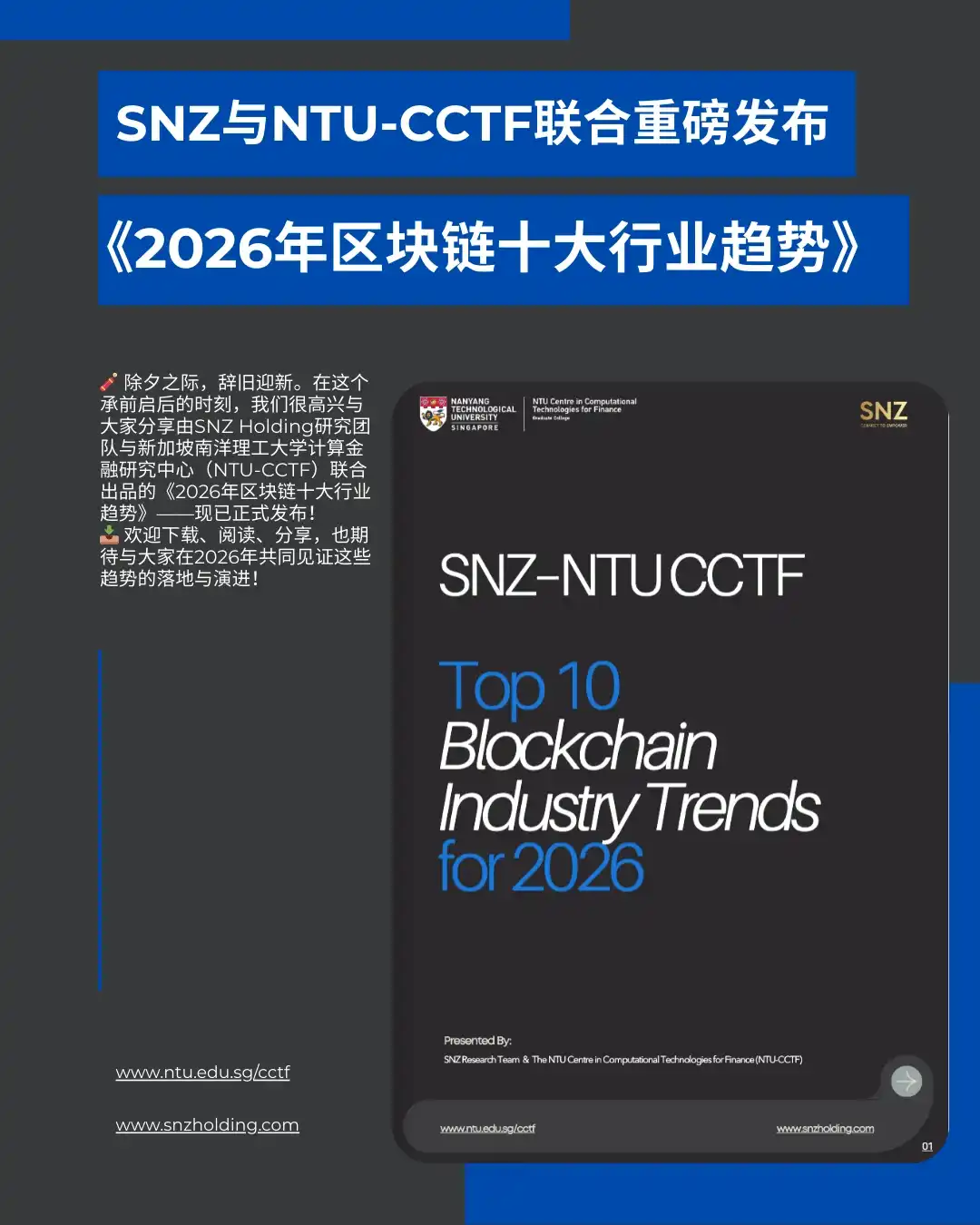
SNZ–NTU CCTF Releases "Top 10 Blockchain Industry Trends for 2026"

marsbitОпубликовано 2026-02-16Обновлено 2026-02-16

Введение

SNZ Holding and Nanyang Technological University's Computational Finance Centre (NTU-CCTF) have jointly released the "Top 10 Blockchain Industry Trends for 2026." The report highlights the ongoing transformation of Web3 from speculative experimentation into verifiable financial infrastructure. Key trends include the maturation of Real-World Assets (RWA) into composable DeFi instruments, the growing role of stablecoins in global payments, and the adoption of smart accounts and intent-based execution to improve user experience. Zero-knowledge proofs are evolving from privacy tools to foundational infrastructure for verifiable computation, while shared security and restaking are redefining security as a tradable economic resource. Other significant developments include progress in privacy-compliance engineering, DePIN networks shifting from incentive-driven models to verifiable systems, decentralized AI moving from hype to practical implementation, and token governance focusing on institutional accountability rather than mere voting procedures. The report aims to serve as a practical and forward-looking guide for industry builders, researchers, and decision-makers.

On New Year's Eve, as we bid farewell to the old and welcome the new, we are delighted to share the "Top 10 Blockchain Industry Trends for 2026," jointly produced by the SNZ Holding research team and the Nanyang Technological University Centre for Computational Finance (NTU-CCTF) in Singapore. The report is now officially released! (Read the full report)

Looking back from the beginning of 2026, Web3 is undergoing a profound transformation: evolving from early speculative experiments to verifiable financial infrastructure. Stablecoins are no longer just units of account in the crypto market but are widely discussed as a settlement layer for global payments; RWA assets have moved beyond the pilot stage to become composable financial instruments in DeFi; technologies such as smart accounts, intent-based execution, and zero-knowledge proofs are bringing on-chain interactions into the mainstream user experience as expected.

Based on a systematic review of technological advancements, market dynamics, and cutting-edge academic research, we have distilled the top ten trends most worth watching in 2026:

1. On-chain Treasury Bonds and Cash Management: RWA Transitions from Concept to Product;

2. Stablecoins: The New Focus of Global Payments in 2026;

3. The Era of Smart Accounts: Returning On-Chain Interactions to Everyday User Experience;

4. From "Manual Transaction Construction" to "Goal-Based Execution + Backend Bidding";

5. Zero-Knowledge Proofs: From Privacy Features to Verifiable Computing Infrastructure;

6. Privacy and Compliance: From Trade-offs to Verifiable Engineering Balance;

7. Shared Security and Restaking: Redefining Security Budgets as Tradable Economic Resources;

8. DePIN Networks: From Incentive-Driven Narratives to Verifiable Engineering;

9. Decentralized AI: From Narrative Hype to Engineering Practice;

10. Token Governance: Returning from Voting Procedures to Institutionalized Design of Rights and Responsibilities.

This report combines SNZ Holding's industry insights in the Web3 space with NTU-CCTF's academic research, aiming to provide a forward-looking and practical reference guide for industry builders, researchers, and decision-makers.

We welcome you to download, read, and share the report, and we look forward to witnessing the implementation and evolution of these trends together in 2026! Happy New Year's Eve, and may the Year of the Bingwu bring new joy!

Связанные с этим вопросы

QWhat is the main focus of the 'Top 10 Blockchain Industry Trends for 2026' report published by SNZ Holding and NTU-CCTF?

AThe report focuses on the transformation of Web3 from early speculative experiments to verifiable financial infrastructure, highlighting key trends such as stablecoins, RWA, smart accounts, zero-knowledge proofs, and decentralized AI.

QWhich trend in the report discusses the evolution of Real World Assets (RWA) in the blockchain space?

AThe trend 'On-chain Treasury and Cash Management: RWA from Concept to Product' discusses RWA moving out of the pilot phase and becoming composable financial tools in DeFi.

QHow does the report describe the role of stablecoins in 2026?

AThe report describes stablecoins as no longer just a unit of account in crypto markets but as a widely discussed settlement layer for global payments.

QWhat technological advancements are mentioned as improving the mainstream user experience in blockchain interactions?

ASmart accounts, intent-based execution, and zero-knowledge proofs are mentioned as technologies bringing on-chain interactions into the mainstream user experience.

QWhich trend emphasizes a shift from voting procedures to institutionalized design of responsibilities in token governance?

AThe trend 'Token Governance: From Voting Procedures to Institutionalized Design of Responsibilities' emphasizes this shift.

Похожее

It's Not Jensen Huang Who Wants to Change the PC, But the PC That's Revolting Against Itself

The 40-year-old PC industry is undergoing a fundamental transformation, driven by the rise of AI PCs. At the GTC Taipei 2026 event, NVIDIA, backed by Microsoft and major PC OEMs, announced the RTX Spark super chip for Windows PCs, marking its official entry into the PC core processor market. This move aims to redefine the AI PC by shifting its core from the CPU to an AI-focused SoC (System on Chip). NVIDIA envisions the PC evolving from a personal computer to a "personal AI"—a platform where local AI Agents can autonomously perform tasks. While Intel pioneered the AI PC concept earlier in 2026, NVIDIA's aggressive push, leveraging its vast CUDA developer ecosystem of 6 million, positions it to potentially reshape the industry's long-standing Wintel (Windows-Intel) power structure. NVIDIA's strategy extends beyond hardware; it's about embedding its CUDA, RTX, and AI software stack into the PC platform itself. The article identifies key shifts: 1) The move from a CPU-centric to an AI SoC-centric architecture, similar to Apple's approach with its M-series chips. 2) The PC's evolution from a human-operated tool to a platform for human-Agent collaboration. 3) The extension of NVIDIA's data center-centric CUDA ecosystem to personal devices via RTX Spark. Ultimately, the change is driven by the broader trend of AI moving to personal devices. Companies like Intel, AMD, Qualcomm, and Apple are all participating in this shift. NVIDIA's entry accelerates the competition, but the core driver is the technology itself finding its optimal expression in the PC. The industry is reinventing itself, with the outcome hinging on execution, ecosystem development, and the creation of compelling local AI applications.

marsbit2 ч. назад

It's Not Jensen Huang Who Wants to Change the PC, But the PC That's Revolting Against Itself

marsbit2 ч. назад

Торговля

Спот
Фьючерсы
活动图片