Should Bitcoin rush its move to post-quantum cryptography?

ambcryptoОпубликовано 2026-04-08Обновлено 2026-04-08

Введение

The Bitcoin community is divided on the urgency of migrating to post-quantum cryptography (PQC) by the 2029 deadline. JAN3 founder Samson Mow warns against rushing untested PQC solutions, arguing it could expose Bitcoin to attacks from classical computers, reduce transaction throughput due to larger signature sizes, and potentially introduce hidden backdoors. He advocates for solving the quantum computing (QC) problem later rather than sooner. This debate follows a Google Quantum AI report suggesting quantum processors could break Bitcoin's encryption sooner than previously estimated, potentially requiring only 1,200–1,450 logical qubits. Google urges a PQC upgrade by 2029 to protect nearly 7 million BTC. In contrast, figures like Adam Back and Grayscale's Zach Pandl believe practical quantum computers are still years away, posing no immediate threat. However, they agree efforts to prepare for a post-quantum future should accelerate. The issue is complicated by Bitcoin's history of contentious protocol changes and potential for significant technical trade-offs.

The Bitcoin community is divided on whether there is really a need to rush to meet the 2029 deadline of migrating to a quantum-secure network.

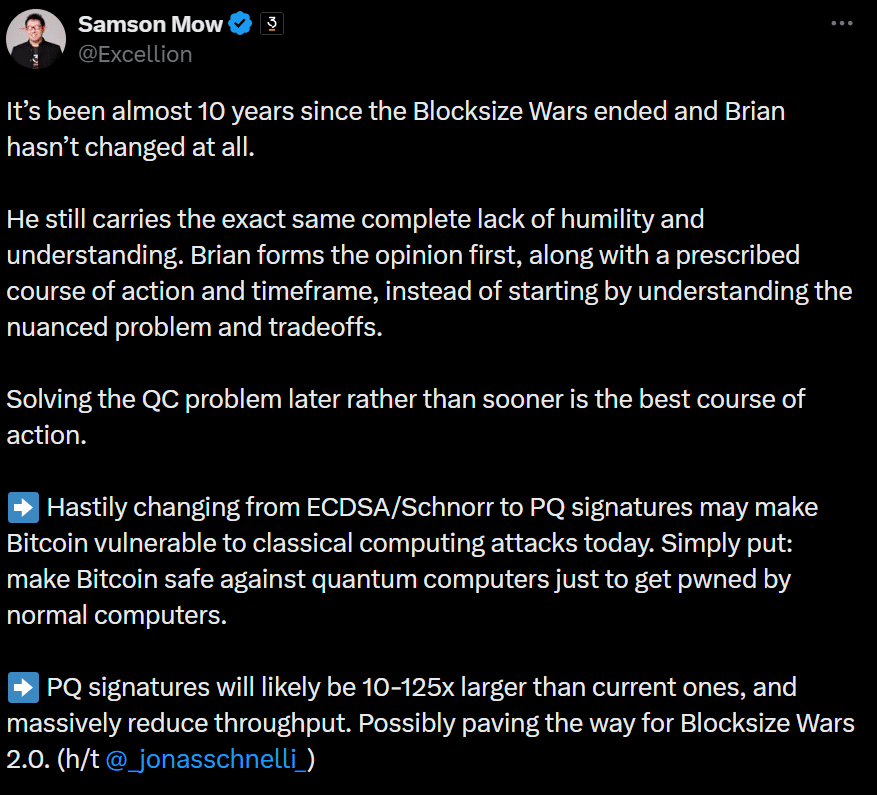
For his part, Samsom Mow, founder of JAN3, an advisory for nation-state BTC adoption, has warned against a hurried push for untested and unverified post-quantum (PQ) solutions. He cautioned that,

Solving the QC problem later rather than sooner is the best course of action.

Source: X/Samson Mow

Mow slammed Coinbase CEO Brian Armstrong’s call for a ‘sooner’ PQ upgrade. He stated that it could expose BTC to attack from current classical computers.

Additionally, the proposed PQ solutions would reduce Bitcoin transactions due to larger block sizes.

PQ signatures will likely be 10-125x larger than current ones, and massively reduce throughput. Possibly paving the way for Blocksize Wars 2.0.

In fact, Solana, one of the fastest blockchains, has reported a potential 90% slowdown if current PQ solutions are implemented.

Finally, Mow pointed out the possibility of the U.S. NSA (National Security Agency) pushing current PQ solutions as standards with hidden ‘backdoors’ to infiltrate future systems.

Google urges fast PQ Bitcoin upgrade before 2029

The renewed debate follows a recent report by Google Quantum AI, which found that Bitcoin and most blockchain encryption could be broken sooner than earlier estimates suggested.

According to the findings, advanced quantum processors may require around 500,000 physical qubits or 1,200–1,450 stable logical qubits to compromise crypto security.

This was contrary to the prior estimates of millions of qubits. Google had urged a PQ upgrade by 2029 to prevent nearly 7 million BTC from being at risk.

In short, there is less than three years before further quantum advancement threatens BTC.

Bitcoin’s history complicates this. Protocol changes often take time and spark disagreement.

In fact, Charles Edwards of Capriole Investment projected that BTC will never reach a new all-time high unless it migrates to PQ.

However, some crypto and cypherpunks like Adam Back still hold that physical quantum computers are years away from hitting the market despite recent advancements.

Grayscale’s head of research, Zach Pandl, reinforced a similar stance and noted,

Investors should not fret. In our view, there is no security threat to public blockchains from quantum computers today. But it’s time to accelerate efforts to prepare for our post-quantum future.

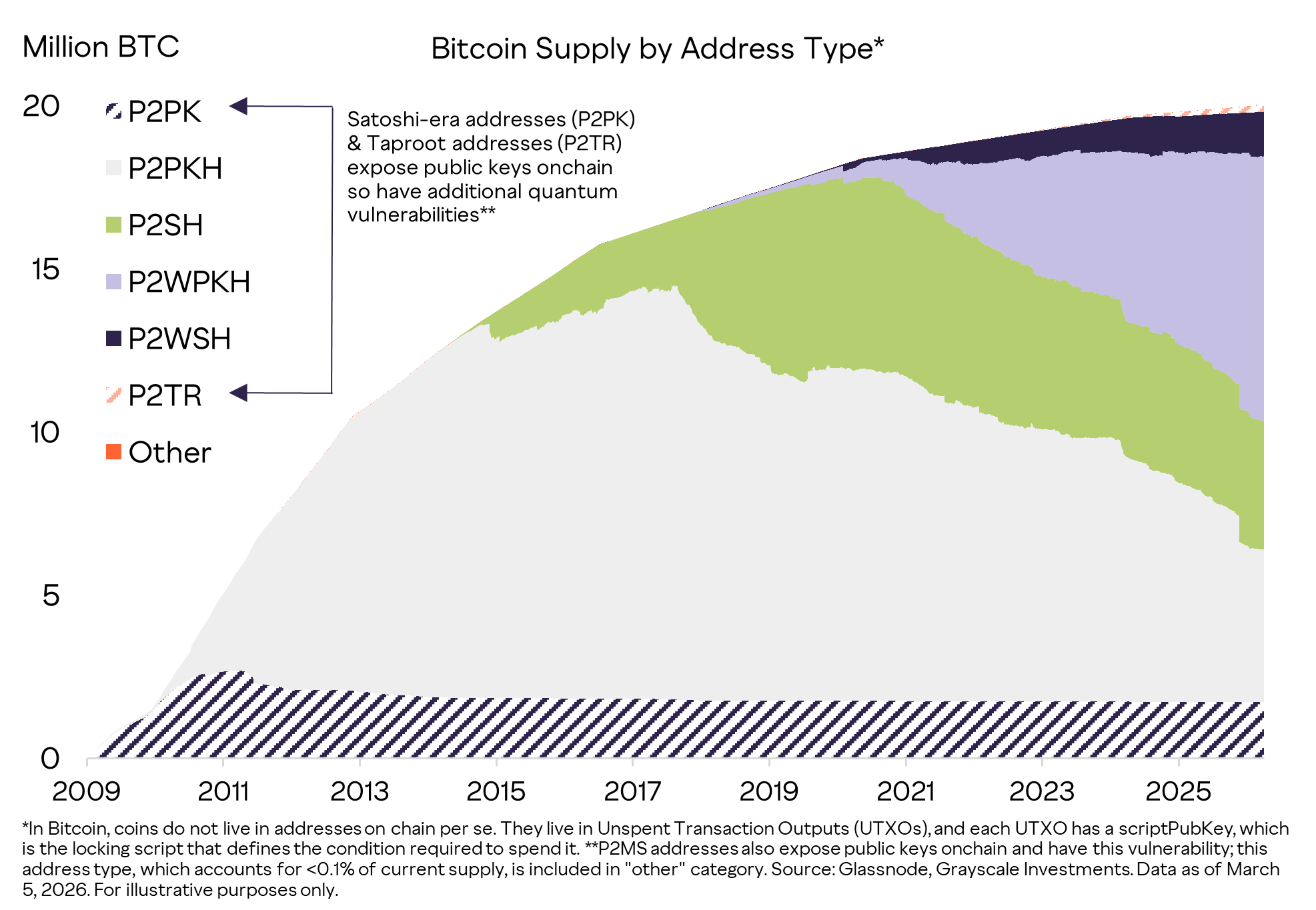
Source: Grayscale

Apart from the Satoshi-era and Taproot wallets, most investors have migrated to relatively more resistant addresses (Segwit, P2WPKH).


Final Summary

  • Jan3’s Samson Mow blasted Coinbase CEO for rushed push for PQ upgrade for Bitcoin, citing transfer speed risks and further attacks.
  • Grayscale said QC was not a problem just yet, but urged players to accelerate PQ upgrades.

Связанные с этим вопросы

QWhat is the main point of disagreement within the Bitcoin community regarding post-quantum cryptography?

AThe Bitcoin community is divided on whether there is a need to rush to meet the 2029 deadline for migrating to a quantum-secure network, with some warning against hurriedly implementing untested solutions.

QAccording to Samson Mow, what are the two main risks of rushing a post-quantum upgrade for Bitcoin?

ASamson Mow warned that a rushed upgrade could expose Bitcoin to attacks from current classical computers and that the proposed solutions would reduce transaction throughput due to significantly larger signature sizes.

QWhat did the Google Quantum AI report find regarding the threat to Bitcoin's encryption?

AThe Google Quantum AI report found that advanced quantum processors may require far fewer qubits than previously estimated (around 500,000 physical or 1,200–1,450 stable logical qubits) to compromise crypto security, urging an upgrade by 2029.

QWhat is the stance of Grayscale's head of research, Zach Pandl, on the quantum computing threat?

AZach Pandl stated that quantum computers pose no security threat to public blockchains today, but he urged the community to accelerate efforts to prepare for a post-quantum future.

QWhat potential negative impact did Samson Mow suggest a post-quantum upgrade could have on Bitcoin's network?

AMow suggested that post-quantum signatures, being 10-125x larger than current ones, would massively reduce transaction throughput and could potentially lead to a 'Blocksize Wars 2.0'.

Похожее

How Many Tokens Away Is Yang Zhilin from the 'Moon Chasing the Light'?

The article explores the intense competition between two leading Chinese AI companies, DeepSeek and Kimi (Moon Dark Side), and the mounting pressure on Yang Zhilin, the founder of Kimi. While DeepSeek re-emerged after 15 months of silence with its powerful V4 model—boasting 1.6 trillion parameters and low-cost, long-context capabilities—Kimi has been focusing on long-context processing and multi-agent systems with its K2.6 model. Yang faces a threefold challenge: technological rivalry, commercialization pressure, and investor expectations. Despite Kimi’s high valuation (reaching $18 billion), its revenue heavily relies on a single product with low paid conversion rates, while DeepSeek’s strategic silence and open-source influence have strengthened its market position and valuation prospects, now targeting over $20 billion. Both companies reflect broader trends in China’s AI ecosystem: Kimi aims for global influence through open-source contributions and agent-based advancements, while DeepSeek prioritizes foundational innovation and hardware independence, notably shifting to Huawei’s chips. Their competition is seen as vital for China’s AI progress, with the gap between top Chinese and U.S. models narrowing to just 2.7% on the Elo rating scale. Ultimately, the article argues that this rivalry, though anxiety-inducing for leaders like Zhilin, is essential for driving innovation and solidifying China’s role in the global AI landscape.

marsbit11 ч. назад

How Many Tokens Away Is Yang Zhilin from the 'Moon Chasing the Light'?

marsbit11 ч. назад

Торговля

Спот
Фьючерсы

Популярные статьи

Как купить MOVE

Добро пожаловать на HTX.com! Мы сделали приобретение Movement (MOVE) простым и удобным. Следуйте нашему пошаговому руководству и отправляйтесь в свое крипто-путешествие.Шаг 1: Создайте аккаунт на HTXИспользуйте свой адрес электронной почты или номер телефона, чтобы зарегистрироваться и бесплатно создать аккаунт на HTX. Пройдите удобную регистрацию и откройте для себя весь функционал.Создать аккаунтШаг 2: Перейдите в Купить криптовалюту и выберите свой способ оплатыКредитная/Дебетовая Карта: Используйте свою карту Visa или Mastercard для мгновенной покупки Movement (MOVE).Баланс: Используйте средства с баланса вашего аккаунта HTX для простой торговли.Третьи Лица: Мы добавили популярные способы оплаты, такие как Google Pay и Apple Pay, для повышения удобства.P2P: Торгуйте напрямую с другими пользователями на HTX.Внебиржевая Торговля (OTC): Мы предлагаем индивидуальные услуги и конкурентоспособные обменные курсы для трейдеров.Шаг 3: Хранение Movement (MOVE)После приобретения вами Movement (MOVE) храните их в своем аккаунте на HTX. В качестве альтернативы вы можете отправить их куда-либо с помощью перевода в блокчейне или использовать для торговли с другими криптовалютами.Шаг 4: Торговля Movement (MOVE)С легкостью торгуйте Movement (MOVE) на спотовом рынке HTX. Просто зайдите в свой аккаунт, выберите торговую пару, совершайте сделки и следите за ними в режиме реального времени. Мы предлагаем удобный интерфейс как для начинающих, так и для опытных трейдеров.

531 просмотров всегоОпубликовано 2024.12.13Обновлено 2025.03.21

Как купить MOVE

Обсуждения

Добро пожаловать в Сообщество HTX. Здесь вы сможете быть в курсе последних новостей о развитии платформы и получить доступ к профессиональной аналитической информации о рынке. Мнения пользователей о цене на MOVE (MOVE) представлены ниже.

活动图片