Shiba Inu Whales Are On The Move Again, But In What Direction?

bitcoinistОпубликовано 2026-03-10Обновлено 2026-03-10

Введение

Shiba Inu whale activity has intensified as large holders move billions of SHIB tokens away from centralized exchanges, causing exchange reserves to hit a record low of 80.9 trillion SHIB. This significant withdrawal, coupled with a dramatic spike in the SHIB burn rate—including a 53,950% surge in a single day—suggests growing deflationary pressure and reduced circulating supply. While SHIB continues to trade weakly amid broader market uncertainty, these movements indicate that whales may be accumulating in anticipation of a potential price rebound or major market shift.

Shiba Inu (SHIB) whale activity has intensified as major token holders shift their assets away from centralized exchanges (CEXs). Exchange reserves have plummeted to record lows, while the SHIB burn rate has accelerated dramatically, suggesting these investors may be preparing for significant market movements. These developments raise the question of whether the whales are positioning ahead of a potential market rebound or simply taking advantage of price declines to accumulate.

Shiba Inu Whales Execute Massive Exchange Withdrawals

Shiba Inu has experienced a dramatic shift in whale behavior, as billions of SHIB tokens have recently moved away from crypto exchanges. This shift comes at a time when the broader cryptocurrency and meme coin market faces major headwinds, with Shiba Inu continuing to trade without clear directional momentum even as its price weakens.

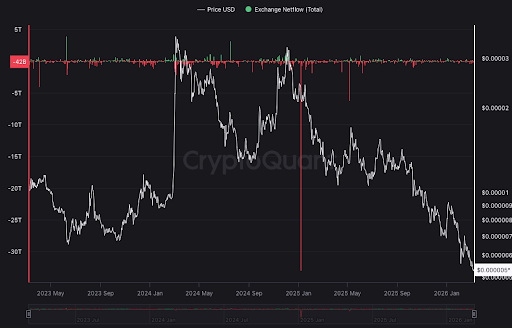
On March 8, on-chain analytics platform CryptoQuant detected a sharp decline in exchange net flow, with a total outflow of 166.16 billion SHIB tokens across major exchanges, nearly double the previous day’s 88 billion tokens. Even earlier, on March 6, exchanges recorded a negative net flow of 170.53 billion tokens, indicating sustained large-scale withdrawals by whales.

Source: Chart from CryptoQuant

Reports from WhaleScan on X have revealed that these whales have been active for a while now, securing their positions ahead of any major market movement. Usually, when whales move tokens from exchanges, it means those tokens are being removed from circulation. This reduces the supply of tokens available for trading on markets, which can create upward price pressure if demand continues to rise.

The recent whale movement also signals conviction in Shiba Inu despite its weakened fundamentals and recent sideways trading. Notably, WhaleScan has reported that due to the massive token exodus from exchanges, reserves on these crypto platforms have hit a record low of 80.9 trillion SHIB. This suggests that while weak hands are watching short-term price action, whales are accumulating, contributing to the decreasing supply.

SHIB Deflationary Pressures Build As Burn Rate Spikes

In addition to declining reserves, Shiba Inu’s burn rate has accelerated dramatically, increasing by 27.4% just last week. Most notably, on March 6, the burn rate skyrocketed by over 53,950% in just 24 hours, reflecting a staggering increase in tokens being removed from circulation.

Combined with the billions of tokens that recently flowed out of exchanges, Whale Scan has noted that Shiba Inu’s supply crunch is becoming increasingly clear and difficult to ignore. Recent burn statistics paint the picture of token holders seeking deflation amid weakening price action.

Approximately 337 billion SHIB tokens were burned on March 3, last week, as the Shibarium ecosystem prepared for the anticipated FHE privacy upgrade for Q2 2026. These developments indicate that Shiba Inu’s deflationary pressure is building as supply continues to decrease on exchanges.

SHIB trading at $0.000005 on the 1D chart | Source: SHIBUSDT on Tradingview.com

Связанные с этим вопросы

QWhat is the main reason for the recent significant drop in Shiba Inu (SHIB) exchange reserves?

AThe main reason is that Shiba Inu whales have been executing massive withdrawals, moving billions of SHIB tokens away from centralized exchanges, which has caused the reserves to plummet to a record low of 80.9 trillion SHIB.

QAccording to the article, what are the two possible motivations behind the whales' movement of SHIB off exchanges?

AThe two possible motivations are that the whales are either positioning ahead of a potential market rebound or simply taking advantage of price declines to accumulate more tokens.

QHow did the SHIB burn rate change on March 6, and what does this indicate?

AOn March 6, the SHIB burn rate skyrocketed by over 53,950% in 24 hours, indicating a massive and accelerated removal of tokens from circulation, which increases deflationary pressure.

QWhat on-chain analytics platform detected the sharp decline in SHIB exchange net flow, and what was the outflow amount on March 8?

AThe on-chain analytics platform CryptoQuant detected the sharp decline. On March 8, the total outflow was 166.16 billion SHIB tokens across major exchanges.

QWhat broader market context is Shiba Inu facing, as mentioned in the article?

AShiba Inu is facing major headwinds in the broader cryptocurrency and meme coin market, continuing to trade without clear directional momentum even as its price weakens.

Похожее

Borrowing Money from a Hundred Years Later, Building Incomprehensible AI

Tech giants like Alphabet, Amazon, Meta, and Microsoft are undergoing a radical financial transformation due to AI. Their traditional "light-asset, high-free-cash-flow" model is being dismantled by staggering capital expenditures on AI infrastructure—data centers, GPUs, and power. Combined 2026 guidance exceeds $700 billion, a 4.5x increase from 2022, causing free cash flow to plummet (e.g., Amazon's fell 95%). To fund this, they are borrowing unprecedented sums through long-dated, multi-currency bonds (e.g., Alphabet's 100-year bond). The world's most conservative capital—pensions, insurers—is now funding Silicon Valley's most speculative bet. This shift makes these companies resemble heavy-asset industrials (railroads, utilities) rather than software firms, threatening their premium valuations. Historically, such infrastructure booms (railroads, fiber optics) followed a pattern: genuine technology, overbuilding fueled by competitive frenzy, aggressive debt financing, and a crash triggered by financial conditions—not technology failure. The infrastructure remained, but many original builders and financiers did not survive. The core gamble is a "time arbitrage": using cheap debt today to build scale and lock in customers before AI capabilities commoditize. They are betting that AI revenue will materialize before debt comes due. Their positions vary: Amazon is under immediate cash pressure; Meta's path to monetization is unclear; Alphabet has a robust core business buffer; Microsoft has the shortest path from infrastructure to revenue. The contract is set: the most risk-averse global capital has lent its time to Silicon Valley, awaiting a future that is promised but uncertain.

marsbit31 мин. назад

Borrowing Money from a Hundred Years Later, Building Incomprehensible AI

marsbit31 мин. назад

The 'VVV' Concept Soars 9x in Half a Year, The New AI Narrative on Base Chain

"The article explores the 'VVV' concept as the new AI-focused narrative within the Base ecosystem, centered around the token $VVV of the privacy-focused, uncensored generative AI platform Venice, led by crypto veteran Erik Voorhees. Venice has seen significant growth in 2026, with its API users surging, partly attributed to exposure from OpenClaw. The platform now boasts over 2 million total users and 55,000 paid subscribers. Correspondingly, the $VVV token price has risen over 9x this year. Key to its performance are tokenomics designed for value accrual: reduced annual emissions, subscription revenue used for buyback-and-burn, and a unique staking mechanism. Staking $VVV yields $sVVV, which can be used to mint $DIEM tokens. Each staked $DIEM provides a daily $1 credit for using Venice's API services, creating tangible utility. The article also highlights other tokens associated with the 'VVV' narrative. $POD, the token of distributed AI network Dolphin (which co-developed Venice's default AI model), saw a massive price surge. $cyb3rwr3n, a project for a Venice credit auction market, gained attention due to perceived connections to Venice's team despite official denials. Finally, $SR of robotics platform STRIKEROBOT.AI rose after announcing a partnership with Venice for robot vision-language model development. Overall, the 'VVV' ecosystem combines AI platform growth, deflationary tokenomics, and innovative utility mechanisms, driving significant investor interest and price action in related tokens."

marsbit39 мин. назад

The 'VVV' Concept Soars 9x in Half a Year, The New AI Narrative on Base Chain

marsbit39 мин. назад

Anthropic and OpenAI Have Single-Handedly Severed the Logic of Pre-IPO Stock Tokenization

The pre-IPO stock token market is experiencing significant turmoil following strong statements from AI giants Anthropic and OpenAI. Both companies have updated their official policies, declaring that any transfer of their company shares—including sales, transfers, or assignments of share interests—without prior board approval is "invalid" and will not be recognized in their corporate records. This means buyers in such unauthorized transactions would not be recognized as shareholders and would have no shareholder rights. A major point of contention is the use of Special Purpose Vehicles (SPVs), which are legal entities commonly used by pre-IPO token platforms to pool investor funds and indirectly acquire shares from employees or early investors. The companies explicitly state they do not permit SPVs to acquire their shares, and any such transfer violates their restrictions. They warn that third parties selling shares through SPVs, direct sales, forward contracts, or stock tokens are likely engaged in fraud or are offering worthless investments due to these transfer limits. This stance directly threatens the core model of many pre-IPO token platforms, which rely on SPV structures. The announcement revealed additional risks within this model, such as complex "SPV-within-SPV" layering that obscures legal transparency, increases management fees, and creates a chain reaction risk of invalidation. Following the news, tokens like ANTHROPIC and OPENAI on platforms like PreStocks fell sharply (over 20%). The market reaction highlights a divergence: while asset-backed pre-IPO tokens plummeted, purely speculative pre-IPO futures contracts, which are bilateral bets on future IPO prices with no claim to actual shares, remained relatively stable as they are unaffected by the transfer restrictions. The industry is split on the implications. Some believe the fundamental logic of pre-IPO token trading is broken if leading companies reject SPV-held shares, potentially causing a domino effect. Others, like Rivet founder Nick Abouzeid, argue that buyers of such unofficial tokens always knowingly accepted the risk of non-recognition by the company. The statements serve as a stark risk warning and a corrective measure for a market where valuations for some AI-related pre-IPO tokens had soared to irrational levels, far exceeding recent funding round valuations.

marsbit1 ч. назад

Anthropic and OpenAI Have Single-Handedly Severed the Logic of Pre-IPO Stock Tokenization

marsbit1 ч. назад

Anthropic and OpenAI Personally Sever the Logic of Pre-IPO Crypto-Stocks

The pre-IPO token market has been rocked by strong statements from Anthropic and OpenAI. Both AI giants have updated official warnings, declaring that any sale or transfer of their company shares without explicit board approval is "invalid" and will not be recognized on their corporate records. This directly targets Special Purpose Vehicles (SPVs), the common legal structure used by pre-IPO token platforms. These platforms typically use an SPV to acquire shares from employees or early investors, then issue blockchain-based tokens representing a claim on the SPV's economic benefits. Anthropic and OpenAI's position means that if an SPV's share purchase lacked authorization, the underlying asset could be deemed worthless, nullifying the token's value. Anthropic explicitly warned that any third party selling its shares—via direct sales, forwards, or tokens—is likely fraudulent or offering a valueless investment. The crackdown highlights risks in the popular SPV model, including complex multi-layered "Russian doll" SPV structures that obscure legal ownership, add fees, and concentrate risk. If one layer is invalidated, the entire chain could collapse. Following the announcements, tokens like ANTHROPIC and OPENAI on platforms like PreStocks fell sharply (over 20%). In contrast, purely speculative pre-IPO prediction contracts remained stable, as they involve no actual share ownership. The move is seen as a corrective measure amid a market frenzy where some pre-IPO token valuations (e.g., Anthropic's token hitting a $1.4 trillion implied valuation) far exceeded recent official funding rounds. Opinions are split: some believe this undermines the core logic of pre-IPO token trading if top companies reject SPVs, while others argue buyers always assumed this legal risk when accessing unofficial channels. The statements serve as a stark warning and a potential catalyst for market de-leveraging and clearer boundaries.

Odaily星球日报1 ч. назад

Anthropic and OpenAI Personally Sever the Logic of Pre-IPO Crypto-Stocks

Odaily星球日报1 ч. назад

Торговля

Спот
Фьючерсы

Популярные статьи

Как купить MOVE

Добро пожаловать на HTX.com! Мы сделали приобретение Movement (MOVE) простым и удобным. Следуйте нашему пошаговому руководству и отправляйтесь в свое крипто-путешествие.Шаг 1: Создайте аккаунт на HTXИспользуйте свой адрес электронной почты или номер телефона, чтобы зарегистрироваться и бесплатно создать аккаунт на HTX. Пройдите удобную регистрацию и откройте для себя весь функционал.Создать аккаунтШаг 2: Перейдите в Купить криптовалюту и выберите свой способ оплатыКредитная/Дебетовая Карта: Используйте свою карту Visa или Mastercard для мгновенной покупки Movement (MOVE).Баланс: Используйте средства с баланса вашего аккаунта HTX для простой торговли.Третьи Лица: Мы добавили популярные способы оплаты, такие как Google Pay и Apple Pay, для повышения удобства.P2P: Торгуйте напрямую с другими пользователями на HTX.Внебиржевая Торговля (OTC): Мы предлагаем индивидуальные услуги и конкурентоспособные обменные курсы для трейдеров.Шаг 3: Хранение Movement (MOVE)После приобретения вами Movement (MOVE) храните их в своем аккаунте на HTX. В качестве альтернативы вы можете отправить их куда-либо с помощью перевода в блокчейне или использовать для торговли с другими криптовалютами.Шаг 4: Торговля Movement (MOVE)С легкостью торгуйте Movement (MOVE) на спотовом рынке HTX. Просто зайдите в свой аккаунт, выберите торговую пару, совершайте сделки и следите за ними в режиме реального времени. Мы предлагаем удобный интерфейс как для начинающих, так и для опытных трейдеров.

560 просмотров всегоОпубликовано 2024.12.13Обновлено 2025.03.21

Как купить MOVE

Обсуждения

Добро пожаловать в Сообщество HTX. Здесь вы сможете быть в курсе последних новостей о развитии платформы и получить доступ к профессиональной аналитической информации о рынке. Мнения пользователей о цене на MOVE (MOVE) представлены ниже.

活动图片