Samourai Co-Founder Writes From Prison After Surrender: ‘Confusing And Unnatural’

bitcoinistОпубликовано 2025-12-27Обновлено 2025-12-27

Введение

Keonne Rodriguez, co-founder of Bitcoin privacy tool Samourai Wallet, has written a letter from a US federal prison after beginning a five-year sentence. Dated Christmas Eve, the letter describes the intake process and his initial days behind bars as "confusing and unnatural" but manageable, noting respectful treatment from fellow inmates. Rodriguez was sentenced on November 19 for charges related to his role in a crypto mixing protocol. His case has sparked a significant legal and ethical debate over whether developers of privacy software can be held criminally liable for misuse by others. This mirrors concerns in the prosecution of Tornado Cash co-founder Roman Storm, raising questions about the legal treatment of open-source code. Supporters argue the case threatens free speech and software development, with a clemency petition gathering over 12,000 signatures. They claim no direct victims were harmed by his work. Prosecutors, however, contend that the tools were structured and promoted in ways that enabled illicit transactions. US President Donald Trump has acknowledged he will "take a look" at the case, keeping the possibility of a pardon in public discourse. The situation highlights the ongoing tension between neutral technology and its potential for criminal use, drawing attention from developers, legal experts, and privacy advocates.

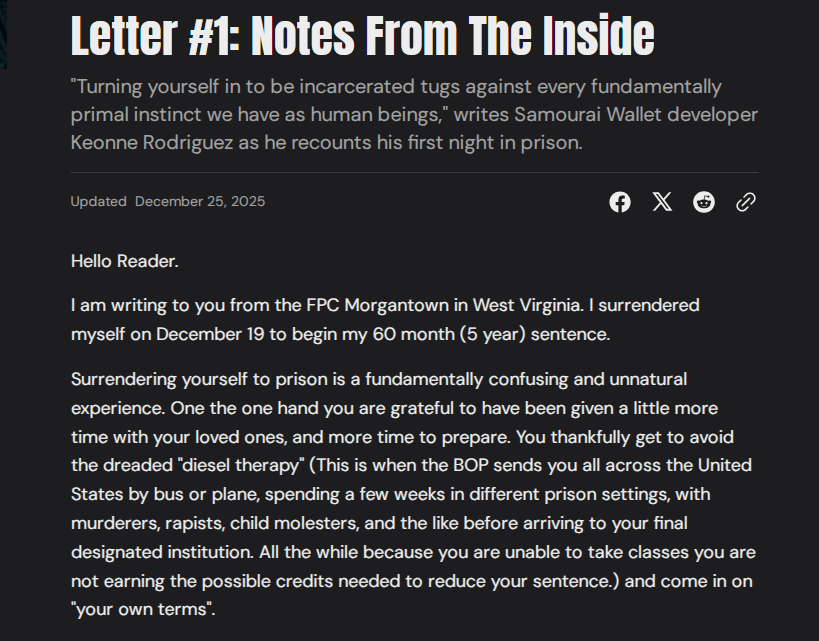
Keonne Rodriguez, a co-founder of the Bitcoin privacy tool Samourai Wallet, began serving a five-year sentence and wrote a letter from inside a US federal prison on Christmas Eve.

The letter, shared publicly, offers a short, personal account of intake procedures, the move into housing, and his first days behind bars. He wrote that the place was “confusing and unnatural”, yet “manageable”, and that fellow inmates had treated him with respect.

Inside The Prison Letter

Rodriguez wrote that he had gone through searches and medical checks during intake, and that he was settling in after what he called an emotional goodbye to family days before the holiday.

The note was dated Christmas Eve and marked his seventh day at the facility. Reports said his wife was scheduled as his first visitor on Christmas Day. Those details make the timing — and the human side of the story — hard to miss.

Source: The Rage/ Letter of Keonne Rodriguez, co-founder of Bitcoin privacy tool Samourai Wallet.

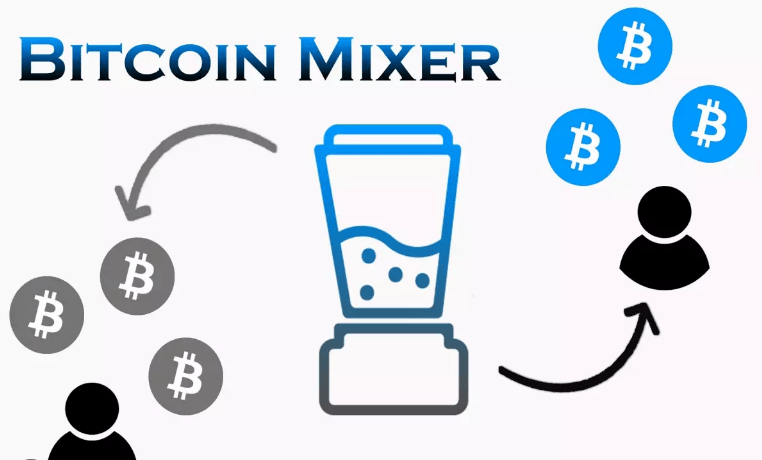
Rodriguez was sentenced on Nov. 19 on charges tied to his role in a crypto mixing protocol. His case has become a touchpoint for a wider dispute about whether building or maintaining privacy software can carry criminal liability when others misuse those tools.

The debate has drawn comparisons to the prosecution of Roman Storm, a co-founder of Tornado Cash, and raised questions about how the law treats open-source code and the people who write it.

Total crypto market cap at $2.96 trillion on the daily chart: TradingView

Samourai: Legal Debate Over Code And Crime

Supporters say Rodriguez’s prosecution threatens free speech and software development. A petition asking for clemency gathered more than 12,000 signatures, and many privacy advocates argue that no direct victims were harmed by his work.

In public posts, Rodriguez framed his case as “lawfare” and criticized regulators and judges for targeting innovation. Those claims have been repeated widely in crypto circles.

Prosecutors argue differently. They point to the structure and promotion of certain tools and say some actors used them to hide illicit transfers.

Courts have faced the hard question of where to draw the line between code as neutral technology and code used to facilitate crime. That tension is central to why Rodriguez’s sentence has drawn such attention from developers, legal scholars, and privacy groups.

Image: Blockmanity

Samourai Drama: Calls For Clemency Gain Traction

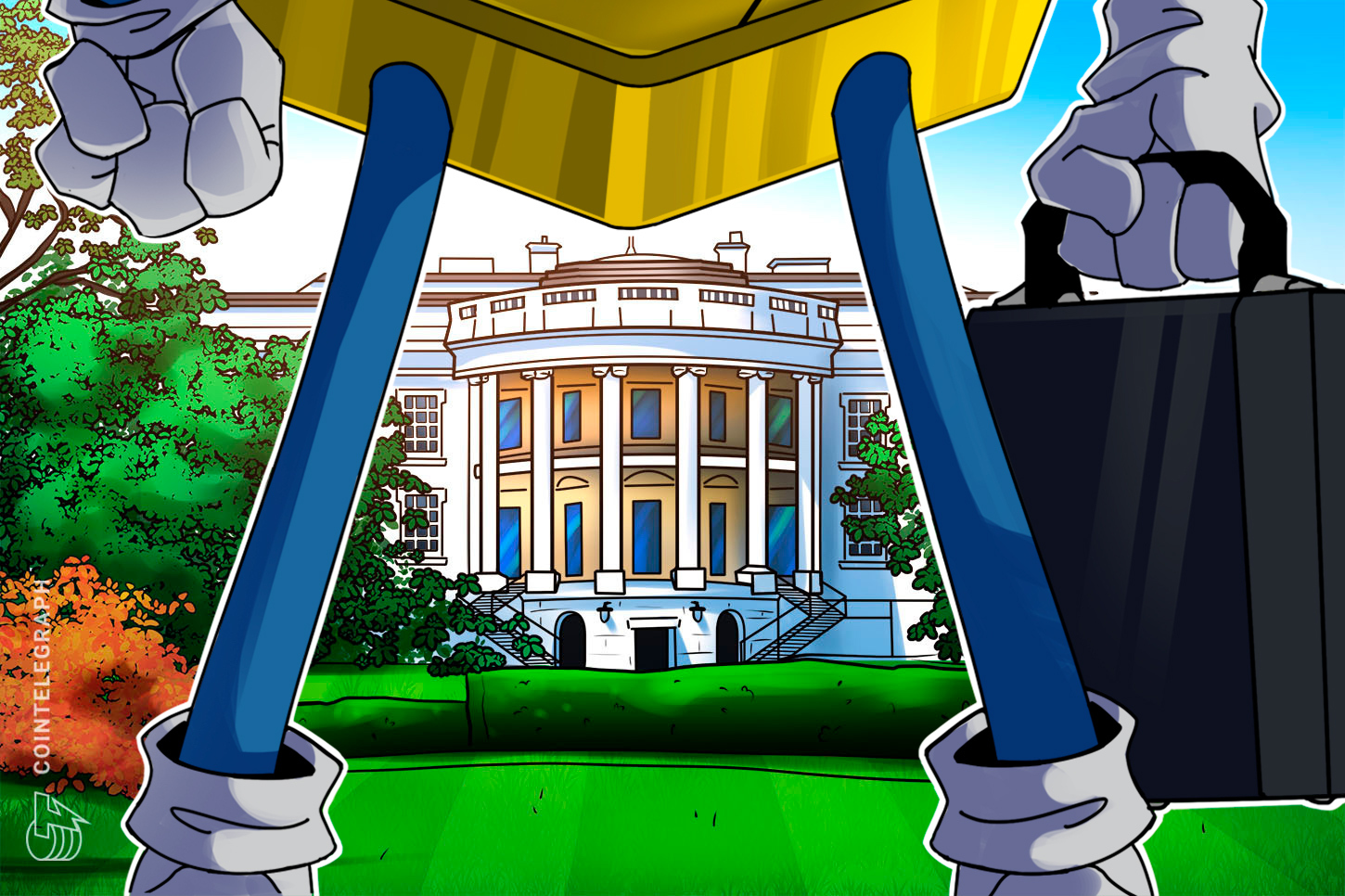
US President Donald Trump said on Dec. 16 that he would “take a look” at Rodriguez’s case after it gained public attention. That brief remark kept the possibility of executive clemency in public view, though such reviews do not always lead to action. Rodriguez publicly appealed to the president for a pardon as he began serving his sentence.

Public reaction has been mixed. Some see the petition and media coverage as a push to protect open-source developers. Others stress that courts will weigh evidence about intent and conduct, not just the code itself.

What remains clear is that this case has pulled the issue into the open and made it harder for lawmakers and courts to ignore.

Featured image from Cyber Security News, chart from TradingView

Связанные с этим вопросы

QWho is Keonne Rodriguez and what is his current situation?

AKeonne Rodriguez is a co-founder of the Bitcoin privacy tool Samourai Wallet. He is currently serving a five-year sentence in a US federal prison after being convicted on charges related to his role in a crypto mixing protocol.

QWhat was the main sentiment expressed in Rodriguez's prison letter?

AIn his letter, Rodriguez described the prison environment as 'confusing and unnatural' but also 'manageable'. He noted that his fellow inmates treated him with respect.

QWhy has Rodriguez's case become a significant topic of debate?

AHis case has become a touchpoint for a wider dispute about whether building or maintaining privacy software can carry criminal liability when others misuse those tools. It raises questions about the legal treatment of open-source code and its developers.

QWhat action did US President Donald Trump take regarding this case?

AUS President Donald Trump said on Dec. 16 that he would 'take a look' at Rodriguez's case, keeping the possibility of executive clemency in public view.

QWhat is the core legal argument made by prosecutors against Rodriguez?

AProsecutors argue that the structure and promotion of certain tools, like the crypto mixer, were used by some actors to hide illicit transfers, thus making the developers criminally liable.

Похожее

Saylor's Purchase of 1550 Bitcoin Is a Bad Trade

**Title: Saylor's Purchase of 1,550 Bitcoins Was a Bad Trade** The article critically analyzes Strategy's recent move of selling 32 bitcoins followed by a much larger purchase of 1,550 bitcoins. While appearing bullish, the author argues this trade is detrimental to MSTR shareholders. The core argument revolves around the concept of "breakeven modified Net Asset Value (mNAV)," a key metric for Strategy. To increase Bitcoin per share (BPS) for MSTR holders, Strategy must issue new shares at a premium high enough that the funds raised can buy more bitcoin than the bitcoin backing each existing share. Currently, this breakeven mNAV is estimated at 1.30. The recent trade failed on two counts: 1. The shares for the $181 million raise were issued at an mNAV *below* the 1.30 breakeven point. Selling "cheap" shares to buy bitcoin actually *reduces* BPS. 2. Only $101.3 million of the raised funds were used to buy bitcoin; the rest went to boost the company's dollar reserves. The breakeven mNAV calculation assumes *100%* of proceeds are used for bitcoin purchases. Diverting funds, even if mNAV were high, dilutes BPS. The result is an estimated 0.19% decrease in Bitcoin per share for MSTR holders. In exchange, Strategy merely extended its operational runway for its dollar reserves from ~6.3 months to 7 months. The author interprets this as Strategy prioritizing the survival and development of its STRC business over its stated core goal of increasing MSTR's BPS. This constitutes a gamble: if sacrificing MSTR value leads to improved market sentiment and a recovery in STRC's price (and thus mNAV), the whole system could work. If not, Strategy may be forced into a cycle of further diluting MSTR to stay afloat, potentially leading to deferred STRC dividends or corporate decline. The article concludes with a hope for price recovery for Bitcoin, MSTR, and STRC.

Foresight News12 мин. назад

Saylor's Purchase of 1550 Bitcoin Is a Bad Trade

Foresight News12 мин. назад

The AI Bear Market Lasting Two Days Is Over; Why Did Funds Buy Back Storage Stocks First?

After a severe two-day selloff in early June that erased over $1 trillion from U.S. chip stock market value, capital is flowing back first to the memory sector. The correction was not driven by a collapse in AI demand but rather a market reassessment of high expectations. Stocks like Broadcom faced selling pressure despite strong AI revenue guidance, signaling a shift in focus from who has an "AI story" to who can most rapidly translate AI demand into verifiable profits and earnings per share (EPS). Memory companies, such as Micron and SK Hynix, are leading the recovery because their EPS growth is more immediately verifiable. The AI server boom directly increases demand for high-bandwidth memory (HBM) and high-capacity server DRAM, tightening supply and driving up contract prices for conventional DRAM and NAND Flash. This price increase, coupled with a shift to higher-margin products, flows directly into near-term revenue and profitability, as evidenced in recent earnings reports. In contrast, other AI semiconductor segments like GPUs, ASICs, and optical modules, while central to the long-term AI infrastructure story, face longer and less certain paths to EPS validation. Their growth depends more on future product cycles, customer adoption timelines, and capital expenditure plans. The rebound in memory stocks highlights a market preference for assets with shorter, more transparent EPS conversion cycles following the recent de-risking phase. However, this does not negate the potential of other AI hardware segments should they provide clearer near-term order visibility. The episode has raised the validation bar for all AI-related investments.

marsbit12 мин. назад

The AI Bear Market Lasting Two Days Is Over; Why Did Funds Buy Back Storage Stocks First?

marsbit12 мин. назад

Monera Digital|Crypto Market May Report: Four Major Reasons Behind the Accelerated Decline

Monera Digital Crypto Market May Report: Four Key Reasons Behind the Accelerated Decline The crypto market experienced a significant downturn in May, driven by an internal liquidity crisis rather than external macro factors. Bitcoin fell from around $82,850 to $73,674, even as traditional markets rallied in the final week, highlighting a clear "liquidity transmission failure" specific to crypto. Four primary internal factors caused the accelerated sell-off: 1. **Major ETF Outflows:** U.S. spot Bitcoin ETFs saw a net outflow of $2.425 billion for the month, the third-largest monthly withdrawal since their launch. Ethereum ETFs also reversed to net outflows. This turned a key pillar of the bull run into a source of selling pressure. 2. **Holder Capitulation:** On-chain data showed textbook "surrender" patterns. The Short-Term Holder MVRV ratio fell below 1.0, indicating this cohort is now in aggregate loss. The Net Unrealized Profit/Loss (NUPL) metric also deteriorated significantly. 3. **Contagious Negative Sentiment:** The Coinbase Premium Index, which shows U.S. institutional buying/selling pressure, turned deeply negative for most of the month. This confirmed the ETF outflows and reflected a strategic shift away from crypto toward assets like U.S. Treasuries. 4. **Leverage Unwinding and Psychological Breaks:** Despite the downturn, futures open interest initially grew, signaling leveraged positioning. This culminated in a sharp deleveraging event with $307 million in long liquidations. Furthermore, the price broke below the critical $75K-$76K support zone, which is both a key gamma option level and the approximate average cost basis for major public companies holding Bitcoin, turning them from potential buyers into potential sellers. The report concludes that the market's pricing power has shifted from macro narratives to internal liquidation. While Bitcoin's 200-week moving average quantile has entered a historical "value zone" at 10.2%, this indicates a deep bear market reset is underway, not an immediate reversal. A sustainable recovery will require both a genuine improvement in the macro liquidity environment and clear signs of renewed on-chain demand, such as ETF inflows resuming and the Coinbase Premium turning positive. Until then, discipline and capital preservation are paramount.

marsbit23 мин. назад

Monera Digital|Crypto Market May Report: Four Major Reasons Behind the Accelerated Decline

marsbit23 мин. назад

Торговля

Спот
Фьючерсы

Популярные статьи

Как купить ZEST

Добро пожаловать на HTX.com! Мы сделали приобретение Zest Protocol (ZEST) простым и удобным. Следуйте нашему пошаговому руководству и отправляйтесь в свое крипто-путешествие.Шаг 1: Создайте аккаунт на HTXИспользуйте свой адрес электронной почты или номер телефона, чтобы зарегистрироваться и бесплатно создать аккаунт на HTX. Пройдите удобную регистрацию и откройте для себя весь функционал.Создать аккаунтШаг 2: Перейдите в Купить криптовалюту и выберите свой способ оплатыКредитная/Дебетовая Карта: Используйте свою карту Visa или Mastercard для мгновенной покупки Zest Protocol (ZEST).Баланс: Используйте средства с баланса вашего аккаунта HTX для простой торговли.Третьи Лица: Мы добавили популярные способы оплаты, такие как Google Pay и Apple Pay, для повышения удобства.P2P: Торгуйте напрямую с другими пользователями на HTX.Внебиржевая Торговля (OTC): Мы предлагаем индивидуальные услуги и конкурентоспособные обменные курсы для трейдеров.Шаг 3: Хранение Zest Protocol (ZEST)После приобретения вами Zest Protocol (ZEST) храните их в своем аккаунте на HTX. В качестве альтернативы вы можете отправить их куда-либо с помощью перевода в блокчейне или использовать для торговли с другими криптовалютами.Шаг 4: Торговля Zest Protocol (ZEST)С легкостью торгуйте Zest Protocol (ZEST) на спотовом рынке HTX. Просто зайдите в свой аккаунт, выберите торговую пару, совершайте сделки и следите за ними в режиме реального времени. Мы предлагаем удобный интерфейс как для начинающих, так и для опытных трейдеров.

282 просмотров всегоОпубликовано 2026.05.19Обновлено 2026.06.02

Как купить ZEST

Обсуждения

Добро пожаловать в Сообщество HTX. Здесь вы сможете быть в курсе последних новостей о развитии платформы и получить доступ к профессиональной аналитической информации о рынке. Мнения пользователей о цене на A (A) представлены ниже.

活动图片