Ronin and ZKsync’s onchain metrics fell the most in 2025

cointelegraphОпубликовано 2025-12-16Обновлено 2025-12-16

Введение

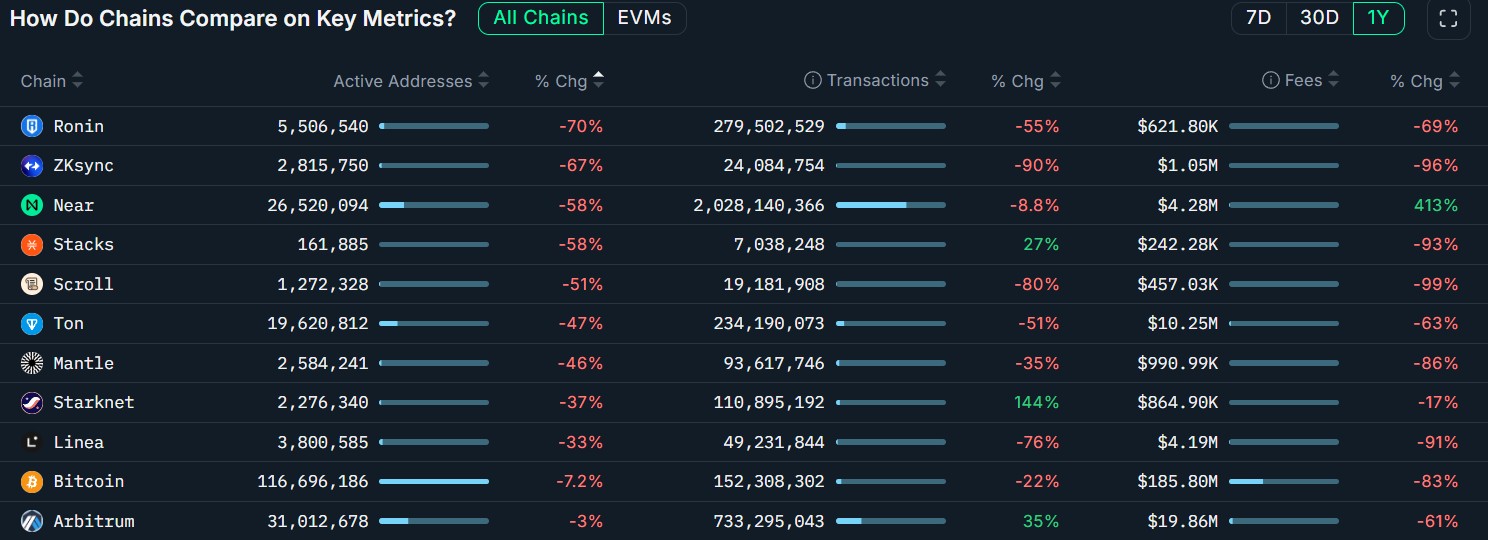
According to Nansen data, onchain activity declined sharply across several major blockchain networks in 2025. Ronin saw the largest drop in active addresses at 70%, largely due to decreased usage of the Pixels game. ZKsync experienced one of the steepest transaction declines, falling 90% after its 2024 airdrop. Several Ethereum layer-2 networks, including Scroll, also posted declines as airdrop-related activity cooled. In contrast, Ethereum’s base layer saw active addresses rise 25% and transactions increase over 20%. Solana led the industry in active addresses with over 1 billion, despite a token price drop, while BNB Chain posted a 159% increase in active addresses. The data highlights how onchain activity is highly volatile and often driven by short-term factors like airdrops, viral applications, and migrating ecosystems, rather than indicating long-term network failure.

Onchain activity declined sharply on several major networks, according to Nansen data, with 11 blockchains posting drops in active addresses in the past year.

Ronin fell the most at 70%, while Bitcoin registered a 7.2% decline. Several Ethereum layer-2 networks made the list.

Nansen data also showed drops in transaction activity across many of the same networks. ZKsync recorded one of the steepest declines, with transactions falling 90%.

Meanwhile, Ethereum’s base layer recorded a 25% increase in active addresses and more than a 20% rise in transactions, even as debate continued around Ethereum’s rollup-centric roadmap and concerns over liquidity fragmentation across layer-2 networks.

Ronin and Ethereum layer-2 chains dominate activity declines as Bitcoin sneaks into the list. Source: Nansen

Networks with the biggest usage declines

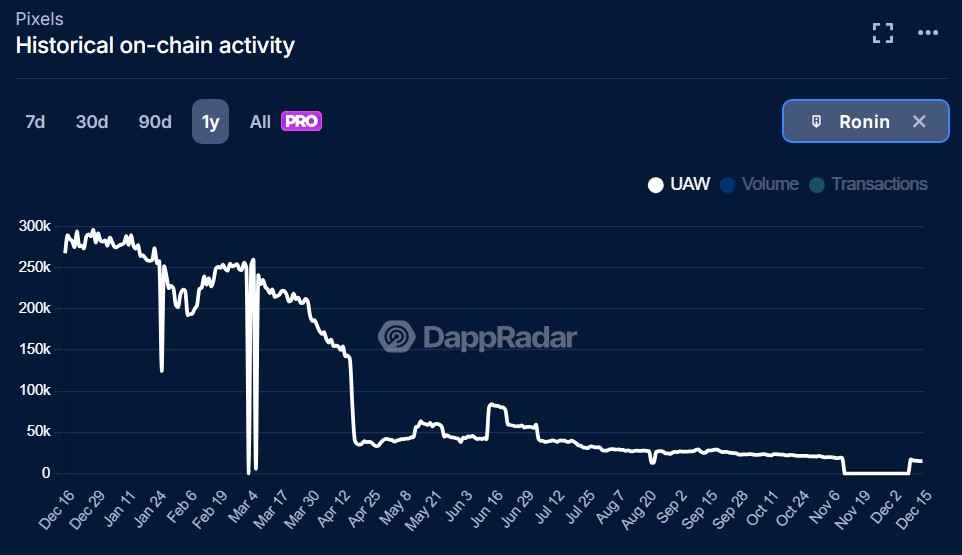
Pixels is a popular game that migrated to Ronin from Polygon in the second half of 2023. At the time, Ronin had roughly 20,000 daily active users before Pixels’ arrival drove a sharp increase in activity, briefly making Ronin the second-most active chain by daily users.

By December 2024, Pixels registered around 300,000 daily active users, according to DappRadar. The game’s popularity has since declined, and Ronin’s onchain activity has fallen alongside it, showing the network’s reliance on hit games.

Pixels activity dropped throughout 2025. Source: DappRadar

Several Ethereum layer-2 networks also experienced a decline in usage as activity tied to airdrops cooled. ZKsync’s token airdrop claim opened in June 2024. The network said nearly 700,000 wallets were eligible while fending off criticism of its Sybil filtering. Nansen data showed that more than 40% of the top airdrop wallets immediately sold their allocations. Scroll also appeared on the list following its October 2024 airdrop, after which onchain activity slowed down.

Arbitrum saw active addresses fall by 3%, though its roughly 31 million users still ranked it among the top 10 networks by activity. The Ethereum rollup conducted its airdrop in 2023, and its transaction volume rose 36% over the past year to about 734.5 million, beating Ethereum’s 507 million transactions. Arbitrum drew activity from tokenized assets, including 500 US stocks stamped on the network by Robinhood.

Related: How crypto is used in 2025: YouTube, Pokémon cards and more

Base and Optimism stood out among Ethereum layer-2 networks. Both posted increases in active addresses and transaction volumes. Base does not have a native token and has never conducted an airdrop. Onchain activity rose alongside interest in areas such as memecoins, AI-related applications and decentralized exchanges.

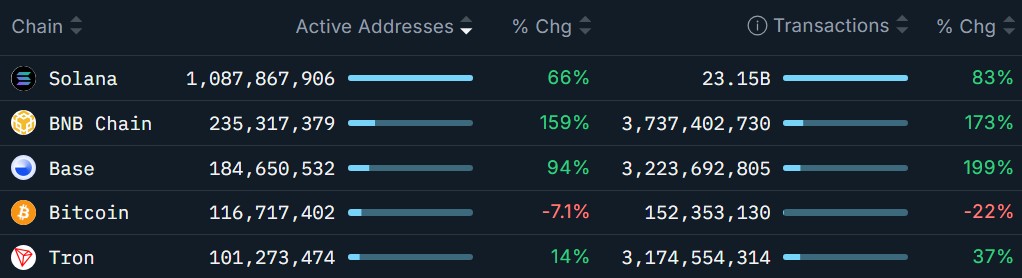
Solana recorded the most active addresses in the industry with more than 1 billion, followed by Tron and Ethereum. BNB Chain posted a 159% increase in active addresses, while Bitcoin was the only network in the top five to record a decline, alongside a 22% drop in transactions.

Memecoin activity has cooled, but Solana still leads the industry in onchain activity. Source: Nansen

What the declines do and do not show

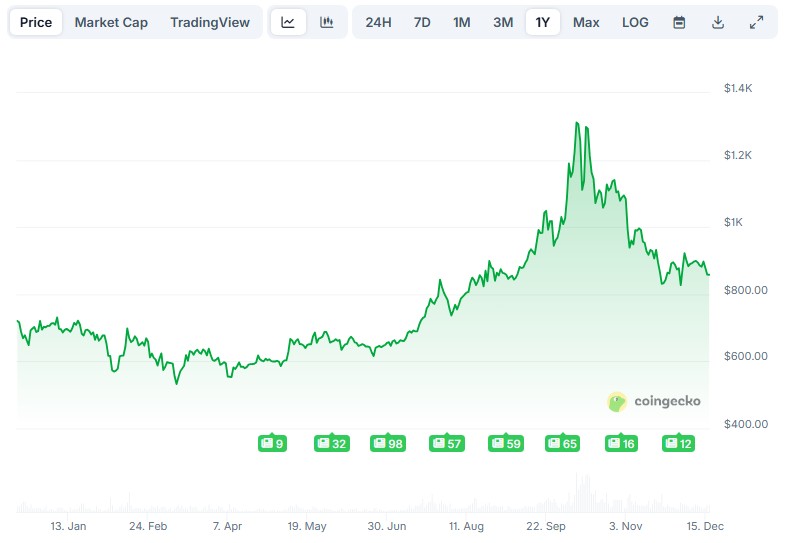
The data showed little consistent relationship between onchain usage and token prices. Solana’s price fell over the past year despite a 66% increase in active addresses, while BNB’s (BNB) token price rose alongside increased network activity.

BNB rose almost 20% in the past year. Source: CoinGecko

The year-over-year declines do not necessarily point to terminal problems for the networks involved. Onchain activity can swing sharply as applications migrate, incentive programs wind down or users shift between chains, particularly among newer networks still establishing their core use cases.

Telegram-linked blockchain The Open Network (TON) also recorded a 47% drop in active addresses and a 51% decline in transactions, a reversal that followed outsized growth in 2024. Telegram-based mini-games drove much of that earlier activity, drawing in users beyond the platform’s typical crypto-native audience.

Related: Bitcoin decouples from stocks in second half of 2025

Hamster Kombat was among the most prominent examples. The tapping-based game lowered the barrier to entry through simple mechanics and drew heavy participation from users anticipating a future token airdrop. According to Telegram CEO Pavel Durov, the viral game attracted 239 million users within three months, with more than 130 million qualifying for its airdrop in late September.

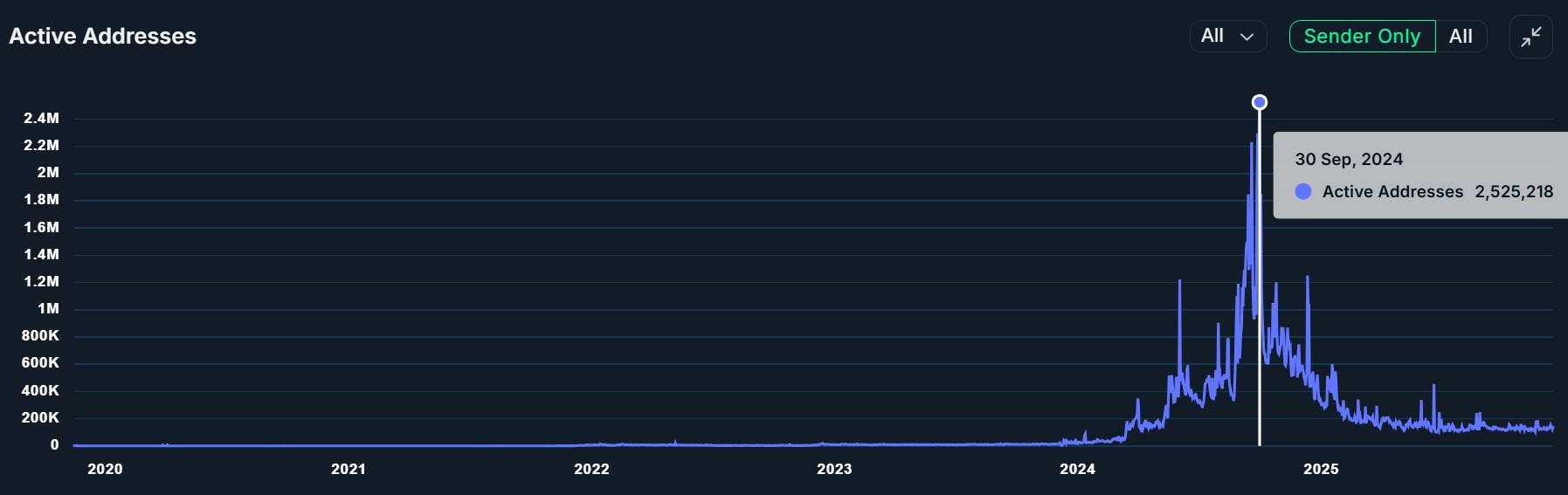
Nansen data shows that TON’s active addresses peaked at roughly 2.5 million per day on Sept. 30. Activity has since fallen back as engagement tied to Hamster Kombat cooled, underscoring how short-lived surges can distort year-over-year comparisons.

Hamster Kombat pushed Ton’s activity to new records. Source: Nansen

A few chains retained usage after hype

The past year’s blockchain data shows that onchain activity shifts quickly between networks rather than remaining anchored to any single chain. Usage fell most sharply on blockchains where activity had been concentrated around a small number of applications, incentive programs or viral moments.

At the same time, those declines do not automatically signal broader ecosystem failure. In several cases, activity cooled after periods of outsized growth, highlighting how year-over-year comparisons can be distorted by hype cycles, airdrops or short-lived applications.

Solana offers a useful contrast. While memecoin-driven activity boomed throughout 2024 and early 2025 before cooling toward the end of the year, the surge also brought in users, liquidity and applications that continued to support the network.

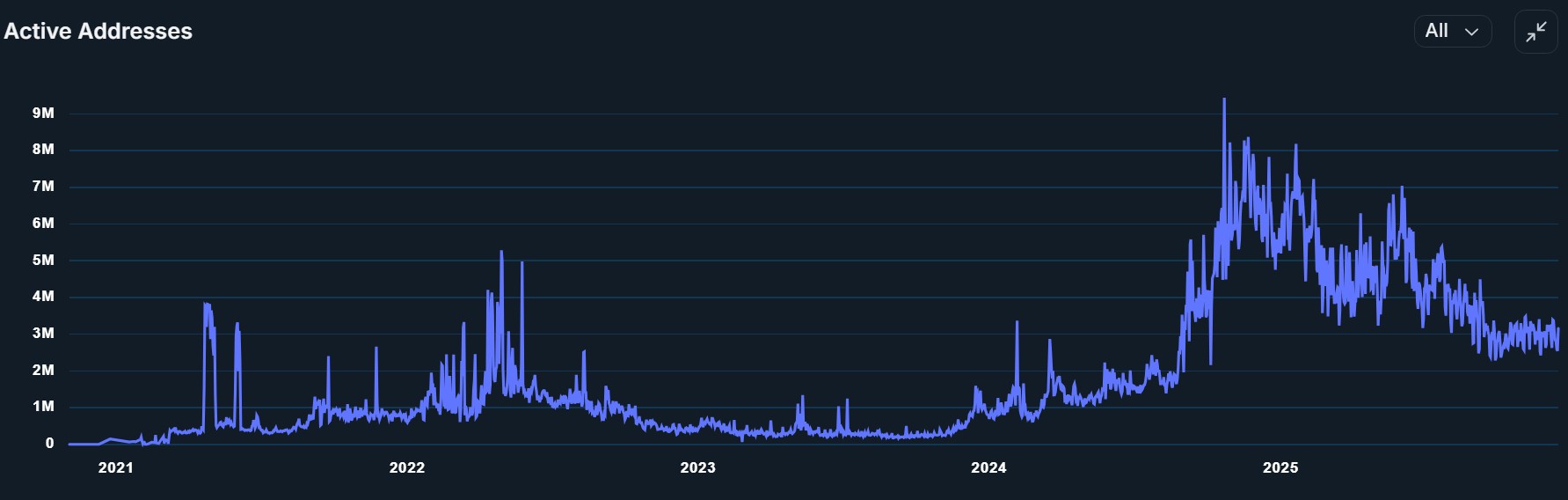
Solana’s memecoin boom has brought in new addresses that stayed after the boom. Source: Nansen

Solana’s daily active addresses peaked above 9 million on Oct. 22, 2024, during the height of memecoin trading. By December, daily users fluctuated between 2 million and 3 million. While that marked a sharp pullback from peak levels, activity remained consistently higher than before the boom.

Much of the past year’s onchain activity decline was driven by short-term profit-seeking, but networks such as Solana, BNB Chain and Base showed signs of retaining usage beyond viral surges, setting them apart from chains that saw sharper reversals.

Magazine: Big questions: Would Bitcoin survive a 10-year power outage?

Похожее

OpenAI Post-Training Engineer Weng Jiayi Proposes a New Paradigm Hypothesis for Agentic AI

OpenAI engineer Weng Jiayi's "Heuristic Learning" experiments propose a new paradigm for Agentic AI, suggesting that intelligent agents can improve not just by training neural networks, but also by autonomously writing and refining code based on environmental feedback. In the experiment, a coding agent (powered by Codex) was tasked with developing and maintaining a programmatic strategy for the Atari game Breakout. Starting from a basic prompt, the agent iteratively wrote code, ran the game, analyzed logs and video replays to identify failures, and then modified the code. Through this engineering loop of "code-run-debug-update," it evolved a pure Python heuristic strategy that achieved a perfect score of 864 in Breakout and performed competitively with deep reinforcement learning (RL) algorithms in MuJoCo control tasks like Ant and HalfCheetah. This approach, termed Heuristic Learning (HL), contrasts with Deep RL. In HL, experience is captured in readable, modifiable code, tests, logs, and configurations—a software system—rather than being encoded solely into opaque neural network weights. This offers potential advantages in explainability, auditability for safety-critical applications, easier integration of regression tests to combat catastrophic forgetting, and more efficient sample use in early learning stages, as demonstrated in broader tests on 57 Atari games. However, the blog acknowledges clear limitations. Programmatic strategies struggle with tasks requiring long-horizon planning or complex perception (e.g., Montezuma's Revenge), areas where neural networks excel. The future vision is a hybrid architecture: specialized neural networks for fast perception (System 1), HL systems for rules, safety, and local recovery (also System 1), and LLM agents providing high-level feedback and learning from the HL system's data (System 2). The core proposition is that in the era of capable coding agents, a significant portion of an AI's learned experience could be maintained as an auditable, evolving software system.

marsbit57 мин. назад

OpenAI Post-Training Engineer Weng Jiayi Proposes a New Paradigm Hypothesis for Agentic AI

marsbit57 мин. назад

Your Claude Will Dream Tonight, Don't Disturb It

This article explores the recent phenomenon of AI companies increasingly using anthropomorphic language—like "thinking," "memory," "hallucination," and now "dreaming"—to describe machine learning processes. Focusing on Anthropic's newly announced "Dreaming" feature for its Claude Agent platform, the piece explains that this function is essentially an automated, offline batch processing of an agent's operational logs. It analyzes past task sessions to identify patterns, optimize future actions, and consolidate learnings into a persistent memory system, akin to a form of reinforcement learning and self-correction. The article draws parallels to similar features in other AI agent systems like Hermes Agent and OpenClaw, which also implement mechanisms for reviewing historical data, extracting reusable "skills," and strengthening long-term memory. It notes a key difference from human dreaming: these AI "dreams" still consume computational resources and user tokens. Further context is provided by discussing the technical challenges of managing AI "memory" or context, highlighting the computational expense of large context windows and innovations like Subquadratic's new model claiming drastically longer contexts. The core critique argues that this strategic use of human-centric vocabulary does more than market products; it subtly reshapes user perception. By framing algorithms with terms associated with consciousness, companies blur the line between tool and autonomous entity. This linguistic shift can influence user expectations, tolerance for errors, and even perceptions of responsibility when systems fail, potentially diverting scrutiny from the companies and engineers behind the technology. The article concludes by speculating that terms like "daydreaming" for predictive task simulation might be next, continuing this trend of embedding the idea of an "inner life" into computational processes.

marsbit59 мин. назад

Your Claude Will Dream Tonight, Don't Disturb It

marsbit59 мин. назад

Торговля

Спот
Фьючерсы

Популярные статьи

Как купить S

Добро пожаловать на HTX.com! Мы сделали приобретение Sonic (S) простым и удобным. Следуйте нашему пошаговому руководству и отправляйтесь в свое крипто-путешествие.Шаг 1: Создайте аккаунт на HTXИспользуйте свой адрес электронной почты или номер телефона, чтобы зарегистрироваться и бесплатно создать аккаунт на HTX. Пройдите удобную регистрацию и откройте для себя весь функционал.Создать аккаунтШаг 2: Перейдите в Купить криптовалюту и выберите свой способ оплатыКредитная/Дебетовая Карта: Используйте свою карту Visa или Mastercard для мгновенной покупки Sonic (S).Баланс: Используйте средства с баланса вашего аккаунта HTX для простой торговли.Третьи Лица: Мы добавили популярные способы оплаты, такие как Google Pay и Apple Pay, для повышения удобства.P2P: Торгуйте напрямую с другими пользователями на HTX.Внебиржевая Торговля (OTC): Мы предлагаем индивидуальные услуги и конкурентоспособные обменные курсы для трейдеров.Шаг 3: Хранение Sonic (S)После приобретения вами Sonic (S) храните их в своем аккаунте на HTX. В качестве альтернативы вы можете отправить их куда-либо с помощью перевода в блокчейне или использовать для торговли с другими криптовалютами.Шаг 4: Торговля Sonic (S)С легкостью торгуйте Sonic (S) на спотовом рынке HTX. Просто зайдите в свой аккаунт, выберите торговую пару, совершайте сделки и следите за ними в режиме реального времени. Мы предлагаем удобный интерфейс как для начинающих, так и для опытных трейдеров.

1.3k просмотров всегоОпубликовано 2025.01.15Обновлено 2025.03.21

Как купить S

Sonic: Обновления под руководством Андре Кронье – новая звезда Layer-1 на фоне спада рынка

Он решает проблемы масштабируемости, совместимости между блокчейнами и стимулов для разработчиков с помощью технологических инноваций.

2.2k просмотров всегоОпубликовано 2025.04.09Обновлено 2025.04.09

Sonic: Обновления под руководством Андре Кронье – новая звезда Layer-1 на фоне спада рынка

HTX Learn: Пройдите обучение по "Sonic" и разделите 1000 USDT

HTX Learn — ваш проводник в мир перспективных проектов, и мы запускаем специальное мероприятие "Учитесь и Зарабатывайте", посвящённое этим проектам. Наше новое направление .

1.8k просмотров всегоОпубликовано 2025.04.10Обновлено 2025.04.10

HTX Learn: Пройдите обучение по "Sonic" и разделите 1000 USDT

Обсуждения

Добро пожаловать в Сообщество HTX. Здесь вы сможете быть в курсе последних новостей о развитии платформы и получить доступ к профессиональной аналитической информации о рынке. Мнения пользователей о цене на S (S) представлены ниже.

活动图片