Ripple Sends New Letter To The SEC: What It Could Mean For XRP

bitcoinistОпубликовано 2026-01-13Обновлено 2026-01-13

Введение

Ripple has submitted a new letter to the SEC’s Crypto Task Force, urging a clear distinction between securities offerings and the underlying tokens traded in secondary markets. Dated January 9, 2026, the letter argues that regulatory focus should shift from "decentralization" to legal rights and obligations, emphasizing that the SEC’s jurisdiction should be time-bound to the lifespan of the obligation—not perpetual. Ripple contends that without this clarity, regulatory overreach could stifle secondary markets and create compliance burdens for issuers. The submission aligns with ongoing legislative efforts and could influence how XRP and similar tokens are regulated post-lawsuit. At the time of writing, XRP traded at $2.05.

Ripple has sent a new market-structure letter to the SEC’s Crypto Task Force, urging the agency to draw a hard line between a securities offering and the underlying token that may later trade in secondary markets, a framing that could matter for how XRP (post SEC lawsuit) and other tokens are treated in disclosure and jurisdiction debates.

In the January 9, 2026 submission, signed by Chief Legal Officer Stuart Alderoty, General Counsel Sameer Dhond, and Deputy General Counsel Deborah McCrimmon, Ripple positions its comments as input to ongoing Commission rulemaking or guidance, explicitly tying its argument to parallel legislative efforts on Capitol Hill.

The company references earlier letters from March 21, 2025 and May 27, 2025, and points to the House’s CLARITY Act of 2025 and Senate discussion drafts as evidence that classification choices will cascade into “jurisdiction, disclosures, and secondary-market treatment.”

Ripple Presses SEC To Cement XRP’s Post-Lawsuit Status

Ripple’s core thesis is that regulators should move away from “decentralization” as a legal metric because it is “not a binary state” and creates “intolerable uncertainty,” including both “false negative” and “false positive” outcomes.

One of Ripple’s key concerns is that an asset could be treated as stuck in a securities regime simply because an entity still holds inventory or continues contributing to development, a point with obvious parallels to Ripple. The company still holds a large chunk of all XRP in their escrow while developer arm RippleX contributes heavily to the development of the XRP Ledger.

Instead, Ripple pushes the SEC to ground jurisdiction in “legal rights and obligations,” emphasizing enforceable promises rather than market narratives about ongoing efforts. The letter argues that regulatory theories focusing on “efforts of others” risk collapsing the multi-part Howey analysis into a single factor and, in Ripple’s view, sweeping too broadly.

The most consequential section is Ripple’s argument that the SEC’s jurisdiction should be time-bound to the “lifespan of the obligation,” rather than treating the asset as permanently labeled. In a passage that goes directly to secondary-market implications, Ripple writes:

“The Commission’s jurisdiction should track the lifespan of the obligation; regulating the ‘promise’ while it exists, but liberating the ‘asset’ once that promise is fulfilled or otherwise ends. The dispositive factor is the holder’s legal rights, not their economic hopes. Without that bright line, the definition of a security, and the SEC’s jurisdictional limits, become amorphous and unbounded.”

That framing matters for XRP and draws parallels to the SEC lawsuit: whether secondary-market trading of a token can remain subject to securities-law oversight long after any initial distribution, marketing, or development-era statements. Ripple explicitly rejects the idea that active secondary trading is itself a jurisdictional hook, comparing high-velocity crypto markets to spot commodities like gold and silver and even secondary markets for consumer devices.

Ripple also spends meaningful time on the “capital raising” boundary, arguing for privity as a bright line that distinguishes primary distributions from exchange trading where counterparties are unknown and the issuer is “merely as another market actor.”

In that context, the letter warns that treating every issuer sale as a perpetual capital raise creates “perverse outcomes,” including what it calls a “Zombie Promise” and “Operational Paralysis”: language that, while generalized, clearly speaks to concerns around issuer-held token inventories and the compliance burdens that could attach to treasury management and sales practices.

Separately, Ripple endorses “fit-for purpose” disclosures in cases where securities regulation is actually warranted, rather than forcing “full corporate registration designed for traditional equity.” For XRP holders and market participants, that is a directional signal: Ripple is arguing for a regime where disclosure triggers attach to specific promises or specific forms of ongoing control, not to the token as an object indefinitely.

The timing is also notable. Ripple dated the letter January 9, 2026, less than a week before a January 15 markup on comprehensive digital-asset market structure legislation in the US Senate Banking Committee, an approaching deadline that could shape how classification language, jurisdictional lines, and disclosure concepts harden into legislative text.

At press time, XRP traded at $2.05.
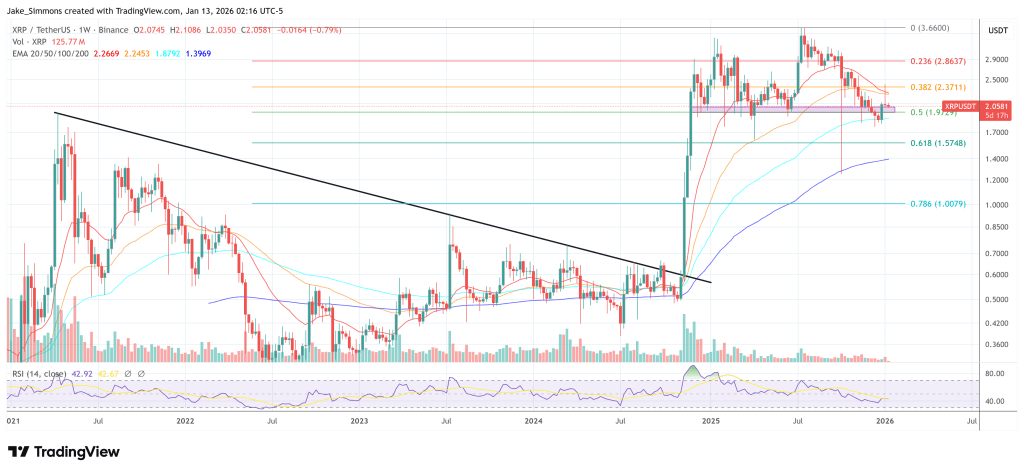
XRP rejected at the 0.382 Fib, 1-week chart | Source: XRPUSDT on TradingView.com

Связанные с этим вопросы

QWhat is the core argument Ripple makes to the SEC regarding the classification of tokens?

ARipple's core argument is that regulators should move away from using 'decentralization' as a legal metric because it creates uncertainty. Instead, jurisdiction should be grounded in 'legal rights and obligations,' focusing on enforceable promises, and it should be time-bound to the 'lifespan of the obligation' rather than treating an asset as permanently labeled as a security.

QWhy does Ripple argue that the SEC's jurisdiction should be time-bound?

ARipple argues that the SEC's jurisdiction should be time-bound to the 'lifespan of the obligation' to create a clear regulatory bright line. This means the SEC regulates the 'promise' while it exists but should liberate the 'asset' once that promise is fulfilled or ends, preventing the asset from being perpetually subject to securities laws based on its initial offering.

QWhat specific concern does Ripple raise about an entity holding inventory or contributing to development?

ARipple is concerned that an asset could be incorrectly classified as a security indefinitely simply because an entity (like Ripple itself) still holds a large inventory in escrow or continues to contribute to the asset's development through its developer arm (RippleX), creating what it calls 'false positive' outcomes and 'intolerable uncertainty.'

QHow does Ripple's argument relate to secondary-market trading of tokens like XRP?

ARipple argues that active secondary-market trading of a token should not itself be a jurisdictional hook for the SEC. It compares crypto markets to spot commodities like gold, asserting that once the initial obligation is fulfilled, the token should be free from securities-law oversight in secondary markets, where trades occur between unknown counterparties and the original issuer is merely another market actor.

QWhat legislative context does Ripple's letter reference, and why is the timing significant?

ARipple's letter references the House’s CLARITY Act of 2025 and Senate discussion drafts. The timing is significant because it was submitted on January 9, 2026, just days before a January 15 markup on comprehensive digital-asset market structure legislation in the US Senate Banking Committee, aiming to influence how classification and jurisdictional language is written into law.

Похожее

Торговля

Спот
Фьючерсы

Популярные статьи

Что такое XRP 2.0

XRP 2.0: Новая грань в мире криптовалют Введение в XRP 2.0 В постоянно развивающейся сфере криптовалют появляются новые проекты, стремящиеся к вниманию и внедрению. Один из таких многообещающих проектов - это XRP 2.0, новая криптовалюта, созданная для использования передовых технологий блокчейна и надежных методов шифрования. Хотя название вызывает ассоциации с XRP от Ripple, важно отметить, что XRP 2.0 функционирует независимо, сосредоточив внимание на повышении безопасности сделок, конфиденциальности и масштабируемости. Поскольку цифровая финансовая среда все больше принимает децентрализованные решения, XRP 2.0 намерена внести значимый вклад в web3 и общее расширение криптопроектов. Что такое XRP 2.0? XRP 2.0 в своей основе - это проект криптовалюты, цель которого - создать безопасную и децентрализованную экосистему цифровой валюты. Его базовая технология интегрирует сложные принципы блокчейна с современными методами шифрования. Основная цель XRP 2.0 - утвердиться как надежная и эффективная платформа, позволяющая быстро осуществлять транзакции с приоритетом на улучшенную защиту конфиденциальности для своих пользователей. Проект рекламируется как решение многих недостатков, с которыми сталкиваются существующие криптовалюты, предлагая систему, способную обрабатывать более высокий объем транзакций с улучшенной скоростью и конфиденциальностью. Эта универсальность позиционирует XRP 2.0 как значимого конкурента на рынке, переполненном различными цифровыми валютами. Кто создатель XRP 2.0? Идентичность создателя XRP 2.0 была обозначена как «Уилбур». Однако исчерпывающие данные о Уилбуре или связанном с ним проекте остаются неясными. Анонимность многих создателей криптовалют не является редким явлением в этой отрасли и часто применяется для сохранения определенной степени конфиденциальности и безопасности. Кто инвесторы XRP 2.0? <pна данный момент конкретная информация о инвестиционных фондах или организациях, поддерживающих xrp 2.0, не доступна публично. в секторе криптовалют поддержка репутабельными инвесторами может существенно повлиять на кредитоспособность и успех проекта, однако прозрачность в отношении финансовых спонсоров 2.0 еще была установлена. Как работает XRP 2.0? XRP 2.0 выделяется использованием сочетания технологий блокчейна и продвинутых алгоритмов шифрования, что обеспечивает безопасные и децентрализованные транзакции. Его инновационная структура включает уникальные функции, разработанные для повышения вовлеченности пользователей и расширения функциональности за пределами традиционных транзакций с криптовалютами. Среди этих функций XRP 2.0 интегрирует возможности с искусственным интеллектом, такие как текст в изображение и текст в речь. Эти дополнения разработаны для улучшения интерактивной работы пользователей, способствуя более широкому применению в различных секторах. Соединяя технологические достижения с дизайном, ориентированным на пользователя, XRP 2.0 стремится привлечь внимание разнообразных индивидуумов и предприятий, стремящихся интегрировать решения с криптовалютой в свои бизнес-процессы. Хронология XRP 2.0 Для понимания XRP 2.0 необходимо рассмотреть ключевые события, которые определили его путь до сих пор: 23 июля 2023 года: XRP 2.0 представлен как новый проект криптовалюты, стремящийся революционизировать возможности безопасных и децентрализованных транзакций в области блокчейна. 8 сентября 2023 года: Запуск другого проекта, XRP20, который представляет собой токен ERC-20 на блокчейне Ethereum и не имеет отношения к XRP 2.0. 13 ноября 2023 года: XRP Ledger подвергается значительному обновлению с выпуском программного обеспечения серверов rippled версии 2.0.0. Важно отметить, что это развитие не связано с проектом криптовалюты XRP 2.0. Ключевые моменты о XRP 2.0 Чтобы выделить суть XRP 2.0, возникают несколько критически важных факторов: Уникальные особенности: Включение таких функций, как основанные на ИИ текст в изображение и текст в речь, дополнительно разнообразит потенциальные приложения XRP 2.0. Технология блокчейна: Структура использует современные механизмы блокчейна и протоколы шифрования, обеспечивая безопасную и децентрализованную среду для транзакций. Масштабируемость и конфиденциальность: XRP 2.0 придает приоритет повышенным мерам защиты конфиденциальности в процессах транзакций и масштабируемости, необходимой для привлечения растущей базы пользователей. Нет связи с Ripple: Важно отметить, что, несмотря на свое название, XRP 2.0 не имеет никаких отношений или сотрудничества с XRP от Ripple, что отличает его операционные рамки и цели в экосистеме криптовалют. Заключение XRP 2.0 представляет собой амбициозное начинание в сфере криптовалют, стремясь предложить сочетание безопасности, конфиденциальности и эффективности в цифровых транзакциях. Интегрируя сложные технологии и удобные функции, проект стремится расширить горизонты того, что может достичь криптовалюта в современной цифровой экономике. Хотя анонимность его создателя и отсутствие раскрытых инвесторов могут вызвать вопросы у некоторых, акцент XRP 2.0 на передовых функциональных возможностях и децентрализации увеличивает его привлекательность на фоне все более переполненного крипто-рынка. Поскольку мир криптовалют продолжает развиваться, XRP 2.0 может еще стать ключевым игроком в расширении безопасных и масштабируемых блокчейн-решений.

198 просмотров всегоОпубликовано 2024.04.05Обновлено 2024.12.03

Что такое XRP 2.0

Неделя обучения по популярным токенам 13: запуск основной сети HIP-4 ожидается в середине 2026 года на фоне смещения фокуса рынка к масштабируемому внедрению ключевых криптоактивов, включая XRP

HIP-4 представит децентрализованные рынки прогнозов без разрешений, бинарные (исходные) контракты и опционы 0DTE.

825 просмотров всегоОпубликовано 2026.04.22Обновлено 2026.04.22

Неделя обучения по популярным токенам 13: запуск основной сети HIP-4 ожидается в середине 2026 года на фоне смещения фокуса рынка к масштабируемому внедрению ключевых криптоактивов, включая XRP

Обсуждения

Добро пожаловать в Сообщество HTX. Здесь вы сможете быть в курсе последних новостей о развитии платформы и получить доступ к профессиональной аналитической информации о рынке. Мнения пользователей о цене на XRP (XRP) представлены ниже.

活动图片