Riot Financial Report Breakdown: When BTC Falls Below $74K, Miners Can't Even Cover Electricity Costs

marsbitОпубликовано 2026-03-09Обновлено 2026-03-09

Введение

Based on Riot Platforms' financial data, this analysis deconstructs Bitcoin mining costs into three distinct layers: electricity, operational, and accounting. At a BTC price of $67,200, a miner with modern ASICs and a $0.0667/kWh electricity rate (like in Texas) can cover its direct power cost ($64,635/BTC) for a slim profit. However, adding Riot's non-power operational expenses ($9,809/BTC) pushes the operational breakeven to ~$74,444, resulting in a loss. Further incorporating non-cash depreciation ($39,687/BTC) raises the full accounting breakeven to ~$114,130, indicating significant losses at the corporate level. The model projects that only a BTC price of $126,000 would make mining profitable across all three layers for Riot before the next halving. This framework demonstrates that a mining operation can be cash-flow positive from electricity while remaining unprofitable from operational and accounting perspectives, highlighting the substantial gap between simply running machines and running a profitable public company. The analysis underscores that machine efficiency and electricity rates are critical, as older hardware carries a persistent cost disadvantage.

Author: CryptoSlate

Compiled by: Deep Tide TechFlow

Deep Tide Guide: With BTC currently around $67K, miners are barely breaking even on electricity costs, but operational expenses and depreciation keep overall operations in the red. This article uses real financial data from Riot Platforms to build a three-tier cost model, thoroughly deconstructing the often oversimplified number of "mining cost"—providing direct reference value for understanding mining stock valuations and BTC price pressure levels.

Right now, buying Bitcoin is cheaper than mining it, unless your electricity cost is below 7 cents per kWh.

Full Text Below:

Riot Case Reveals the Three-Tier Profit and Loss Structure of US Miners

Bitcoin mining cost is often simplified to a single number: "the cost to mine one BTC." In reality, this number depends on which level of the business you are measuring.

Electricity costs determine whether to turn on the machines today, operational expenses determine if the mining farm can sustain the entire company, and accounting costs determine whether the business ultimately reports a profit.

To analyze these three levels more clearly, CryptoSlate built a Bitcoin mining cost model based on first principles, calculating mining economics from network difficulty, block reward, transaction fees, ASIC efficiency, and electricity price.

The model then incorporated company-level cost data from Riot Platforms' public financial filings to show the actual economic situation.

Under current network conditions, the model shows miners can cover electricity costs but still cannot cover broader operational and accounting expenses.

Riot's Texas operations reveal: even after the BTC price recovery, there remains a significant gap between the electricity break-even point, the operational break-even point, and the full accounting profitability point.

Riot's Mining Economics Reveal a Three-Tier Profit and Loss Structure

At the current BTC price of $67,200, Riot crosses one break-even point but fails to cross the latter two.

The model is built on the following current network conditions: Bitcoin difficulty 145,042,165,424,850, block reward 3.125 BTC, modern ASIC efficiency around 17-19 J/TH, Texas industrial electricity price approx. $0.0667/kWh. As the current average transaction fee is about 0.02 BTC/block, this model ignores block fees.

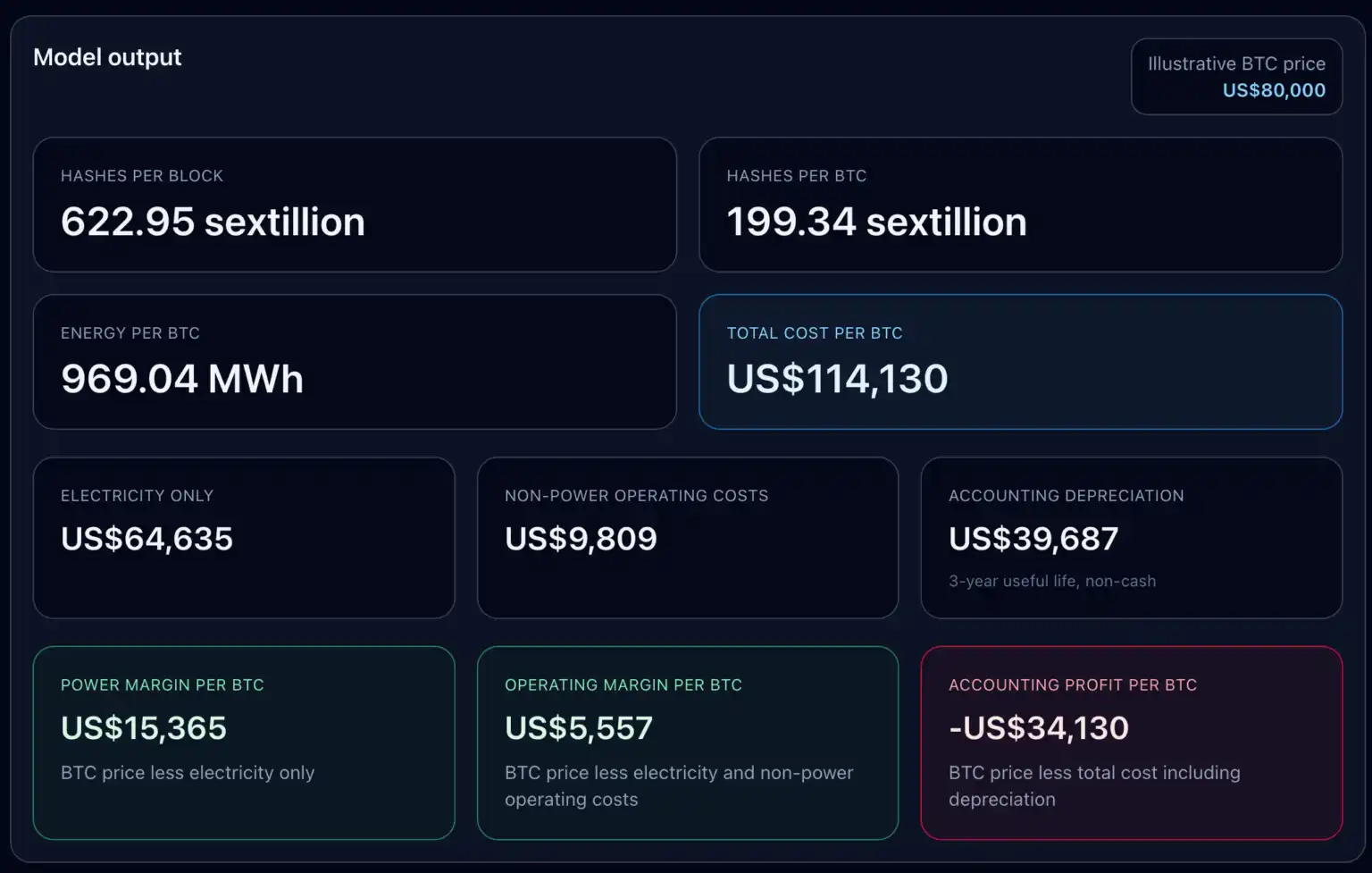
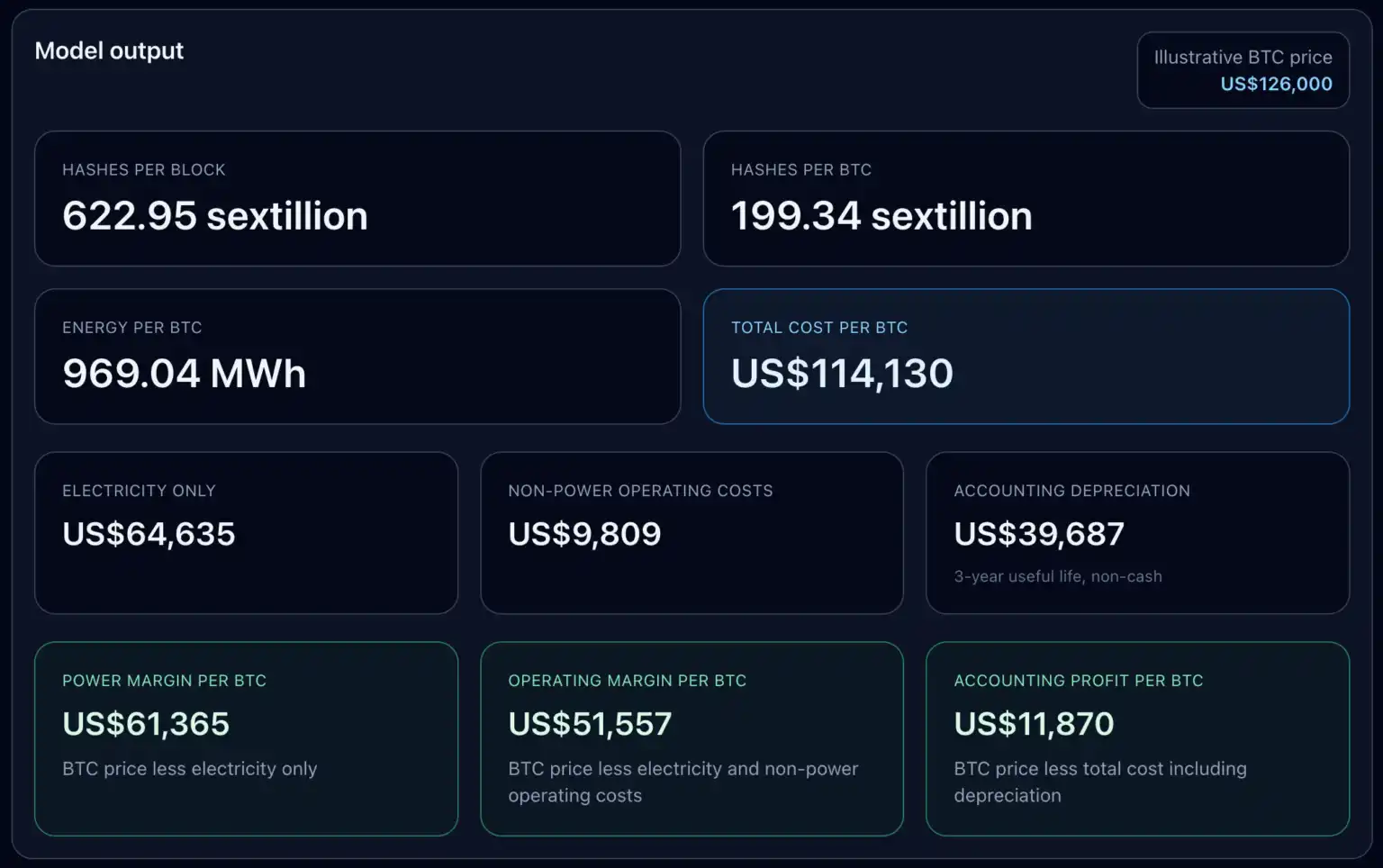
The above parameters yield the following results: total network hashrate per block 622.95 exahashes, hashrate required per BTC 199.34 exahashes, energy consumption per BTC 969.04 MWh.

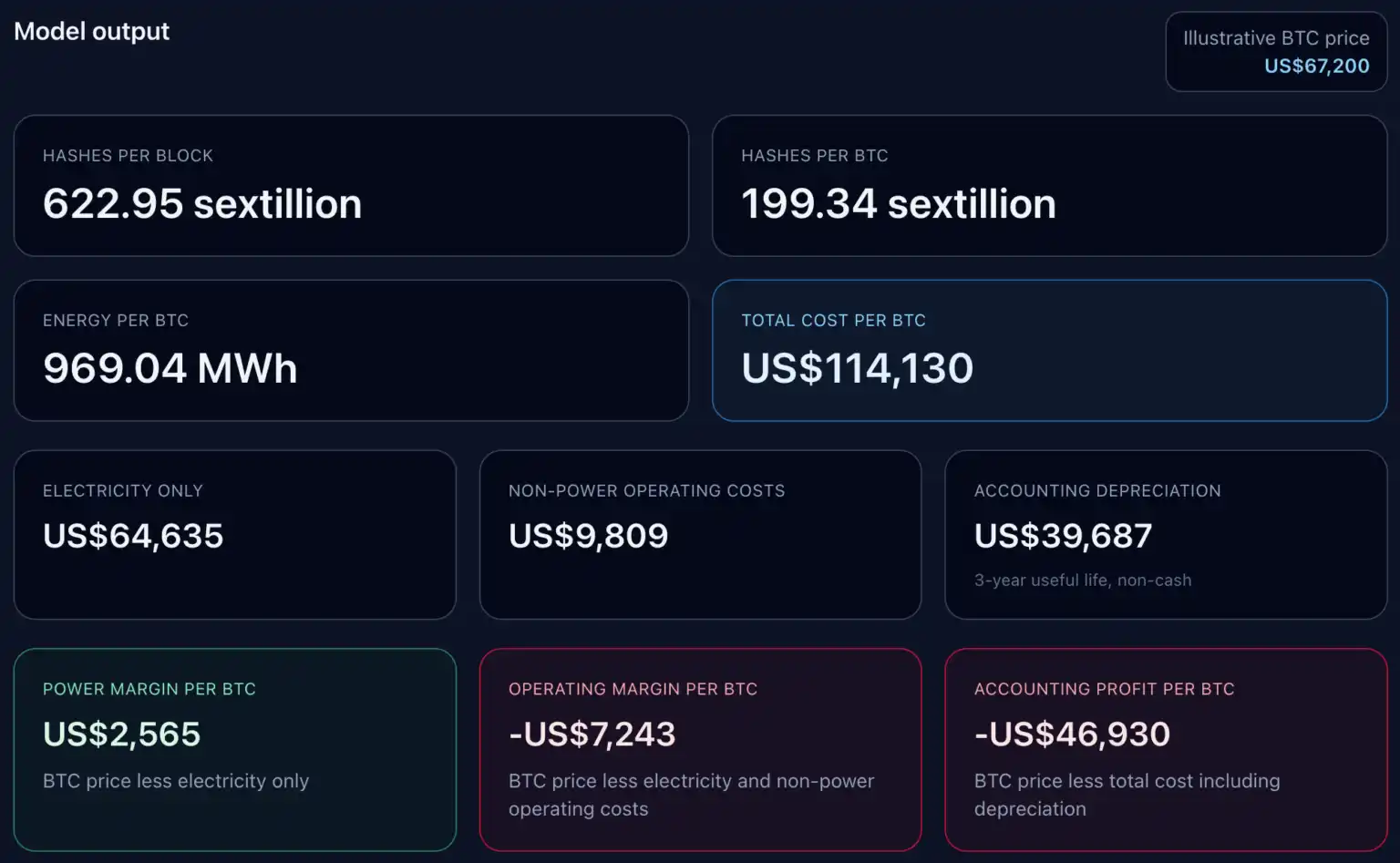
Accordingly, the electricity cost to mine one BTC at the current price is $64,635, resulting in an electricity profit of $2,565/BTC.
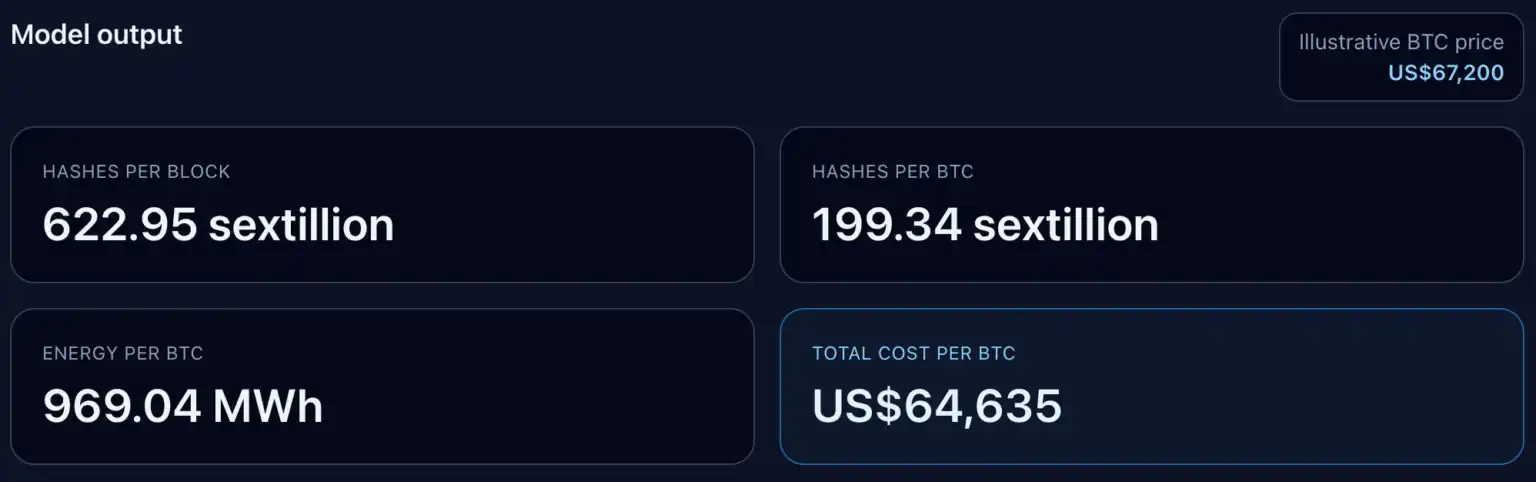
After adding non-electricity operational costs of approximately $9,809/BTC from Riot's financial filings, the operational profit becomes negative $7,243, and the total cost increases accordingly. After further adding non-cash depreciation of approximately $39,687/BTC, the accounting profit falls to negative $46,930.

This clearly shows that for large US miners, there is no single number for "the cost to mine one BTC."

First tier: Electricity cost, determines short-term profitability of turning on machines.

Second tier: Adds broader operational costs, determines if self-mining can cover the overall business.

Third tier: Adds depreciation, determines if book profit aligns with cash profit.

The model displays these three tiers side by side, revealing how large the gap between them remains even after the market recovery.

The Break-Even Ladder Defines the Operational Picture

The break-even ladder provided by the model is more illustrative than any single all-in cost number.

Break-even point for electricity cost only: $64,635/BTC.

After adding Riot's non-electricity operational costs, the break-even point rises to approximately $74,444.

After adding accounting depreciation, the full accounting break-even point rises to $114,130.

Therefore, a miner can report positive gains at the electricity level while still being at a loss at the operational or accounting level.
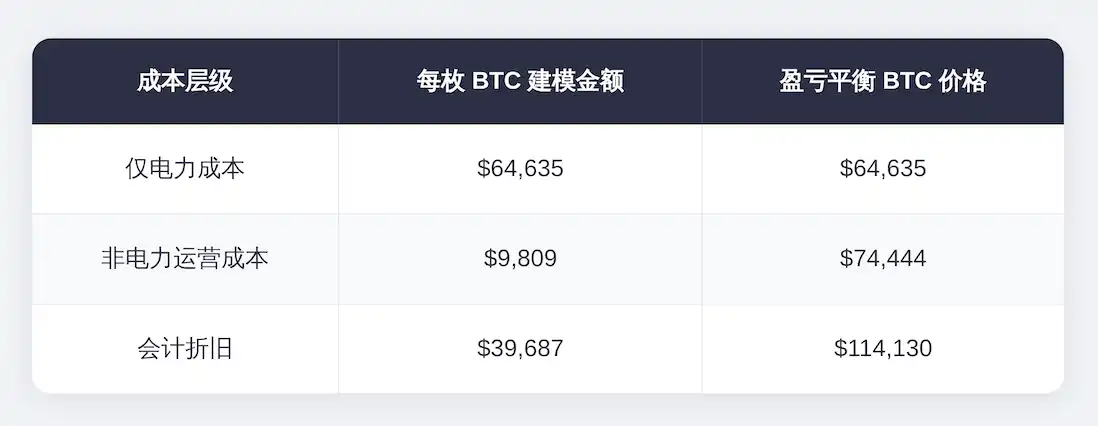
I created four price scenarios to demonstrate how this ladder works in practice.

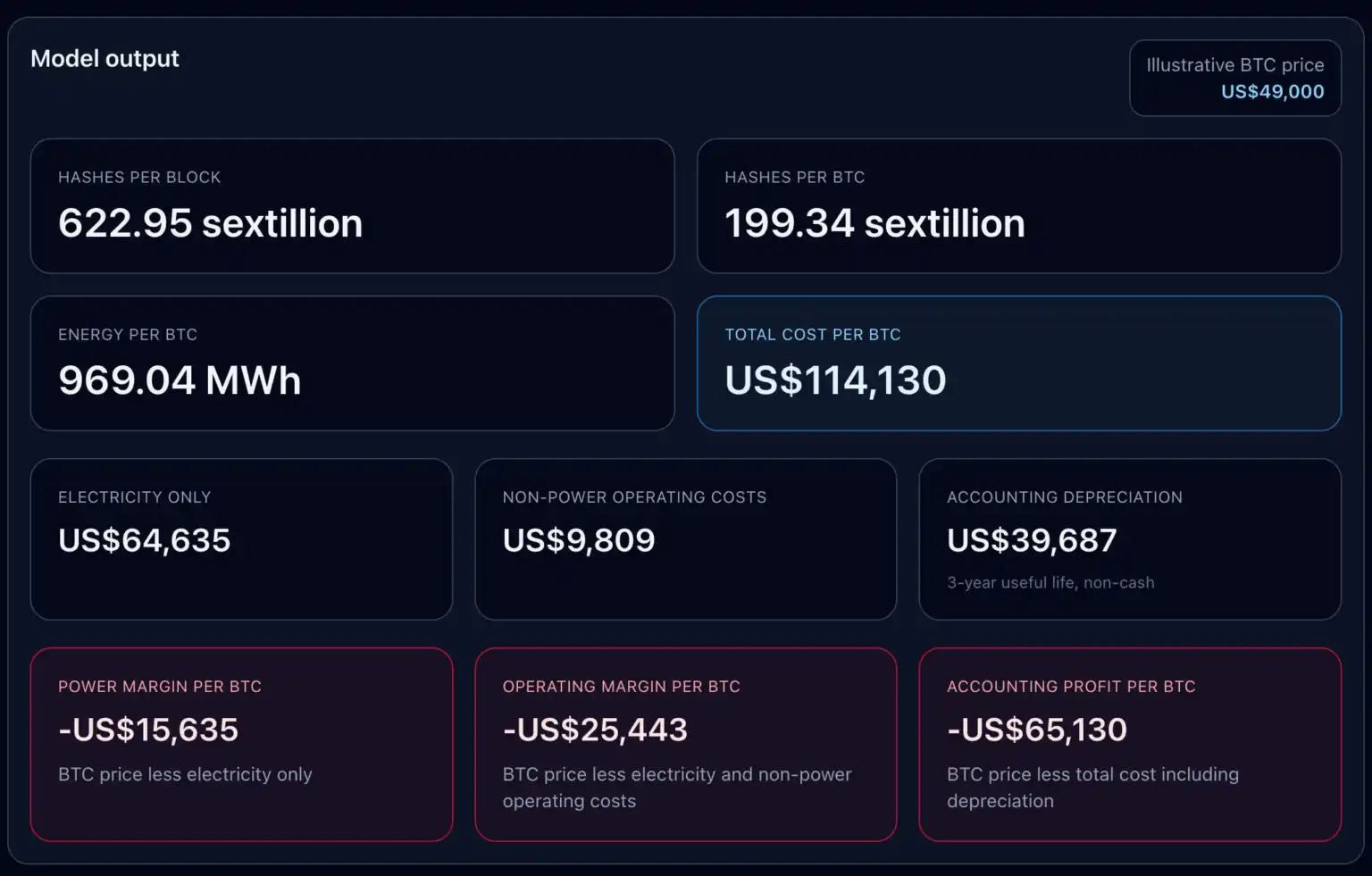
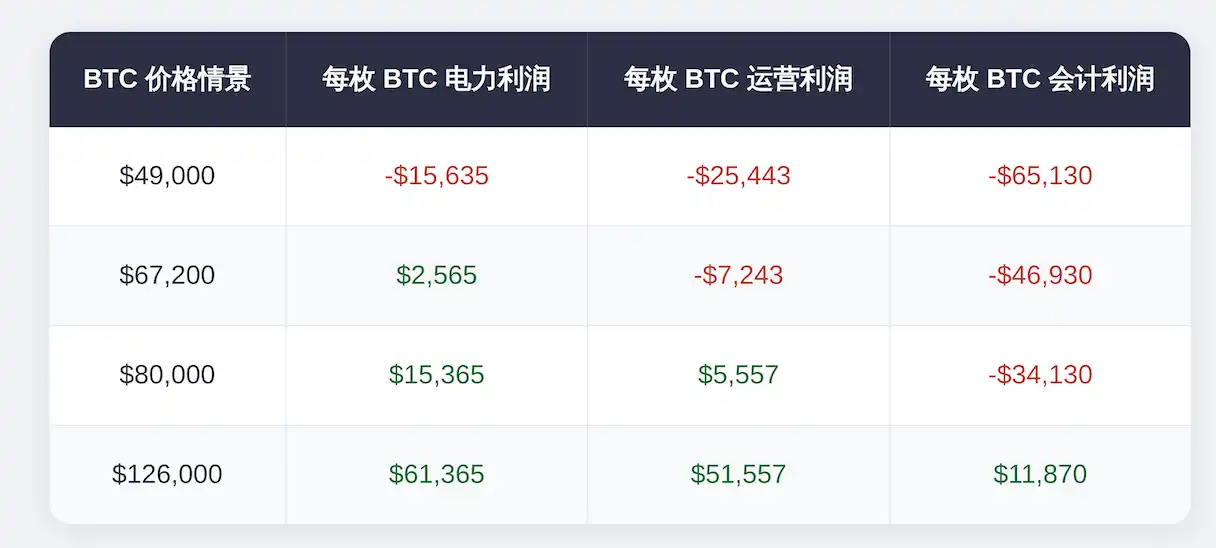
In the $49,000 bear market scenario, Riot is negative at all levels: electricity profit -$15,635/BTC, operational profit -$25,443/BTC, accounting profit -$65,130/BTC.
In the $67,200 current price scenario, Riot just crosses the electricity break-even point, barely above the threshold. Electricity profit turns positive, but the operational and accounting perspectives remain negative.
In the $80,000 recovery scenario, Riot crosses the operational break-even point, with an operational profit of $5,557/BTC, but remains at a loss of $34,130 at the accounting level.
For all three levels to turn positive simultaneously, BTC needs to return to its all-time high of $126,000, at which point the accounting profit would be $11,870/BTC.
This distinction has practical significance. Riot's depreciation layer is explicitly characterized as a non-cash expense, calculated based on a three-year useful life, representing an accounting allocation rather than a short-term avoidable cash outflow.

But it is still part of this picture because listed miners cannot survive on electricity profit alone—they must report income statements, replace machinery, and bear corporate operating costs.

Therefore, the truly valuable question is: which profit line are investors, analysts, and management actually looking at when judging a miner's profitability.

Riot's Price Stress Test Before the Next Halving

We then extended the cost model to the next halving in 2028.

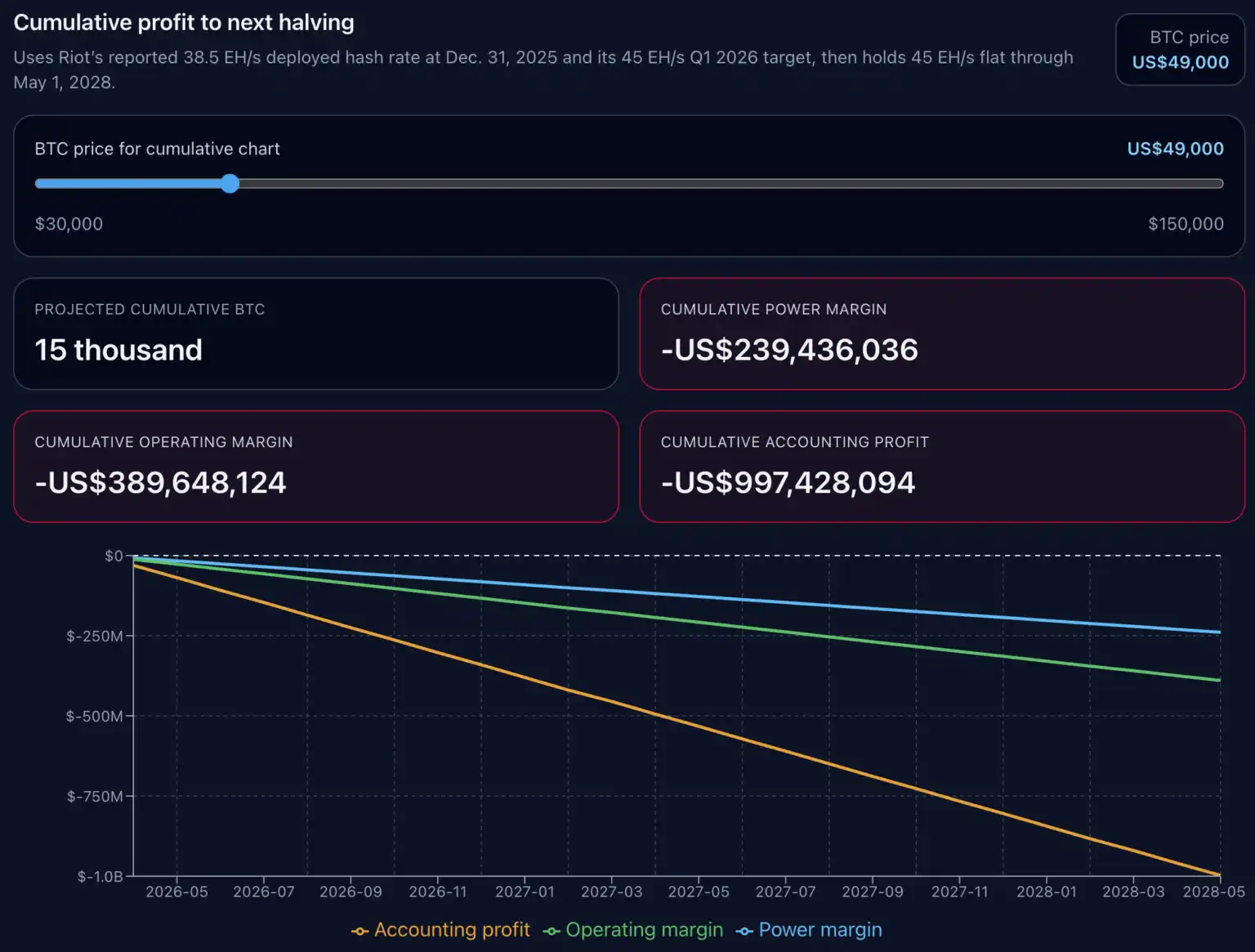
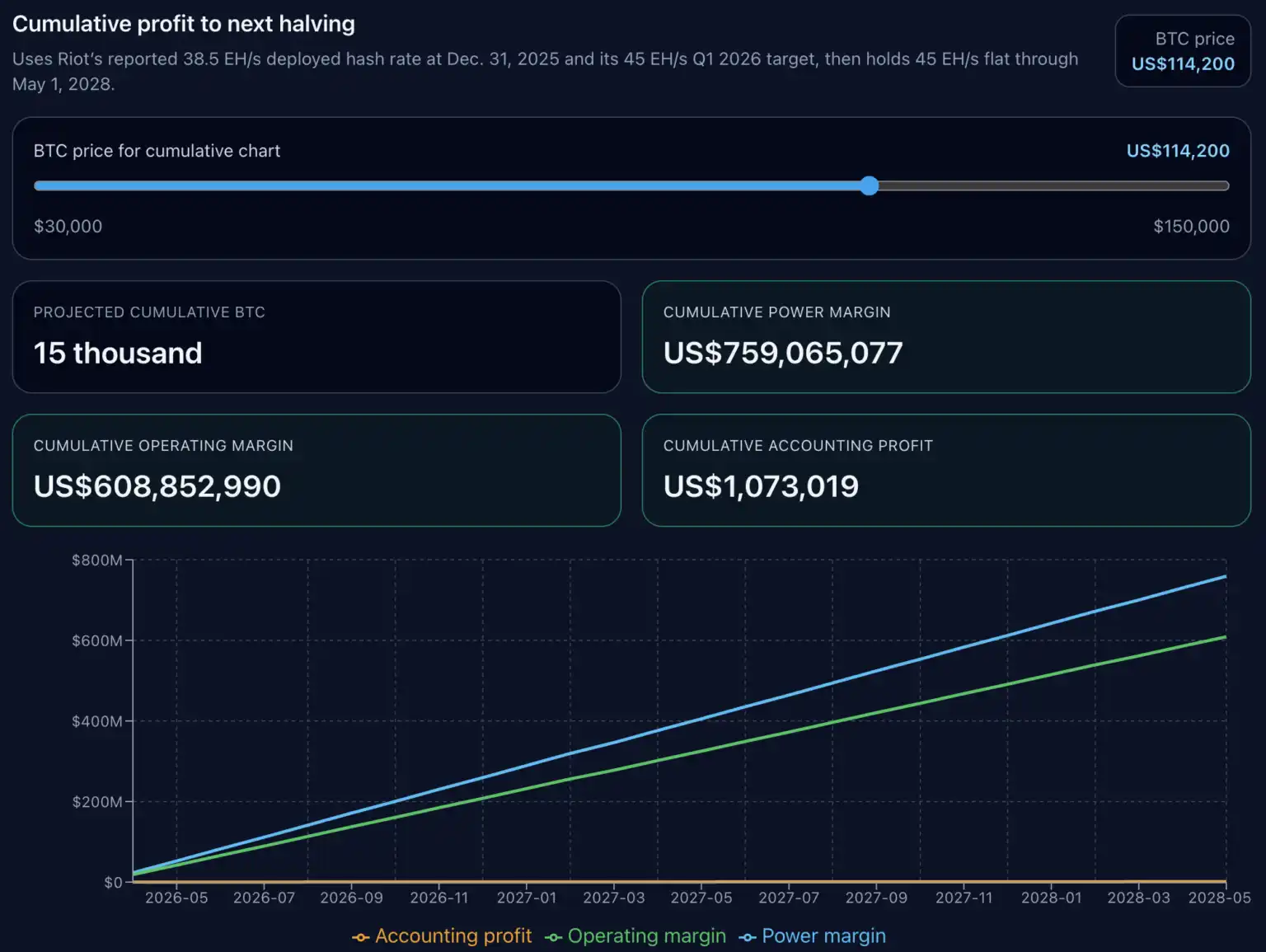
Based on Riot's latest public filings, assuming a current hashrate of 38.5 EH/s, ramping up to 45 EH/s by March 31, 2026, and maintaining that level until the next halving window.

This model does not reconstruct the entire market but rather keeps the current per-BTC economics constant and projects them along the self-mining hashrate path Riot has reported and planned.

This is a scenario analysis focused on operational leverage, with clear price sensitivity.

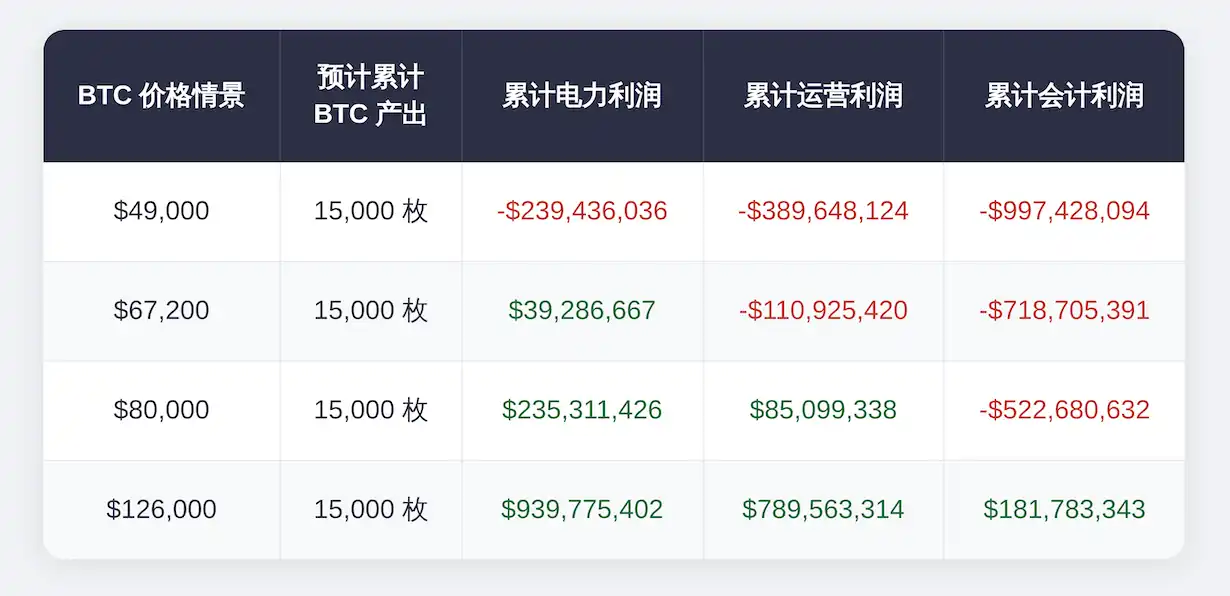
In all four scenarios, the projected cumulative total mined BTC is 15,000 coins; what changes is the profit structure.

In the $49,000 scenario, Riot's cumulative electricity profit is -$239,436,036, cumulative operational profit is -$389,648,124, and cumulative accounting profit is -$997,428,094.
In the $67,200 scenario, cumulative electricity profit turns positive to $39,286,667, but cumulative operational profit remains negative at -$110,925,420, and cumulative accounting profit is -$718,705,391.
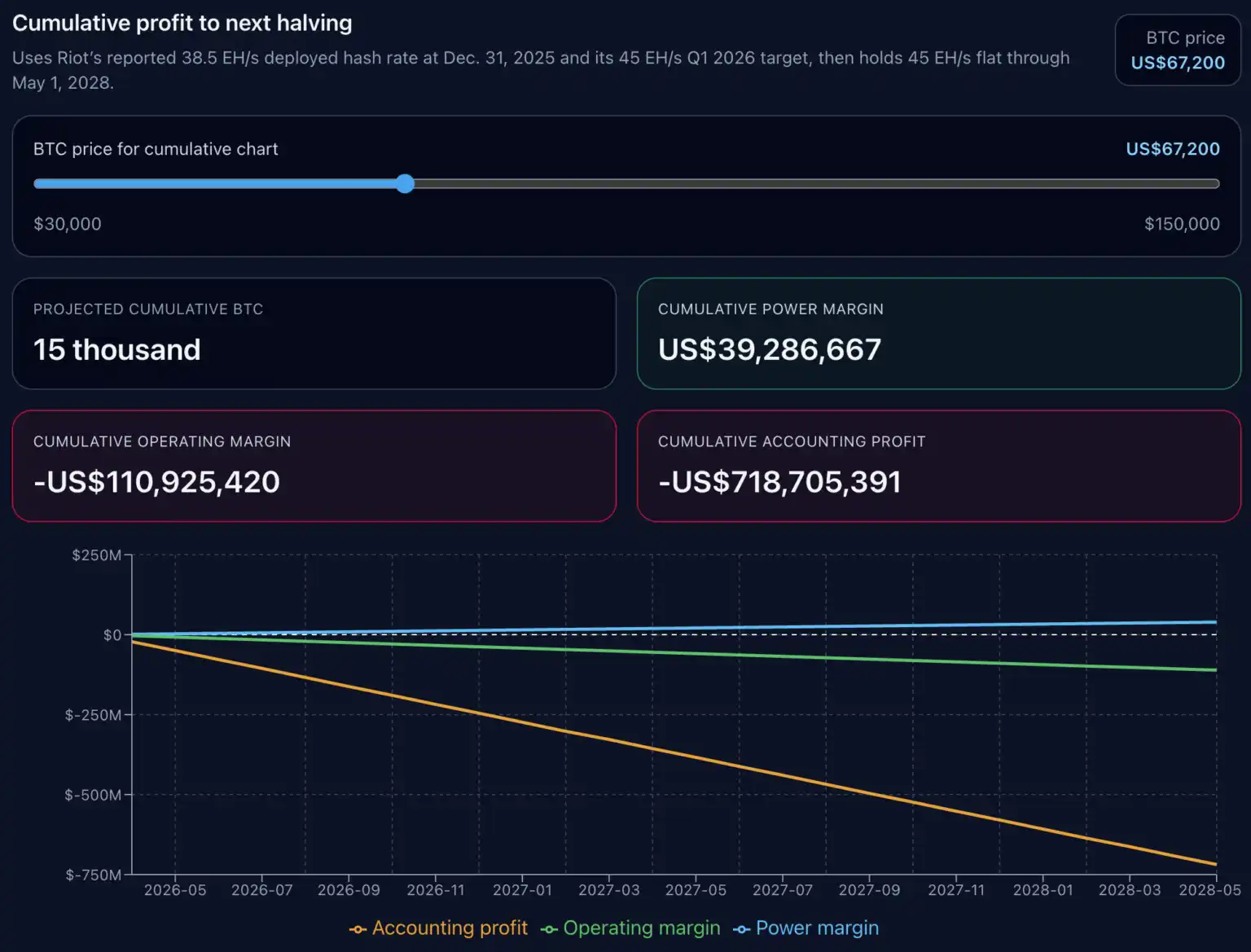
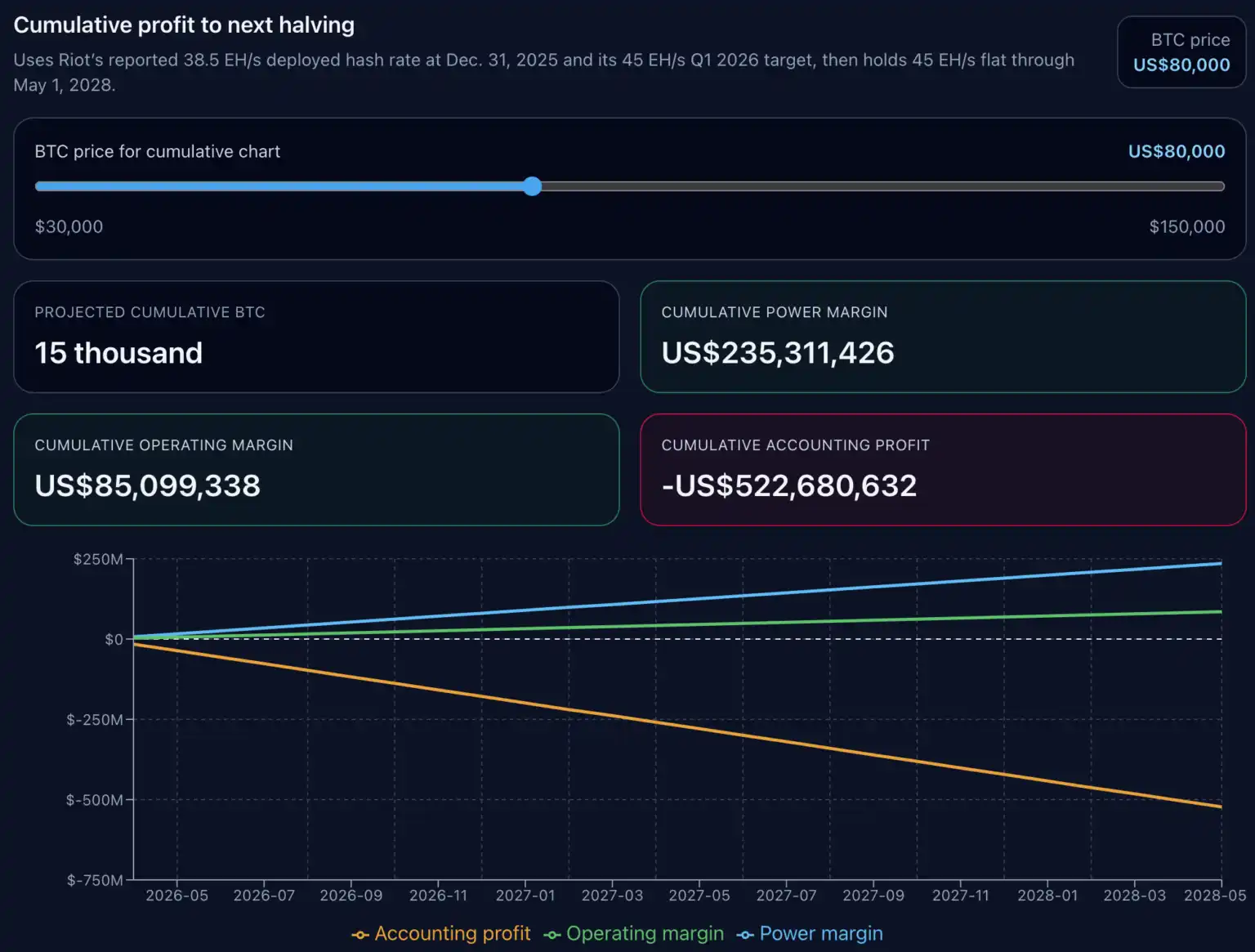
In the $80,000 scenario, cumulative operational profit turns positive to $85,099,338, but cumulative accounting profit remains negative at -$522,680,632.
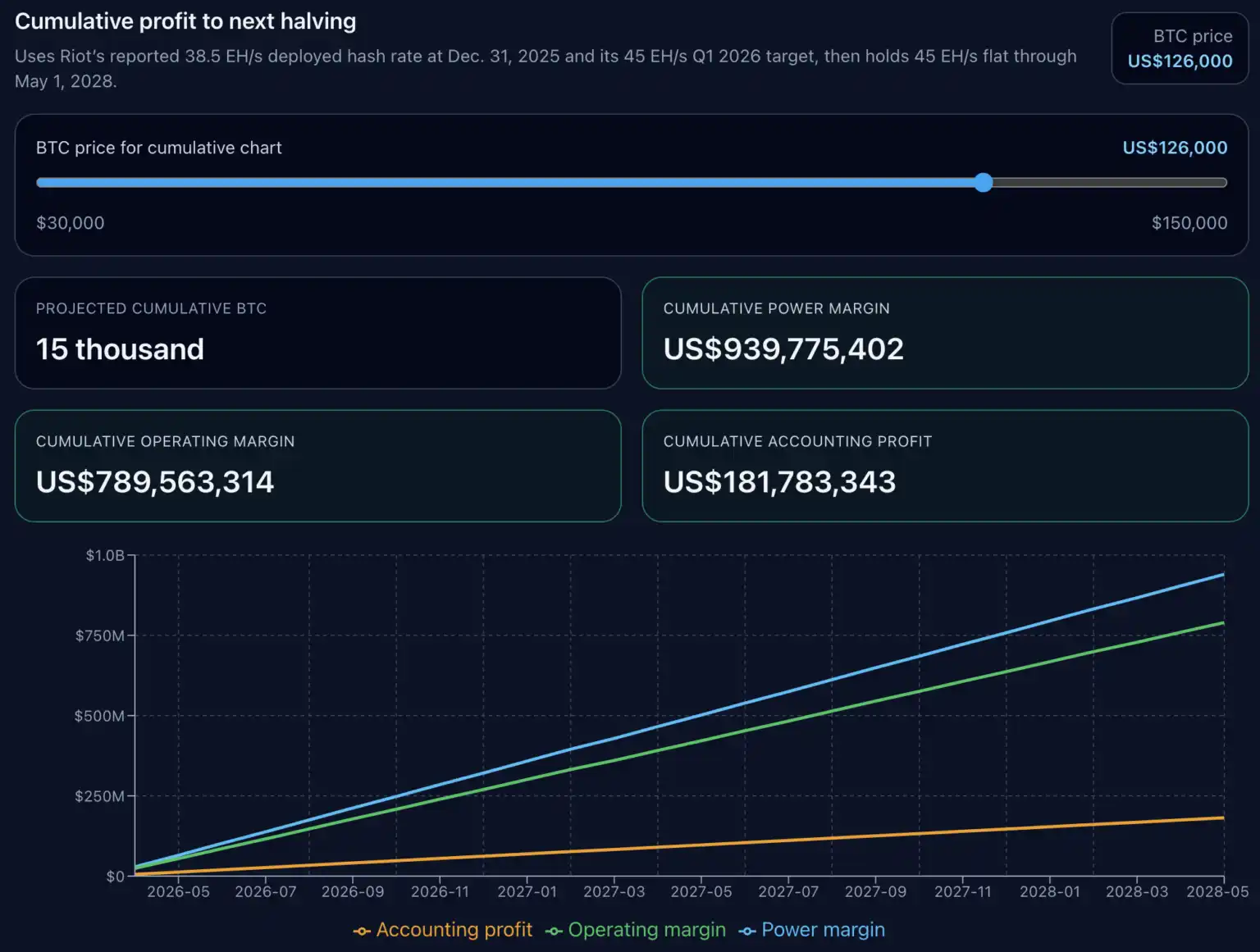
Only in the $126,000 scenario do all three lines turn positive, with a cumulative accounting profit of $181,783,343.
Miners can maintain positive electricity returns for extended periods yet still fail to cover broader operational costs; they can also be operationally positive while still far from accounting profitability. The Riot case shows this gap between these two states is substantial.

In the model, the gap between the electricity break-even point and the full accounting break-even point is approximately $49,495/BTC. This spread helps explain why miners might appear healthy at the hashrate scheduling level but seem stretched thin at the reported profitability level.

Our cumulative charts do not predict future difficulty, fees, downtime, demand response income, financing, or new capital expenditures, only assuming current per-BTC economics remain constant and projecting them along Riot's planned hashrate path.

This limitation does not affect the core signal the model conveys: with other economic factors held constant, fixing these parameters, the discussion before the next halving will still largely depend on the BTC price.

For Riot, the model achieves cumulative accounting profitability in the $126,000 scenario, but in absolute terms, this critical point is $114,200.
Implications of the Riot Case for the Entire US Mining Sector

For US miners, the broader implication is direct: price alone cannot solve operational problems; machine efficiency and electricity price remain the first hurdles.

Regarding cost sensitivity, we compared three ASIC presets: Bitmain S21 (17.5 J/TH), MicroBT M60S (18.5 J/TH), and Antminer S19 Pro (29.5 J/TH), all using the Texas industrial reference electricity price.
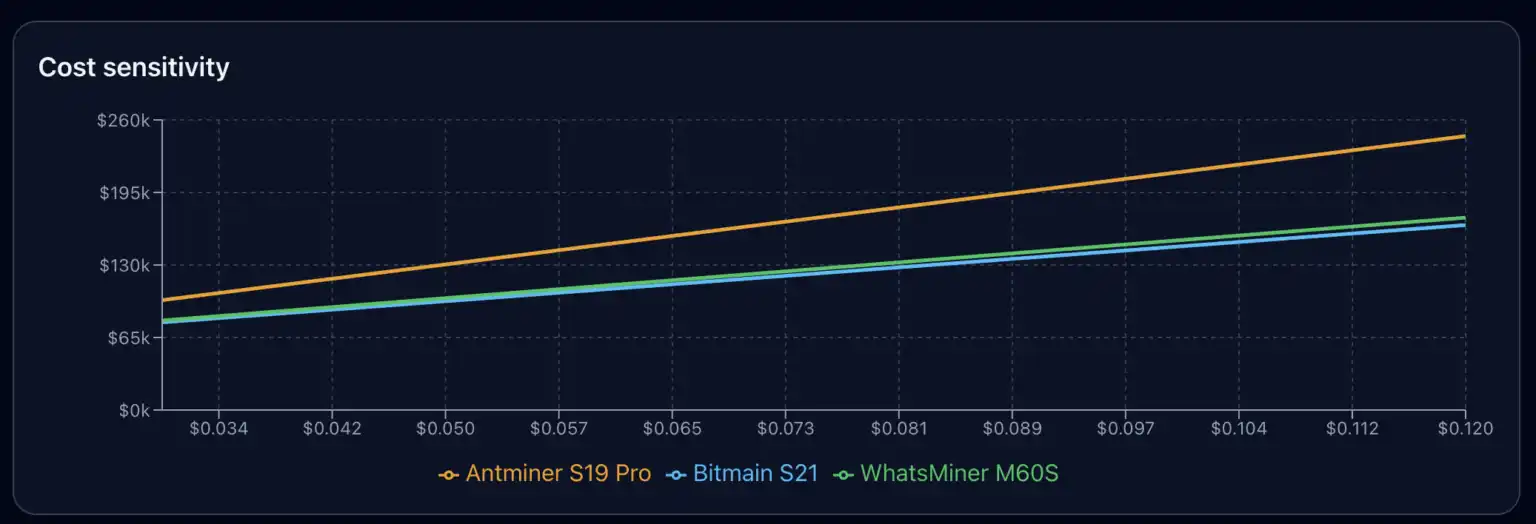
Within this electricity price range, the per-BTC cost for the S19 Pro remains higher than the newer models. The two new models have similar costs, while the less efficient miner maintains a significantly higher cost line throughout the chart.

This conclusion applies beyond Riot. Riot's non-electricity cost layer and depreciation assumptions are company-specific; other miners may have different overhead bases, different useful life assumptions, different demand response income structures, or different actual electricity mixes. But the applicability of the three-tier analysis framework itself is not affected.

First tier: Electricity cost. Second tier: Operational cost. Third tier: Accounting cost.

Companies that survive low-price cycles often easily cross the first tier. Companies that compound growth through cycles...


Связанные с этим вопросы

QWhat are the three layers of the Bitcoin mining cost structure as revealed by Riot Platforms' financial data?

AThe three layers are: 1) Electricity cost, which determines short-term operational decisions; 2) Operational cost, which includes non-power operational expenses and determines if the overall business is sustainable; 3) Accounting cost, which includes non-cash depreciation and determines the final reported profitability.

QAt what Bitcoin price does Riot Platforms break even on its electricity costs according to the model?

ARiot Platforms breaks even on its electricity costs at a Bitcoin price of $64,635 per BTC.

QWhat is the full accounting break-even price for Riot Platforms, and what major cost component pushes it so high?

AThe full accounting break-even price for Riot Platforms is $114,130 per BTC. The major cost component that pushes it this high is the non-cash depreciation expense, which amounts to approximately $39,687 per BTC.

QWhy can a mining company like Riot show a profit at the electricity level but still report an overall accounting loss?

AA mining company can show a profit at the electricity level if the Bitcoin price covers the direct power cost. However, it can still report an overall accounting loss because the broader operational costs (e.g., salaries, maintenance) and significant non-cash accounting depreciation expenses are not covered by that price.

QWhat does the Riot case study suggest about the relationship between ASIC efficiency and mining profitability?

AThe Riot case study highlights that ASIC efficiency (measured in J/TH) is a critical first hurdle for profitability. Newer, more efficient models like the Bitmain S21 have a significantly lower cost per BTC compared to older, less efficient models like the Antminer S19 Pro, especially at a given electricity price. This efficiency directly impacts the first layer of the cost structure (electricity cost).

Похожее

Will the Fed Still Cut Interest Rates? Tonight's Data Is Crucial

The core debate surrounding the Federal Reserve's potential interest rate cuts is intensifying amid geopolitical conflict and rebounding inflation. The key question is whether high energy prices will cause persistent inflation or weaken consumer demand enough to force the Fed to cut rates. Citigroup presents a bullish case for cuts, arguing that oil supply disruptions from the Strait of Hormuz are temporary and will not lead to lasting inflationary pressure. They point to receding bond yields and oil prices as evidence the market is pricing in a short-lived shock. Citi's data also shows tightening financial conditions, a stabilizing labor market, and healthy tax returns, supporting their view that the path to lower rates remains open. Conversely, Deutsche Bank offers a starkly contrasting, more hawkish outlook. They argue the Fed's current policy is already neutral and expect rates to remain unchanged indefinitely. Their view is based on stalled disinflation progress and a shift toward more hawkish rhetoric from key Fed officials like Waller, who cited risks from prolonged Middle East conflict and tariffs. Other officials, including Williams and Hammack, signaled rates would likely stay on hold for a "considerable time." The market pricing has shifted dramatically, now forecasting zero cuts in 2026. The imminent release of the March retail sales "control group" data is highlighted as a critical test. This metric, which excludes gas station sales, will reveal if high gasoline prices are eroding consumer spending in other areas. A weak reading could support the case for imminent rate cuts, while a strong one would bolster the argument for the Fed to hold steady. This data is pivotal for determining the near-term policy path.

marsbit12 мин. назад

Will the Fed Still Cut Interest Rates? Tonight's Data Is Crucial

marsbit12 мин. назад

The Second Half of Macro Influencer Fu Peng's Career

Fu Peng, a prominent Chinese macroeconomist and former chief economist of Northeast Securities, has joined Hong Kong-based digital asset management firm Bitfire Group (formerly New Huo Group) as its chief economist. This move, announced in April 2026, triggered an 11% surge in Bitfire's stock price. Fu, known for his accessible macroeconomic commentary and large social media following, will focus on integrating digital assets into global asset allocation frameworks, particularly combining FICC (fixed income, currencies, and commodities) with cryptocurrencies for institutional clients. His career includes roles at Lehman Brothers and Solomon International, with significant influence gained through public communication. However, in late 2024, Fu faced temporary social media bans after a controversial private speech at HSBC on China's economic challenges, though he denied regulatory sanctions. He later left Northeast Securities citing health reasons. Bitfire, a licensed virtual asset manager serving high-net-worth clients, seeks to build trust and attract traditional capital through Fu’s expertise and credibility. The partnership represents a strategic shift for both: Fu enters the crypto sector after a traditional finance peak, while Bitfire aims to leverage his macro framework for institutional adoption. Outcomes remain uncertain regarding capital inflows and compatibility within corporate structure.

marsbit1 ч. назад

The Second Half of Macro Influencer Fu Peng's Career

marsbit1 ч. назад

Торговля

Спот
Фьючерсы

Популярные статьи

Тест по Bitcoin Биткоина

HTX Learn: Изучите Bitcoin halving и Заработаете Токены USDT

3.0k просмотров всегоОпубликовано 2024.04.16Обновлено 2024.04.16

Тест по Bitcoin  Биткоина

Что такое $BITCOIN

ЦИФРОВОЕ ЗОЛОТО ($BITCOIN): Комплексный анализ Введение в ЦИФРОВОЕ ЗОЛОТО ($BITCOIN) ЦИФРОВОЕ ЗОЛОТО ($BITCOIN) — это проект на основе блокчейна, работающий в сети Solana, который стремится объединить характеристики традиционных драгоценных металлов с инновациями децентрализованных технологий. Хотя он носит имя Биткойн, часто называемого “цифровым золотом” из-за его восприятия как средства хранения ценности, ЦИФРОВОЕ ЗОЛОТО является отдельным токеном, предназначенным для создания уникальной экосистемы в ландшафте Web3. Его цель — позиционировать себя как жизнеспособный альтернативный цифровой актив, хотя детали его применения и функциональности все еще развиваются. Что такое ЦИФРОВОЕ ЗОЛОТО ($BITCOIN)? ЦИФРОВОЕ ЗОЛОТО ($BITCOIN) — это токен криптовалюты, специально разработанный для использования в блокчейне Solana. В отличие от Биткойна, который выполняет широко признанную роль хранения ценности, этот токен, похоже, сосредоточен на более широких приложениях и характеристиках. Примечательные аспекты включают: Инфраструктура блокчейна: Токен построен на блокчейне Solana, известном своей способностью обрабатывать высокоскоростные и недорогие транзакции. Динамика предложения: ЦИФРОВОЕ ЗОЛОТО имеет максимальное предложение, ограниченное 100 квадриллионами токенов (100P $BITCOIN), хотя детали о его обращающемся предложении в настоящее время не раскрыты. Утилита: Хотя точные функциональные возможности не описаны, есть указания на то, что токен может быть использован для различных приложений, потенциально связанных с децентрализованными приложениями (dApps) или стратегиями токенизации активов. Кто создатель ЦИФРОВОГО ЗОЛОТА ($BITCOIN)? На данный момент личность создателей и команды разработчиков, стоящих за ЦИФРОВЫМ ЗОЛОТОМ ($BITCOIN), остается неизвестной. Эта ситуация типична для многих инновационных проектов в области блокчейна, особенно тех, которые связаны с децентрализованными финансами и феноменом мем-криптовалют. Хотя такая анонимность может способствовать культуре, ориентированной на сообщество, она усиливает опасения по поводу управления и ответственности. Кто инвесторы ЦИФРОВОГО ЗОЛОТА ($BITCOIN)? Доступная информация указывает на то, что у ЦИФРОВОГО ЗОЛОТА ($BITCOIN) нет известных институциональных спонсоров или значительных венчурных капиталовложений. Проект, похоже, функционирует по модели пирингового взаимодействия, сосредоточенной на поддержке и принятии сообществом, а не на традиционных путях финансирования. Его активность и ликвидность в основном сосредоточены на децентрализованных биржах (DEX), таких как PumpSwap, а не на устоявшихся централизованных торговых платформах, что еще больше подчеркивает его подход, ориентированный на grassroots. Как работает ЦИФРОВОЕ ЗОЛОТО ($BITCOIN) Операционные механизмы ЦИФРОВОГО ЗОЛОТА ($BITCOIN) можно подробно описать на основе его дизайна блокчейна и характеристик сети: Механизм консенсуса: Используя уникальный механизм доказательства истории (PoH) Solana в сочетании с моделью доказательства доли (PoS), проект обеспечивает эффективную валидацию транзакций, что способствует высокой производительности сети. Токеномика: Хотя конкретные дефляционные механизмы не были подробно описаны, большое максимальное предложение токенов подразумевает, что оно может быть предназначено для микротранзакций или нишевых случаев использования, которые еще предстоит определить. Интероперабельность: Существует потенциал для интеграции с более широкой экосистемой Solana, включая различные платформы децентрализованных финансов (DeFi). Однако детали относительно конкретных интеграций остаются неуточненными. Хронология ключевых событий Вот хронология, которая подчеркивает значимые вехи, касающиеся ЦИФРОВОГО ЗОЛОТА ($BITCOIN): 2023: Первоначальное развертывание токена происходит в блокчейне Solana, отмеченное его адресом контракта. 2024: ЦИФРОВОЕ ЗОЛОТО приобретает видимость, когда оно становится доступным для торговли на децентрализованных биржах, таких как PumpSwap, позволяя пользователям обменивать его на SOL. 2025: Проект наблюдает спорадическую торговую активность и потенциальный интерес к инициативам, возглавляемым сообществом, хотя на данный момент не зафиксировано никаких значительных партнерств или технических достижений. Критический анализ Сильные стороны Масштабируемость: Основная инфраструктура Solana поддерживает высокие объемы транзакций, что может повысить полезность $BITCOIN в различных сценариях транзакций. Доступность: Потенциально низкая цена торговли за токен может привлечь розничных инвесторов, способствуя более широкому участию благодаря возможностям дробного владения. Риски Отсутствие прозрачности: Отсутствие публично известных спонсоров, разработчиков или процесса аудита может вызвать скептицизм относительно устойчивости и надежности проекта. Волатильность рынка: Торговая активность сильно зависит от спекулятивного поведения, что может привести к значительной волатильности цен и неопределенности для инвесторов. Заключение ЦИФРОВОЕ ЗОЛОТО ($BITCOIN) является интригующим, но неоднозначным проектом в быстро развивающейся экосистеме Solana. Хотя он пытается использовать нарратив “цифрового золота”, его отход от установленной роли Биткойна как средства хранения ценности подчеркивает необходимость более четкого различения его предполагаемой утилиты и структуры управления. Будущее принятие и усвоение, вероятно, будут зависеть от решения текущей непрозрачности и более четкого определения его операционных и экономических стратегий. Примечание: Этот отчет охватывает синтезированную информацию, доступную на октябрь 2023 года, и с тех пор могут произойти события.

99 просмотров всегоОпубликовано 2025.05.13Обновлено 2025.05.13

Что такое $BITCOIN

Fractal Bitcoin: масштабирование Биткоина с помощью рекурсивной системы

Fractal Bitcoin — масштабное Layer-1-решнение, созданное на базе кода Биткоина, позволяющего достигать бесконечного масштабирования с помощью рекурсивного подхода.

2.2k просмотров всегоОпубликовано 2025.06.30Обновлено 2025.06.30

Fractal Bitcoin: масштабирование Биткоина с помощью рекурсивной системы

Обсуждения

Добро пожаловать в Сообщество HTX. Здесь вы сможете быть в курсе последних новостей о развитии платформы и получить доступ к профессиональной аналитической информации о рынке. Мнения пользователей о цене на BTC (BTC) представлены ниже.

活动图片