Reviewing Arthur Hayes' 2025: All Hype Calls Ultimately Lead to Cashing Out

marsbitОпубликовано 2026-01-29Обновлено 2026-01-29

Введение

Arthur Hayes, the founder of BitMEX and a prominent crypto influencer, had a highly profitable yet controversial 2025. While his public calls, such as predicting "$1 million Bitcoin" and "$10,000 ETH," attracted retail traders, his on-chain actions often contradicted his bullish narratives, resulting in gains for him and losses for followers. His strategies fell into three main categories: 1. **"Pump and Dump" of VC Coins**: Hayes frequently promoted tokens like Hyperliquid (HYPE), where he held early, low-cost shares. He would build hype with ambitious predictions, then sell near peaks. For instance, he sold HYPE just before a price drop, citing "unlock risks," only to buy back months later. 2. **Failed Revival of "Old Narratives"**: Attempts to boost outdated sectors like DeSci (e.g., BIO) and metaverse projects (e.g., WILD) largely failed. His investments in these areas saw significant losses, with some tokens dropping over 85%. 3. **The ZEC "Smokescreen"**: Hayes aggressively promoted Zcash (ZEC), claiming a "$10,000 target," while simultaneously selling ETH and other assets to fund ZEC purchases. This move allowed him to shift transparent assets (ETH) into privacy-focused ZEC, obscuring his true position. He later sold ETH again to reinvest in other areas, using ZEC’s volatility to divert market attention. Hayes operates as a pragmatic trader, not a steadfast "HODLer." His public analyses are valuable for macro insights, but his on-chain activity reveals a pattern o...

Original author: angelilu, Foresight News

Looking back at 2025, Arthur Hayes remains the big winner who is both loved and hated.

As the founder of BitMEX and the KOL in the crypto circle who is best at writing "essays," every "hype call" he made in 2025 could stir up retail trading enthusiasm. But looking back at 2025, you will suddenly realize that if you got on board every time he made a call, the result would be that he made money, and you lost.
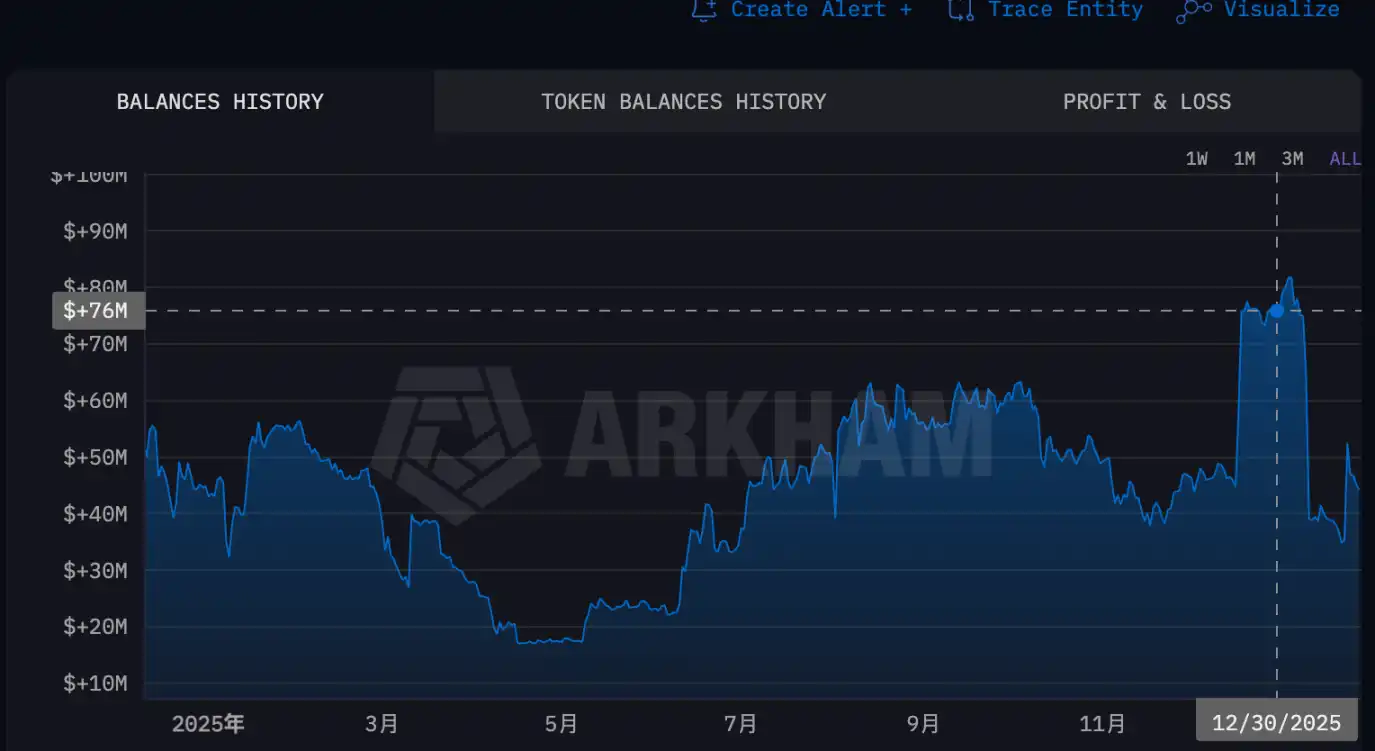
He shouted "Bitcoin to one million dollars" and "ETH to $10,000" on Twitter, but on-chain, Arthur Hayes would always inadvertently sell the assets he once favored. If we lay out all his operations from last year, you will find an extremely calm, even冷酷 (cold-blooded), trading record of a top trader.

We can break down his operations into three categories.

VC Coins: "Publicly Hype, Privately Dump"

Hayes' most controversial operations usually occur with projects where he obtained early筹码 (chips/allocations). This is actually a completely asymmetrical game: perhaps he made 10x when selling at $50, while your losses were just beginning when buying at $60.

The most typical script happened with Hyperliquid (HYPE). As an early investor who obtained extremely low-cost筹码 (chips), his operating logic is very simple and crude:

Step one: Use influence to hype at high prices, building grand narratives (e.g., "HYPE 100x in three years");

Step two: Wait until the token unlocks or liquidity is sufficient, then decisively clear the position.
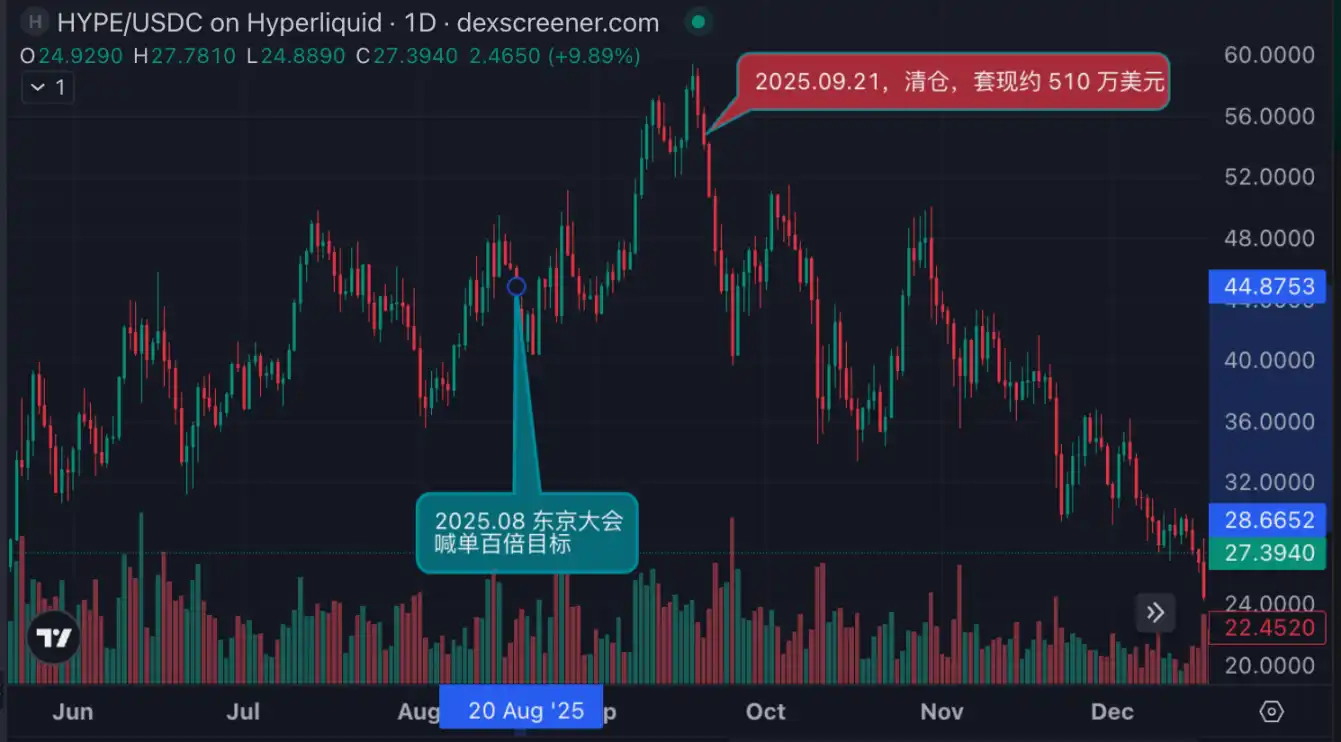
For example, last August, Hayes predicted at a conference in Tokyo that HYPE would have hundred-fold growth and高调 (high-profile) bought in. Just one month later, he cleared his position before HYPE fell and made millions of dollars in profit, giving the reason "to avoid unlocking risks."
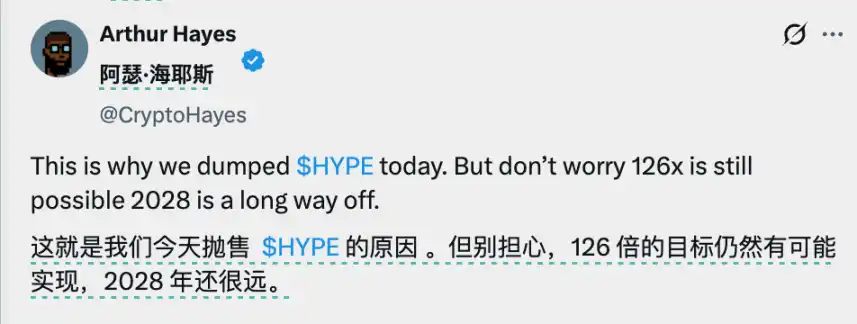
But HYPE was not completely abandoned by him. In mid-January 2026, Hayes bought about $499,000 worth of HYPE again after three months.

The same story happened repeatedly, including with ETHFI, ATH, etc., all experiencing similar scripts.

But imagine, if you were Arthur Hayes, what would you do? To achieve profit with large capital, this seems to be the standard playbook: first, put forward market analysis that is足以自圆其说 (sufficient to justify itself),征服 (conquering) the audience with logic; when believers flock in, the market will naturally confirm his prophecy.

And for whales, the only window to quietly exit is when the crowd is bustling and liquidity is most abundant.

The "Old Narratives" That Couldn't Be Hype

After reviewing Hayes' successful hype narratives, we found that Hayes also had times when he failed. Especially when he tried to "revive" some old or niche sectors.

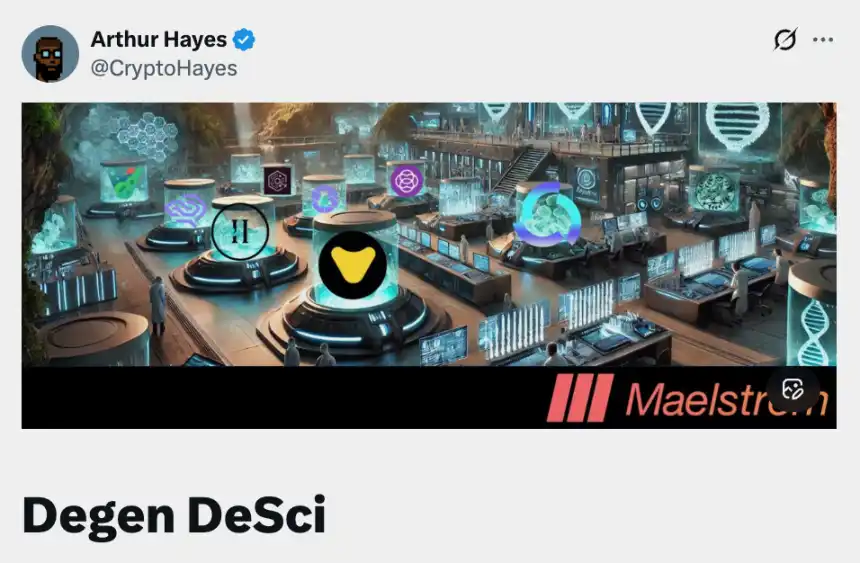
In early 2025, his family fund Maelstrom wrote a long and profound article "Degen DeSci," strongly bullish on the DeSci (Decentralized Science) sector. He listed a bunch of coins, BIO, GROW...

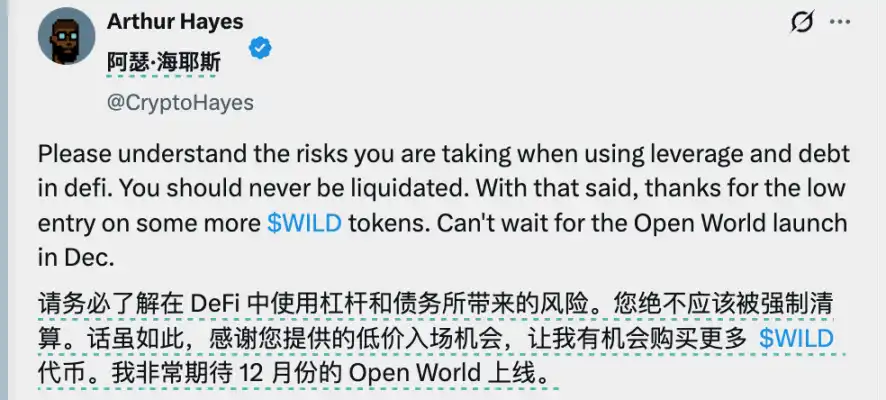
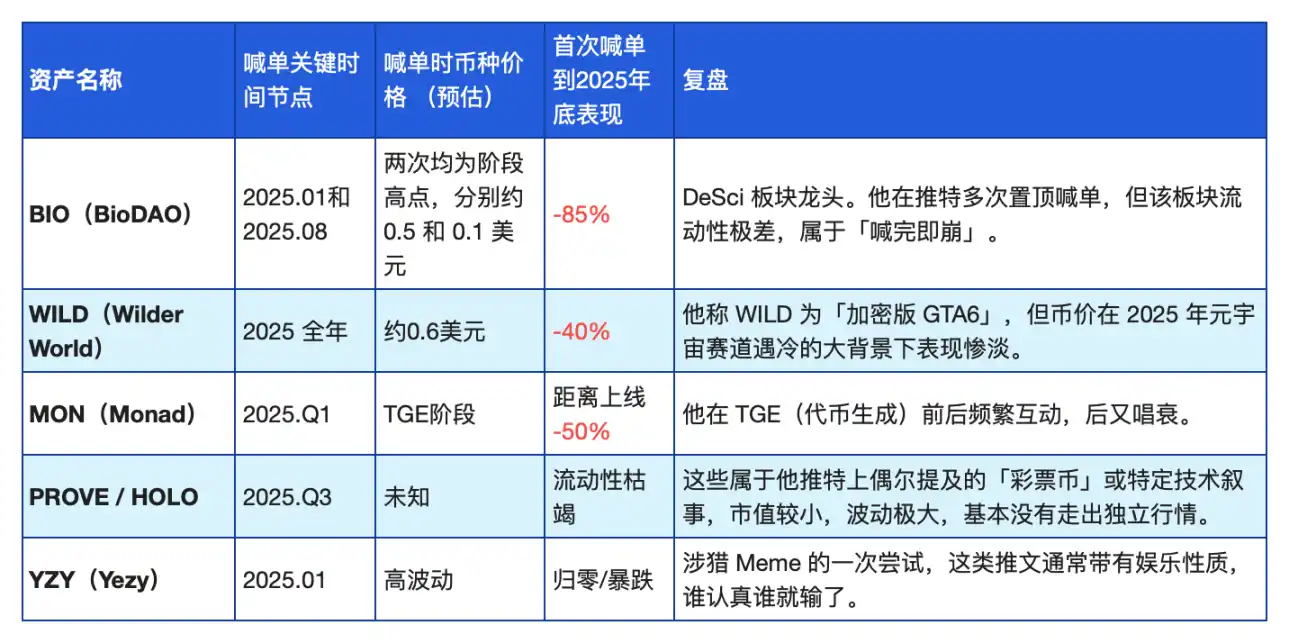
The result is clear for all to see: the DeSci sector almost全军覆没 (was completely wiped out), with many tokens falling more than 85% from their highs. Hayes built a position of $1.1 million worth of BIO again in August and finally deposited 7.66 million BIO into Binance in late November, with a potential loss of $640,000 (-58%).
Then there's Wilder World (WILD), which he called the "Crypto version of GTA6." He hyped it for a whole year, and finally the price sank along with the metaverse concept.
Most of the tokens Hayes hyped had热度 (heat/hype) at specific stages. A summary is shown in the chart:
ZEC's "Smoke Screen"

This might be Hayes' most brilliant and intriguing operation in 2025.

On the surface, Hayes疯狂 (crazily) hyped Zcash (ZEC), stating that he initially bought millions of dollars worth after hearing the suggestion from Silicon Valley big shot Naval at a private dinner during Token 2049. In November last year, he shouted the slogan "target $10,000."

Hayes even initiated a withdrawal movement, calling on everyone to withdraw their coins to the chain to lock up liquidity.
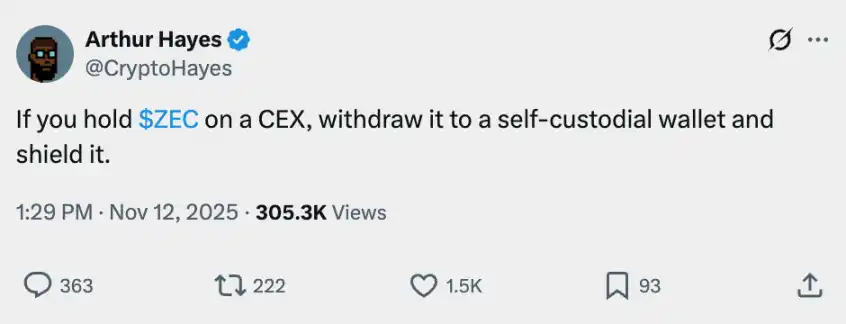
Many people watched his wallet to see if he was secretly selling ZEC. The result: he didn't sell; he was even adding to his position.

Perhaps the real purpose of Hayes creating this ZEC frenzy was: to sell ETH and exchange it for anything that was rising fast at the time.

Hayes had actually already taken a "knife" to ETH several times before this. Although he高喊 (shouted loudly) in 2025 that ETH would rise to $10,000, he experienced several "反复横跳" (back-and-forth jumps). He sold about $13.34 million worth of ETH and other tokens on August 2nd but expressed regret on August 9th for taking profits and had to buy back.

By November 15, 2025, just when he was vigorously hyping ZEC, Lookonchain monitored him transferring millions of dollars worth of ETH and ENA to Binance. On the same day, Hayes publicly declared on Twitter that he had "Aped more ZEC." On-chain analyst EmberCN also分析指出 (analyzed and pointed out) that this selling was极大概率 (most likely) to supply "ammunition" for adding to the ZEC position.

Due to ZEC's privacy features, his transparent ETH was sold and exchanged for opaque assets. On the chain, we can only see him "exiting" (selling ETH) but cannot quantify the scale of his "entering" (buying ZEC).

But in the last two weeks of 2025, Hayes sold another 1,871 ETH (about $5.53 million) and went back to buy the DeFi assets he had abandoned a month earlier.

This is a very冷酷 (cold) signal: in his logic, Ethereum is the "cash reserve" in his investment组合 (portfolio). He sells it when he needs money to buy new narratives (ZEC), and he still sells it when he needs money to bottom-fish old sectors (DeFi).

In the end, you will find that he used ZEC's price increase to attract the attention of the entire market, and then quietly completed his position rotation while everyone was discussing the "privacy renaissance." It wasn't until early 2026, when ZEC plummeted due to internal team strife, that everyone realized that although Hayes's holdings had shrunk, he successfully exited the top of ETH, which performed even worse during that phase.

How to Understand Arthur Hayes?

After reviewing this year, you will find that Hayes,正如 (just as) written in his X background picture, is not a "believer" HODLer but an extremely精明 (shrewd) businessman.
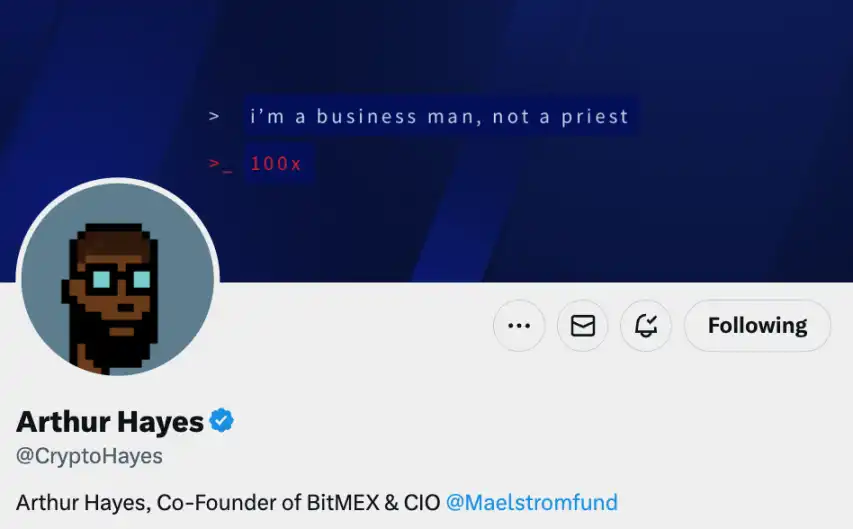
He uses words to build dreams to attract liquidity; he uses on-chain operations to harvest profits to avoid risks; he dares to quickly admit mistakes when he is wrong (e.g., abandoning ETH) to preserve capital.

So, his articles are still worth reading because his macro judgments have been verified. But before you press the "buy" button, please take one more step: don't listen to what he says, go see what his on-chain wallet is doing.

After all, in this残酷 (cruel) market, his loyalty to "volatility" is far higher than his belief in any single project. And volatility is precisely the money transferred from the pockets of retail traders to the pockets of traders.


Связанные с этим вопросы

QWhat was the main criticism of Arthur Hayes' actions in 2025 according to the article?

AThe main criticism was that Hayes' public endorsements ('calling orders') were often a strategy to create market hype and liquidity, allowing him to profitably sell his positions at high prices, while retail investors who followed his advice frequently ended up losing money.

QDescribe Hayes' typical strategy with VC coins like Hyperliquid (HYPE).

AHis strategy involved two steps: first, using his influence to endorse the coin at high prices and build a grand narrative (e.g., 'HYPE will grow 100x in three years'); second, liquidating his position for substantial profits once the token was unlocked or liquidity was sufficient, often just before a price drop.

QWhich investment narrative promoted by Hayes in 2025 failed significantly, and what was the result?

AHis promotion of the DeSci (Decentralized Science) narrative failed significantly. Coins in this sector, such as BIO, plummeted by over 85% from their highs. Hayes' investment in BIO resulted in a loss of approximately $640,000, a 58% decrease.

QWhat was the suspected real purpose behind Hayes' strong public endorsement of Zcash (ZEC)?

AThe suspected real purpose was to create a market frenzy around ZEC to attract attention and liquidity, which allowed him to discreetly sell his transparent assets like ETH and convert them into the more opaque ZEC. This move helped him rotate his portfolio away from underperforming assets like ETH.

QHow does the article suggest investors should interpret Hayes' public statements and actions?

AThe article advises investors to read his macro analyses but to verify his on-chain wallet activities before making investment decisions. It emphasizes that his loyalty is to 'volatility' and profit, not to any specific project's long-term success, making his actions more those of a shrewd trader than a faithful holder.

Похожее

Может ли модель генерации обучаться end-to-end? В основе — простой цикл for

В статье представлен новый подход к обучению генеративных моделей под названием Explorative Modeling (XM), который позволяет осуществлять сквозное (end-to-end) обучение. Традиционные генеративные модели, такие как диффузионные или авторегрессионные, страдают от «смешения мод» (mode blurring), когда модель усредняет множество возможных правильных ответов, что приводит к размытым или нереалистичным результатам. Это также вызывает «смещение экспозиции» (exposure bias), когда ошибки накапливаются во время вывода. Ключевая идея XM проста: на каждом шаге обучения модель генерирует K кандидатов, а для обратного распространения градиента выбирает только того кандидата, который наиболее близок к реальным данным. Этот цикл, реализованный в несколько строк кода, повышает «генеративную выразительность» модели, позволяя ей охватывать несколько мод распределения данных, а не усреднять их. Авторы показывают, что «исследование» (exploration) становится третьей осью масштабирования наряду с увеличением параметров и данных. Эксперименты с изображениями, видео и текстом демонстрируют монотонное улучшение качества: при увеличении масштаба данных выгода от исследования возрастает с 7% до 36%, а эффективность использования вычислений (FLOP) повышается в 4.1 раза. В задачах управления роботами сквозная модель XM с одним проходом вперед достигает результатов, сравнимых с диффузионными моделями, требующими сотни проходов. Таким образом, Explorative Modeling предлагает путь к truly end-to-end генеративным моделям, перенося сложность с этапа вывода на этап обучения, что открывает потенциал для более эффективных и мощных систем.

marsbit8 мин. назад

Может ли модель генерации обучаться end-to-end? В основе — простой цикл for

marsbit8 мин. назад

Upbit проводит ребалансировку 864 млрд SHIB при перемещении между внутренними кошельками

Корейская биржа Upbit провела внутреннюю ребалансировку 864 миллиардов токенов SHIB между своими кошельками. Движение активов на сумму около 4 миллионов долларов произошло после роста стоимости SHIB на 36%, что привлекло внимание трейдеров. Однако анализ помеченных адресов показывает, что это была стандартная операция по перераспределению средств между "горячими" и другими внутренними кошельками биржи, а не вывод средств или подготовка к продаже. Общий объем перемещений включал 384 миллиарда SHIB, отправленных с основного горячего кошелька, и 480 миллиардов SHIB, возвращенных обратно. Этот случай подчеркивает важность проверки контекста и меток кошельков при интерпретации крупных ончейн-транзакций, чтобы избежать ошибочных выводов о продаже или давлении на рынок.

bitcoinist9 мин. назад

Upbit проводит ребалансировку 864 млрд SHIB при перемещении между внутренними кошельками

bitcoinist9 мин. назад

Максимум 20 статей на человека? Исследователи DeepMind «просят» снять ограничения ICLR

Новая политика конференции ICLR 2027 ограничивает количество подаваемых одним автором работ до 20. По мнению организаторов, это необходимо для снижения нагрузки на рецензентов, учитывая рекордный рост числа заявок — на 68% за год. В ответ на это исследователь Google DeepMind Дэн Рой иронично запустил «петицию» против лимита, заявив, что он замедлит прогресс в ИИ, особенно в эпоху, когда агенты ИИ могут генерировать множество статей, а рецензии часто пишутся с помощью больших языковых моделей (по некоторым данным, до 21% рецензий на ICLR 2026 могли быть полностью сгенерированы ИИ). Его сатирический пост поднимает серьёзный вопрос о целесообразности простого ограничения количества работ вместо решения системных проблем, связанных с массовым производством статей и автоматизацией рецензирования в современной академической среде.

marsbit14 мин. назад

Максимум 20 статей на человека? Исследователи DeepMind «просят» снять ограничения ICLR

marsbit14 мин. назад

Уязвимость Coldcard привела к краже $89 млн и вызвала самую масштабную миграцию средств в блокчейне после краха FTX

Уязвимость в аппаратном кошельке Coldcard привела к краже 1367,05 BTC (около 89 млн долларов) с 4585 адресов. Инцидент, связанный с ошибкой в генерации сид-фраз в определенной прошивке, вызвал массовую миграцию средств пользователей на новые безопасные адреса. Это привело к аномальному всплеску активности в сети Биткоин, исказив ключевые ончейн-индикаторы, такие как активность долгосрочных держателей и объем мелких транзакций. Активность и рыночные настроения достигли уровня, сравнимого с периодом после краха FTX. Расследование столкнулось с трудностями из-за ограничений коммерческих ИИ-моделей (например, в США), которые блокируют анализ вредоносных данных даже для целей защиты. Следователи были вынуждены использовать открытые модели, такие как китайский GLM 5.2, для отслеживания украденных средств. Этот случай высветил проблему асимметрии: злоумышленники используют неограниченные ИИ-инструменты, в то время как защитники сталкиваются с барьерами коммерческих систем безопасности, что критично в сфере криптовалют, где скорость отслеживания средств крайне важна.

marsbit59 мин. назад

Уязвимость Coldcard привела к краже $89 млн и вызвала самую масштабную миграцию средств в блокчейне после краха FTX

marsbit59 мин. назад

Заработок в миллион на электриках: Meta спешно открывает собственное ПТУ

Новый этап конкуренции в сфере искусственного интеллекта столкнулся с неожиданным препятствием — острой нехваткой квалифицированных технических специалистов, особенно электриков и строителей, для возведения сверхмощных центров обработки данных. В США, согласно прогнозам, к 2030 году для инфраструктуры ИИ потребуется дополнительно 130 000 электриков и 240 000 строителей, однако ежегодно остается незаполненными около 80 000 вакансий электриков. Компании, такие как OpenAI (проект "Stargate" стоимостью $160 млрд), Meta и Microsoft, сталкиваются с огромными убытками из-за задержек строительства. Например, задержка ввода центра мощностью 60 МВт может обернуться потерей $14,2 млн в месяц. Причина спроса — беспрецедентная сложность строительства ИИ-центров. Они потребляют колоссальную энергию (сотни мегаватт), требуют уникальных систем электроснабжения и охлаждения (жидкостное или иммерсионное), что делает работу высококвалифицированных монтажников, сантехников и инженеров незаменимой. Для решения проблемы кадрового голода ИИ-гиганты начали масштабные программы обучения. Meta инвестировала $115 млн в создание собственной школы строителей с бесплатным обучением и стипендией, а OpenAI сотрудничает с профсоюзами. Активная вербовка ведется даже среди старшеклассников. Потребление энергии ИИ-центрами растет экспоненциально, опережая общий рост энергопотребления в 16 раз и увеличивая счета за электричество для потребителей. Однако строительство таких объектов носит проектный характер: для возведения центра "Stargate" требуется 6400 рабочих, а для его обслуживания — всего 100-1000. Это создает риск перенасыщения рынка труда после завершения строительного бума, что может привести к падению зарплат в отрасли.

marsbit1 ч. назад

Заработок в миллион на электриках: Meta спешно открывает собственное ПТУ

marsbit1 ч. назад

Торговля

Спот
活动图片




