Quantum Computing Will Trigger A Bitcoin Supply Shock: Michael Saylor

bitcoinistОпубликовано 2025-12-20Обновлено 2025-12-20

Введение

Quantum computing will not break Bitcoin but instead harden it, according to Michael Saylor. In response to a future quantum threat, a coordinated global upgrade to quantum-resistant encryption will be enforced. Active Bitcoin holders will migrate their coins to secure new wallets, while lost or inaccessible coins will remain permanently frozen. This process will enhance network security, reduce the effective supply of Bitcoin, and trigger a deflationary event. Saylor argues that the upgrade is inevitable and that the market will ultimately reach consensus, despite Bitcoin’s decentralized nature. The result will be a clearer accounting of lost BTC and a stronger, more secure network.

Quantum computing has become a durable risk narrative for Bitcoin. This week, Galaxy Digital head of research Alex Thorn sat down with Strategy executive chairman Michael Saylor addressing the issue, shortly after Saylor posted his own “Bitcoin Quantum Leap” thesis on X.

“The Bitcoin Quantum Leap: Quantum computing won’t break Bitcoin—it will harden it. The network upgrades, active coins migrate, lost coins stay frozen. Security goes up. Supply comes down. Bitcoin grows stronger,” Saylor wrote on Dec. 16, 2025.

Saylor Doubles Down On Freezing Dormant Bitcoin

In Thorn’s interview, Saylor’s argument is less a cryptography lesson than a coordination claim: when a quantum threat is broadly recognized, the response will not be optional, and Bitcoin will follow the same upgrade logic as the rest of the digital economy.

“There’s going to be a point when the world will form a consensus that there’s a quantum threat. We’re not there now, but you won’t miss it because the United States government will direct all of the defense contractors to upgrade their encryption algorithms to be quantum resistant,” Saylor said.

He described a cascade in which major platforms ship standardized quantum-resistant libraries across consumer devices and core financial systems, with enforced timelines and re-authentication requirements. In that scenario, Saylor suggested, Bitcoin’s transition would be a software upgrade problem, not an existential crisis.

“They will ship an upgrade and they will say [...] please install the new client software and reauthenticate yourself. And you’ve got X days, 90 days, 30 days... And if you don’t, we’re going to freeze your funds. For your own good,” Saylor said.

Saylor repeatedly returned to incentives as the decisive factor. In his view, owners of meaningful balances will not rationally opt out of an upgrade that preserves access to their holdings, and the same logic extends to the broader ecosystem’s ability to reach rough consensus.

“The Bitcoin network just runs on software. There’s going to be a quantum upgrade. It’s going to have quantum resistant encryption libraries,” he said, adding that he would expect those to align with widely adopted standards shipped across operating systems and enterprise infrastructure.

Where his answer becomes more explicitly market-relevant is in the downstream implication: coins that can be migrated will be migrated, and coins that cannot be migrated — because the holders are deceased or keys are irretrievable — would remain stranded. Saylor framed that as a security hardening event that also forces a clearer accounting of lost supply.

“We’re going to re-encrypt all the Bitcoin and all the wallets [...] It’s going to get re-encrypted if the holders of the private keys are alive and if they like money,” he said. “If they’re dead, they’re not going to re-encrypt. And if they’ve lost the keys, they’re not going to re-encrypt.”

Bitcoin Supply Shock Imminent

That is where the “deflationary event” language enters: the upgrade, in his view, would effectively separate recoverable BTC from unrecoverable BTC in a way the market would have to price. “This is going to be a massive upgrade to network security and it’s going to be a massive deflationary event,” Saylor said. “And we’re going to get the answer to the age old question, how much BTC has been lost?”

Saylor also addressed the common objection that decentralization makes coordinated upgrades impractical. He argued the opposite: decentralized networks still converge when sufficiently motivated, and global supply chains and defense ecosystems coordinate under pressure despite being fragmented across thousands of entities.

“You think you’re not going to get consensus? All the smart people with money in the world that thought it was smart to put their money on the crypto network, you think they’re the people too stupid to want to upgrade?” he said.

In his framing, the practical difference versus a bank-driven migration is timing. A centralized institution can enforce a short deadline; Bitcoin, because it is global and permissionless, would likely take longer, on the order of months to years, but would still converge. “We’re probably going to do this over the course of 30 days or 90 days. It’ll probably take two years or one year,” Saylor said.

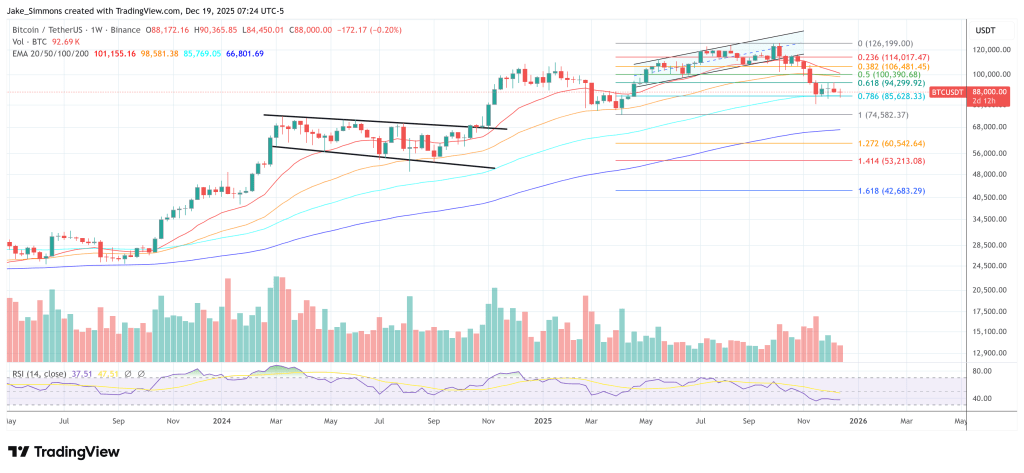
At press time, BTC traded at $88,000.

Bitcoin remains between the 0.618 and 0.786 Fib, 1-week chart | Source: BTCUSDT on TradingView.com

Связанные с этим вопросы

QWhat is Michael Saylor's main argument about quantum computing and Bitcoin?

AMichael Saylor argues that quantum computing will not break Bitcoin but will instead harden it. He believes the network will upgrade, active coins to quantum-resistant encryption, while lost coins remain frozen. This process will increase security, reduce supply, and make Bitcoin stronger.

QAccording to Saylor, what will trigger the global consensus to upgrade encryption algorithms?

ASaylor states that the United States government will direct all defense contractors to upgrade their encryption algorithms to be quantum-resistant, which will signal a broad recognition of the quantum threat and trigger a global consensus for upgrades.

QHow does Saylor describe the process of Bitcoin's quantum upgrade?

ASaylor describes it as a software upgrade where quantum-resistant encryption libraries will be shipped. Users will be required to install new client software and reauthenticate within a deadline (e.g., 30-90 days), or their funds will be frozen for security reasons.

QWhy does Saylor believe the quantum upgrade will be a deflationary event for Bitcoin?

AHe explains that the upgrade will separate recoverable BTC (migrated by active users) from unrecoverable BTC (held by deceased or key-losers), effectively reducing the circulating supply and forcing the market to account for lost coins, thus creating a deflationary shock.

QHow does Saylor counter the argument that decentralization makes coordinated upgrades impractical?

ASaylor argues that decentralized networks can still reach consensus when motivated, citing examples like global supply chains and defense ecosystems coordinating under pressure. He believes Bitcoin holders, being smart and financially invested, will rationally choose to upgrade to protect their assets.

Похожее

The First Year of Computing Power Inflation: The Cheaper DeepSeek Gets, the Harder It Is to Stop This Round of Price Hikes

The year 2026 marks the beginning of "computing power inflation." While AI inference costs have dropped by over 80% in 18 months globally, China's three major cloud providers—Alibaba Cloud, Baidu AI Cloud, and Tencent Cloud—simultaneously announced price hikes of 20–30%. This reflects a deeper structural shift driven by Jevons Paradox: as unit costs fall (e.g., via models like DeepSeek-R1), demand explodes, especially with the rise of reasoning models and AI agents that consume 10–50x more tokens per task. Although DeepSeek open-sourced its model weights, it did not release its inference optimization stack, leaving a significant engineering efficiency gap between cloud providers and smaller players. The big three are leveraging this advantage to reposition: Alibaba focuses on high-margin premium clients, Baidu filters out low-value users, and Tencent capitalizes on ecosystem lock-in. Meanwhile, ByteDance’s Volcano Engine adopts a more moderate pricing strategy to capture displaced customers. Unexpectedly, the price surge is pushing large enterprises toward self-built computing solutions once their cloud bills exceed a certain threshold. While cloud providers aim to boost profitability, they risk driving away innovative startups and accelerating competition from GPU leasing and domestic hardware providers like Huawei. The涨价 trend is expected to persist for 2–3 years, fueled by rising token consumption from reasoning models, AI agent adoption, and NVIDIA export restrictions. The inflection point depends on whether domestic chips can match NVIDIA’s efficiency, likely around 2027–2028. Until then, cloud providers will maintain pricing power, and the key for AI companies is to optimize token usage—the real moat in this era.

marsbit21 мин. назад

The First Year of Computing Power Inflation: The Cheaper DeepSeek Gets, the Harder It Is to Stop This Round of Price Hikes

marsbit21 мин. назад

Торговля

Спот
Фьючерсы

Популярные статьи

Как купить BASED

Добро пожаловать на HTX.com! Мы сделали приобретение Based (BASED) простым и удобным. Следуйте нашему пошаговому руководству и отправляйтесь в свое крипто-путешествие.Шаг 1: Создайте аккаунт на HTXИспользуйте свой адрес электронной почты или номер телефона, чтобы зарегистрироваться и бесплатно создать аккаунт на HTX. Пройдите удобную регистрацию и откройте для себя весь функционал.Создать аккаунтШаг 2: Перейдите в Купить криптовалюту и выберите свой способ оплатыКредитная/Дебетовая Карта: Используйте свою карту Visa или Mastercard для мгновенной покупки Based (BASED).Баланс: Используйте средства с баланса вашего аккаунта HTX для простой торговли.Третьи Лица: Мы добавили популярные способы оплаты, такие как Google Pay и Apple Pay, для повышения удобства.P2P: Торгуйте напрямую с другими пользователями на HTX.Внебиржевая Торговля (OTC): Мы предлагаем индивидуальные услуги и конкурентоспособные обменные курсы для трейдеров.Шаг 3: Хранение Based (BASED)После приобретения вами Based (BASED) храните их в своем аккаунте на HTX. В качестве альтернативы вы можете отправить их куда-либо с помощью перевода в блокчейне или использовать для торговли с другими криптовалютами.Шаг 4: Торговля Based (BASED)С легкостью торгуйте Based (BASED) на спотовом рынке HTX. Просто зайдите в свой аккаунт, выберите торговую пару, совершайте сделки и следите за ними в режиме реального времени. Мы предлагаем удобный интерфейс как для начинающих, так и для опытных трейдеров.

230 просмотров всегоОпубликовано 2026.03.30Обновлено 2026.03.30

Как купить BASED

Неделя обучения по популярным токенам 10: Обновление Alpenglow ожидается в первой половине 2026 года, долгосрочный прогноз по XAUT и XAG остается позитивным

Ожидается, что в первой половине 2026 года начнется развертывание масштабного обновления Alpenglow SOL.

1.1k просмотров всегоОпубликовано 2026.03.31Обновлено 2026.03.31

Неделя обучения по популярным токенам 10: Обновление Alpenglow ожидается в первой половине 2026 года, долгосрочный прогноз по XAUT и XAG остается позитивным

Обсуждения

Добро пожаловать в Сообщество HTX. Здесь вы сможете быть в курсе последних новостей о развитии платформы и получить доступ к профессиональной аналитической информации о рынке. Мнения пользователей о цене на A (A) представлены ниже.

活动图片