Public Chains 2025: The Bustle Belongs to the Casino, the Desolation to the Ecosystem

比推Опубликовано 2025-12-18Обновлено 2025-12-18

Введение

The 2025 public blockchain landscape reveals a stark divide between hype and reality, with a severe concentration of value and widespread "zombification" of projects. Analysis of DeFiLlama's on-chain fee data exposes a critical structural issue: the crypto space is dominated by a "profit concentration and long-tail zombie" era. Notable examples highlight this crisis. Algorand, a chain with a $1 billion market cap and advanced technology, generated a mere $17 in daily fees, while Cardano, a top-10 asset, saw only around $6,000. These "classic chains" are likened to empty, expensive cities with no real economic activity. The biggest value capturers are not the most technologically elegant chains. Tron leads with $1.24 million in daily fees, succeeding as a low-cost payment rail for USDT transfers—crypto's only true mass-adoption use case. Solana ($600k daily) thrives as a high-frequency casino for meme coins and speculation, and Base ($105k daily) demonstrates that distribution (via Coinbase) is more critical than pure technology. The only validated business models generating significant fees are low-cost payments, high-frequency speculation, and, to a lesser extent, Ethereum's asset settlement layer. The VC-driven model is failing. New chains like Sui, Sei, and Starknet, which raised hundreds of millions, show a severe disconnect between their high valuations and meager daily fee revenue (ranging from $320 to $12,000). Their lifecycle often follows a "pump and dump" pattern...

Author: BlockWeeks Block Weekly

In the cryptocurrency market, if you only look at Market Cap, you see a thriving, flourishing digital utopia. Valuations in the tens of billions, grand technical whitepapers, the halo of Turing Award winners... everything looks like the dawn of the next generation of the internet.

But if you put on a different pair of glasses—glasses that only see "on-chain real revenue (Fees)"—you see a completely different, even spine-chilling picture: in this so-called trillion-dollar market, the vast majority of "unicorns" are actually zombies that stopped breathing long ago.

Recently, BlockWeeks conducted a detailed analysis of the "Fees" data for public chains on DeFiLlama, and we discovered an unavoidable structural problem: crypto public chains have entered an era of "extremely concentrated profits and a collectively zombified long tail."

The core data of this article are sourced from DeFiLlama's "Fees / Revenue by Chain" panel (capture time: December 16, 2025). The "Fees" defined here refer to the total fees paid by users on-chain (top-line), serving as an approximate indicator of the scale of on-chain economic activity, not the protocol's net retained income (Protocol Revenue). This article aims to use this open, unified standard to examine the on-chain value capture ability of various public chains.

I. The $17 Humiliation: The Demise of the Technological Utopia

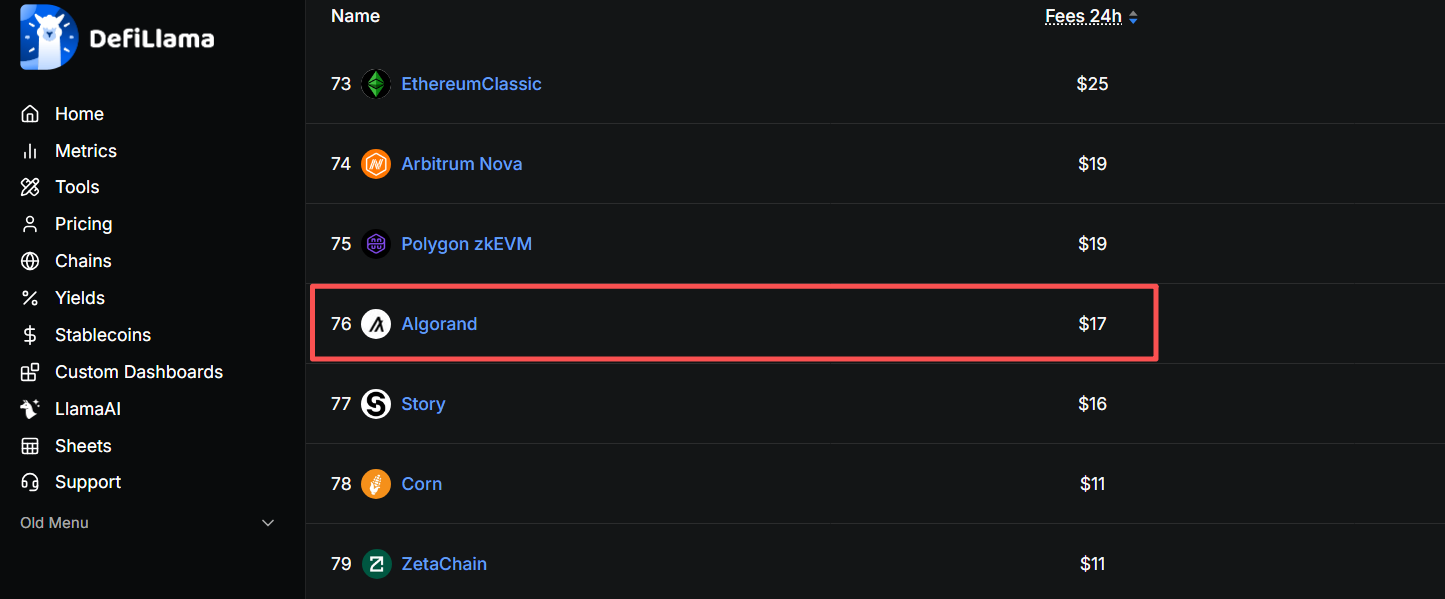
According to the public data we captured from DeFiLlama, the most alarming figure did not come from the million-dollar giants at the top, but from the $17 at the bottom.

This is the daily protocol revenue for Algorand—a chain once crowned the "blockchain trilemma solver," founded by Turing Award winner Silvio Micali, and boasting top-tier technical credentials.

You read that right, not $170,000, but $17.

At this very moment, Algorand's market cap remains in the billion-dollar range. A "digital nation" with a billion-dollar market cap generates direct tax revenue from its digital economy that isn't enough to buy four lattes at Starbucks. It shows that despite possessing the most advanced decentralized technology, without real, sustained application demand, its economic value capture ability approaches zero.

This is not just an embarrassment for Algorand; it's the death knell for the entire "classic public chain" camp.

Look at Cardano (ADA), a behemoth consistently in the top 10 by market cap, with millions of token holding addresses. Yet the data tells us its recent average daily on-chain fees hover around $6,000. This means that aside from asset transfers between holders and network maintenance staking, there is a lack of commercial activity on that chain significant enough to generate substantial fees—no large-scale lending, no high-frequency trading, no real, paid value exchange.

These public chains are like luxurious empty cities built at great expense in the middle of a desert. The infrastructure is complete, the roads are wide, the city hall (foundation) is well-funded, but no citizens (active paying users) are seen on the streets. Their method of sustaining operation is often for the city hall to continuously sell off reserves (dumping tokens) to cover operational costs.

II. The Ugly Victory: Who is Actually Capturing Value?

When shifting focus to the top of the list, a fact that makes "technological purists" even more uncomfortable emerges: the ones making the most money are often not the most "elegant" or "decentralized" in terms of technology.

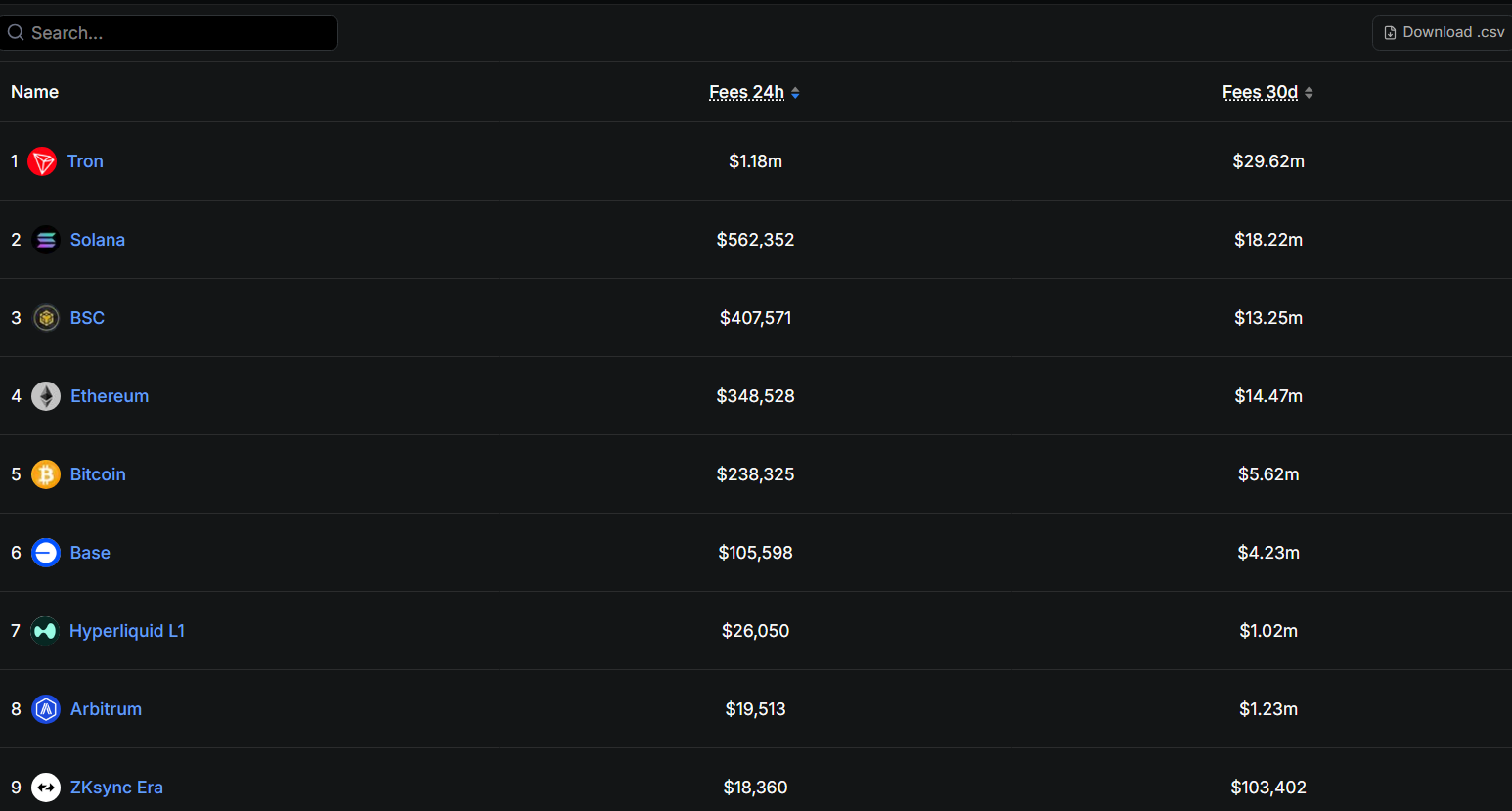
Topping the chart is Tron, with average daily fees as high as $1.24 million. In the eyes of many elitists, Tron might hardly be considered "technical." But the market has given the ultimate answer by voting with its feet: payments are a rigid demand. Tron carries the vast majority of the global on-chain transfer demand for USDT. In this industry full of speculation and bubbles, Tron has inadvertently become the only payment layer application with mass adoption—even if it merely serves as a shadow banking channel for fiat currencies.

One could say: payments, the oldest and most basic internet need, are currently the only mass adoption in the Crypto world. Tron's success is a powerful mockery of all project teams that pursue "perfect technology" while ignoring "real demand."

Close behind is Solana, with nearly $600,000 in average daily fees. Its success logic is even more straightforward: it is the world's most active on-chain casino. Meme coins, high-frequency DEX trading, front-running—these activities contribute the vast majority of the fees. Solana's moat is no longer TPS, but "attention traffic." The rise of Base is even more disruptive (approx. $105k daily): it proves that distribution channels are far more important than the technology itself. Backed by Coinbase's huge user base, Base delivers a dimensional打击 to other L2s.

This provides a brutal yet clear revelation: the current Crypto market has only two and a half business models that are verified and can generate large-scale on-chain fees—low-cost payments (Tron), high-frequency speculation (Solana/Base), and the asset settlement layer (Ethereum), which is being constantly eroded by L2s.

Beyond these, those once highly anticipated "enterprise-level applications," "supply chain traceability," and "Web3 social" have, in the face of cold on-chain fee data, at least at this stage, not yet demonstrated规模化付费 demand.

III. The VC Syndicate Dilemma: Why "Peak at Launch"?

This data also reveals another deep crisis: the narrative model for new L1/L2s driven by massive venture capital (VC) financing is facing a brutal reality check regarding monetization.

We see that new public chains like Sui (~$12k daily), Sei (~$320 daily), Starknet (~$10k daily), which launched with great fanfare and raised hundreds of millions or even billions of dollars, have severely inverted链上手续费收入 compared to their fully diluted valuations (FDV) of tens or hundreds of billions.

The standard playbook of the past few years has been: VC investment -> team piles on technical highlights -> attract airdrop farmers to刷取数据 -> token lists on exchanges creating wealth -> retail investors buy into the narrative -> airdrop farmers撤离 -> on-chain activity data plummets.

This is why many new chains have astonishing TPS and hundreds of thousands of daily active users at launch, only to quickly become "ghost towns" months later. Because those users are mercenaries, not residents. When airdrop expectations are realized, when incentive subsidies stop, the real, organic demand is exposed for what it is—daily fee revenues of a few thousand or tens of thousands of dollars simply cannot support billion-dollar valuation dreams.

We are facing severe "block space inflation." The industry has built too many chains, too many L2s, too many data availability (DA) layers, but innovation at the application layer is extremely scarce. This is like狂热ly laying成千上万条光纤 in the early days of broadband internet普及, before Netflix, YouTube, or any killer app that must use this bandwidth has been born.

IV. Investor Awakening: From "Listening to Stories" to "Checking the Books"

For a long time, the valuation logic of the crypto market was built on "dream multiples." The grander the narrative, the richer the imagination, the higher the market cap could fly.

But 2024-2025 is becoming a watershed. As macro liquidity tightens and institutional investors demand more substantial returns, the market is being forced to return to rationality.

For investors, the logic must change:

  1. Beware of "Zombie Coins": If a project has a market cap of billions but daily on-chain fees of only a few hundred or thousand dollars, this extreme "unworthiness" is often the starting point for a long-term decline. Its only support—community faith—will eventually run out.

  2. Focus on "Positive Cash Flow" Ability: Look for ecosystems where users are willing to持续付费 for services even without token incentives. Tron's stablecoin transfer fees, Base and Solana's transaction fees are direct reflections of real demand.

  3. Acknowledge "Channels and Ecosystems are King": Base's success proves that pure technical advantages can hardly be a moat anymore. Giants entering with massive user bases (like Coinbase), or native communities that can breed狂热 cultures, are more valuable assets at the current stage. Purely technical public chains, if they cannot solve the "who will use it and why" problem, will ultimately become Algorand-style academic exhibits.

  4. See Through the VC Game: Stop paying for虚假繁荣 driven by subsidies and airdrops.

Faced with the harsh reality of $17 daily revenue, rather than paying for grand narratives and empty "digital ghost cities," it's better to tighten your purse strings and turn to the few ecosystems that can generate real cash flow and have active paying users.

This is not a denial of the long-term value of all technological exploration, but a necessary清算 of the current畸形的 valuation system. Only when the market learns to pay for "value actually generated," rather than透支 for "stories promised in the future," can this industry usher in a truly healthy dawn.

Important Notes and Evaluation Framework

The core of this article is to use "on-chain fees" as a unified, public ruler to measure the "immediate value capture ability" of various public chains. When reading and citing the conclusions of this article, please be sure to understand the following key background and limitations:

1. General Background Notes

  • Development Stage Differences: Some public chains may be technologically advanced but in their early stages, with a user base not yet formed for scale effects. The data in this article reflects the "current state," not the "ultimate potential."

  • Impact of Fee Models: Some public chains are designed to pursue ultra-low transaction fees (Gas Fee), and their native token prices are low. This means that even if the number of on-chain transactions is considerable, the "total fee revenue" denominated in USD appears tiny. This suggests that evaluating such chains should combine metrics like transaction count and active address number for a comprehensive judgment, but the upper limit of their USD-denominated economic throughput remains an objective fact.

2. Evaluation Notes for Specific Types of Chains

For a fairer discussion, we provide the following evaluation ideas for specific types of projects:

Chain Type This Article's Evaluation & Suggestion
Storage/Service Networks

(e.g., Filecoin, Arweave)

There is indeed a difference in口径. The core value of these networks lies in storage/retrieval services, and their revenue model differs from单纯 transaction fees. DeFiLlama's "Fees" metric may severely underestimate their actual commercial activity. If you are an investor, you should be on their storage market capacity, active交易订单, and real storage revenue streams.
Off-Chain/Consortium Business-Driven Public Chains

(e.g., some enterprise chains)

Data has limitations. DeFiLlama only statistics public on-chain activity, a point BlockWeeks fully agrees with. But we同样疑惑, if the main value of a public chain is not reflected on-chain, then what supports the market cap of its publicly issued tokens used for on-chain governance and security?
Technical Low-Fee/High-TPS Public Chains The design初衷 is good. However, extremely low per-transaction fees mean the value captured by the chain itself and validators is extremely low. The success of this model must rely on extremely high transaction volume to compensate for the low price disadvantage. If low fees fail to attract massive transactions, its economic model may face challenges.
Chains with Ecosystem Traffic Concentrated on CEXs Hard to evaluate. If a public chain's on-chain economic activity is weak and cannot generate sufficient fees, then its practical value and value capture ability as a "decentralized settlement layer" or "smart contract platform" are low. Its value may be closer to a单纯的 "digital collectible."

We始终 believe that in a world of highly concentrated profits, projects in the long tail are almost sentenced to fate unless they find unique application scenarios (like gaming or specific AppChains). Only platforms that can generate cash flow through real, sustained user demand have the potential to survive long-term and outperform the market.


Twitter:https://twitter.com/BitpushNewsCN

Bitpush TG Discussion Group:https://t.me/BitPushCommunity

Bitpush TG Subscription: https://t.me/bitpush

Original Link:https://www.bitpush.news/articles/7596644

Связанные с этим вопросы

QWhat is the core metric used in the article to evaluate the health and value capture of public blockchains?

AThe article uses on-chain fees (total fees paid by users) as the core metric, sourced from DeFiLlama's 'Fees / Revenue by Chain' dashboard, to measure the scale of economic activity and value capture.

QAccording to the article, which blockchain has the highest daily on-chain fees, and what is the primary use case driving this activity?

ATron (TRX) has the highest daily on-chain fees at $1.24 million, driven primarily by its role as a low-cost payment layer for USDT stablecoin transfers, serving as a 'shadow banking channel'.

QWhat does the example of Algorand's $17 daily fee revenue illustrate about the current state of many 'classic' public blockchains?

AAlgorand's $17 daily fee revenue, despite its multi-billion dollar valuation and advanced technology, illustrates that many 'classic' public blockchains have become 'zombies'—they lack real, sustained application demand and their economic value capture is nearly zero, making them like 'luxury empty cities in the desert'.

QWhat are the two and a half business models that the article states have been validated to generate large-scale on-chain fees?

AThe two and a half validated business models are: 1. Low-cost payments (exemplified by Tron), 2. High-frequency speculation/gambling (exemplified by Solana and Base), and the half being the asset settlement layer (exemplified by Ethereum, which is being constantly eroded by L2s).

QWhat major shift in investor logic does the article suggest is happening in the 2024-2025 market?

AThe article suggests a shift from valuing projects based on grand narratives and 'dream ratios' to a more rational approach that focuses on 'checking the books'—prioritizing real cash flow-generating ability, active paying users, and avoiding 'zombie coins' with massive valuations but minuscule on-chain revenue.

Похожее

Breaking: OpenAI Undergoes Major Reorganization, President Brockman Assumes Command

OpenAI has announced a major internal reorganization just months before its anticipated IPO. The company is merging its three flagship product lines—ChatGPT, Codex, and the API platform—into a single, unified product organization. The most significant leadership change involves co-founder and President Greg Brockman moving from a background technical role to take full, permanent control over all product strategy. This follows the indefinite medical leave of AGI Deployment CEO Fidji Simo. Additionally, ChatGPT's longtime lead, Nick Turley, has been reassigned to enterprise products, with former Instagram executive Ashley Alexander taking over consumer offerings. The consolidation, internally framed as a strategic move towards an "Agentic Future," aims to break down internal silos and create a cohesive "Super App." This planned desktop application would integrate ChatGPT's conversational abilities, Codex's coding power, and a rumored internal web browser named "Atlas" to autonomously perform complex user tasks. The reorganization occurs amid significant internal and external pressures. OpenAI has recently seen a wave of high-profile departures, including Sora co-lead Bill Peebles and other senior technical leaders, leading to concerns about a thinning executive bench. Externally, rival Anthropic recently secured funding at a staggering $900 billion valuation, surpassing OpenAI's own. Google's upcoming I/O developer conference also poses a competitive threat. Analysts suggest the dramatic restructure is a pre-IPO move to present a clearer, more focused narrative to Wall Street—streamlining operations and demonstrating decisive leadership under Brockman to counter internal turbulence and intense market competition.

marsbit3 ч. назад

Breaking: OpenAI Undergoes Major Reorganization, President Brockman Assumes Command

marsbit3 ч. назад

Two Survival Structures of Market Makers and Arbitrageurs

Market makers and arbitrageurs represent two distinct survival structures in high-frequency trading. Market makers primarily use limit orders (makers) to profit from the bid-ask spread, enjoying high capital efficiency (nominally 100%) but bearing inventory risk. This "inventory risk" arises from passive, fragmented, and discontinuous order fills in the limit order book (LOB). This risk, while a potential cost, can also contribute to excess profit if managed within control boundaries, allowing for mean reversion. Market makers essentially sell "time" (uncertainty over execution timing) to the market for price control and low fees. In contrast, cross-exchange arbitrageurs typically use market orders (takers) to exploit price differences or funding rates, resulting in lower nominal capital efficiency (requiring capital on both exchanges) and higher transaction costs. Their risk exposure stems from asymmetries in exchange rules (e.g., minimum order sizes), execution latency, and infrastructure risks (e.g., ADL, oracle drift). These exposures are active, exogenous gaps that primarily erode profits rather than contribute to them. Arbitrageurs essentially sell "space" (capital sunk across venues) for localized, immediate certainty. Both strategies engage in a trade-off between execution friction and residual risk. Optimal systems allow for temporary, controlled risk exposure rather than enforcing zero exposure at all costs. Their evolution converges towards hybrid models: arbitrageurs may use maker orders to reduce costs, while market makers may use taker orders or hedges for risk management. Ultimately, both use different forms of risk exposure—market makers exposing inventory, arbitrageurs immobilizing capital—to extract marginal, hard-won certainty from the market.

链捕手3 ч. назад

Two Survival Structures of Market Makers and Arbitrageurs

链捕手3 ч. назад

Who Will Define the Rules of the AI Era? Anthropic Discusses the 2028 US-China AI Landscape

This article, based on Anthropic's analysis, outlines the intensifying systemic competition between the U.S./allies and China for AI leadership by 2028. It argues that access to advanced computing power ("compute") is the critical bottleneck, where the U.S. currently holds a significant advantage through chip export controls and allied innovation. However, China's AI labs remain competitive by exploiting policy loopholes—via chip smuggling, overseas data center access, and "model distillation" attacks to copy U.S. model capabilities—keeping them close to the frontier. The piece presents two contrasting scenarios for 2028. In the first, decisive U.S. action to tighten compute controls and curb distillation locks in a 12-24 month AI capability lead, cementing democratic influence over global AI norms, security, and economic infrastructure. In the second, policy inaction allows China to achieve near-parity through continued access to U.S. technology, enabling Beijing to promote its AI stack globally and integrate advanced AI into its military and governance systems, altering the strategic balance. Anthropic contends that maintaining a decisive U.S. lead is essential for shaping safe AI development and governance. The core recommendation is for U.S. policymakers to urgently close compute and model access loopholes while promoting global adoption of the U.S. AI technology stack to secure a lasting strategic advantage.

marsbit5 ч. назад

Who Will Define the Rules of the AI Era? Anthropic Discusses the 2028 US-China AI Landscape

marsbit5 ч. назад

Торговля

Спот
Фьючерсы

Популярные статьи

Как купить HPP

Добро пожаловать на HTX.com! Мы сделали приобретение House Party Protocol (HPP) простым и удобным. Следуйте нашему пошаговому руководству и отправляйтесь в свое крипто-путешествие.Шаг 1: Создайте аккаунт на HTXИспользуйте свой адрес электронной почты или номер телефона, чтобы зарегистрироваться и бесплатно создать аккаунт на HTX. Пройдите удобную регистрацию и откройте для себя весь функционал.Создать аккаунтШаг 2: Перейдите в Купить криптовалюту и выберите свой способ оплатыКредитная/Дебетовая Карта: Используйте свою карту Visa или Mastercard для мгновенной покупки House Party Protocol (HPP).Баланс: Используйте средства с баланса вашего аккаунта HTX для простой торговли.Третьи Лица: Мы добавили популярные способы оплаты, такие как Google Pay и Apple Pay, для повышения удобства.P2P: Торгуйте напрямую с другими пользователями на HTX.Внебиржевая Торговля (OTC): Мы предлагаем индивидуальные услуги и конкурентоспособные обменные курсы для трейдеров.Шаг 3: Хранение House Party Protocol (HPP)После приобретения вами House Party Protocol (HPP) храните их в своем аккаунте на HTX. В качестве альтернативы вы можете отправить их куда-либо с помощью перевода в блокчейне или использовать для торговли с другими криптовалютами.Шаг 4: Торговля House Party Protocol (HPP)С легкостью торгуйте House Party Protocol (HPP) на спотовом рынке HTX. Просто зайдите в свой аккаунт, выберите торговую пару, совершайте сделки и следите за ними в режиме реального времени. Мы предлагаем удобный интерфейс как для начинающих, так и для опытных трейдеров.

147 просмотров всегоОпубликовано 2026.04.29Обновлено 2026.04.29

Как купить HPP

Что такое GENIUS

I. Введение в проект1. Что такое Genius?Genius (GENIUS) позиционируется как «конечный терминал на блокчейне», децентрализованная торговая платформа, ориентированная на конфиденциальность и скорость. Интегрируя технологии конфиденциальности высшего уровня, она стремится создать инфраструктуру торговли с конфиденциальностью нового поколения на таких сетях, как BNB Chain, позволяя пользователям взаимодействовать на блокчейне с бесшовным опытом, сопоставимым с централизованными биржами.2. Как работает Genius?Основная техническая архитектура Genius структурирована следующим образом:(1) Невидимость для цепочки: Пользователям не нужно вручную обрабатывать многоступенчатые одобрения для кросс-цепочных операций, упаковки активов или сложного управления газом.(2) Торговля без подписи: Благодаря интеграциям, таким как Turnkey, Genius позволяет мгновенно торговать без всплывающих подтверждений или авторизации на каждую транзакцию.(3) Аггрегатор аггрегаторов: Genius работает на основе лучшего в своем классе стека агрегации, интегрированного с более чем 150 DEX, утверждая о превосходной эффективности котировок по сравнению с конкурентными продуктами.(4) Управление аккаунтом: Платформа использует некастодиальную архитектуру и использует Turnkey и Lit Protocol для управления ключами, позволяя пользователям безопасно получать доступ к своим аккаунтам через пасскоды.3. Кто создал Genius?Согласно официальным Условиям обслуживания, Genius был разработан компанией Shuttle Labs, Inc. На основе официального аккаунта проекта в X, Райан Майер является одним из ключевых участников, способствующих итерации продукта, включая разработки, такие как внедрение протокола Ghost, а также более широкое вовлечение сообщества.Основатель Binance CZ официально присоединился к проекту в качестве советника с целью помочь команде создать более быструю и конфиденциальную торговлю на блокчейне.Кроме того, проект получил сильную поддержку от YZi Labs, которая инвестировала в Genius и работает вместе с Фондом Genius, ответственным за поддержание основного Протокола Моста Genius (GBP).4. Токеномика GeniusGENIUS — это родной токен экосистемы Genius. На данный момент проект не выпустил полный документ по токеномике.Согласно последним официальным раскрытиям, Genius включает дефляционный механизм, и 4,6% от общего объема токенов уже было сожжено в ходе ранней фазы запуска.Система Genius Points (GP):(1) Торговля за вознаграждение: Платформа создала пул вознаграждений в 200 миллионов Genius Points, и пользователи зарабатывают GP за каждую сделку, выполненную через терминал.(2) Уровни и значки: Genius предлагает систему значков на основе прогрессии от Умного до Бога, с более высокими уровнями, открывающими дополнительные привилегии и преимущества.(3) Родной доход: Пользователи, держащие определенные активы, такие как usdGG на панели управления, могут зарабатывать родной доход напрямую, не проходя через сложное стекинг.(4) Реферальные стимулы: Рефереры могут зарабатывать возвраты комиссии более 45%, выплачиваемые в USDC, а также дополнительные GP.5. Хронология и ключевые вехиМарт 2020: Официальный аккаунт проекта в X был создан, что ознаменовало начало его ранней подготовительной фазы.13 января 2026: Genius объявил о многомиллионной инвестиции от YZi Labs и одновременно подтвердил CZ в качестве советника для ускорения создания своей инфраструктуры торговли с конфиденциальностью.18 апреля 2026: Проект объявил, что протокол конфиденциальности Ghost будет запущен в ближайшее время.29 апреля 2026: Протокол Ghost официально открылся для первых 50 тестеров, что ознаменовало начало новой эры для торговли с конфиденциальностью на BNB Chain. В то же время команда подтвердила, что 4,6% токенов были сожжены.​II. Информация о токенах1) Основная информацияНазвание токена: GENIUS (Genius)III. Связанные ссылкиВебсайт: https://www.tradegenius.com/homeЭксплореры: https://bscscan.com/address/0x1f12b85aac097e43aa1555b2881e98a51090e9a6Социальные сети: https://x.com/GeniusTerminalПримечание: Введение в проект основано на материалах, опубликованных или предоставленных официальной командой проекта, и предназначено только для справки и не является инвестиционной рекомендацией. HTX не несет ответственности за любые прямые или косвенные убытки, возникшие в результате этого.

251 просмотров всегоОпубликовано 2026.04.29Обновлено 2026.05.12

Что такое GENIUS

Как купить GENIUS

Добро пожаловать на HTX.com! Мы сделали приобретение Genius (GENIUS) простым и удобным. Следуйте нашему пошаговому руководству и отправляйтесь в свое крипто-путешествие.Шаг 1: Создайте аккаунт на HTXИспользуйте свой адрес электронной почты или номер телефона, чтобы зарегистрироваться и бесплатно создать аккаунт на HTX. Пройдите удобную регистрацию и откройте для себя весь функционал.Создать аккаунтШаг 2: Перейдите в Купить криптовалюту и выберите свой способ оплатыКредитная/Дебетовая Карта: Используйте свою карту Visa или Mastercard для мгновенной покупки Genius (GENIUS).Баланс: Используйте средства с баланса вашего аккаунта HTX для простой торговли.Третьи Лица: Мы добавили популярные способы оплаты, такие как Google Pay и Apple Pay, для повышения удобства.P2P: Торгуйте напрямую с другими пользователями на HTX.Внебиржевая Торговля (OTC): Мы предлагаем индивидуальные услуги и конкурентоспособные обменные курсы для трейдеров.Шаг 3: Хранение Genius (GENIUS)После приобретения вами Genius (GENIUS) храните их в своем аккаунте на HTX. В качестве альтернативы вы можете отправить их куда-либо с помощью перевода в блокчейне или использовать для торговли с другими криптовалютами.Шаг 4: Торговля Genius (GENIUS)С легкостью торгуйте Genius (GENIUS) на спотовом рынке HTX. Просто зайдите в свой аккаунт, выберите торговую пару, совершайте сделки и следите за ними в режиме реального времени. Мы предлагаем удобный интерфейс как для начинающих, так и для опытных трейдеров.

207 просмотров всегоОпубликовано 2026.04.29Обновлено 2026.05.12

Как купить GENIUS

Обсуждения

Добро пожаловать в Сообщество HTX. Здесь вы сможете быть в курсе последних новостей о развитии платформы и получить доступ к профессиональной аналитической информации о рынке. Мнения пользователей о цене на A (A) представлены ниже.

活动图片