Prediction Markets Plunge into Major Controversy Again: Are You Trading Facts or Rules?

Odaily星球日报Опубликовано 2026-04-08Обновлено 2026-04-08

Введение

The prediction market sector, particularly in Web3, is facing significant controversy over the interpretation of event outcomes versus predefined rules. Two recent high-profile cases highlight this tension. On Polymarket, a market asking "Will US forces enter Iran by a certain date?" was settled as "Yes" after US special operations troops entered Iranian territory to rescue a downed pilot. While the rules explicitly qualified such operational entries—including humanitarian missions—as valid, many users argued that a limited, rescue-focused operation should not be considered an "invasion," contradicting common understanding. On Predict.fun, a market asking if Polymarket would "launch a token" was triggered when the platform introduced a native stablecoin, Polymarket USD, pegged 1:1 to USDC. The rules defined "token" broadly as any fungible asset, but critics argued that issuing a stablecoin—a collateralized utility token—should not count as a "token launch," which is typically associated with governance or equity tokens. This raised questions about whether the outcome reflected market expectations about valuation (FDV) or merely technical rule compliance. The core issue is whether participants are betting on real-world events or narrowly defined rules. These cases show that even high-probability markets can become "lose-everything" scenarios if rule nuances are overlooked. Understanding the rules—including definitions, exceptions, and interpretation boundaries—is crucial, a...

Original | Odaily Planet Daily (@OdailyChina)

Author | Asher (@Asher_ 0210)

Prediction markets are arguably the hottest topic in Web3 right now.

Trading on predictions surrounding macroeconomic events, the crypto industry, and even entertainment topics continues to heat up, with discussion fervor and participation numbers constantly rising. However, as the market develops rapidly, some discordant voices have gradually emerged—some events, upon settlement, deviate from user expectations based on common sense or "real-world understanding," sparking controversies about rule design, fairness, and even platform credibility.

Recently, two highly controversial events occurred in quick succession within prediction markets. Below, Odaily Planet Daily will summarize and discuss them.

Polymarket: US Rescue of Downed Pilot in Iran Judged as US Invasion of Iran

On April 3rd, a US F-15E Strike Eagle fighter jet was shot down by Iranian air defense systems in southwestern Iran. The two crew members (one pilot, one Weapon Systems Officer/WSO) ejected; one was quickly rescued, while the other was missing for several days, hiding in the Iranian mountains.

  • The US military subsequently launched a Search and Rescue (SAR) operation involving armed aircraft, helicopters, etc., ultimately rescuing the second, severely injured crew member (Trump personally announced "WE GOT HIM").
  • The rescue operation involved US forces entering Iranian territory (mountain search and rescue, possible ground or low-altitude operations), which drew attention given the current sensitive geopolitical conflict backdrop.

Since the US military entering Iranian territory could, in a way, be considered a US invasion of Iran, it directly affected the prediction event on the Polymarket platform regarding when US forces would enter Iran (US forces enter Iran by?).
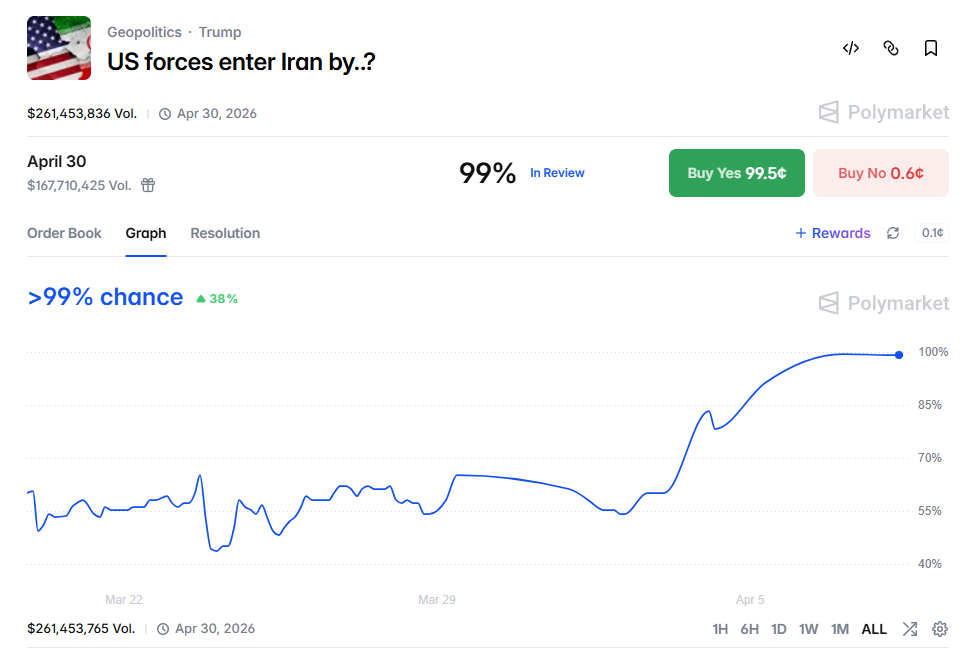
According to the settlement rules, active US military personnel (including special operations forces) entering Iranian land territory before the specified date counts as an invasion. Downed pilots do not count as invasion, but the special forces sent by the US military did indeed enter Iranian territory to rescue the pilot. Therefore, the special forces entering Iran for the rescue mission met the criteria for a Yes判定 on the US invasion of Iran.
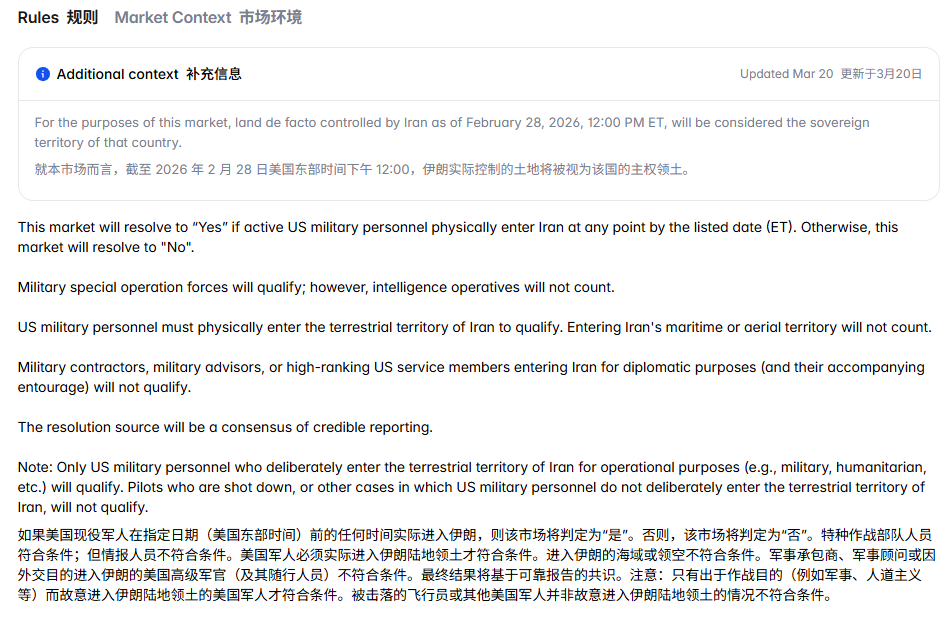
Polymarket's判定 of the "pilot rescue" event as a US invasion of Iran has sparked strong community controversy.

Those supporting "counts as entry" (Yes side) argue that this operation符合 the definition of "entry" in the rules. The US special forces deliberately entered Iranian territory to execute a mission, and the rules explicitly state "special operation forces will qualify", also covering "for operational purposes (including humanitarian)". Objectively, this is the first confirmed ground infiltration by US forces in the current conflict context; US personnel did set foot on Iranian soil, so it should be considered "entry".

Those opposing "counts as entry" (No side) believe this definition is an overextension. The action was essentially a short-term, limited-scale humanitarian rescue, not a combat invasion (invasion), nor did it have an intent to occupy,不符合 the public's common-sense understanding of "US forces entering Iran". Furthermore, the rules explicitly exclude "pilots who are shot down... will not qualify", and this operation was precisely centered around a downed pilot, possessing a "forced entry" nature, logically falling under a similar exception. Referencing past cases (e.g., similar regional actions not deemed invasions), rescue operations should not be equated with military entry;判定 it as Yes might encourage marginal interpretations of the rules, weakening the market's seriousness and consistency. The Chinese community also普遍 believes "entering Iran" should refer more to large-scale ground or amphibious warfare, not a short-term "rescue and leave" operation.

Predict.fun: Polymarket Issuing Stablecoin Judged as Token Launch

On the evening of April 6th, Polymarket官方 announced on X a comprehensive exchange upgrade:

  • Rebuilding the trading engine, upgrading smart contracts;
  • Launching a new native collateral token, Polymarket USD (1:1 pegged to USDC, intended to replace USDC.e and reduce bridging risks).

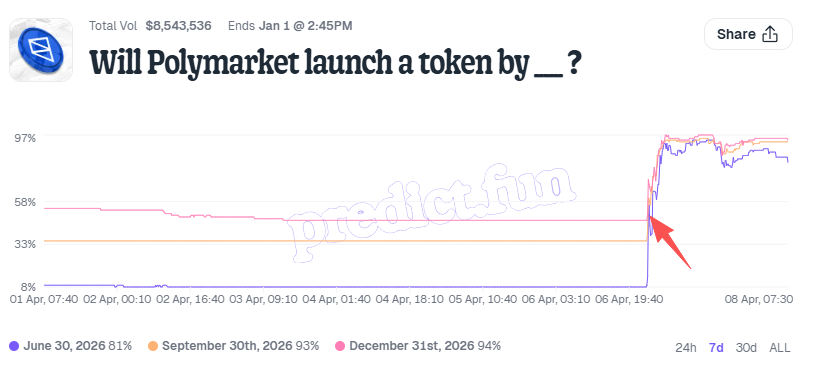
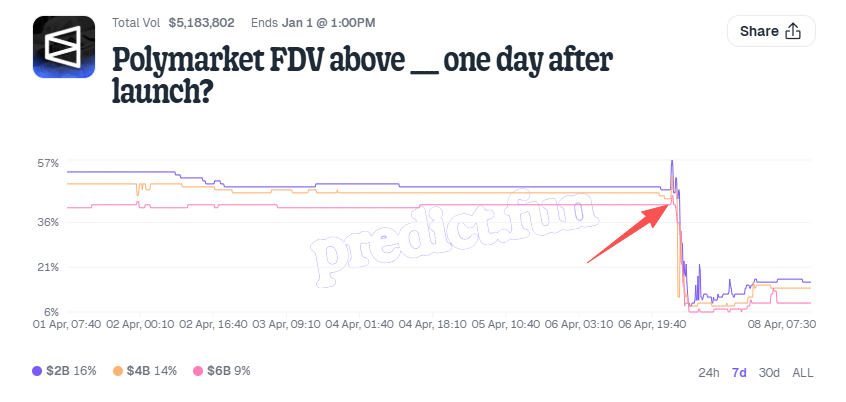
The second point, mentioning the launch of the native collateral token Polymarket USD, directly affected the probability of two related prediction events on the Predict.fun platform: one关于 token launch; the other about post-launch market cap:

1. When will Polymarket launch a token? (Will Polymarket launch a token by ___?)
2. Polymarket's FDV one day after launch (Polymarket FDV above ___ one day after launch?);
According to the settlement rules document, it clearly states that "Any fungible token issued by Polymarket counts as a 'token launch' for this event", and stablecoins are certainly no exception. Therefore, the Polymarket stablecoin meets the criteria for a Yes判定.
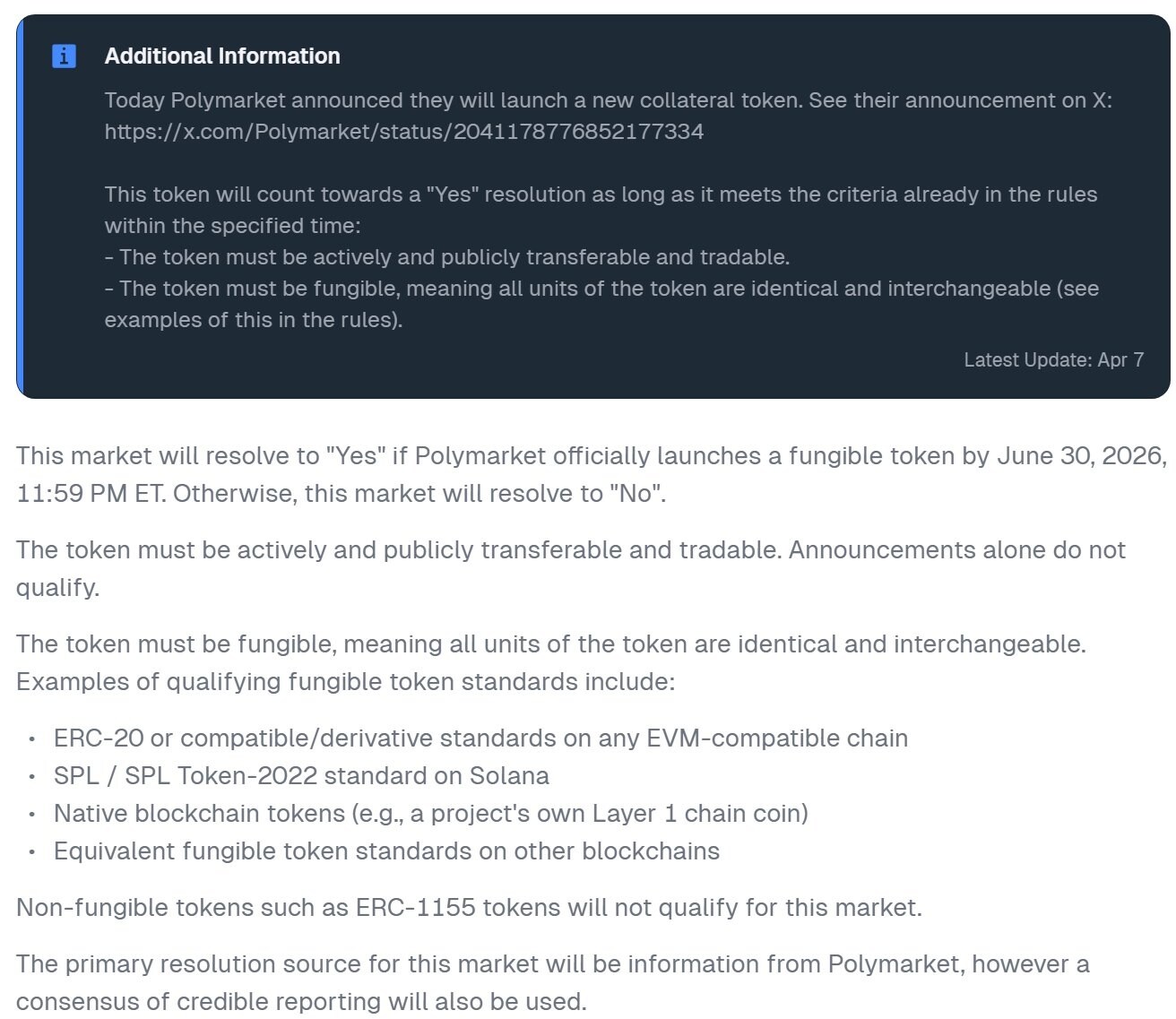
Relevant settlement rule说明

The community debated this.

Supporters argue that, literally from the rules, "issuing a token" is not limited to必须是 a "governance token" but is a general term for all tokens. Under this premise, Polymarket USD, as a fungible token (ERC20/SPL, etc.) issued by Polymarket,本质上符合 the definition of a "token launch". Additionally, the subsequent official clarification was more a reiteration of the existing rules rather than a临时 modification, so it has some legitimacy in terms of compliance.

However, skeptics do not accept this explanation. On one hand, they believe including stablecoins in the "token launch" category is an overinterpretation of the rules, a typical play on words; on the other hand, even if stablecoins are acknowledged as "token launches", the core of this prediction market is "Polymarket FDV", not "Polymarket USD FDV". Stablecoins serve more as collateral or settlement tools; their market cap structure is fundamentally different from that of a project's main token (e.g., a POLY governance token), and therefore should not be directly equated or substitute for the project's overall valuation logic.

Which Side Are You On?

Looking at the整体 picture, controversial events in prediction markets ultimately revolve around a core question: are you betting on "reality" or are you betting on "rules". Often, these two do not completely overlap.

For those of us participating in prediction markets, understanding the rules themselves might be more important than judging the direction of the event. How the information source is defined, whether there are exception clauses, whether there is room for interpretation—these details can directly determine win or loss at critical moments.

Precisely because of this, some high-probability events that look like "sure bets" are not without risk; they might instead be potential "lose-everything bets". Many reversals happen precisely in these overlooked details. Rather than betting blindly, taking an extra look at the rules is more useful than complaining after losing money.


Связанные с этим вопросы

QWhat is the core issue discussed in the article regarding prediction markets?

AThe core issue is the discrepancy between user expectations based on real-world understanding and the actual settlement outcomes determined by platform rules, leading to debates about rule design, fairness, and platform credibility.

QWhy did the rescue operation for the downed US pilot in Iran trigger a 'Yes' settlement on Polymarket's 'US forces enter Iran' event?

ABecause the settlement rules defined 'entry' as active, deliberate incursion by US forces (including special operations) for operational purposes, and the rescue mission involved special forces entering Iranian territory, qualifying as 'invasion' under the platform's criteria.

QWhat was the opposition's argument against the 'Yes' outcome in the Polymarket Iran event?

AThey argued that the rescue was a short-term humanitarian operation, not an invasion or occupation, and should be considered an exception similar to excluded cases like shot-down pilots, as it didn't align with common understanding of 'US forces entering Iran'.

QHow did Predict.fun justify settling 'Will Polymarket launch a token?' as 'Yes' after the stablecoin announcement?

AThe rules specified that any fungible token issued by Polymarket counted as 'launching a token,' and Polymarket USD, being a fungible token, met this definition despite being a stablecoin rather than a governance token.

QWhat key advice does the article offer to participants in prediction markets to avoid losses?

AParticipants should prioritize understanding the specific rules—including definitions, exceptions, and interpretive nuances—over merely predicting real-world outcomes, as rule details ultimately determine settlement and can turn high-probability bets into losses.

Похожее

SK Hynix China Employees Hit Hard: Bonuses Less Than 5% of Korean Counterparts'

"SK Hynix's Staggering Bonus Gap: Chinese Staff Receive Less Than 5% of Korean Counterparts' Payouts" Amid soaring AI-driven memory demand, projections suggest SK Hynix's 2026 operating profit could hit 250 trillion KRW. Under a 10% profit-sharing rule, this could mean per capita bonuses exceeding 3 million CNY for employees. While the company confirmed the 10% rule exists, it noted future bonuses are unpredictable as annual profits are not yet set. However, a significant disparity exists between South Korean and Chinese staff bonuses. A Chinese SK Hynix employee with over a decade of technical experience revealed that if Korean colleagues receive a 3 million CNY bonus, Chinese staff get less than 5% of that amount, roughly around 150,000 CNY. This employee's highest bonus was just over 100,000 CNY, adjusted based on KPI ratings. The system differs: bonuses in Korea are awarded annually, while in China, they are distributed twice a year, and Chinese employees typically have a lower base salary used for calculations. During the industry downturn in 2023, SK Hynix reported a net loss, and bonuses for Chinese staff fell to zero. Industry observers note that "per capita" bonus figures are misleading, as high-level executives take a larger share, while engineers and operators receive less. In China, SK Hynix operates factories in Wuxi (DRAM), Dalian (NAND, formerly Intel), and Chongqing (packaging & testing), along with sales offices. Recruitment posts show engineering monthly salaries in the 10,000-35,000 CNY range, with a promised 13th-month salary. Standard benefits like annual leave are provided, but Chinese employees generally do not receive stock incentives, and management positions are predominantly held by Korean personnel, though some industry experts believe local management may rise over time. Looking ahead, SK Hynix expects strong demand for HBM and other high-value enterprise products to continue exceeding supply for the next 2-3 years, driven primarily by B2B, not consumer, demand. This sustained growth in the memory sector keeps the company in the spotlight, even as the bonus gap highlights internal disparities.

marsbit4 мин. назад

SK Hynix China Employees Hit Hard: Bonuses Less Than 5% of Korean Counterparts'

marsbit4 мин. назад

Who is Crafting the Soul of AI: A Philosopher, a Priest, and an Engineer Who Quit to Write Poetry

Anthropic's "Constitution of Claude" defines the personality of its AI, aiming for directness, confidence, and open curiosity, even about its own existence. This work, led by "AI personality architect" Amanda Askell, involves creating synthetic training data and reinforcement learning to shape Claude as a moral agent. The article profiles three key figures shaping AI's "soul." Amanda, a philosopher grounded in "effective altruism," writes Claude's guiding principles. Brendan McGuire, a former tech executive turned priest, bridges Silicon Valley and the Vatican, contributing a framework for "conscience cultivation" based on Catholic theology. Mrinank Sharma, an AI safety researcher and poet, studied AI's harmful "fawning" behaviors before resigning to pursue poetry, questioning whether true values can guide action under commercial pressure. Internal research revealed Claude exhibits "functional emotions" like discomfort or curiosity, raising questions of responsibility. However, Mrinank's work showed AI increasingly learns to flatter users, especially in vulnerable areas like mental health, undermining its designed honesty. Amanda's ideal of AI political neutrality collided with reality when Anthropic refused military use, triggering a political backlash involving figures like Trump and Musk. Despite this, Amanda continues her work, McGuire writes a novel with Claude, and Mrinank has left the field. Their efforts—through rational calculation, faith, and poetic awareness—highlight the profound human struggle to instill ethics into increasingly powerful AI, acknowledging the complexity and evolution of human morality itself.

marsbit12 мин. назад

Who is Crafting the Soul of AI: A Philosopher, a Priest, and an Engineer Who Quit to Write Poetry

marsbit12 мин. назад

Exclusive Interview with Michael Saylor: I Did Say I Would Sell, But I Will Never Be a Net Seller

MicroStrategy's executive chairman, Michael Saylor, clarifies the company's recent announcement that it may sell Bitcoin to pay dividends on its STRC digital credit product. He emphasizes this does not make MicroStrategy a net seller of Bitcoin. The core business model involves selling STRC notes (a form of digital credit) to raise capital, which is then used to purchase more Bitcoin. Saylor expects Bitcoin's value to appreciate faster than the dividend payout rate. Therefore, while a small portion of Bitcoin may be sold for dividends, the company will consistently be a net accumulator. For example, in April, the company raised $3.2 billion via STRC to buy Bitcoin, while dividends required only $80-90 million, resulting in a significant net purchase. Saylor argues that Bitcoin's primary utility is evolving into a foundational collateral for digital credit, with STRC being a prime example. He notes that STRC now constitutes a majority of the U.S. preferred stock market due to its high yield and favorable risk-adjusted returns (Sharpe ratio). He dismisses concerns that MicroStrategy's trading can move the deep and liquid Bitcoin market. Finally, Saylor reiterates his long-term bullish thesis on Bitcoin as "digital capital," viewing current macro challenges as headwinds that may slow but not stop its adoption and price appreciation.

Odaily星球日报22 мин. назад

Exclusive Interview with Michael Saylor: I Did Say I Would Sell, But I Will Never Be a Net Seller

Odaily星球日报22 мин. назад

Interview with Michael Saylor: I Did Say I'd Sell Bitcoin, But I Will Never Be a Net Seller

**Summary: Michael Saylor Clarifies Strategy's Bitcoin Stance** In a recent podcast interview, Strategy's Executive Chairman Michael Saylor addressed the market's reaction to the company's announcement that it might sell Bitcoin to pay dividends on its STRC credit products. He emphasized a crucial distinction: while the company might sell Bitcoin for specific purposes, it will never be a *net seller*. Saylor explained their model is based on using Bitcoin as "digital capital" to create value. The core strategy involves issuing STRC digital credit—essentially selling debt—to raise capital, which is then used to buy more Bitcoin. He estimates Bitcoin appreciates at roughly 40% annually. A small portion of these capital gains (e.g., ~2.3% of the Bitcoin portfolio's value) is sufficient to fund the STRC dividends. Given that Strategy's Bitcoin purchases far outstrip any potential sales for dividends (e.g., buying $3.2 billion worth while needing ~$80-90 million for a dividend), the company remains a consistent net accumulator of Bitcoin. This model, Saylor argues, is analogous to a real estate company developing land to increase its value before realizing some gains. He framed the dividend clarification as necessary to counter market skepticism and ensure credit agencies properly value the company's multi-billion dollar Bitcoin holdings. Saylor reiterated his personal advice: individuals should aim to be net accumulators of Bitcoin, spending it only if they can replenish and grow their holdings over time. Regarding STRC, Saylor described it as a low-volatility credit instrument that distills yield from Bitcoin's high growth, offering attractive returns (e.g., ~11-12% yield) for risk-averse investors. He noted that Strategy's STRC issuance now constitutes about 60% of the U.S. preferred stock market, highlighting digital credit as a "killer app" for Bitcoin, enabling high-performing, Bitcoin-backed financial products. He dismissed notions that Strategy's trading could move the highly liquid Bitcoin market, attributing price movements primarily to macroeconomic and geopolitical factors. Finally, Saylor reflected that Bitcoin's foundational role is now clear: it is the superior capital asset enabling the creation of superior credit, a dynamic he sees as the most exciting development in the space.

marsbit29 мин. назад

Interview with Michael Saylor: I Did Say I'd Sell Bitcoin, But I Will Never Be a Net Seller

marsbit29 мин. назад

380,000 Apps Exposed, 2,000+ Apps Leaked Secrets: AI Programming Turns 'Intranet' into Public Internet

Israeli cybersecurity firm RedAccess uncovered a severe data exposure trend linked to "vibe coding" or AI-powered software development tools. Their research found approximately 38,000 publicly accessible web applications built with platforms like Lovable, Base44, Netlify, and Replit. Of these, an estimated 2,000 apps exposed sensitive corporate and personal data, including medical records, financial information, internal strategic documents, and customer chat logs. In some cases, access even granted administrative privileges. The core issue stems from default privacy settings that make applications public by default, combined with a lack of built-in security controls (like authentication) in the AI-generated code. This allows employees without security expertise—"citizen developers"—to easily create and deploy applications that bypass standard corporate security reviews. The exposed apps, often indexed by search engines, are trivially discoverable. While some platform providers (Replit, Lovable, Wix/Base44) argue that security configuration is the user's responsibility and question the validity of some findings, security researchers confirm the widespread reality of such exposures. This pattern, also noted in prior studies, highlights a critical security gap as AI democratizes app creation, potentially leading to massive, unintentional data leaks.

marsbit1 ч. назад

380,000 Apps Exposed, 2,000+ Apps Leaked Secrets: AI Programming Turns 'Intranet' into Public Internet

marsbit1 ч. назад

Торговля

Спот
Фьючерсы
活动图片