Polymarket's Departure from Polygon: An Inevitable Choice or a Matter of Timing?

比推Опубликовано 2025-12-23Обновлено 2025-12-23

Введение

Polymarket, a leading prediction market platform, has announced plans to migrate from the Polygon network to its own Ethereum Layer 2 solution, named POLY. This move, driven by both product and economic considerations, aims to provide a more stable and customizable environment for the platform's growth. Key factors behind the decision include Polygon's recent network instability and limitations in supporting Polymarket's expanding scale. By building its own Layer 2, Polymarket can capture more economic value within its ecosystem rather than allowing it to spill over to external networks. Data indicates Polymarket contributed significantly to Polygon’s ecosystem, accounting for roughly a quarter of its total value locked (TVL) and gas consumption. The platform has facilitated over $14.3 billion in historical trading volume and attracted 1.7 million users. The timing of the migration aligns with Polymarket’s upcoming token generation event (TGE), as transitioning post-TGE would be more complex. This shift also allows Polymarket to elevate its valuation by evolving from a single application to a full-stack platform with its own underlying infrastructure. The move reflects a broader trend in crypto where top applications seek greater independence when underlying networks fail to provide sufficient added value.

Author: Azuma

Original Title: The Economic Calculus Behind Polymarket's Exit from Polygon


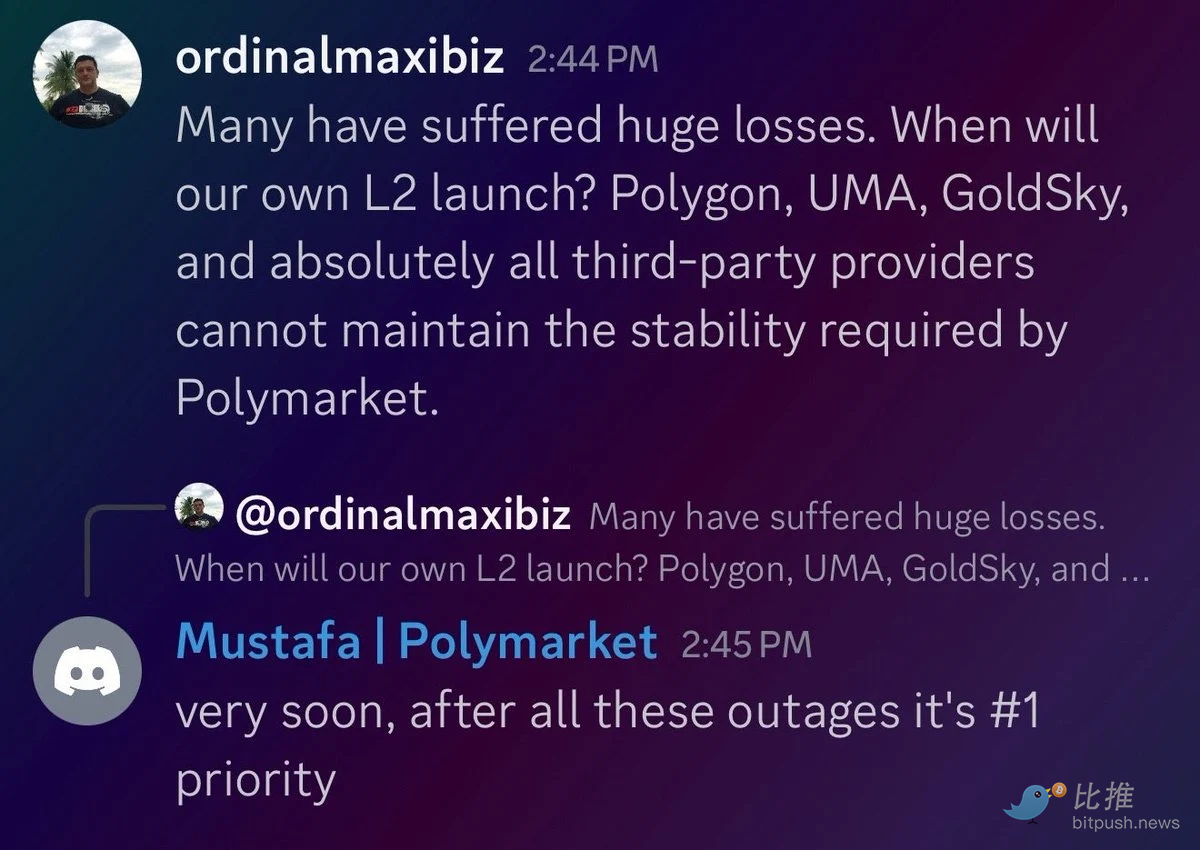
On December 22, news about the leading prediction market platform Polymarket sparked widespread attention—Mustafa, a member of the Polymarket team, confirmed in the Discord community that Polymarket plans to migrate from Polygon and launch an Ethereum Layer2 network named POLY, which is the project's current top priority.

A Not-So-Surprising "Breakup"

Polymarket's decision to leave Polygon is not unexpected. One is a red-hot application-layer star, the other is a gradually declining old infrastructure—the market heat and value expectations between the two have long been mismatched. As Polymarket has grown into a new giant, Polygon's unstable network performance (the latest outage occurred on December 18) and relatively weak ecosystem have objectively become limitations for the former.

For Polymarket, building its own platform represents a win-win choice in both product and economic dimensions.

On the product side, aside from seeking a more stable operating environment, building its own Layer2 network allows Polymarket to tailor the underlying characteristics according to its platform needs, enabling more flexible adaptation for future upgrades and iterations.

The more significant meaning, however, lies in the economic aspect. Building its own network means Polymarket can bring the economic activities and peripheral services derived from its platform into its own system, preventing value from spilling over to external networks and gradually solidifying it into its own systemic advantages.

Explicit and Implicit Economic Contributions

As an application layer, Polymarket's explosive growth once brought substantial direct economic contributions to Polygon. Data compiled by analyst dash on Dune shows:

  • Polymarket's monthly active users this month are 419,309, with a historical total of 1,766,193 users;

  • This month's total transaction count is 19.63 million, with a historical total of 115 million transactions;

  • This month's total transaction volume is $1.538 billion, with a historical total of $14.3 billion.

As for how to assess the proportion of Polymarket's contribution to Polygon's ecosystem economy, Odaily Planet Daily discovered a rather coincidental ratio when compiling data from both.

  • First, regarding deposited funds: Defillama data shows that the total value of positions on the Polymarket platform is currently about $326 million, accounting for about a quarter of Polygon's total value locked (TVL) of $1.19 billion;

  • Second, regarding gas consumption: Coin Metrics reported last October that transactions related to Polymarket were estimated to consume 25% of Polygon's total gas;

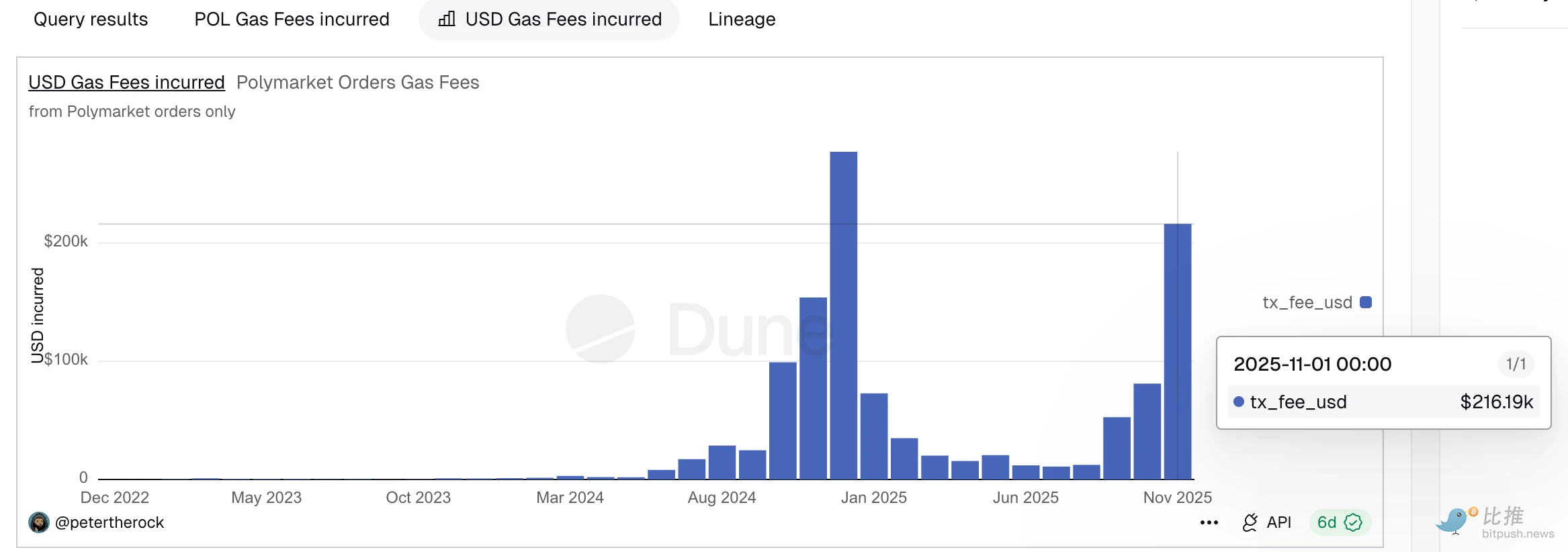
  • Considering this data is somewhat dated, we checked recent changes. Statistics compiled by analyst petertherock on Dune show that in November, transactions related to Polymarket consumed a total of about $216,000 in gas, while Token Terminal statistics show that Polygon's total gas consumption that month was about $939,000—again a ratio close to a quarter (approximately 23%).

While this might be a coincidence due to statistical methods and time windows, the similar results across dimensions can serve as an estimated reference for measuring Polymarket's economic significance to Polygon.

Beyond quantifiable metrics like active users, deposited funds, transaction volume, and gas contributions, Polymarket's economic significance to Polygon also lies in a series of contributions that are harder to measure directly but are equally real.

First is the activation of stablecoin liquidity. All Polymarket transactions are settled in USDC, and its high-frequency, continuous trading behavior objectively significantly increases the circulation demand and usage scenarios for USDC on the Polygon network. Second is the附带 value of retained users' behavior. Beyond the prediction market itself, these users might also turn to using other products on the Polygon ecosystem, such as DeFi, for convenience, thereby enhancing the overall ecological value of the Polygon network. These contributions are difficult to quantify with specific data but constitute the "real demand" that underlying networks value most and find most scarce.

Why Now? The Answer Isn't Hard to Guess

In fact, judging solely by user scale, data performance, and market presence, Polymarket is already fully confident to go independent. This is no longer a question of "should we leave," but rather "when to leave."

The core reason for choosing this particular moment to initiate the migration likely lies in the approaching Polymarket TGE (Token Generation Event). On one hand, once Polymarket completes its token issuance, its governance structure, incentive system, and economic model will become relatively solidified, making the cost and complexity of a subsequent底层 migration significantly higher. On the other hand, upgrading from a "single application" to a "application + infrastructure" full-stack system itself implies a change in valuation logic. Building its own Layer2 undoubtedly opens a higher ceiling for Polymarket in terms of narrative and capital.

In summary, Polymarket's departure from Polygon is essentially not just a simple底层 migration, but a microcosm of structural changes in the crypto industry. When top-tier applications begin to possess the ability to independently carry users, traffic, and economic activities, underlying networks that cannot provide additional value will inevitably be "betrayed."

Nothing more, just profit-seeking nature.


Twitter:https://twitter.com/BitpushNewsCN

Bitpush TG Discussion Group:https://t.me/BitPushCommunity

Bitpush TG Subscription: https://t.me/bitpush

Original link:https://www.bitpush.news/articles/7597879

Связанные с этим вопросы

QWhy is Polymarket migrating from Polygon to its own Layer2 network?

APolymarket is migrating to seek a more stable operating environment, customize the underlying infrastructure to better suit its platform needs, and consolidate economic activities and services within its own ecosystem to prevent value from leaking to external networks.

QWhat economic contributions did Polymarket make to the Polygon ecosystem?

APolymarket contributed significantly to Polygon's economy, accounting for approximately one-quarter of its total value locked (TVL) and gas consumption. It also drove USDC liquidity and user engagement within the Polygon network.

QWhat are the key metrics highlighting Polymarket's user and transaction activity?

AAs of the article, Polymarket had 419,309 monthly active users, 19.63 million monthly transactions, and $1.538 billion in monthly trading volume. Historically, it had over 1.76 million total users and $14.3 billion in total trading volume.

QWhy did Polymarket choose to migrate at this specific time?

AThe migration coincides with Polymarket's impending Token Generation Event (TGE). Moving now avoids higher complexity and costs post-TGE and allows the project to upgrade its valuation narrative by becoming a 'application + infrastructure' full-stack system.

QWhat broader industry trend does Polymarket's migration reflect?

AThe move reflects a structural shift in the crypto industry where top-tier applications, when capable of independently supporting users, traffic, and economic activity, may leave underlying networks if they fail to provide additional value, driven primarily by economic incentives.

Похожее

Bitwise: Crypto Becomes a Contrarian Investment, Three Logics to Understand the Current Market

**Summary** Matt Hougan, Bitwise's CIO, analyzes the current crypto market through three key lenses, arguing it has shifted from a momentum-driven to a contrarian investment. **1) Crypto Becomes a Contrarian Play:** The market is weak, with major assets like Bitcoin and Ethereum down significantly. Capital has moved to hot sectors like AI, leaving crypto as an "unloved" asset class. This transforms crypto investing from trend-following to a test of patience and fundamental analysis. Investors now favor projects with solid fundamentals (e.g., Hyperliquid) over speculative ones. **2) Regulatory Overhang:** The uncertain fate of the U.S. CLARITY Act, a major crypto regulatory framework, is a key headwind. With its passage in 2024 seen as far from guaranteed (estimates range from 30-55%), institutional capital remains on the sidelines, choosing less risky alternatives like AI stocks. The market needs clarity—whether the bill passes or fails—more than any specific outcome to move decisively. **3) Capital Rotates to New Fundamentals:** This cycle differs from past bear markets where money fled to Bitcoin. Now, capital seeks smaller assets with strong use cases. While major cryptos fell in May 2024, tokens like Hyperliquid (+72%), Zcash (+50%), and XLM (+44%) rallied on their specific fundamentals. This rotation confirms the new contrarian, fundamentals-driven logic and signals the bear market may be in its later stages. **Conclusion:** Short-term pressure persists due to regulatory uncertainty and competition from AI narratives. Investing in crypto now requires a contrarian mindset—acting against the crowd and focusing on fundamental value. Patience and targeting high-quality projects based on their merits are essential for capturing long-term gains.

marsbit33 мин. назад

Bitwise: Crypto Becomes a Contrarian Investment, Three Logics to Understand the Current Market

marsbit33 мин. назад

ChatGPT Might Be Disappearing Soon

OpenAI announced at its "Intelligence at Work" event that its coding assistant, Codex, will be fully integrated into the ChatGPT app within weeks. This move marks a strategic shift from a conversational AI (Chat) towards a unified "agentic" platform capable of execution. Codex, originally launched to compete with Anthropic's Claude Code, has grown rapidly to 5 million weekly active users, with 20% being non-developers like analysts and designers. Its enterprise revenue now constitutes 40% of OpenAI's total. The integration is the first step in creating a super-app combining ChatGPT (interface), Codex (execution engine), and the Atlas browser (web access). OpenAI also unveiled new Codex features: specialized Agent plugins for six professional roles, an "Annotations" tool for direct document editing, and a "Sites" function to turn work into shareable web apps. Internally, this reflects a power shift; the Codex team now leads core product strategy. While the ChatGPT brand remains for its vast user base, the platform's future is focused on autonomous agents that perform tasks, not just chat. The article notes that competition with Claude Code pushed OpenAI's development, with Codex competing on cost-effectiveness and accessibility rather than raw coding quality. It concludes that the essence of "ChatGPT" is evolving from a chatbot into an AI agent platform, with the name potentially becoming a legacy symbol of its original function.

marsbit44 мин. назад

ChatGPT Might Be Disappearing Soon

marsbit44 мин. назад

WWDC26 Ultimate Preview: The All-New Siri is the Main Course, iOS 27 is Another Year of Refinements

Apple has confirmed WWDC26 will begin on June 8, with the keynote at 10 AM PT (1 AM Beijing Time, June 9). This year's focus is expected to shift significantly from routine OS updates to Apple's progress in AI, particularly a major overhaul of Siri. Reports indicate the highlight will be a new Siri, reportedly powered by Google's Gemini technology. This upgraded assistant is expected to appear as a lightweight bubble from the Dynamic Island and be accessible via a unified "Search or Ask" system-wide entry point. It aims to deeply integrate with iOS 27, iPadOS 27, and macOS 27, accessing personal data like messages, photos, and documents, with a potential standalone Siri app also in development. For iOS 27, leaks suggest incremental improvements rather than major redesigns. Key updates may include a redesigned, more customizable Camera app, enhanced photo editing tools within the Photos app, and potential early system optimizations for a future foldable iPhone. The update is also rumored to prioritize bug fixes, stability, and performance optimization. iPadOS 27 is anticipated to focus on improving productivity features like window management, file systems, and external display support to better utilize the iPad's hardware. macOS 27 is seen as a core platform for Apple Intelligence, likely receiving an optimized Siri, new AI features, and continued refinement of the "Liquid Glass" design language. Notably, macOS 27 may finally drop support for Intel-based Macs. The overarching theme for WWDC26 is whether Apple can effectively integrate AI across its ecosystem. The success of the new Siri and Apple Intelligence will be judged on their ability to move beyond standalone features and become a cohesive, context-aware system layer that understands user workflows across iPhone, iPad, Mac, and other devices, while maintaining Apple's emphasis on privacy and stability. The conference represents Apple's critical attempt to catch up and redefine the AI assistant experience after a perceived slow start in the generative AI era.

marsbit1 ч. назад

WWDC26 Ultimate Preview: The All-New Siri is the Main Course, iOS 27 is Another Year of Refinements

marsbit1 ч. назад

Торговля

Спот
Фьючерсы

Популярные статьи

Как купить S

Добро пожаловать на HTX.com! Мы сделали приобретение Sonic (S) простым и удобным. Следуйте нашему пошаговому руководству и отправляйтесь в свое крипто-путешествие.Шаг 1: Создайте аккаунт на HTXИспользуйте свой адрес электронной почты или номер телефона, чтобы зарегистрироваться и бесплатно создать аккаунт на HTX. Пройдите удобную регистрацию и откройте для себя весь функционал.Создать аккаунтШаг 2: Перейдите в Купить криптовалюту и выберите свой способ оплатыКредитная/Дебетовая Карта: Используйте свою карту Visa или Mastercard для мгновенной покупки Sonic (S).Баланс: Используйте средства с баланса вашего аккаунта HTX для простой торговли.Третьи Лица: Мы добавили популярные способы оплаты, такие как Google Pay и Apple Pay, для повышения удобства.P2P: Торгуйте напрямую с другими пользователями на HTX.Внебиржевая Торговля (OTC): Мы предлагаем индивидуальные услуги и конкурентоспособные обменные курсы для трейдеров.Шаг 3: Хранение Sonic (S)После приобретения вами Sonic (S) храните их в своем аккаунте на HTX. В качестве альтернативы вы можете отправить их куда-либо с помощью перевода в блокчейне или использовать для торговли с другими криптовалютами.Шаг 4: Торговля Sonic (S)С легкостью торгуйте Sonic (S) на спотовом рынке HTX. Просто зайдите в свой аккаунт, выберите торговую пару, совершайте сделки и следите за ними в режиме реального времени. Мы предлагаем удобный интерфейс как для начинающих, так и для опытных трейдеров.

1.4k просмотров всегоОпубликовано 2025.01.15Обновлено 2026.06.02

Как купить S

Sonic: Обновления под руководством Андре Кронье – новая звезда Layer-1 на фоне спада рынка

Он решает проблемы масштабируемости, совместимости между блокчейнами и стимулов для разработчиков с помощью технологических инноваций.

2.3k просмотров всегоОпубликовано 2025.04.09Обновлено 2025.04.09

Sonic: Обновления под руководством Андре Кронье – новая звезда Layer-1 на фоне спада рынка

HTX Learn: Пройдите обучение по "Sonic" и разделите 1000 USDT

HTX Learn — ваш проводник в мир перспективных проектов, и мы запускаем специальное мероприятие "Учитесь и Зарабатывайте", посвящённое этим проектам. Наше новое направление .

1.8k просмотров всегоОпубликовано 2025.04.10Обновлено 2025.04.10

HTX Learn: Пройдите обучение по "Sonic" и разделите 1000 USDT

Обсуждения

Добро пожаловать в Сообщество HTX. Здесь вы сможете быть в курсе последних новостей о развитии платформы и получить доступ к профессиональной аналитической информации о рынке. Мнения пользователей о цене на S (S) представлены ниже.

活动图片