Pi Network Temporarily Halts Wallet Payment Requests Amid Rising Scams

TheNewsCryptoОпубликовано 2025-12-31Обновлено 2025-12-31

Введение

Pi Network has temporarily disabled its wallet payment request feature due to widespread scams. Scammers were impersonating official accounts and targeting high-balance wallets, tricking users into approving fraudulent requests, resulting in irreversible losses. Over a million PI tokens have been stolen this year, with one wallet receiving more than 838,000 tokens. The Pi Core Team clarified that the issue stems from user approval, not a system vulnerability, and emphasized that this is a common risk across crypto wallets. The token’s value dropped 10% following the incident but has since shown slight recovery. Recent updates include standardized KYC and testnet DEX improvements to enhance security and liquidity.

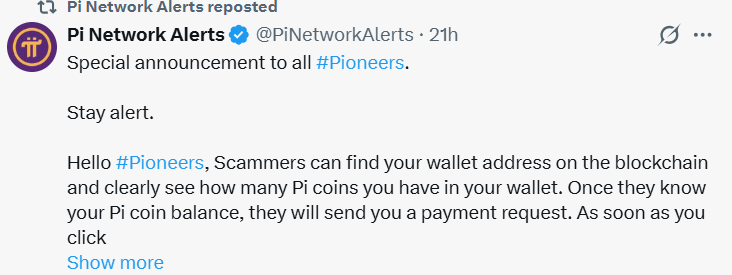
The Pi network, which is the mobile-first Cryptocurrency and web3 blockchain, recently posted a tweet on DEC 30 that the team has warned that scammers are exploiting the Payment request feature to steal Pi tokens from users’ balances. In the Pi network, the wallet balances are publicly visible, and the attackers are targeting the high-balance wallets and sending the payment request to the wallet as an impersonation of official Pi accounts or community moderators.

Once the user approves the payment request, the Tokens will be instantly transferred to the scammers’ account and will be gone forever. No reversal or recovery will be done. The Community reports indicate the scams are widespread, and one scammer’s wallet has received more than 838,000 PI tokens. Overall, more than a million PI tokens have been lost throughout the year. This created a panic situation among the users, and even the experienced users were tricked because the request looked legitimate.

Pi Core Team Denies System Vulnerability, Addresses Market and User Impact

After this incident happened, many users called it a wallet flaw, but the Core team clarified that the problem is from the human approval, not the protocol Flaw. They say that the wallet never sends funds on its own, and the transfer only happens after the user’s approval. This behavior exists in all major Crypto wallets. So to stop this scam, the PI network has disabled all payment requests network-wide. This stops the scams instantly and prevents further user losses. This makes the PI token safe, and it was the fastest way to contain the damage.

The token is currently trading at $0.204 with a market cap of 1.7 billion. The Token has dropped to 10% due to this issue. Recently, the token has updated its ecosystem by adding Standardized KYC to cut the verification backlogs by 50% and speed up mainnet migration for millions of users. Another update is from the testnet DEX, which makes the trading safer and easier by using Pi as the main trading Pair and improving the liquidity. This makes the token regain its momentum, and it has increased by 0.7% in 24 hours.

Highlighted Crypto News:

XDC Network Momentum Test: Will It Break Resistance or Slip Back to Lows?

TagsAltcoinCryptocurrencyPi Network

Связанные с этим вопросы

QWhy did the Pi Network temporarily halt wallet payment requests?

AThe Pi Network temporarily halted wallet payment requests to stop scammers who were exploiting the feature to steal Pi tokens by impersonating official accounts, preventing further user losses.

QHow were the scammers able to steal Pi tokens from users?

AScammers targeted high-balance wallets, sent payment requests while impersonating official Pi accounts or community moderators, and stole tokens once users approved these deceptive transactions.

QWhat was the Pi Core Team's response to the incident being called a 'wallet flaw'?

AThe Pi Core Team clarified that the issue was due to human approval of fraudulent requests, not a protocol flaw, emphasizing that transfers only occur after user authorization, similar to other crypto wallets.

QHow much Pi token value was reported lost due to these scams?

ACommunity reports indicated that over a million Pi tokens were lost throughout the year, with one scammer's wallet receiving more than 838,000 Pi tokens.

QWhat recent updates has the Pi Network implemented to improve its ecosystem?

AThe Pi Network recently added Standardized KYC to reduce verification backlogs by 50% and introduced updates to the testnet DEX, using Pi as the main trading pair to enhance safety and liquidity.

Похожее

Aave Is Surrendering the Throne of DeFi Lending Due to Its Own Stupidity

Aave, a leading DeFi lending protocol, is facing a severe crisis and losing its dominant market position due to its poor handling of a recent security incident. The crisis began when Kelp DAO suffered a hack resulting in a loss of $292 million in rsETH. In the aftermath, approximately $17.2 billion in funds flowed out of Aave as user panic escalated. The article criticizes Aave's crisis management as "extremely foolish." Instead of promptly offering reassurance or committing to cover the potential bad debt—estimated between $123.7 million and $230.1 million, which Aave could have afforded—the protocol initially deflected blame, emphasizing that its code was not at fault. This delay and lack of a clear guarantee led to widespread user anxiety, triggering a bank run-like scenario where users withdrew funds or borrowed aggressively from other pools, causing liquidity shortages. Meanwhile, Aave’s competitor Spark—a fork of Aave’s own code—has benefited significantly. Having removed support for rsETH months earlier, Spark avoided any losses from the incident and has since seen its TVL grow by nearly $2 billion, attracting major deposits such as over $1.24 billion from Justin Sun. Spark has actively capitalized on the situation, publicly criticizing Aave’s security reputation. Although Aave’s founder Stani eventually announced a relief plan named "DeFi United" with several partners and a personal donation, the damage to user trust and capital outflows may be irreversible. The article concludes that Aave is losing its throne in DeFi lending to aggressive competitors like Spark, Morpho, and Jupiter Lend.

Odaily星球日报38 мин. назад

Aave Is Surrendering the Throne of DeFi Lending Due to Its Own Stupidity

Odaily星球日报38 мин. назад

Торговля

Спот
Фьючерсы
活动图片