Phoenix Finance In-Depth Analysis: From "Asset Encapsulation" to "Native Finance", Reconstructing the Yield Logic of RWA

marsbitОпубликовано 2026-01-21Обновлено 2026-01-21

Введение

Phoenix Finance is not merely an asset encapsulation protocol but a comprehensive native financial system for Real World Assets (RWA). It addresses the current fragmentation and inefficiency of the $170 billion RWA market on-chain, where assets remain siloed and disconnected from high-speed DeFi activities. Phoenix introduces a unified settlement layer (PUSD) and an intelligent yield engine to transform static real-world cash flows into composable DeFi products. Key challenges in the RWA space include liquidity fragmentation (e.g., tokenized bonds on Ethereum cannot circulate on Solana), idle capital, and mismatched yield cycles (RWA pays periodically, while DeFi demands block-level compounding). Phoenix bridges this gap with its Intelligent Execution Layer. The product suite includes: - PUSD: A cross-chain native stablecoin enabling frictionless transfers without traditional bridges. - yPUSD: A base yield layer offering automated compounding returns from fragmented RWA repayments. - PYN: Fixed-term NFT notes (7–181 days) that provide alpha returns by matching specific RWA maturity cycles. Core mechanisms powering Phoenix: 1. Teleporter: A unified credit protocol enabling native minting of PUSD on any chain by mapping cross-chain collateral, eliminating fragmentation. 2. Dynamic Reserve Stack (80/15/5): - 80% liquidity layer (USDC/USDT, short-term Treasuries) for instant redemptions. - 15% yield layer (high-grade private credit/structured RWA) for returns. - 5% b...

Phoenix is not just an asset encapsulation protocol, but a complete RWA native financial system. Facing the current situation where 170 billion dollars of RWA assets on-chain are fragmented, dormant, and disconnected from the high-speed flow of DeFi,Phoenix introduces a solution consisting of a unified settlement layer (PUSD) and an intelligent yield engine, aiming to transform static real-world cash flows into composable DeFi protocols.

I. Why Do We Need Phoenix?

"We completed the on-chain migration of assets, but we missed the on-chain migration of financial logic."

2025 stablecoin trading volume has exceeded 33 trillion dollars, far surpassing traditional payment giants like Visa. However, theRWA(Real World Asset) track remains stuck in the初级 "asset mapping" mode. Although government bonds and credit have been successfully tokenized, the market still faces severe structural mismatches:

Liquidity Fragmentation: Tokenized bonds on Ethereum cannot circulate on Solana.

Capital Passively Idle: Static tokens lie idle in wallets, unable to participate in the high-frequency closed loop of DeFi.

Yield Cycle Mismatch: Real-world assets pay yields monthly or quarterly, while DeFi pursues block-level compound growth.

Phoenix Finance is committed to bridging this gap. We not only bring assets on-chain but also build an intelligent execution layer (Intelligent Execution Layer) to orchestrate these assets.

II. Product Matrix: The Financial Refinery
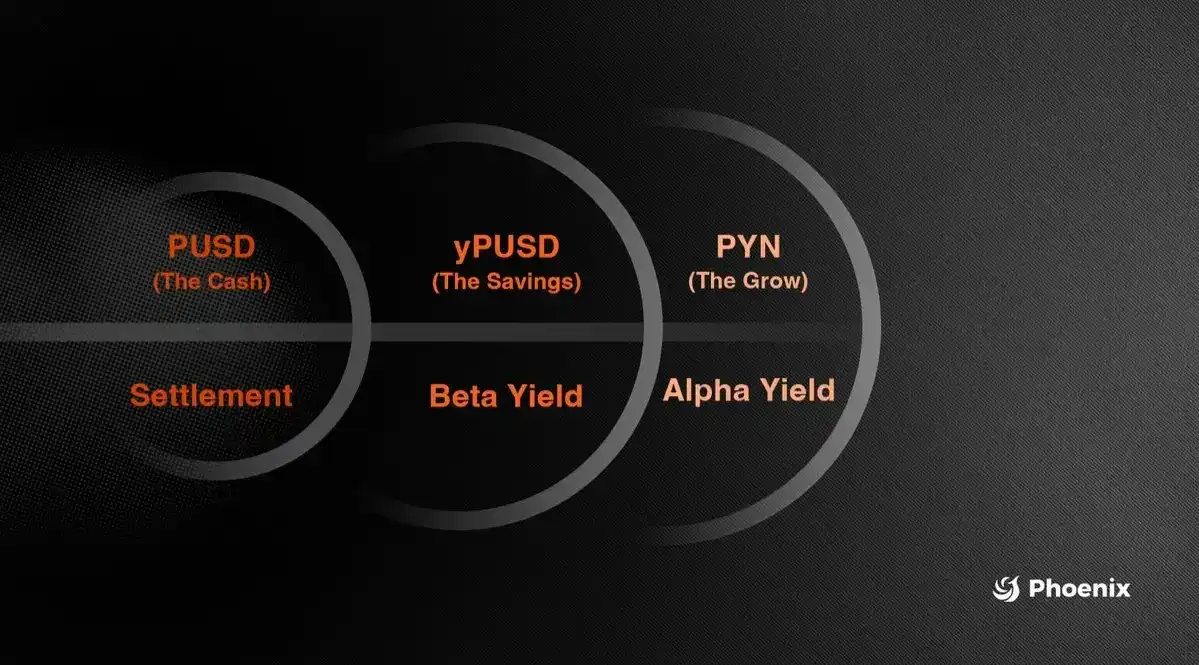
Phoenix plays the role of a"refinery", refining raw, non-standardized real-world yields - into DeFi-friendly standardized products:

PUSD(Settlement Layer): A unified cross-chain stablecoin. Without traditional bridges,PUSD enables inter-chain"instant transmission", with zero-friction circulation.

yPUSD(Base Yield Layer): Provides Beta yield, delivered through an auto-compounding exchange rate. The system smooths fragmented RWA repayments into a continuous yield curve; users gain value simply by holding,无需 manually claiming rewards.

PYN(Structured Yield Layer): Fixed-term NFT notes (7/31/89/181 days). Users lock liquidity to match specific RWA maturities (e.g., structured credit cycles), thereby earning an Alpha premium. This is equivalent to crypto-native principal tokens backed by real-world cash flows.

III. Core Engine: Mechanisms and Logic

1. Teleporter Mechanism (Teleporter): Unified Credit and Native Minting Traditional cross-chain bridges often rely on high-risk"lock-mint" models.Phoenix Teleporter operates as a unified credit protocol,它 maps users' collateral and credit status across chains, allowing for the direct native minting (Native Minting) of PUSD on the target chain. This means PUSD is a native asset on any chain, achieving zero fragmentation.

2. Dynamic Layered Reserve Stack (The Reserve Stack 80/15/5) Solvency is binary—either solvent or in default. To ensure the former, we employ a dynamic layering mechanism:

Liquidity Layer (80%): Composed of USDC/USDT and short-term U.S. Treasuries, ensuring users' ability to exit with rigid兑付 capability at any time.

Yield Layer (15%): Composed of high-rated private credit and structured RWA, serving as the core yield engine of the system.

Buffer Layer (5%): Protocol revenue acts as a"first-loss (First-loss)" layer,优先 absorbing risks before volatility is transmitted to users.

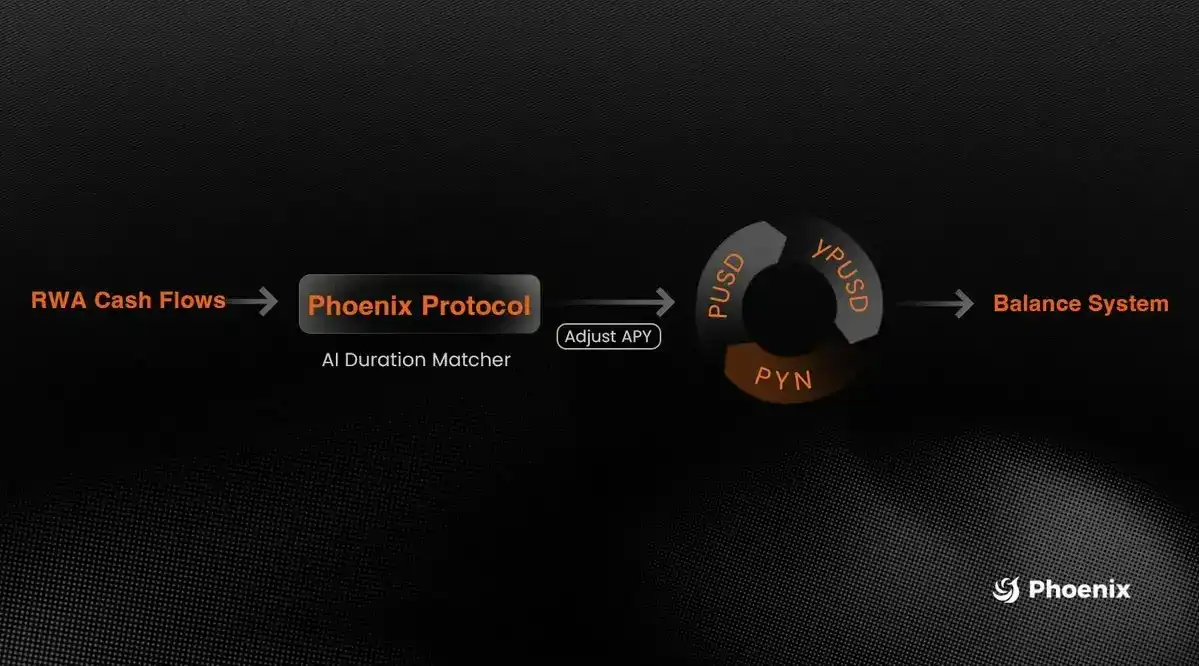
3.AI Controller (AI as Controller) Phoenix's AI is not used for price speculation but serves as a"cycle adapter" and"risk sentinel". When the system detects a mismatch between on-chain liquidity demand and off-chain asset maturity dates (e.g., rigid quarterly interest payments for RWA), theAI dynamically adjusts the APY for specific-term PYN (e.g., 89 day notes). This incentivizes users through market mechanisms to lock capital, precisely balancing the资产负债表.

IV. Transparency and Security Defenses

From Trust to Verification:

Proof of Reserve (Proof of Reserve): Real-time on-chain feeds of all underlying asset data.

Phoenix Hunters(Liquidation Network): An active defense network composed of whitelisted Keepers. When collateral value falls below the threshold,Hunters automatically bid at approximately 95% of the value, instantly clearing bad debt without waiting for lengthy governance processes.

Rejecting Black Boxes: Every bit of yPUSD yield comes from verifiable on-chain sources or audited SPVs.

RWA should not become a museum of assets.Phoenix is transforming it into a highly efficient on-chain economy.


Связанные с этим вопросы

QWhat is the core problem that Phoenix Finance aims to solve in the RWA market?

APhoenix Finance aims to solve the structural mismatch in the RWA market, where $170 billion in on-chain RWA assets are fragmented, static, and disconnected from the high-speed circulation of DeFi. This includes issues like liquidity fragmentation across different blockchains, passive capital sitting idle in wallets, and a mismatch between the periodic yield payments of real-world assets and the block-by-block compound growth demanded by DeFi.

QWhat are the three main components of Phoenix's product matrix, and what role does each play?

AThe three main components are: 1) PUSD: A unified cross-chain stablecoin that acts as the settlement layer, enabling frictionless, 'instant transmission' across chains without traditional bridges. 2) yPUSD: The base yield layer that provides Beta returns through an auto-compounding exchange rate, converting fragmented RWA repayments into a continuous yield curve. 3) PYN: The structured yield layer, which are fixed-term NFT notes (7/31/89/181 days) that allow users to lock liquidity to match specific RWA maturity dates and earn Alpha premiums.

QHow does the 'Teleporter' mechanism differ from a traditional cross-chain bridge?

AUnlike traditional cross-chain bridges that rely on a high-risk 'lock-mint' model, the Teleporter acts as a unified credit protocol. It maps a user's collateral and credit status across different chains, allowing for the direct native minting of PUSD on the target chain. This means PUSD is a native asset on every chain, achieving zero fragmentation.

QDescribe the purpose and composition of the 'Dynamic Layered Reserve (80/15/5)'.

AThe Dynamic Layered Reserve Stack is designed to ensure solvency. It consists of: 1) Liquidity Layer (80%): Composed of USDC/USDT and short-term U.S. Treasury bonds to ensure rigid redemption capability for users. 2) Yield Layer (15%): Composed of high-grade private credit and structured RWA, serving as the system's core yield engine. 3) Buffer Layer (5%): Composed of protocol revenue, which acts as a 'first-loss' layer to absorb risks before they are passed on to users.

QWhat is the role of AI within the Phoenix system, and what specific problem does it address?

AThe AI acts as a 'cycle adapter' and 'risk sentinel,' not for price speculation. Its primary role is to detect and manage the mismatch between on-chain liquidity demand and the rigid payment schedules of off-chain RWA assets (e.g., quarterly interest payments). When a mismatch is detected, the AI dynamically adjusts the APY for specific PYN durations to incentivize users to lock their capital, thereby precisely balancing the system's资产负债表.

Похожее

AAOI Defies Trend with Over 10% Surge, 'New Stock God' Serenity Predicts Potential to Double Again

On June 4th, despite a significant sell-off in the broader AI and semiconductor sector triggered by Broadcom's disappointing guidance, Applied Optoelectronics (AAOI) surged over 11%, showcasing a sharp divergence in market sentiment. Broadcom's warning about potential supply chain diversification by key customer Google and a weaker-than-expected outlook punctured the high-flying AI valuation narrative. This led to heavy selling in names like Broadcom (-12.6%) and Micron (-7%), with funds rotating into traditional industrial stocks. AAOI defied this trend. The stock has experienced high volatility recently, driven by bullish analyst coverage, notably from Rosenblatt which raised its price target to $220. Key catalysts include initial 800G optical module revenue from Amazon, potential certification from Oracle, and strong demand across its product portfolio. The company has reported cumulative orders for 800G/1.6T modules exceeding $324 million and is aggressively expanding manufacturing capacity in Texas, targeting an annualized run-rate of $1.4 billion for its module business by Q3 2027. However, AAOI's fundamentals present a mixed picture. Its Q1 2026 results missed expectations, showing a GAAP net loss, and Q2 guidance points to merely breakeven adjusted EPS. Risks include a delayed 800G production ramp to the second half of the year and high dependence on a few key cloud customers. Recent stock sales by company executives near price highs also noted. The article suggests AAOI's rally reflects a market beginning to differentiate within the AI ecosystem. While Broadcom's issues prompted a reassessment of custom ASIC and customer concentration risks, funds flowing into AAOI indicate a belief that the "physical bottleneck" narrative for optical connectivity—where supply remains tight—remains intact and is somewhat decoupled from the current sector weakness. The sustainability of AAOI's premium valuation now hinges on the successful execution of its production plans and upcoming quarterly results.

marsbit3 мин. назад

AAOI Defies Trend with Over 10% Surge, 'New Stock God' Serenity Predicts Potential to Double Again

marsbit3 мин. назад

Worried about AI's Self-Evolution, Anthropic Intends to Stop Training?

In early 2026, Anthropic signaled a significant shift in its public narrative regarding AI development timelines and safety. In June, its Anthropic Institute published a detailed article, "When AI builds itself," presenting internal data suggesting accelerating AI self-improvement. Key figures included over 80% of merged code being written by Claude and a 52x speedup in certain optimization tasks. The article outlined three future scenarios, with the most speculative being full recursive self-improvement (RSI), where AI autonomously builds better successors. Anthropic stated RSI is "possible" and may arrive faster than most institutions are prepared for. This narrative pivot followed a series of strategic moves. In January, CEO Dario Amodei wrote about a powerful self-improvement feedback loop. In February, Anthropic revised its Responsible Scaling Policy, removing a core commitment to pause training if capabilities outstripped safety controls, citing the risk of falling behind competitors. This change coincided with reported pressure from the US Department of Defense. By May, Anthropic's valuation had soared to $965 billion. Anthropic's stance was mirrored by other industry leaders. DeepMind CEO Demis Hassabis adjusted his AGI timeline to "by 2029" and admitted to using provocative language like "foothills of the singularity" to create urgency. OpenAI also released a model claiming a key role in its own creation process. The article's carefully calibrated tone—presenting dramatic data alongside qualifying footnotes—exemplifies a balancing act between signaling technological acceleration and managing commercial, regulatory, and safety imperatives. External experts offered contrasting interpretations of the same data, from warnings of catastrophic risk akin to Chernobyl to skepticism that current automation merely handles "grunt work," not genius. The coordinated narrative shift among top labs highlights the complex interplay between perceived technical inflection points and strategic communication aimed at investors, regulators, and the public.

marsbit5 мин. назад

Worried about AI's Self-Evolution, Anthropic Intends to Stop Training?

marsbit5 мин. назад

The Macroeconomic Underpinnings of Africa's Payment Market Landscape

The African payments market, characterized by the world's highest mobile money penetration and fastest-growing cryptocurrency adoption, is not a coincidence but a macroeconomic necessity driven by deep structural factors. Two key drivers create this landscape: (1) Africa's heavy reliance on commodity exports, trade, and remittances, generating massive cross-border settlement and remittance demand; and (2) chronically underdeveloped financial infrastructure, exacerbated by international bank de-risking, foreign exchange mismanagement, and persistent inflation. This vacuum has allowed mobile money and crypto to thrive. Mobile money platforms replace banks for domestic payments, while cryptocurrencies serve as a store of value against local currency depreciation and a low-cost medium for cross-border exchange. A crucial division lies along the Sahara Desert. North Africa is integrated into the oil-anchored MENA framework, while Sub-Saharan Africa (SSA), plagued by dollar shortages and fragmented currencies, has become a natural, massive market for mobile money and crypto. Nigeria, Kenya, and South Africa are global leaders in adoption. The SSA economy is deeply dollarized due to currency instability, yet suffers from a severe "dollar shortage" caused by trade deficits and limited export capacity. This creates parallel forex markets and high remittance costs. Cryptocurrencies, particularly stablecoins, fill this gap by providing access to dollar liquidity, cheaper cross-border transfers, and an inflation-resistant store of value, primarily driven by retail users for small-value transactions. While regional initiatives like PAPSS aim to reduce dollar dependence, the fundamental constraints of commodity reliance, trade imbalances, and shallow financial markets persist. Therefore, mobile money and cryptocurrencies are not niche trends but essential financial infrastructure filling a structural void, and they are likely to remain central to Africa's economic landscape for the foreseeable future.

链捕手15 мин. назад

The Macroeconomic Underpinnings of Africa's Payment Market Landscape

链捕手15 мин. назад

Торговля

Спот
Фьючерсы

Популярные статьи

Как купить F

Добро пожаловать на HTX.com! Мы сделали приобретение Synfutures (F) простым и удобным. Следуйте нашему пошаговому руководству и отправляйтесь в свое крипто-путешествие.Шаг 1: Создайте аккаунт на HTXИспользуйте свой адрес электронной почты или номер телефона, чтобы зарегистрироваться и бесплатно создать аккаунт на HTX. Пройдите удобную регистрацию и откройте для себя весь функционал.Создать аккаунтШаг 2: Перейдите в Купить криптовалюту и выберите свой способ оплатыКредитная/Дебетовая Карта: Используйте свою карту Visa или Mastercard для мгновенной покупки Synfutures (F).Баланс: Используйте средства с баланса вашего аккаунта HTX для простой торговли.Третьи Лица: Мы добавили популярные способы оплаты, такие как Google Pay и Apple Pay, для повышения удобства.P2P: Торгуйте напрямую с другими пользователями на HTX.Внебиржевая Торговля (OTC): Мы предлагаем индивидуальные услуги и конкурентоспособные обменные курсы для трейдеров.Шаг 3: Хранение Synfutures (F)После приобретения вами Synfutures (F) храните их в своем аккаунте на HTX. В качестве альтернативы вы можете отправить их куда-либо с помощью перевода в блокчейне или использовать для торговли с другими криптовалютами.Шаг 4: Торговля Synfutures (F)С легкостью торгуйте Synfutures (F) на спотовом рынке HTX. Просто зайдите в свой аккаунт, выберите торговую пару, совершайте сделки и следите за ними в режиме реального времени. Мы предлагаем удобный интерфейс как для начинающих, так и для опытных трейдеров.

513 просмотров всегоОпубликовано 2024.12.21Обновлено 2026.06.02

Как купить F

Обсуждения

Добро пожаловать в Сообщество HTX. Здесь вы сможете быть в курсе последних новостей о развитии платформы и получить доступ к профессиональной аналитической информации о рынке. Мнения пользователей о цене на F (F) представлены ниже.

活动图片