Author: On-Chain Apocalypse

I. Pawn Crossing the River: The Emergence of Pakistan's Cryptocurrency Ambition
On December 12, 2025, the Pakistan Virtual Asset Regulatory Authority (PVARA) issued "No Objection Certificates" (NOCs) to two top global cryptocurrency exchanges. This low-key administrative move, like a "pawn crossing the river" in chess, while not earth-shattering, is a crucial step towards a larger goal. This initiative not only marks Pakistan's formal embrace of blockchain and cryptocurrency technology but also signals its ambition to the global digital economy market: to secure a place in this global digital game.
And this "pawn" is far stronger than it appears on the surface. According to the country's Ministry of Finance, Pakistan already has over 40 million digital asset users, with an estimated annual trading volume exceeding $300 billion. Such a massive market size gives Pakistan undeniable potential in the digital asset space. This data makes every move Pakistan makes particularly significant.
This country, long affectionately called "Iron Brother" by Chinese netizens, is using the language of blockchain and cryptocurrency to attempt to tell a story of economic revival on the global economic chessboard. Its "pawn crossing the river" move might just be the exciting beginning of this story.
II. From Grassroots Frenzy to National Strategy: Pakistan's Crypto Story
Pakistan's cryptocurrency story can be said to have started on the "streets." The country's crypto craze was not a result of government push but a spontaneous action by ordinary citizens. According to the 2025 Global Crypto Adoption Index by blockchain data analysis firm Chainalysis, Pakistan has steadily climbed to third place globally, just behind India and Vietnam—jumping six spots from 9th place in 2024 in just one year, making it the undisputed "dark horse."
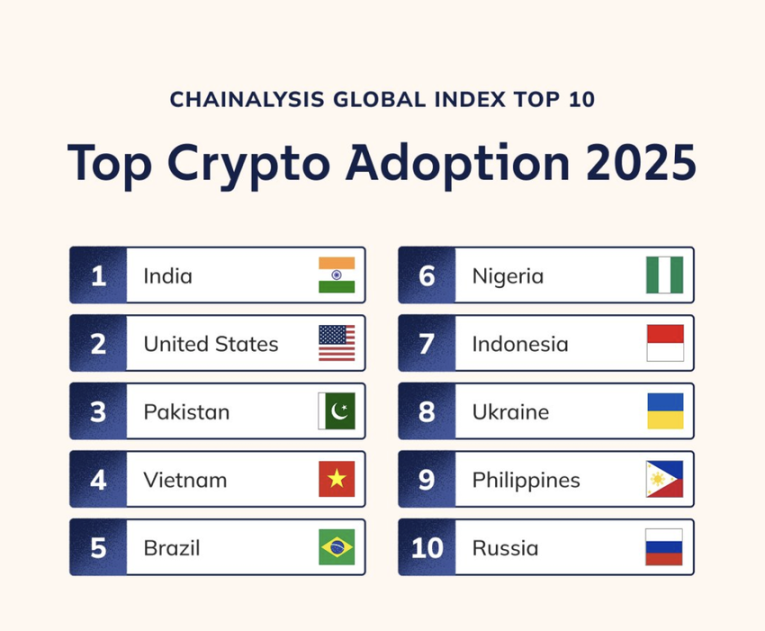
2025 Global Crypto Adoption Index. Source: Chainalysis
Geopolitics and Economy: Pakistan's Crypto Advantages
The country covers a land area of 880,000 square kilometers with a population of 240 million, making it the world's fifth most populous country. It borders Iran to the west, Afghanistan to the north, faces long-standing tensions with India to the east, and is flanked by the Arabian Sea to the south, giving it an extremely sensitive strategic position. More importantly, it sits right at the center of a "crypto-friendly neighborhood":
-
To the west is Iran—the "spiritual ally" in the Middle East of El Salvador, which has adopted Bitcoin as legal tender (while Iran has not officially recognized Bitcoin, it legalized mining as early as 2019 and uses it to circumvent sanctions);
-
To the north is Afghanistan (the Taliban regime has also tacitly allowed Bitcoin transactions for cross-border settlements);
-
To the east is global leader India (also boasting a massive grassroots user base).
This geopolitical environment naturally positions Pakistan as the convergence point of three crypto corridors: Central Asia, South Asia, and the Persian Gulf.
Thus, Pakistan is almost naturally situated at the nodal point of on-chain capital flows across the entire region.
Why is this so important? Because Pakistan receives over $30 billion annually in remittances from overseas workers (5th globally), with traditional channels charging fees as high as 7-12%, while using USDT or Bitcoin reduces this to less than 1%, cutting transfer times from days to minutes. Now, looking at the economic structure:
Traditional pillars are textiles and apparel (60% of exports), agriculture (rice, cotton), and overseas worker remittances.
But these industries are highly vulnerable to the冲击 of rupee depreciation—between 2022 and 2025, the Pakistani rupee depreciated by over 110% against the US dollar.
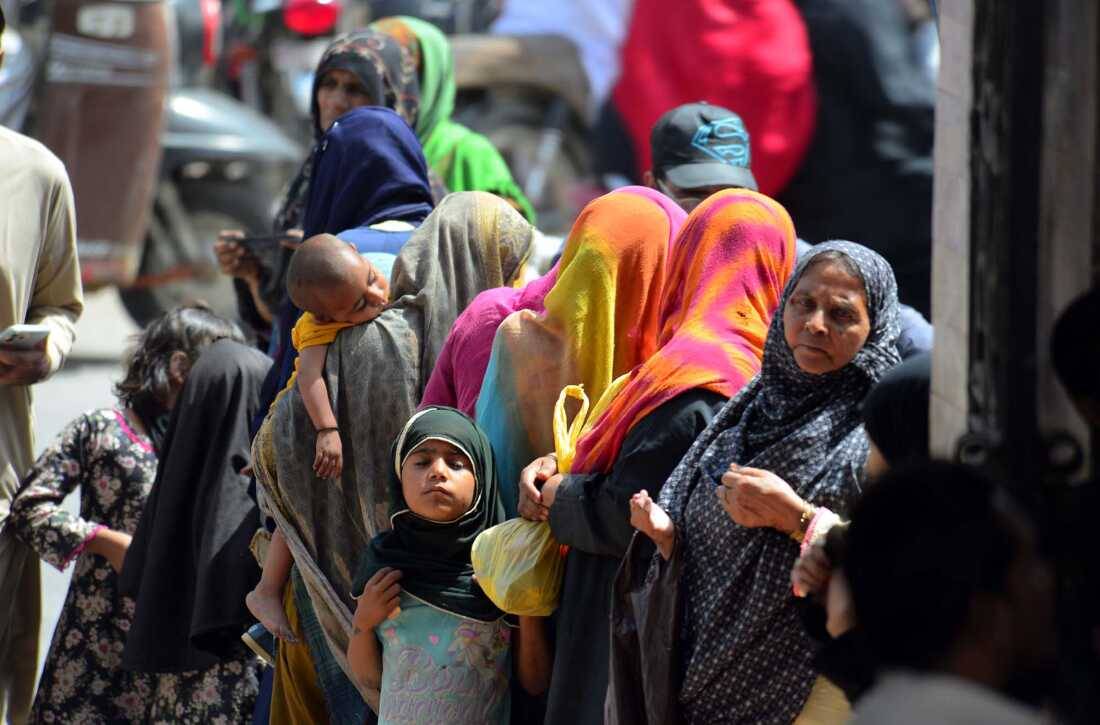
Bank account penetration is only 27% (even lower for women), but smartphone penetration has exceeded 70%, making the youth (70% under 30) natural "on-chain natives."
Pakistan vs. El Salvador: A Multidimensional Comparison
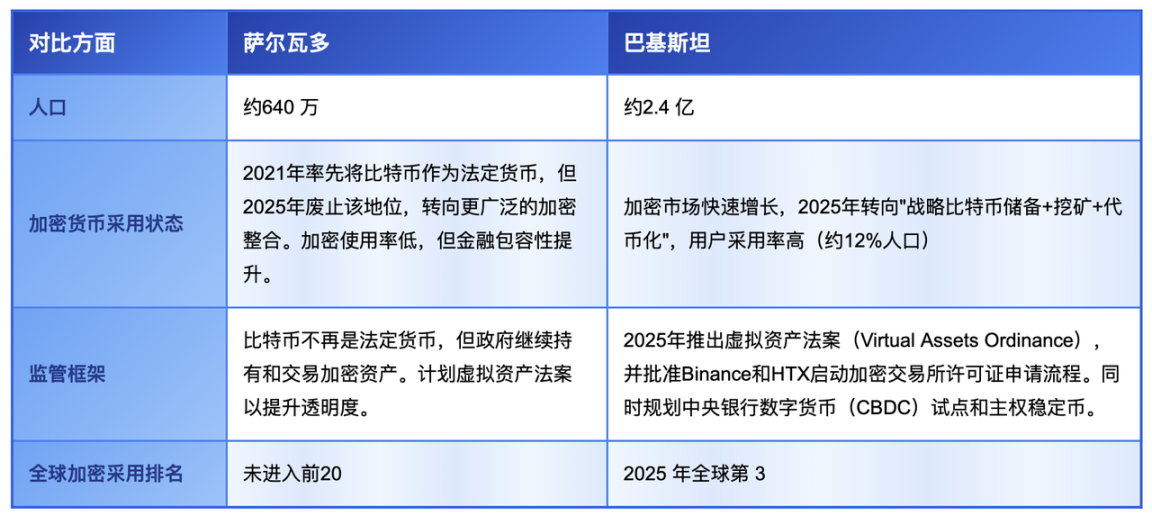
El Salvador conducted a "national experiment" with just over 6 million people, while Pakistan, if successful, would directly impact 240 million people—a completely different scale. It was in this context that PVARA Chairman Saqib's widely quoted statement at the 2025 Bitcoin MENA conference was made:
"My point is simple," he said. "If El Salvador can do it, with a population of only 6 million, then imagine what Pakistan, with 40 times the population and being one of Asia's fastest-growing digital forces, can achieve?"
However, behind the frenzy lie hidden worries. Due to the long-term lack of regulation, illegal trading, money laundering, and scams have occurred from time to time. Watching the market grow larger, the government finally felt compelled to act.
-
In February 2025, Pakistan formally established the world's first AI-assisted virtual asset regulatory authority (PVARA) and introduced the "2025 Virtual Assets Act."
-
In May 2025, Saqib announced that the country was preparing to establish a Bitcoin (BTC) strategic reserve and moving towards more crypto-friendly regulatory policies.
From this moment on, the "grassroots狂欢" from the streets began to be incorporated into the national strategic vision—the goal was no longer to ban it, but to turn this world's third-largest on-chain grassroots economy into a super engine that is transparent, controllable, taxable, and capable of generating foreign exchange for the nation.
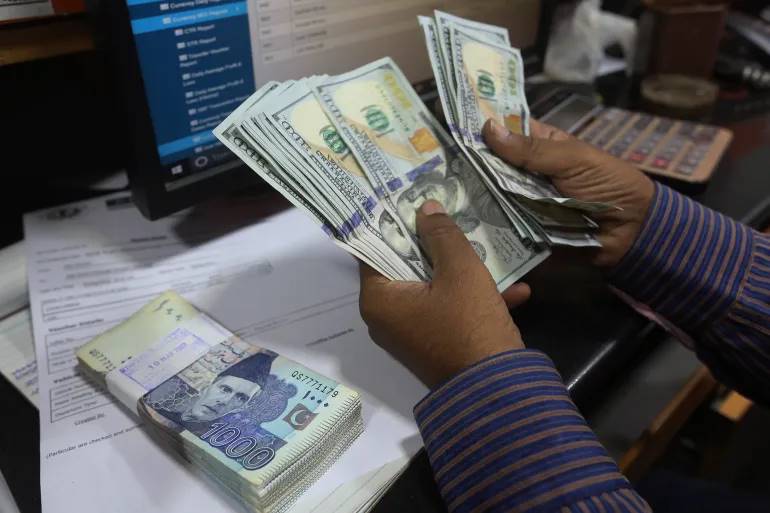
National Asset Tokenization: An Economic Revival Experiment of Putting Everything On-Chain
If Bitcoin is the "new engine" of Pakistan's economy, then blockchain technology is its "new runway." Pakistan is attempting a $2 billion economic experiment—asset tokenization.
The issuance of these "No Objection Certificates" (NOCs) is not merely a market access permit but also a deep collaboration between Pakistan and the global blockchain industry. The most notable part of the MOU signed between the government and the approved exchanges is an asset tokenization plan: using blockchain technology to digitally transform sovereign bonds, national debt, oil, and gas, and other national assets. This project, valued at up to $2 billion, aims to convert traditional financial assets into digital assets tradable on the blockchain.
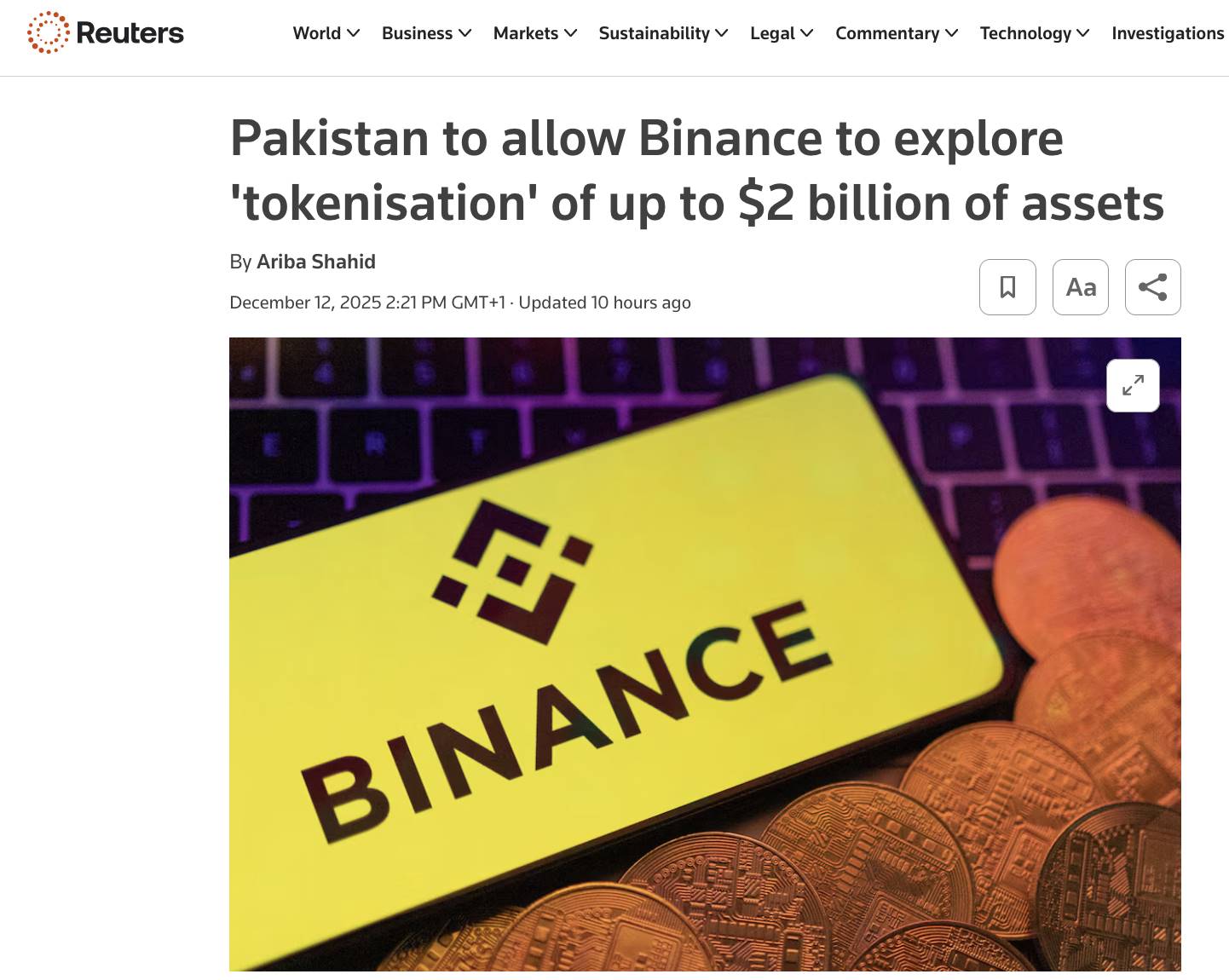
* Pakistan signs MoU with Binance to explore $2 billion national asset tokenization.
Simply put, asset tokenization involves converting Pakistan's traditional national assets, such as bonds, treasury bills, and commodity reserves, into digital assets that can be traded on the blockchain. Through asset tokenization, Pakistan can not only increase asset transparency but also attract the attention of international capital. This innovative model has the potential to become a significant driver of Pakistan's economic recovery, especially for a country with strained foreign exchange reserves; this attempt could be key to overcoming its economic difficulties.
Pakistan's goal is clear: to combine traditional resource advantages with blockchain technology and explore a path to its own economic revitalization. Although this is a bold experiment, its potential should not be underestimated. If successful, it could become a major booster for the country's economic recovery and even provide a replicable experience for other developing countries.
III. Exploring Incremental Markets: Hot Opportunities and Cold Reflection
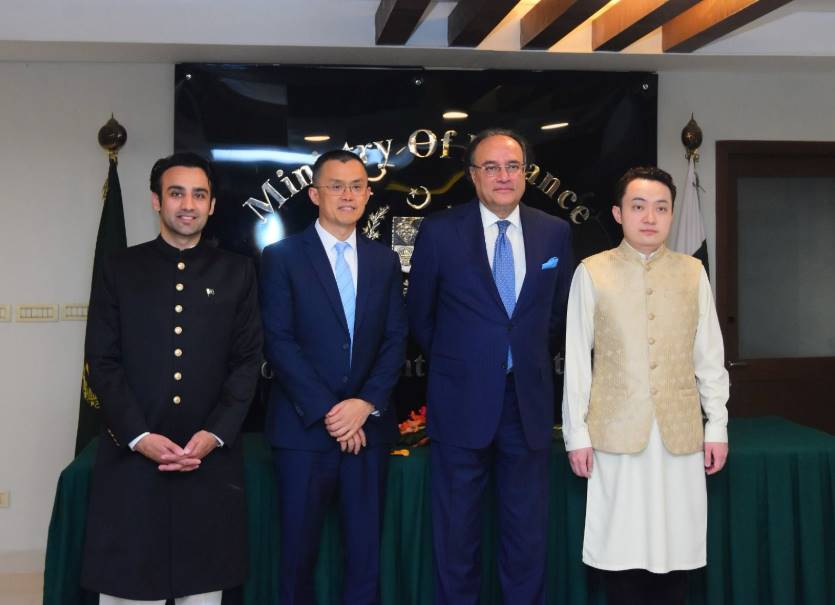
PVARA Chairman Bilal bin Saqib, Binance Co-Founder Changpeng Zhao, Finance Minister Muhammad Aurangzeb, and HTX Advisor Justin Sun (from left to right). Source: PVARA
As the regulatory infrastructure gradually improves, Pakistan is attempting to transform the cryptocurrency frenzy driven by the private sector into a new force for national economic transformation. Recently, Pakistani authorities have begun regulating major global cryptocurrency exchanges and have issued preliminary permits to several leading platforms, allowing them to establish branches in the country.
The platforms that recently received regulatory approval are all major players in the global cryptocurrency industry, holding advantages in market size and technical capabilities. In recent years, these exchanges have actively pursued compliance and have obtained operating licenses in multiple countries. Their entry into the Pakistani market is a key step in their expansion strategy within emerging markets.
Because the reality is, the global Web3 market desperately needs new incremental users.
Currently, cryptocurrency penetration rates in developed markets like Europe and the US are relatively high; most potential users there have already entered the market, leaving behind those who are cautious about cryptocurrencies or staunchly opposed. This means that in these mature markets, exchanges can only compete fiercely for existing users, with customer acquisition costs rising higher and growth space becoming increasingly limited.
More crucially, the vast user base accumulated in the Web2 era is waiting to be "converted." Billions of people globally are still accustomed to traditional internet services but remain unfamiliar with blockchain and cryptocurrency. Pakistan is a classic example—with a population of over 240 million, increasing acceptance of digital payments, and significant room for growth in cryptocurrency penetration.
Although the Pakistani market holds immense potential for "Web2 to Web3 migration," not all exchanges are currently optimistic about this market. However, for those seeking long-term growth and new market expansion, such emerging markets are an essential part of their global strategy. Rather than fighting for存量 users in already red-ocean developed markets, it's better to抢先 enter these emerging markets with huge conversion potential. Here, a Pakistani user who has never接触过 cryptocurrency could, in the long run, be far more valuable than an experienced Western user hopping between multiple platforms.
Conclusion: The Game Has Just Begun, Moves Are Cautious

On the grand chessboard of the global digital economy, Pakistan has cautiously announced its entry with the posture of a "pawn crossing the river." This move, from issuing preliminary No Objection Certificates (NOCs) to exploring potential asset tokenization cooperation, from planning a strategic Bitcoin reserve to gradually iterating regulatory frameworks, has only activated the tip of the iceberg of local grassroots power but has opened up initial imagination space for the Web3 incremental market.
For other emerging countries facing similar challenges of high remittance costs, currency depreciation, and a youth dividend, Pakistan provides a cautious and realistic example: blockchain is not an unattainable patent of wealthy nations but a potential revival path that needs to be gradually explored, controlled, taxed, and capable of generating foreign exchange, all while balancing compliance and risk. The game between regulation and innovation has just begun. Pakistan's blockchain experiment will become a sample worth持续观察.