Over 13% APY, Apyx Is Bringing the 'Killer App for Bitcoin' On-Chain

Odaily星球日报Опубликовано 2026-05-26Обновлено 2026-05-26

Введение

The article discusses the rise of high-yield stablecoins in DeFi, focusing on the Apyx protocol and its integration of STRC (Strategy's Bitcoin credit instrument) to generate sustainable on-chain yields. Apyx addresses a market need for stablecoins with yields exceeding typical DeFi offerings (often below 5-10%). Its core innovation is bridging STRC—a tradable, dividend-yielding equity instrument backed by Strategy's Bitcoin holdings—from traditional finance to the decentralized ecosystem. STRC offers a floating yield (over 12.3%) by converting Bitcoin's long-term appreciation potential into a "digital credit" product. Apyx employs a dual-token model: `apxUSD`, a stablecoin pegged to $1 for liquidity, and `apyUSD`, an interest-bearing token where yields accumulate (currently ~11% APY, targeting over 13%). The yield is derived from STRC dividends, providing a more sustainable income source compared to token-incentivized models. Since its February launch, Apyx has grown rapidly, with `apxUSD` becoming a top-20 DeFi stablecoin by issuance. The protocol enhances its utility and capital efficiency through deep integrations with major DeFi platforms: Morpho (for collateralized borrowing/lending), Curve (for low-slip liquidity pools), and Pendle (for trading and leveraging future yield via PT/YT tokens). Apyx is also running a multi-season points program leading to a Token Generation Event (TGE) and airdrop on October 13, 2026, incentivizing user engagement through activities li...

Original | Odaily Planet Daily(@OdailyChina)

Author | Liaoliao

The cryptocurrency market, particularly the decentralized finance (DeFi) sector, is perpetually in search of underlying assets that combine stability, high liquidity, and high yield. As the yields from traditional real-world assets (RWA, such as U.S. Treasuries) gradually stabilize, the DeFi market's craving for high-yielding, interest-bearing assets is fostering a new paradigm shift. Against this backdrop, stablecoin projects based on STRC are rising at a remarkable pace.

As the cornerstone of the crypto world, the evolution of stablecoins has progressed from early fiat-backed versions (like USDT, USDC), to crypto asset overcollateralized versions (like DAI), to algorithmic versions (like the imploded UST), and to the basis trade arbitrage versions (like USDe) that have emerged in recent years.

However, the current market pain point is that stablecoin yields below 10%, or even 5%, can no longer meet the risk premium demand of on-chain capital, while excessively high algorithmic yields often come with systemic risks like "death spirals."

STRC-driven stablecoin projects are filling this gap at an opportune time. Judging from TVL growth rates, on-chain capital flow directions, to community discussion heat, building stablecoins based on STRC has become one of the most watched niche sectors in the current DeFi market.

Especially with the support of yield protocols like Pendle and Morpho, these products have evolved beyond being mere "stablecoins" into a new asset form that combines stability, yield, and financial composability.

What is STRC?

STRC refers to a "Bitcoin Credit Facility" launched by the treasury company Strategy.

Odaily Note: For a detailed analysis of STRC, please refer to “In-depth Analysis of STRC: Strategy's New Magic Trick for Raising Money to Buy Bitcoin.”

Simply put, Strategy raises capital from the market by issuing STRC, then continuously uses the proceeds to buy Bitcoin. STRC holders receive a floating interest income exceeding 12.3%, paid monthly. Unlike traditional bonds, STRC is a preferred stock instrument, not debt, thus having no fixed maturity date. Simultaneously, its dividend rights are superior to common stock (MSTR), possessing strong "fixed-income-like" properties.

The most unique aspect of STRC is that it essentially transforms the long-term appreciation expectation of Bitcoin into a "Digital Credit" product acceptable to traditional capital markets.

To maintain STRC's value near its $100 face value, Strategy dynamically adjusts its dividend rate – increasing the yield to attract capital when STRC trades below par, and suppressing the premium by issuing more shares when it trades above.
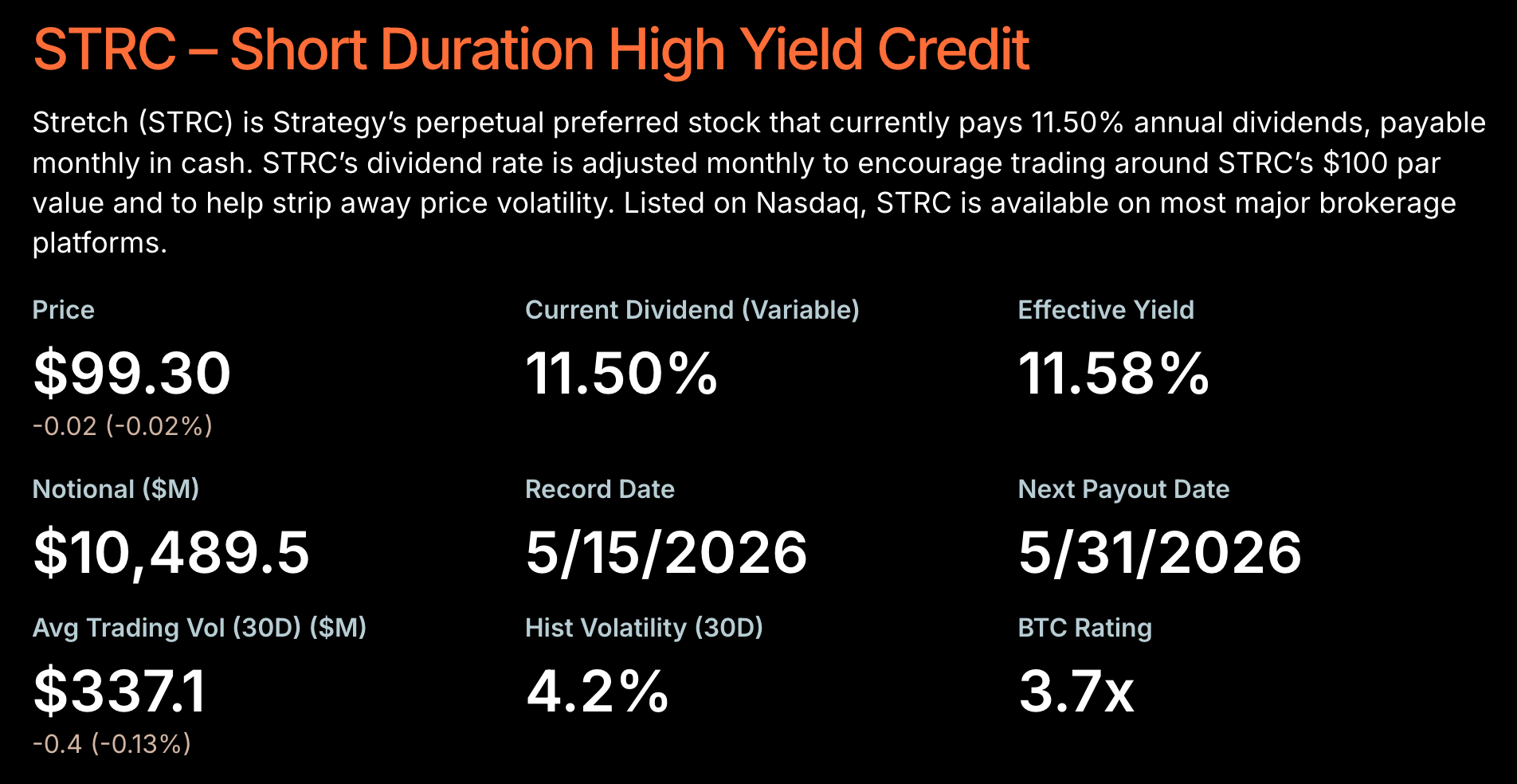
Since Strategy launched STRC, market reception has been quite positive, thanks to its relatively stable "peg" performance (successfully restored after a few brief deviations) and its considerable yield.

At the time of writing, the total issuance size of STRC has surpassed $10.4 billion, accounting for over 60% of the total preferred stock issuance in the global market for 2026.

Earlier this month, Strategy founder Michael Saylor stated in an interview with David Lin – Digital credit products like STRC are the killer application for Bitcoin (refer to Interview with Michael Saylor: I Did Say I'd Sell, But Never Net Sell).

However, traditional STRC shares typically circulate only among Wall Street hedge funds, compliant institutions, and high-net-worth accredited investors. On-chain DeFi users, due to barriers like access, compliance, and capital channels, find it difficult to directly access this high-yield product sweeping through traditional finance.

This is precisely where Apyx, the protagonist of this article, steps in.

What Apyx does is serve as a bridge between Wall Street's digital credit instruments and on-chain DeFi legos. Through innovative on-chain financial architecture, it brings STRC's excess yield opportunities on-chain, constructing the next generation of interest-bearing stablecoins with high liquidity, composability, and higher yields.

Deconstructing Apyx, Perhaps the Highest-Yielding Stablecoin in the Market

Unlike many stablecoin projects reliant on airdrop narratives and lacking real yield sources, Apyx's core competitiveness lies not just in "higher APY," but in its backing which combines traditional finance capital capabilities with on-chain protocol composability.

Regarding background, the core supporter behind Apyx is the NASDAQ-listed treasury company DeFi Development Corp. The latter not only participated in Apyx's incubation and strategic investment but also provided the critical bridge connecting traditional capital markets with the on-chain world.

In terms of product design, Apyx employs a dual-token model of apxUSD + apyUSD.

Among them, apxUSD is closer to a traditional stablecoin, pegged to $1, primarily serving as a medium of exchange and on-chain liquidity. apxUSD itself does not automatically accrue yield; it functions more like a highly liquid "base dollar asset," suitable for trading, payments, lending, etc.

The true embodiment of Apyx's core value is apyUSD – users can lock apxUSD to obtain apyUSD (a 20-day unlock period applies), the latter being similar to Lido's wstETH, with its price increasing continuously as underlying yield accumulates. In other words, apyUSD itself is the carrier of yield.
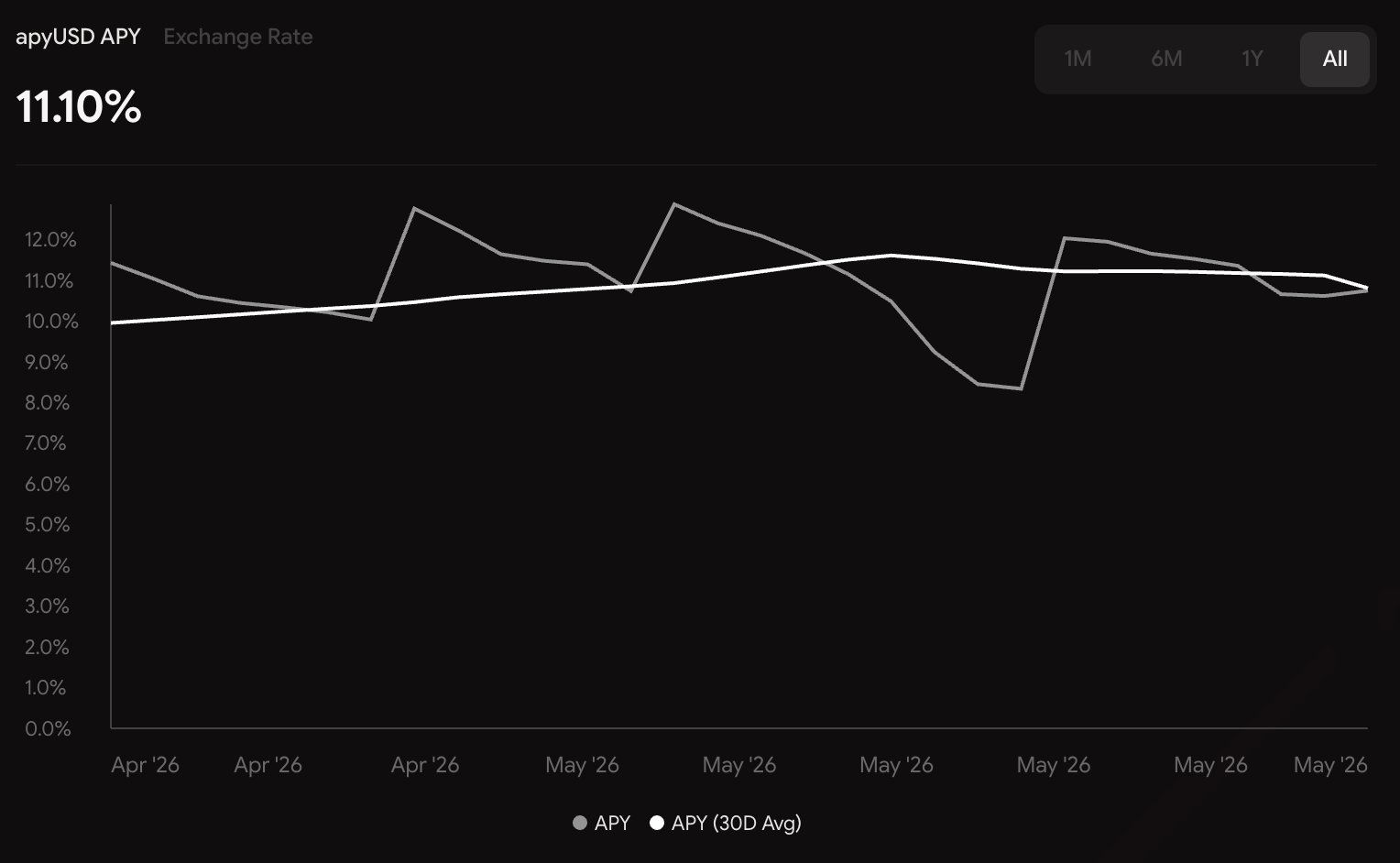
Currently, the real-time annualized yield for apyUSD is approximately 11%, with an expected annualized yield exceeding 13%. Against the backdrop of continuously declining yields for USD stablecoins overall, a stablecoin asset with a genuine yield source and double-digit yield is naturally exceptionally attractive.

Furthermore, it's crucial to emphasize that unlike many stablecoin projects relying on token subsidies to achieve short-term high yields, Apyx's core yield originates from STRC dividends, making the yield source more stable and sustainable.

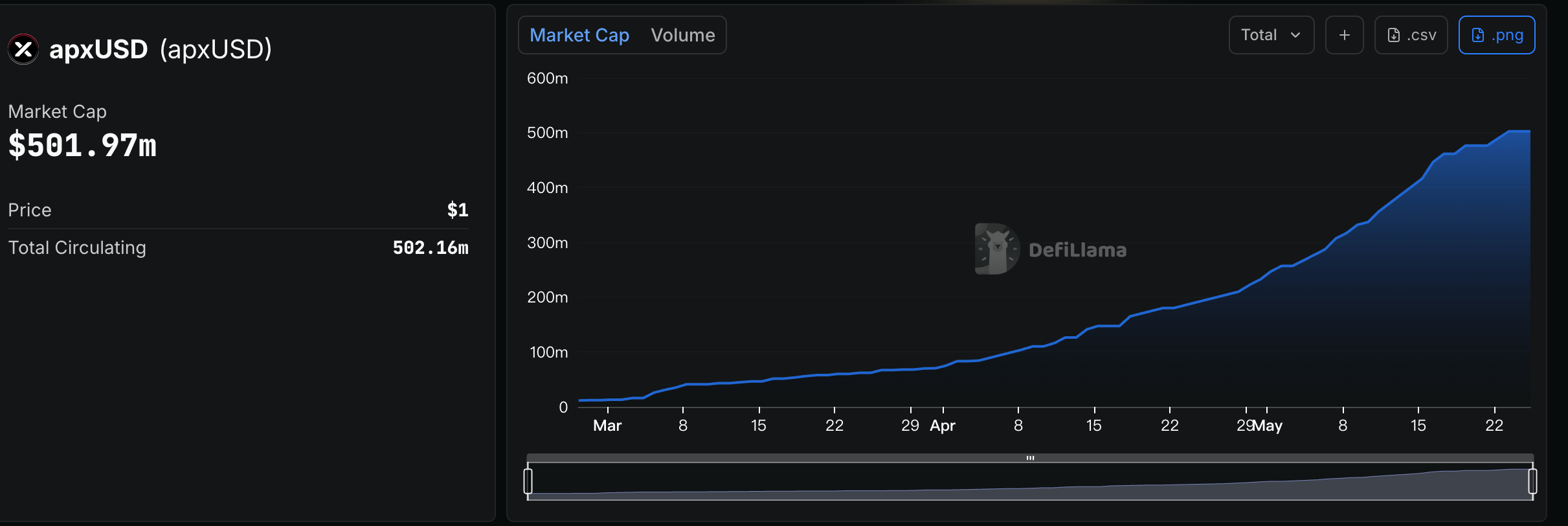
DefiLlama data shows that since its launch at the end of February this year, the issuance scale of apxUSD has rapidly reached 502 million tokens in less than three months, making it the 21st largest stablecoin protocol by issuance size in the DeFi world.
However, yield alone is insufficient to sustain a stablecoin ecosystem. What truly determines a protocol's ceiling is the asset's composability and liquidity efficiency. On this front, Apyx has clearly done extensive work – currently, Apyx is deeply integrated with several mainstream protocols including Morpho, Curve, and Pendle.

On Morpho, users can use apyUSD as collateral to borrow other assets, enabling operations like "earning yield while unlocking liquidity." For more aggressive players, even recursive lending can be employed to amplify yield exposure. Curve addresses liquidity issues. By constructing trading pools with apxUSD and mainstream stablecoins like USDC and USDT, Apyx ensures low slippage even during large-volume swaps, which is crucial for a stablecoin system.

As for Pendle, it might be the most explosive component within the entire Apyx ecosystem. Since Pendle can split yield-bearing assets into PT (Principal Token) and YT (Yield Token), apyUSD evolves beyond being just a "hold-to-earn-yield" asset into a tradable, leveragable, speculatable yield product – conservative users can lock in fixed yields via PT; more aggressive users can amplify bets on future yields by buying YT.

Precisely because of this high degree of composability, Apyx's ecosystem expansion speed is noticeably faster than many traditional stablecoin protocols.

In a sense, what Apyx is doing is not merely "issuing a high-yield stablecoin." It's more akin to attempting to establish an on-chain credit market centered around STRC.

Points Program and Point-Earning Strategies

In today's DeFi market, "points" are no longer just simple user incentive tools; they resemble a way to pre-price future token rights. Especially as the market re-enters a phase of liquidity competition, whether a project can continuously attract capital often depends on two things – whether the yield is sufficiently high, and whether the token expectation is sufficiently clear.

A significant reason for Apyx's rapid TVL accumulation in a short time is closely related to its current points system. According to the official plan, Apyx's points program follows a phased rollout model:

  • Season 1 concluded on May 22, 2026. The official has confirmed that 5% of the total token supply will be allocated to early participants in this stage;
  • Season 2 commenced immediately after Season 1 ended and will continue until October 11, releasing another 6% in token incentives;
  • After Season 2 concludes, Apyx will conduct its TGE and airdrop on October 13.

This rhythm is quite clever. On one hand, the Season deadlines naturally create "sprint windows," incentivizing capital inflows to accelerate before the end. On the other hand, the seamless transition from Season 1 to Season 2 avoids the common problem of "TVL collapse right after Season 1 ends" seen in many projects. Most importantly, Apyx has set a clear future TGE and airdrop date, providing users with more definite interaction expectations.

For the market, this means Apyx's airdrop expectation is not a short-term event but more like a liquidity war lasting several months. From the user's perspective, the more critical question is "how to earn points more efficiently."
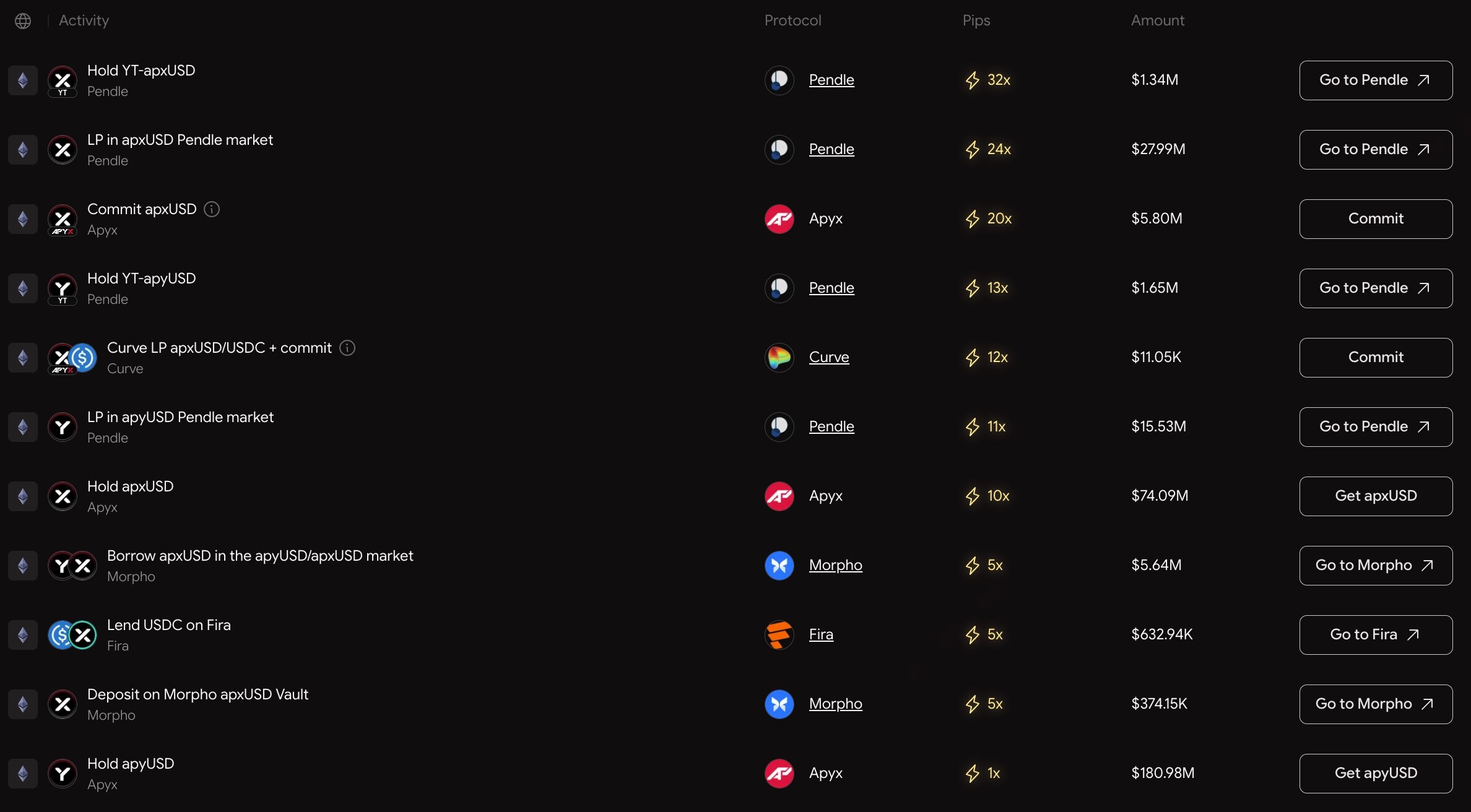
Apyx outlines point-earning efficiency for different operations on its official website, broadly categorized into "Basic Mode" and "Advanced Mode."

"Basic Mode" involves simply holding apxUSD (10x points) or apyUSD (1x point). "Advanced Mode" entails flexibly using the integrated protocols mentioned above, such as borrowing/lending apxUSD on Morpho (5x points), providing LP for apxUSD on Curve (12x points). The most efficient strategies revolve around Pendle: directly holding YT for apxUSD yields 32x points, and providing LP for apxUSD on Pendle also offers a 24x points multiplier.

Competitive Landscape of the Sector, and Apyx's Advantages

As an emerging sector still in its very early stages, the STRC-driven stablecoin market currently doesn't have many core players in the true sense. Judging by capital scale, market attention, and ecosystem expansion speed, the projects that have truly formed influence are essentially just Apyx and Saturn. In a sense, the entire "Digital Credit Stablecoin" sector is gradually evolving into a dual-leader competitive landscape.

Although Saturn launched earlier, Apyx has now surpassed it in terms of data metrics. Overall, Apyx's competitive advantages manifest in the following key dimensions.

First, absolute TVL size and underlying asset holdings advantage. Apyx established a clear strategic goal in its project positioning – to become the world's largest institutional holder of STRC. As of the end of April, holdings had reached $125 million (Saturn only $50 million). If Apyx achieves its strategic objective, it would essentially monopolize the on-chain yield distribution rights based on Strategy's digital credit at the source. Furthermore, for a stablecoin, Apyx's TVL size advantage translates to deeper trading pools, lower slippage for large swaps, and more robust liquidity efficiency, safely accommodating large capital inflows and outflows.

Second, higher yield, with no risk of yield pause. For the target clientele of Apyx and Saturn, the core demand is continuous and predictable yield. Compared to Saturn's sUSDat, Apyx's apyUSD static holding yield maintains an approximate 2% annualized yield advantage. Additionally, and very importantly, sUSDat's design is deeply tied to STRC's exchange rate. When STRC falls below the "Watermark" due to ex-dividend events or other reasons, YT-sUSDat's yield accumulation completely pauses, a problem Apyx does not have.

Third, clearer TGE expectations, and no VC sell-side pressure. Users in the crypto industry detest "indefinite points PUA." Compared to Saturn, Apyx has clearly disclosed the TGE date, the timing of each Season's points activities, and the allocated token amounts, making users psychologically more likely to stay. Moreover, Apyx's development did not involve VC funding, only minimal early investment, partly from the founding contributors themselves. This means there are no private round institutions dumping for profit before retail investors enter, making the token rewards corresponding to points more ideal.

Potential Risks and Outlook Expectations

It is crucial to clearly emphasize that Apyx's high yield does not equate to "risk-free." Essentially, Apyx remains a yield product built upon a Bitcoin credit structure, not a traditional risk-free dollar asset. Therefore, before discussing its growth potential, one must also acknowledge the risk sources behind it.

First, is the credit risk of the underlying asset itself. The core logic of STRC is built upon Strategy and its Bitcoin balance sheet. In other words, the market's acceptance of STRC's yield is fundamentally based on belief that Strategy can continuously utilize its Bitcoin assets to maintain its credit structure and perpetually execute financing, balance sheet expansion, and interest payments.

Should the Bitcoin market experience extreme volatility, such as a sharp crash in a short period, or a significant decline in market risk appetite towards Strategy's leveraged model, then STRC's market pricing, liquidity, and yield structure could all be impacted. While this "systemic risk" doesn't imply immediate protocol collapse, it does signify that Apyx's yield source is somewhat tied to the Bitcoin cycle itself.

Second, are the typical DeFi composability risks. Since Apyx is deeply integrated with protocols like Morpho, Curve, and Pendle, its ecosystem is built upon highly complex on-chain composability. The advantage of this structure is the极大提升资金效率; but the trade-off is that the system's risks become more coupled.

For instance, if a foundational protocol encounters a smart contract vulnerability, liquidity crisis, or abnormal liquidation mechanism, risks could propagate throughout the ecosystem via LP, collateral, and yield-splitting structures. Especially as recursive lending and high-leverage玩法 become more普及, market fluctuations can be further amplified.

Therefore, Apyx is better understood as a "medium-to-high risk, high yield" on-chain credit asset, not a replacement for traditional overcollateralized stablecoins. But it is precisely this risk stratification that gives Apyx its unique appeal in the current market environment.

The stablecoin market today faces an increasingly evident problem – yields are rapidly becoming homogenized. As U.S. Treasury yields recede and traditional arbitrage spaces narrow, the real yield most stablecoin protocols can provide is increasingly limited. The market needs new yield sources, and users are willing to bear a certain degree of risk for higher yields.

Over the past few years, from LSD, Restaking to Pendle yield trading, the entire DeFi market has essentially been validating one thing – users never reject risk; what they truly reject are assets with no "risk-reward ratio." The emergence of STRC恰好为市场提供了一种新的"风险 vs 收益"选项.

And over the past few months, the sustained growth in TVL for Apyx and the entire STRC sector demonstrates that the market is voting for this narrative with real capital.


Связанные с этим вопросы

QWhat is STRC, and how does it generate high yields?

ASTRC is a 'Bitcoin credit instrument' issued by the company MicroStrategy. It is a form of preferred equity (not debt) that allows MicroStrategy to raise funds from the market to continuously buy Bitcoin. STRC holders receive a high, floating interest rate (over 12.3%, paid monthly). This effectively transforms the long-term appreciation expectation of Bitcoin into a 'Digital Credit' product with stable yield characteristics acceptable to traditional capital markets. Its yield is dynamically adjusted to maintain its price near a $100 par value.

QWhat are the two tokens in Apyx's model, and what are their respective functions?

AApyx uses a dual-token model. 1) apxUSD is a stablecoin pegged to $1, functioning primarily as a transaction medium and a source of on-chain liquidity for trading, payments, and lending. It does not automatically accrue yield. 2) apyUSD is the yield-bearing token. Users lock apxUSD to receive apyUSD (with a 20-day unlocking period). Its price increases over time as underlying yield accrues, making it the direct carrier of the protocol's returns.

QHow does Apyx achieve its high expected APY of over 13% for apyUSD?

AApyx's core yield is derived from the dividends paid by the underlying STRC assets. The protocol acts as a bridge, bringing the high-yield STRC product from traditional finance onto the blockchain. This provides a real, sustainable yield source rather than relying on temporary token subsidies, which differentiates it from many other high-APY stablecoin projects.

QWhat key DeFi protocols has Apyx integrated with to enhance its utility and capital efficiency?

AApyx has been deeply integrated with several major DeFi protocols: Morpho (for using apyUSD as collateral to borrow other assets, enabling leveraged yield strategies), Curve (for providing deep liquidity pools between apxUSD and other stablecoins like USDC/USDT, ensuring low slippage), and Pendle (for splitting apyUSD's yield into Principal Tokens (PT) and Yield Tokens (YT), allowing for fixed yield locking or speculative trading on future yields).

QWhat are the main potential risks associated with investing in or using Apyx?

AThe primary risks are twofold: 1) Underlying Asset Risk: Apyx's yield depends on STRC, which is tied to MicroStrategy's Bitcoin strategy. Extreme Bitcoin price volatility or a loss of market confidence in MicroStrategy's leveraged model could impact STRC's pricing, liquidity, and yield payments. 2) DeFi Composability Risk: Deep integration with protocols like Morpho and Pendle creates a complex, interconnected system. Smart contract vulnerabilities, liquidity crises, or liquidation issues in any integrated protocol could propagate risk throughout the Apyx ecosystem, especially when leverage is involved.

Похожее

U.S. Government Bans Foreign Nationals from Using Fable 5, Anthropic Issues Rebuttal

U.S. Government Bans Foreign Access to Fable 5, Anthropic Issues Rebuttal On June 12th, the U.S. government ordered AI company Anthropic to immediately suspend all foreign access—including foreign nationals within the U.S. and Anthropic's own foreign employees—to its newly released Fable 5 and Mythos 5 AI models, citing national security concerns. This forced Anthropic to temporarily disable access to both models for all users globally, as it cannot technically differentiate user nationality at scale. The models, released just three days prior, represent Anthropic's highest public capability tier. Fable 5 is the first publicly available model from the advanced "Mythos" family, while Mythos 5 is a less-restricted version for approved cybersecurity and critical infrastructure partners. The government's directive was reportedly triggered by claims from another company that it could "jailbreak" Mythos 5, raising alarm within the Trump administration. Anthropic, in a detailed public statement, strongly challenged this rationale. The company argues the demonstrated "jailbreak" is a narrow, non-generalized technique that merely involves identifying minor, known software vulnerabilities—a capability common to other publicly available models like OpenAI's GPT-5.5 and routinely used by cybersecurity defenders. Anthropic stated it has complied with the order but disagrees with the government's standard, warning that applying it industry-wide would halt all new frontier model deployments. The company criticized the lack of a transparent, fact-based legal process and expressed confidence the situation stems from a misunderstanding. It is working to restore access and will release more technical details within 24 hours. Other Anthropic models remain unaffected.

链捕手16 мин. назад

U.S. Government Bans Foreign Nationals from Using Fable 5, Anthropic Issues Rebuttal

链捕手16 мин. назад

The Revelation from the Raydium Theft Incident: New DeFi Vulnerabilities Lurking in Forgotten Old Contracts

**Raydium Exploit Reveals DeFi's Hidden Risk: Forgotten "Zombie" Contracts** A recent attack on Raydium's deprecated V3 AMM pools resulted in a loss of approximately $1.34 million. The hacker exploited pools that were no longer supported by Raydium's current UI or SDK but remained fully functional and accessible on-chain. This incident highlights a critical, often overlooked category of risk in DeFi: inactive or legacy smart contracts that projects fail to properly decommission. Since March 2025, there have been at least 8 publicly reported attacks targeting such abandoned contracts, with total losses around $10.8 million. Including older pools and deprecated features, the count rises to 10 incidents with roughly $22.5 million in losses. These "zombie contracts" represent a lifecycle management failure rather than a code vulnerability, yet they are typically misclassified under general "code bug" categories in security reports, masking the true scale of the problem. The root cause is that projects often merely document a contract as "deprecated" without taking essential technical steps to secure it: withdrawing remaining assets, disabling external call functions, and implementing ongoing monitoring. These forgotten, under-monitored components become prime targets for attackers. To address this, the industry needs to recognize "zombie contracts" as a distinct risk category and establish standardized decommissioning protocols. Essential steps should include: 1) a formal retirement announcement, 2) removal of all front-end integrations, 3) withdrawal of locked assets, 4) disabling key contract functions, 5) ongoing security monitoring, 6) clear user communication, and 7) a post-mortem analysis. The value of a DeFi project lies not only in its current TVL but also in the security of its historical codebase, which has now become a new attack surface.

Foresight News2 ч. назад

The Revelation from the Raydium Theft Incident: New DeFi Vulnerabilities Lurking in Forgotten Old Contracts

Foresight News2 ч. назад

Robots Begin to 'Consume Data': The Hidden Production Chain from Indian Data Factories to Billion-Dollar Humanoid Robots

Robots have started to 'consume data,' driving the formation of a new industrial supply chain focused on producing training data for embodied AI. Unlike large language models, which are trained on vast internet text corpora, embodied AI models face a 'data desert' in the physical world. This has created a massive demand for first-person perspective video data (Ego Data), captured by workers wearing cameras in places like Indian garment factories. Companies like Neocambrian AI are establishing 'data factories' where workers perform standardized tasks (e.g., sorting clothes, kitchen organization) to generate thousands of hours of video. Research, such as NVIDIA's EgoScale, demonstrates that scaling this human demonstration data predictably improves robot performance, particularly for dexterous manipulation. This has validated a training path combining large-scale human data for pre-training with smaller amounts of robot-specific data for fine-tuning. The value of different data types varies significantly, forming a 'data pyramid.' The base consists of low-cost, large-scale internet and Ego Data. Higher layers include more expensive motion-capture data (e.g., from data gloves), simulation/synthetic data, and the most costly and scarce layer: real robot teleoperation data. This demand has spawned a layered ecosystem of data suppliers: low-cost data factories, motion capture and alignment specialists, robot-native teleoperation service providers, simulation data companies, and platforms aiming for data standardization. Robot companies themselves are adopting a 'layered procurement' strategy: outsourcing generic Ego Data while building in-house capabilities for robot-specific adaptation data and the critical deployment/failure data generated in real-world applications. The industry is shifting focus from hardware and basic mobility to the data pipelines required for general-purpose capability. While parallels exist to data labeling companies like Scale AI in the LLM boom, the physical complexity of robot data—involving action success ambiguity and sim-to-real gaps—requires more integrated solutions for data collection, annotation, and a continuous feedback loop. The race is on to build the data engines that will teach robots to operate reliably in the unstructured real world.

marsbit4 ч. назад

Robots Begin to 'Consume Data': The Hidden Production Chain from Indian Data Factories to Billion-Dollar Humanoid Robots

marsbit4 ч. назад

Торговля

Спот
Фьючерсы

Популярные статьи

Тест по Bitcoin Биткоина

HTX Learn: Изучите Bitcoin halving и Заработаете Токены USDT

3.1k просмотров всегоОпубликовано 2024.04.16Обновлено 2024.04.16

Тест по Bitcoin  Биткоина

Что такое $BITCOIN

ЦИФРОВОЕ ЗОЛОТО ($BITCOIN): Комплексный анализ Введение в ЦИФРОВОЕ ЗОЛОТО ($BITCOIN) ЦИФРОВОЕ ЗОЛОТО ($BITCOIN) — это проект на основе блокчейна, работающий в сети Solana, который стремится объединить характеристики традиционных драгоценных металлов с инновациями децентрализованных технологий. Хотя он носит имя Биткойн, часто называемого “цифровым золотом” из-за его восприятия как средства хранения ценности, ЦИФРОВОЕ ЗОЛОТО является отдельным токеном, предназначенным для создания уникальной экосистемы в ландшафте Web3. Его цель — позиционировать себя как жизнеспособный альтернативный цифровой актив, хотя детали его применения и функциональности все еще развиваются. Что такое ЦИФРОВОЕ ЗОЛОТО ($BITCOIN)? ЦИФРОВОЕ ЗОЛОТО ($BITCOIN) — это токен криптовалюты, специально разработанный для использования в блокчейне Solana. В отличие от Биткойна, который выполняет широко признанную роль хранения ценности, этот токен, похоже, сосредоточен на более широких приложениях и характеристиках. Примечательные аспекты включают: Инфраструктура блокчейна: Токен построен на блокчейне Solana, известном своей способностью обрабатывать высокоскоростные и недорогие транзакции. Динамика предложения: ЦИФРОВОЕ ЗОЛОТО имеет максимальное предложение, ограниченное 100 квадриллионами токенов (100P $BITCOIN), хотя детали о его обращающемся предложении в настоящее время не раскрыты. Утилита: Хотя точные функциональные возможности не описаны, есть указания на то, что токен может быть использован для различных приложений, потенциально связанных с децентрализованными приложениями (dApps) или стратегиями токенизации активов. Кто создатель ЦИФРОВОГО ЗОЛОТА ($BITCOIN)? На данный момент личность создателей и команды разработчиков, стоящих за ЦИФРОВЫМ ЗОЛОТОМ ($BITCOIN), остается неизвестной. Эта ситуация типична для многих инновационных проектов в области блокчейна, особенно тех, которые связаны с децентрализованными финансами и феноменом мем-криптовалют. Хотя такая анонимность может способствовать культуре, ориентированной на сообщество, она усиливает опасения по поводу управления и ответственности. Кто инвесторы ЦИФРОВОГО ЗОЛОТА ($BITCOIN)? Доступная информация указывает на то, что у ЦИФРОВОГО ЗОЛОТА ($BITCOIN) нет известных институциональных спонсоров или значительных венчурных капиталовложений. Проект, похоже, функционирует по модели пирингового взаимодействия, сосредоточенной на поддержке и принятии сообществом, а не на традиционных путях финансирования. Его активность и ликвидность в основном сосредоточены на децентрализованных биржах (DEX), таких как PumpSwap, а не на устоявшихся централизованных торговых платформах, что еще больше подчеркивает его подход, ориентированный на grassroots. Как работает ЦИФРОВОЕ ЗОЛОТО ($BITCOIN) Операционные механизмы ЦИФРОВОГО ЗОЛОТА ($BITCOIN) можно подробно описать на основе его дизайна блокчейна и характеристик сети: Механизм консенсуса: Используя уникальный механизм доказательства истории (PoH) Solana в сочетании с моделью доказательства доли (PoS), проект обеспечивает эффективную валидацию транзакций, что способствует высокой производительности сети. Токеномика: Хотя конкретные дефляционные механизмы не были подробно описаны, большое максимальное предложение токенов подразумевает, что оно может быть предназначено для микротранзакций или нишевых случаев использования, которые еще предстоит определить. Интероперабельность: Существует потенциал для интеграции с более широкой экосистемой Solana, включая различные платформы децентрализованных финансов (DeFi). Однако детали относительно конкретных интеграций остаются неуточненными. Хронология ключевых событий Вот хронология, которая подчеркивает значимые вехи, касающиеся ЦИФРОВОГО ЗОЛОТА ($BITCOIN): 2023: Первоначальное развертывание токена происходит в блокчейне Solana, отмеченное его адресом контракта. 2024: ЦИФРОВОЕ ЗОЛОТО приобретает видимость, когда оно становится доступным для торговли на децентрализованных биржах, таких как PumpSwap, позволяя пользователям обменивать его на SOL. 2025: Проект наблюдает спорадическую торговую активность и потенциальный интерес к инициативам, возглавляемым сообществом, хотя на данный момент не зафиксировано никаких значительных партнерств или технических достижений. Критический анализ Сильные стороны Масштабируемость: Основная инфраструктура Solana поддерживает высокие объемы транзакций, что может повысить полезность $BITCOIN в различных сценариях транзакций. Доступность: Потенциально низкая цена торговли за токен может привлечь розничных инвесторов, способствуя более широкому участию благодаря возможностям дробного владения. Риски Отсутствие прозрачности: Отсутствие публично известных спонсоров, разработчиков или процесса аудита может вызвать скептицизм относительно устойчивости и надежности проекта. Волатильность рынка: Торговая активность сильно зависит от спекулятивного поведения, что может привести к значительной волатильности цен и неопределенности для инвесторов. Заключение ЦИФРОВОЕ ЗОЛОТО ($BITCOIN) является интригующим, но неоднозначным проектом в быстро развивающейся экосистеме Solana. Хотя он пытается использовать нарратив “цифрового золота”, его отход от установленной роли Биткойна как средства хранения ценности подчеркивает необходимость более четкого различения его предполагаемой утилиты и структуры управления. Будущее принятие и усвоение, вероятно, будут зависеть от решения текущей непрозрачности и более четкого определения его операционных и экономических стратегий. Примечание: Этот отчет охватывает синтезированную информацию, доступную на октябрь 2023 года, и с тех пор могут произойти события.

99 просмотров всегоОпубликовано 2025.05.13Обновлено 2025.05.13

Что такое $BITCOIN

Fractal Bitcoin: масштабирование Биткоина с помощью рекурсивной системы

Fractal Bitcoin — масштабное Layer-1-решнение, созданное на базе кода Биткоина, позволяющего достигать бесконечного масштабирования с помощью рекурсивного подхода.

2.3k просмотров всегоОпубликовано 2025.06.30Обновлено 2025.06.30

Fractal Bitcoin: масштабирование Биткоина с помощью рекурсивной системы

Обсуждения

Добро пожаловать в Сообщество HTX. Здесь вы сможете быть в курсе последних новостей о развитии платформы и получить доступ к профессиональной аналитической информации о рынке. Мнения пользователей о цене на BTC (BTC) представлены ниже.

活动图片