One Article to Understand $UORE: The V4 Hook Project That Packs Mining, Lottery, and NFT Into a Single Transaction

marsbitОпубликовано 2026-05-09Обновлено 2026-05-09

Введение

An In-Depth Look at $UORE: The V4 Hook Project Packing Mining, Lotteries, and NFTs into a Single Transaction $UORE is the latest project leveraging the Uniswap V4 Hook mechanism, following in the footsteps of projects like SATO, uPEG, and Slonks. It distinguishes itself by integrating multiple functions—on-chain mining, a buy-to-enter lottery, auto-generated pixel NFTs (Orelings), and a deflationary burn mechanism—all within a single Uniswap V4 liquidity pool transaction. This complexity results in transaction gas fees that are 2-3 times higher than a standard swap. The project's tokenomics are intricate. Each whole $UORE token held automatically mints a corresponding Oreling NFT, a 32x32 pixel miner character with random traits determined by the next block's hash. Each Oreling has a Class (rarity) and Hash value, which combine to form its Mining Power for staking rewards. Rewards are distributed daily from an emission that decays by 1% daily, with an 80/20 split between stakers and a Motherlode lottery pool. A "refined-ore boost" mechanism taxes early reward claims, redistributing 10% to remaining stakers. The Motherlode lottery awards tickets for buys of ≥0.1 ETH, with winning chances scaling up to 1% for 1 ETH purchases. Wins split the pool 50% to the buyer and 50% to a random staker. A 1% buy tax is burned, and a 1% sell tax funds an automatic buyback-and-burn mechanism triggered at 0.1 ETH. The project's code is a fork of uPEG, with claimed fixes for NFT duplication ...

Author: Curry, Shenchao TechFlow

Still FOMOing over yesterday's trending on-chain Ethereum project Slonk? Actually, a new narrative has arrived:

V4 Hook.

Over the past two weeks, Uniswap V4's Hook mechanism suddenly became hot. SATO used Hooks to create an on-chain bonding curve, pushing its market cap to $40 million. uPEG, leveraging the viral story of Uniswap's discarded naming drafts, reached over $30 million in two weeks. Slonks embedded an AI model into a smart contract to mimic CryptoPunks, achieving 586 ETH in trading volume within six days of launch.

While these three projects have different gameplay, they all utilize Uniswap's V4 mechanism.

Now the fourth one is here.

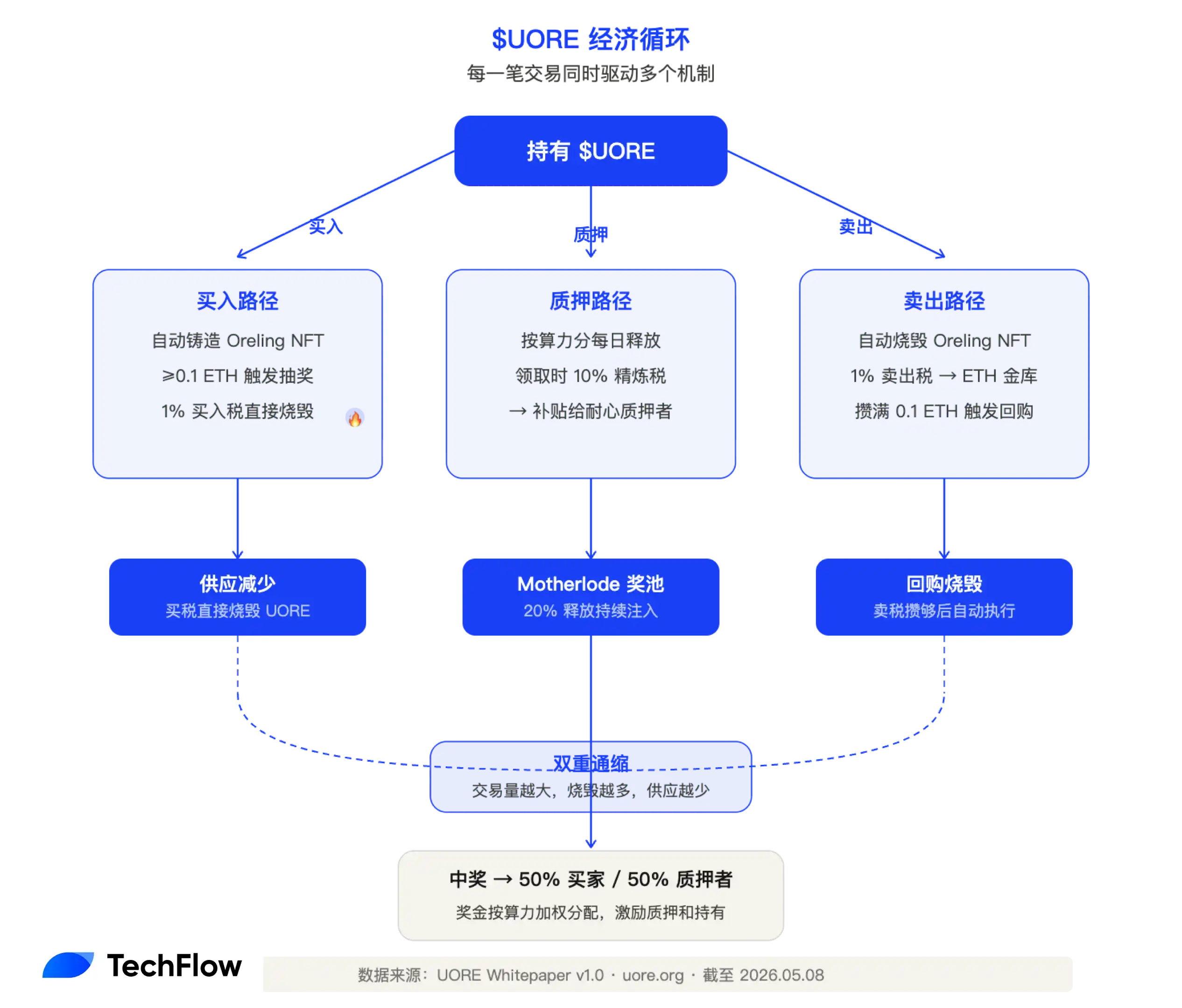
The new project is called $UORE, launched just yesterday. What it does can be summarized in one sentence: It packs on-chain mining, token-buying lottery, pixel NFT auto-generation, and deflationary burning mechanisms, all into a single Uniswap V4 trading pool.

Because buying tokens in this pool triggers the contract to simultaneously perform these six actions in the background, the gas fee for one transaction is two to three times that of a normal swap...

Currently on Crypto Twitter, you'll find everyone complaining about this high gas cost.

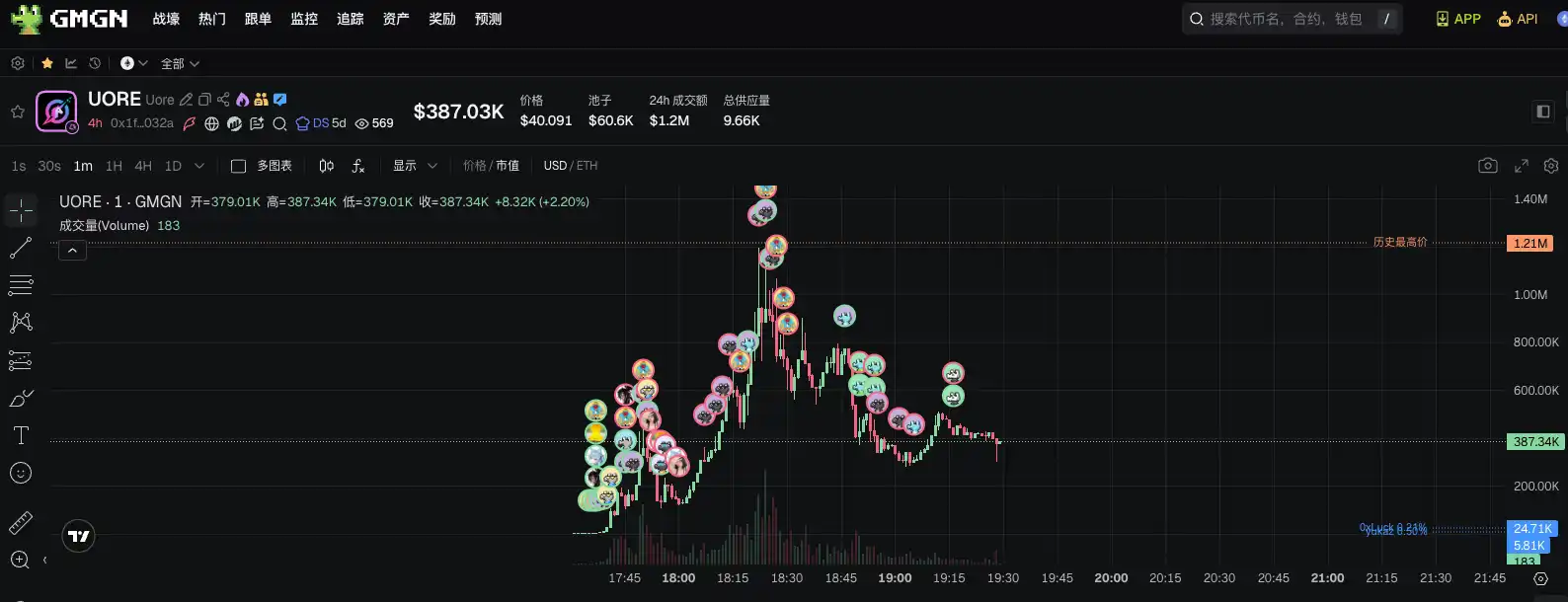
Regarding the token, according to GMGN data as of the time of writing, $UORE surged to a market cap of $1.2 million within hours of launch, then quickly dropped back to $440k. The pool liquidity is only $64k, but the 24-hour trading volume is $1.2 million, meaning the money in the pool has been turned over nearly twenty times.

However, there are only 741 holders, and the total supply is less than ten thousand tokens.

Currently, the risks appear extremely high. After a brief study, I personally think it's the most mechanically complex project in the V4 Hook ecosystem (this round of new on-chain plays tends to be confusing in terms of mechanics...).

It is simultaneously a token, an NFT collection, a staking mining farm, and a lottery system. Moreover, these four things are not independent; they are welded together.

The Four-in-One Mining Farm

In most NFT projects, the token and the NFT are two separate things, bought and sold independently.

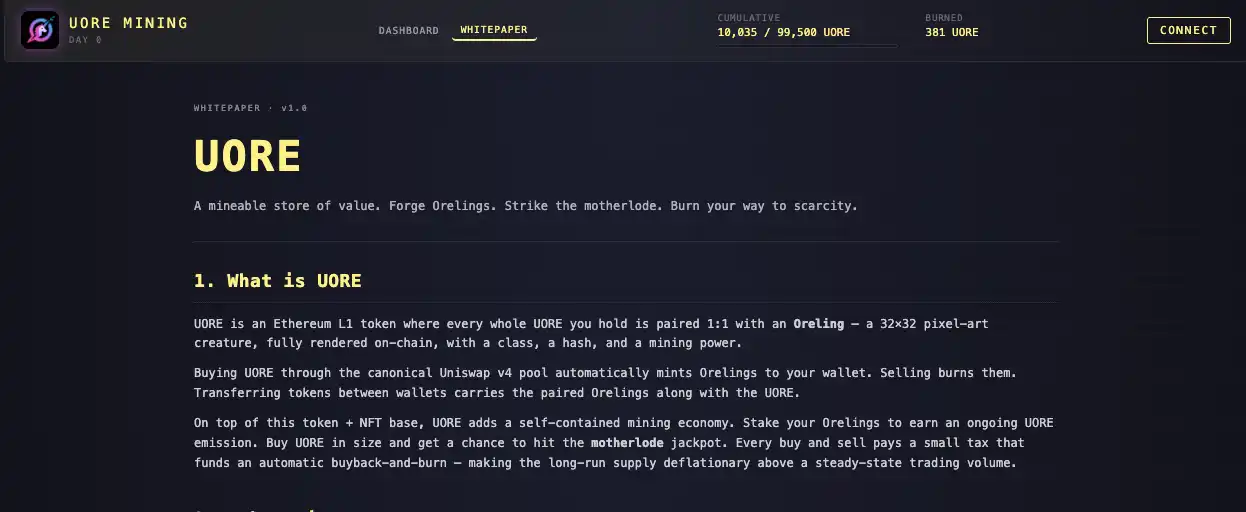
UORE is not. Its NFT is called Oreling, a 32×32 pixel miner character directly embedded into the token. For every full integer UORE you hold in your wallet, you automatically own one corresponding Oreling.

The contract mints it for you when you buy tokens, burns it when you sell tokens, and the Oreling moves with the UORE when you transfer. You cannot buy an Oreling separately, nor can you detach it from UORE.

Each Oreling's traits are determined by the hash of the next block the moment it is minted. This means you don't know what kind of character you'll get when you buy; not even the validator can see the result in advance.

The differences between these characters are not just about appearance.

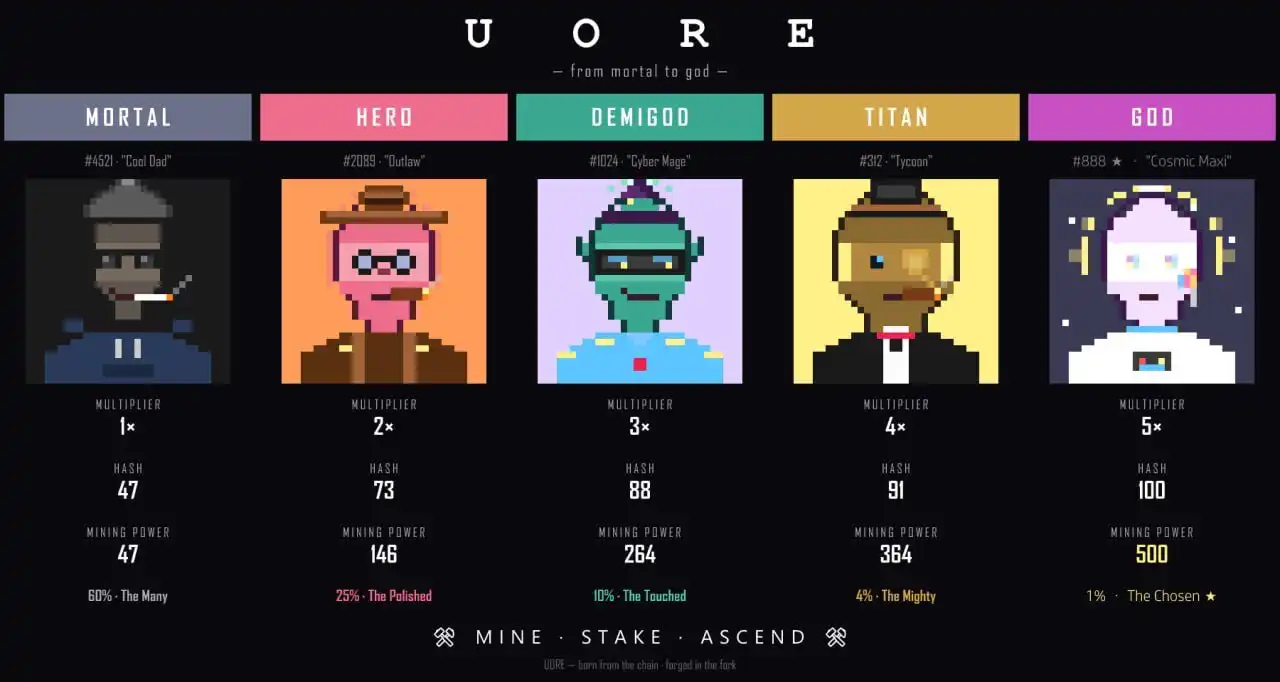
Each Oreling has a Class (rarity) and a Hash (a random number from 1 to 100). Multiplying these two gives its Mining Power.

The most common Mortal class accounts for 60% with a 1x multiplier; the rarest God class has only a 1% probability with a 5x multiplier. If you're lucky and get a God with Hash 100, your mining power is 500, more than ten times that of an ordinary miner.

So what is mining power used for? Old-school play: staking.

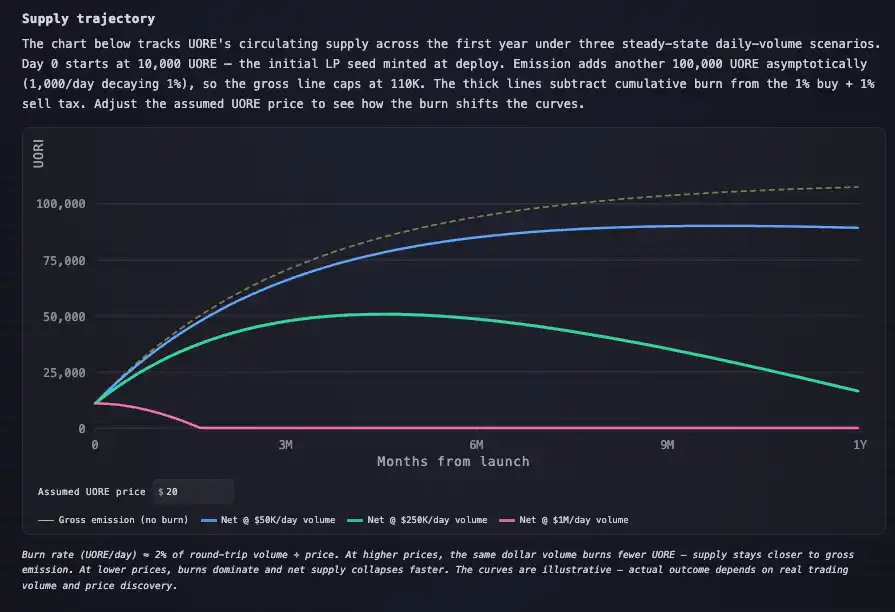
Stake your Oreling into the mining pool, and you start receiving a share of the daily UORE release based on your mining power proportion. According to the official whitepaper, 1000 UORE are released on the first day, decaying by 1% daily thereafter, with a half-life of approximately 69 days. 80% of the release is distributed to stakers, and 20% goes into the Motherlode prize pool.

This decay rate means that within a year, 97% of the total emission will be released. The earlier you enter to mine, the larger the slice you get.

A design worth noting when claiming rewards: a 10% "refining tax" is deducted and redistributed to all stakers who haven't claimed yet. The whitepaper calls this the refined-ore boost.

In plain language, those who claim later receive more of the taxes paid by others. Those in a hurry to claim are subsidizing the patient ones.

Then there's the Motherlode, translated as the "mineral vein jackpot."

Every time you buy ≥ 0.1 ETH worth of UORE through official channels, you automatically get a lottery ticket. The winning probability is tied to the purchase amount: ~1/600 for 0.1 ETH, ~1/200 for 0.5 ETH, and capped at ~1/100 for 1 ETH. Buying more than 1 ETH doesn't increase the probability, preventing whales from spamming.

If you win, the prize pool is split in two: 50% goes directly to the buyer, and 50% is randomly distributed to one staker (weighted by mining power). As of writing, there have only been 4 wins in history, with the largest prize being 6.4 UORE.

Finally, the deflationary flywheel.

A 1% tax on buys is directly burned, and a 1% tax on sells goes into a buyback treasury. When the treasury accumulates 0.1 ETH, anyone can trigger an automatic buyback, and all bought-back UORE are burned. As of writing, 58 buybacks have been executed, cumulatively burning 358 UORE.

Looking at the overall design, it's a small innovation in token-NFT gameplay, an old trick for creating scarcity, yet another Ponzi in economic model design.

The Code is Forked, The Gameplay is Stitched

UORE wasn't written from scratch.

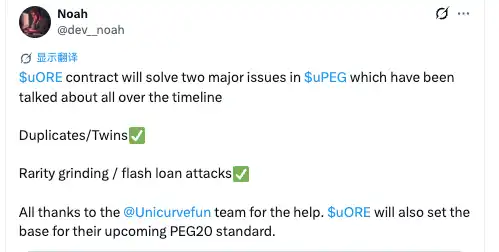
Someone in the community reviewed the source code and found a folder named `reference/unipeg-hook-source/`. The founder, Noah, hasn't hidden it either. He directly stated on Twitter that UORE's contract is forked from uPEG, and it fixed two known issues with uPEG: duplicate NFT generation and flash loan attacks to farm rarity.

Checking out this founder's account, his bio reads "Ethereum dev & BAYC holder." On May 2nd, he posted his first tweet about UORE, saying the project combines the mining concept from Solana's ORE with the V4 Hook architecture of uPEG.

He also proactively @'ed Unicurvefun and Openpeg, asking if they could support Orelings trading after their marketplaces launch.

From this public information, UORE's project lineage is clear:

Solana ORE provided the "on-chain mining + lottery" gameplay template, uPEG provided the V4 Hook code skeleton, and Noah made improvements and assembly on these two foundations.

Forking itself isn't the issue. I think the current problems are:

  1. Gas. People on CT report that each UORE transaction needs to complete six steps within the Hook, consuming two to three times the gas of a normal swap. Swapping back and forth might leave little profit.
  2. Time Window. The V4 Hook narrative, affected by uPEG's decline, will have a lower ceiling for subsequent projects. UORE is the fourth project in this wave of Hook hype, and the heat for the first three is already cooling. The attention window for the track waits for no one.
  3. Complexity. UORE might be the most mechanically intricate of these four projects. For an average user to understand the whole set of rules—Oreling rarity, mining power calculation, staking decay, refining tax, Motherlode probability, buyback trigger conditions—the barrier is high, and the official website is cryptic.

Moreover, the project whitepaper is also interesting:

"Read the contracts and understand the mechanics before deploying capital."

Translated into Chinese, this roughly means "Understand it before you come; don't blame me if you don't."

Combining this with the previous Hook projects, we can see that this wave of on-chain trends features complex mechanism design + immense information asymmetry, having alpha potential, but the shelf life of that alpha is getting shorter and shorter.

SATO gave about a week, uPEG gave a few days, and by the time we get to UORE, the time left for you to understand the rules might be just a few hours...

By the time you understand, the market move might already be over.

Связанные с этим вопросы

QWhat is the core concept of the $UORE project, and what makes it unique among other V4 Hook projects?

AThe $UORE project integrates multiple mechanisms into a single Uniswap V4 transaction. Its unique concept is bundling on-chain mining, a buy-to-enter lottery, dynamically generated pixel NFTs (Orelings), and a deflationary burn mechanism all within one trading pool. Each buy/sell transaction automatically handles token purchase, NFT minting/burning, lottery ticket allocation, and tax distribution.

QWhat is an Oreling, and how is it intrinsically linked to the $UORE token?

AAn Oreling is a 32x32 pixel miner NFT. It is directly embedded into the $UORE token: holding one full $UORE automatically grants one Oreling. You cannot buy, sell, or transfer an Oreling separately from its $UORE token. Its features, determined by the next block's hash, dictate its mining power for the staking reward system.

QExplain the staking and mining reward mechanism for $UORE/Orelings.

AUsers stake their Orelings in a mining pool. Each Oreling's mining power (calculated as Class rarity multiplier x Hash value from 1-100) determines the holder's share of daily $UORE emissions. Emission starts at 1,000 tokens per day, decaying by 1% daily. 80% of emissions go to stakers, and 20% goes to the Motherlode lottery pool. A "refined-ore boost" tax of 10% is deducted from claimed rewards and redistributed to unstaked participants, incentivizing delayed claims.

QWhat is the 'Motherlode', and how does the buy-to-enter lottery work?

AThe Motherlode is a lottery prize pool. Buying at least 0.1 ETH worth of $UORE via official channels grants one lottery ticket. The winning probability scales with the purchase amount, capped at a 1% chance for purchases of 1 ETH or more. Upon winning, the prize pool is split: 50% goes to the buyer, and 50% is randomly distributed to one staker (weighted by their mining power).

QWhat are the key risks and challenges mentioned about the $UORE project?

AThe article highlights several risks: 1) High gas fees (2-3x normal swaps) due to complex contract execution. 2) A short attention window as it's the fourth project in a potentially fading V4 Hook narrative trend. 3) High complexity and information asymmetry, making it difficult for average users to understand the full mechanics quickly. 4) Its code is a fork of the uPEG project, raising questions about novelty, though it claims to fix some of uPEG's vulnerabilities.

Похожее

Why is China's AI Developing So Fast? The Answer Lies Inside the Labs

A US researcher's visit to China's top AI labs reveals distinct cultural and organizational factors driving China's rapid AI development. While talent, data, and compute are similar to the West, Chinese labs excel through a pragmatic, execution-focused culture: less emphasis on individual stardom and conceptual debate, and more on teamwork, engineering optimization, and mastering the full tech stack. A key advantage is the integration of young students and researchers who approach model-building with fresh perspectives and low ego, prioritizing collective progress over personal credit. This contrasts with the US culture of self-promotion and "star scientist" narratives. Chinese labs also exhibit a strong "build, don't buy" mentality, preferring to develop core capabilities—like data pipelines and environments—in-house rather than relying on external services. The ecosystem feels more collaborative than tribal, with mutual respect among labs. While government support exists, its scale is unclear, and technical decisions appear driven by labs, not state mandates. Chinese companies across sectors, from platforms to consumer tech, are building their own foundational models to control their tech destiny, reflecting a broader cultural drive for technological sovereignty. Demand for AI is emerging, with spending patterns potentially mirroring cloud infrastructure more than traditional SaaS. Despite challenges like a less mature data industry and GPU shortages, Chinese labs are propelled by vast talent, rapid iteration, and deep integration with the open-source community. The competition is evolving beyond a pure model race into a contest of organizational execution, developer ecosystems, and industrial pragmatism.

marsbit1 ч. назад

Why is China's AI Developing So Fast? The Answer Lies Inside the Labs

marsbit1 ч. назад

3 Years, 5 Times: The Rebirth of a Century-Old Glass Factory

Corning, a 175-year-old glass company, is experiencing a dramatic revival as a key player in AI infrastructure, driven by surging demand for high-performance optical fiber in data centers. AI data centers require vastly more fiber than traditional ones—5 to 10 times as much per rack—to handle high-speed data transmission between GPUs. This structural demand shift, coupled with supply constraints from the lengthy expansion cycle for fiber preforms, has created a significant supply-demand gap. Nvidia has invested in Corning, along with Lumentum and Coherent, in a $4.5 billion total commitment to secure the optical supply chain for AI. Corning's competitive edge lies in its expertise in producing ultra-low-loss, high-density, and bend-resistant specialty fiber, which is critical for 800G+ and future 1.6T data rates. Its deep involvement in co-packaged optics (CPO) with partners like Nvidia further solidifies its position. While not the largest fiber manufacturer globally, Corning's revenue from enterprise/data center clients now exceeds 40% of its optical communications sales, and it has secured multi-year supply agreements with major hyperscalers including Meta and Nvidia. Financially, Corning's optical communications revenue has surged, doubling from $1.3 billion in 2023 to over $3 billion in 2025. Its stock price has risen nearly 6-fold since late 2023. Key future catalysts include the rollout of Nvidia's CPO products and the scale of undisclosed customer agreements. However, risks include high current valuations and potential disruption from next-generation technologies like hollow-core fiber. The company's long-term bet on light over electricity, maintained even through the telecom bubble crash, is now being validated by the AI boom.

marsbit1 ч. назад

3 Years, 5 Times: The Rebirth of a Century-Old Glass Factory

marsbit1 ч. назад

In the Age of AI, the Organization Itself Is the Moat

In the AI era, where products, interfaces, and narratives are easily replicated, a company's true moat is its organizational structure. The article argues that exceptional companies like OpenAI, Anthropic, and Palantir differentiate themselves not merely through technology but by inventing new organizational forms that allow a specific type of talent to thrive and become a version of themselves they couldn't elsewhere. These companies compete on identity, offering ambitious individuals a sense of being special, chosen, close to power, and part of a historic mission. However, this emotional commitment must be matched by structural commitment—real power, ownership, status, and economic participation. For founders, the key question is not how to tell a better story, but what kind of person can only truly realize their potential within their specific company structure. For individuals evaluating opportunities, the distinction between "being chosen" (an emotional feeling) and "being seen" (a structural reality of tangible power and rewards) is crucial. The most dangerous promises are those priced in future time. While AI makes copying visible elements easy, it does not make building a great, novel organization any easier. The next frontier of competition is creating organizational vessels that attract, structure, and compound the judgment of the right people—those whom traditional boxes cannot contain. The company itself becomes the moat.

marsbit2 ч. назад

In the Age of AI, the Organization Itself Is the Moat

marsbit2 ч. назад

I've Been a Divorce Lawyer for 26 Years: How Has Cryptocurrency Become a New Tool for the Wealthy to Hide Assets?

Natalie Brunell reports on insights from divorce lawyer James Sexton, who has 26 years of experience. He argues that money itself is not the root of marital breakdown; rather, emotional disconnection is the core issue. While financial hardship increases divorce risk, excessive wealth can also make divorce easier by reducing the incentive to work on the relationship. Sexton discusses financial management in marriages, advocating for transparency and a "yours, mine, and ours" system that balances shared finances with individual autonomy and privacy. He notes the growing normalization of prenuptial agreements, especially among younger generations. A significant portion focuses on cryptocurrency's role in divorce. Sexton explains that crypto became a new tool for hiding assets due to its early anonymity and complexity. He highlights that many lawyers and spouses lack understanding, allowing knowledgeable parties to gain advantages. He cites a New York legal form that only added a specific crypto disclosure field in 2026. On saving relationships, Sexton emphasizes small, consistent acts of reconnection, affirmation, and expressing appreciation, which he finds more effective than criticism. He concludes that fostering warmth and kindness is a simple yet powerful way to strengthen bonds and, in his words, "put divorce lawyers out of business."

marsbit2 ч. назад

I've Been a Divorce Lawyer for 26 Years: How Has Cryptocurrency Become a New Tool for the Wealthy to Hide Assets?

marsbit2 ч. назад

Turing Award Laureate Sutton's New Work: Using a Formula from 1967 to Solve a Major Flaw in Streaming Reinforcement Learning

New research titled "Intentional Updates for Streaming Reinforcement Learning" (arXiv:2604.19033v1), involving Turing Award laureate Richard Sutton, addresses a core challenge in deep reinforcement learning (RL): the "stream barrier." Current deep RL methods typically rely on replay buffers and batch training for stability, failing catastrophically when learning online from single data points (streaming). The authors propose a fundamental shift: instead of prescribing how far to move parameters (a fixed step size), their "Intentional Updates" method specifies the desired change in the function's output (e.g., a 5% reduction in value prediction error). It then calculates the step size needed to achieve that intent. This idea is inspired by the Normalized Least Mean Squares (NLMS) algorithm from 1967. Applied to value and policy learning, this yields algorithms like Intentional TD(λ) and Intentional AC. The method inherently stabilizes learning by adapting the step size based on the local gradient landscape, preventing overshooting/undershooting. In experiments on MuJoCo continuous control and Atari discrete tasks, Intentional AC achieved performance rivaling batch-based algorithms like SAC in a streaming setting (batch size=1, no replay buffer), while being ~140x more computationally efficient per update. The work demonstrates significant robustness, reducing reliance on numerous stabilization tricks. A remaining challenge is bias in policy updates due to action-dependent step sizes. Overall, this approach advances efficient, online, "learn-as-you-go" RL, enabling adaptive systems without massive data buffers or compute clusters.

marsbit2 ч. назад

Turing Award Laureate Sutton's New Work: Using a Formula from 1967 to Solve a Major Flaw in Streaming Reinforcement Learning

marsbit2 ч. назад

Торговля

Спот
Фьючерсы

Популярные статьи

Как купить ONE

Добро пожаловать на HTX.com! Мы сделали приобретение Harmony (ONE) простым и удобным. Следуйте нашему пошаговому руководству и отправляйтесь в свое крипто-путешествие.Шаг 1: Создайте аккаунт на HTXИспользуйте свой адрес электронной почты или номер телефона, чтобы зарегистрироваться и бесплатно создать аккаунт на HTX. Пройдите удобную регистрацию и откройте для себя весь функционал.Создать аккаунтШаг 2: Перейдите в Купить криптовалюту и выберите свой способ оплатыКредитная/Дебетовая Карта: Используйте свою карту Visa или Mastercard для мгновенной покупки Harmony (ONE).Баланс: Используйте средства с баланса вашего аккаунта HTX для простой торговли.Третьи Лица: Мы добавили популярные способы оплаты, такие как Google Pay и Apple Pay, для повышения удобства.P2P: Торгуйте напрямую с другими пользователями на HTX.Внебиржевая Торговля (OTC): Мы предлагаем индивидуальные услуги и конкурентоспособные обменные курсы для трейдеров.Шаг 3: Хранение Harmony (ONE)После приобретения вами Harmony (ONE) храните их в своем аккаунте на HTX. В качестве альтернативы вы можете отправить их куда-либо с помощью перевода в блокчейне или использовать для торговли с другими криптовалютами.Шаг 4: Торговля Harmony (ONE)С легкостью торгуйте Harmony (ONE) на спотовом рынке HTX. Просто зайдите в свой аккаунт, выберите торговую пару, совершайте сделки и следите за ними в режиме реального времени. Мы предлагаем удобный интерфейс как для начинающих, так и для опытных трейдеров.

646 просмотров всегоОпубликовано 2024.04.12Обновлено 2025.06.06

Как купить ONE

Обсуждения

Добро пожаловать в Сообщество HTX. Здесь вы сможете быть в курсе последних новостей о развитии платформы и получить доступ к профессиональной аналитической информации о рынке. Мнения пользователей о цене на ONE (ONE) представлены ниже.

活动图片