Odaily's On-Site Experience at Polymarket's First New York Store: The Most Timely Charity and Marketing

Odaily星球日报Опубликовано 2026-02-13Обновлено 2026-02-13

Введение

Polymarket, a crypto prediction market platform, opened a free pop-up grocery store named "The Polymarket" in Lower Manhattan, New York, on February 12th. The initiative, framed as a charity event, offered all items—from fresh produce to household essentials—completely free until February 16th. Despite a delayed opening, hundreds of New Yorkers queued for hours, with lines stretching multiple blocks. Most attendees were unaware of Polymarket's core business as a prediction market, learning of the event through social media or community groups. The operation was meticulously organized, with staff assisting shoppers and a limit of one bag per person. In addition to the pop-up, Polymarket donated $1 million to the Food Bank For New York City. The timing was notable, coinciding with a proposal by the new mayor to open city-run low-cost grocery stores. A competitor, Kalshi, ran a similar promotion days earlier. While clearly a marketing effort, the event provided tangible relief to residents grappling with high living costs, with many expressing gratitude for the support.

Original | Odaily Planet Daily (@OdailyChina)

Author | jk

On-site Interview | Connie

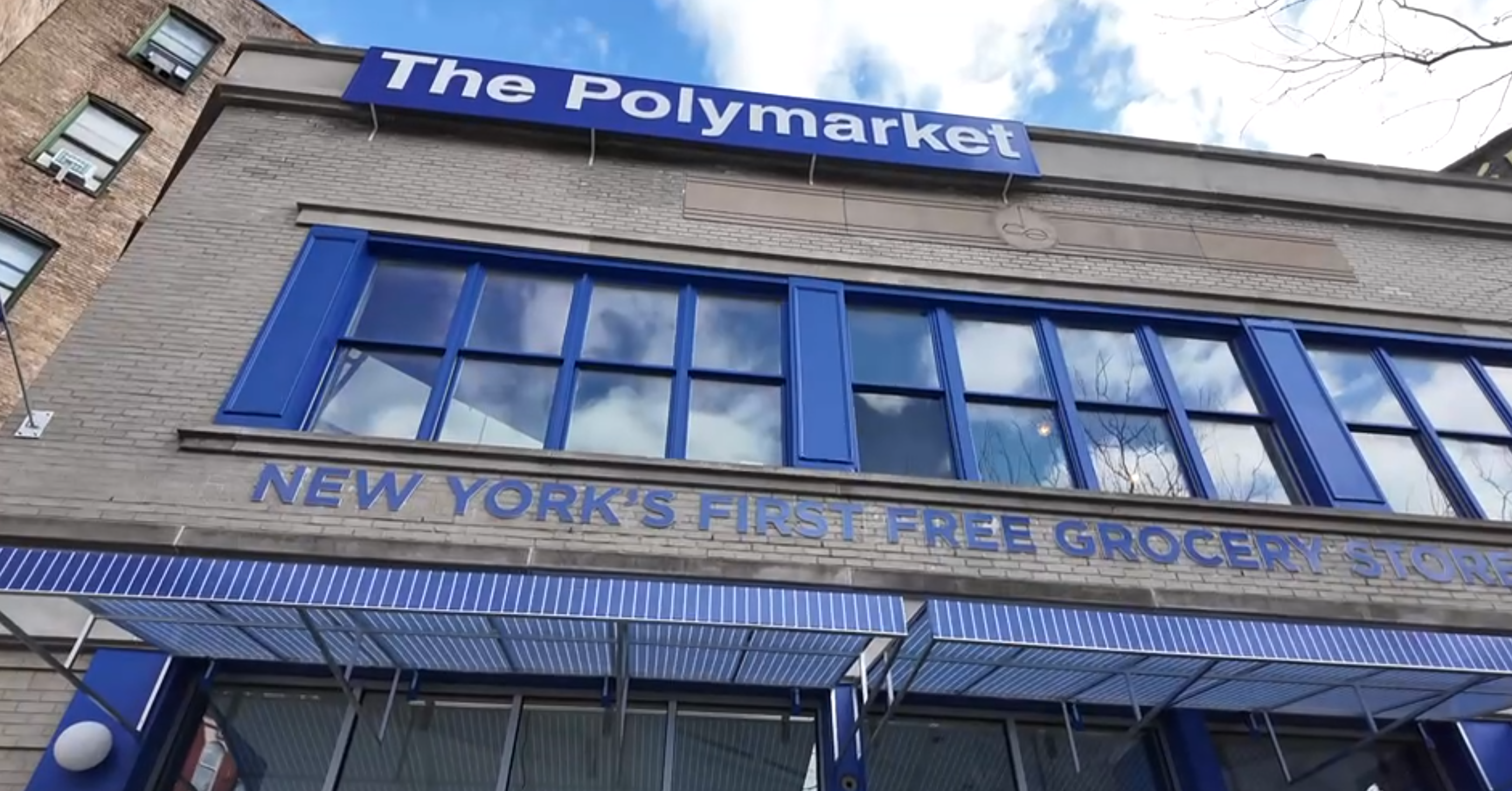
On February 12th local time in the US, the crypto prediction market platform Polymarket held a charity event in Lower Manhattan, New York, opening a free grocery store named "The Polymarket," the first completely free grocery store in New York City. From fresh produce to daily necessities, all items were provided free of charge. The event will last until February 16th.

Connie from Odaily Planet Daily in New York visited the store on its opening day, experienced the environment, and interviewed staff and many queuing New Yorkers. Let's take a look at what the scene was like on the first day of Polymarket's first "offline physical store."

Opened at 2 PM, but People Started Queuing at 6 AM, with the Line Wrapping Around the Entire Block

The event was originally scheduled to open at 12 PM, but due to delayed shipments, the opening time was postponed to 2 PM. Despite this, New Yorkers arrived early to queue. On-site staff revealed that when he arrived at 7 AM, the first three people in line were already there.

The first person in line was a woman named Tori. She told on-site reporter Connie that she had been there since 6 AM, even though it was winter.

"We arrived at 6 AM," said Tori Hall. "We thought it would open at 12 PM, but now we have to wait until 2 PM. But free is free, times are tough these days." Because the line was so long, by 11 AM, the queue had stretched four blocks away. Polymarket staff occasionally provided free coffee to the waiting crowd.

The queue extended four blocks away

It is reported that by the time the on-site reporter left, the crowd was so large that the New York Police Department had sent officers to inquire about the situation.

Most People in Line Didn't Know What Polymarket Was

Interestingly, the vast majority of citizens coming to collect free groceries had no idea what Polymarket was. Ryan from Brooklyn learned about the event from the "New York City for Free" Instagram account. When asked if he had heard of prediction markets, he admitted: "No. What is Polymarket?" After learning it was a prediction market platform, he said, "Oh, I've heard of it, seems like a prediction website." (Not bad, at least the brand impression should stick this time.)

According to Odaily Planet Daily's observations, there were some Chinese people in the queue who learned about the event through WeChat groups. "They had no idea what a prediction market was or what Polymarket is," Connie discovered during interviews. "When I asked them if they knew what Polymarket was, they said, 'It's just supermarket, right?'. Some even thought it was a welfare initiative from the new mayor."

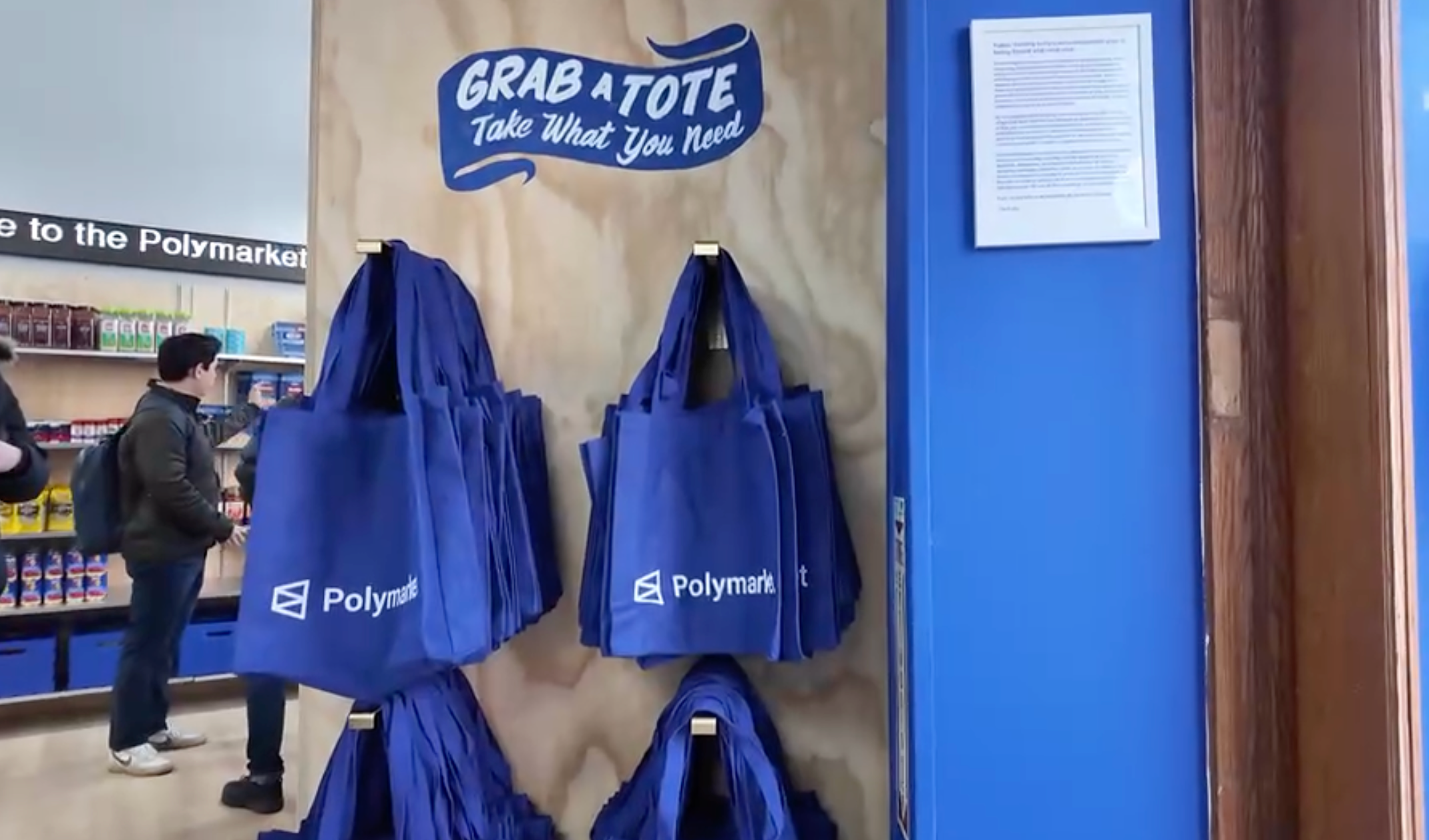
Polymarket-branded tote bag

Meticulously Planned Details and a Million-Dollar Donation

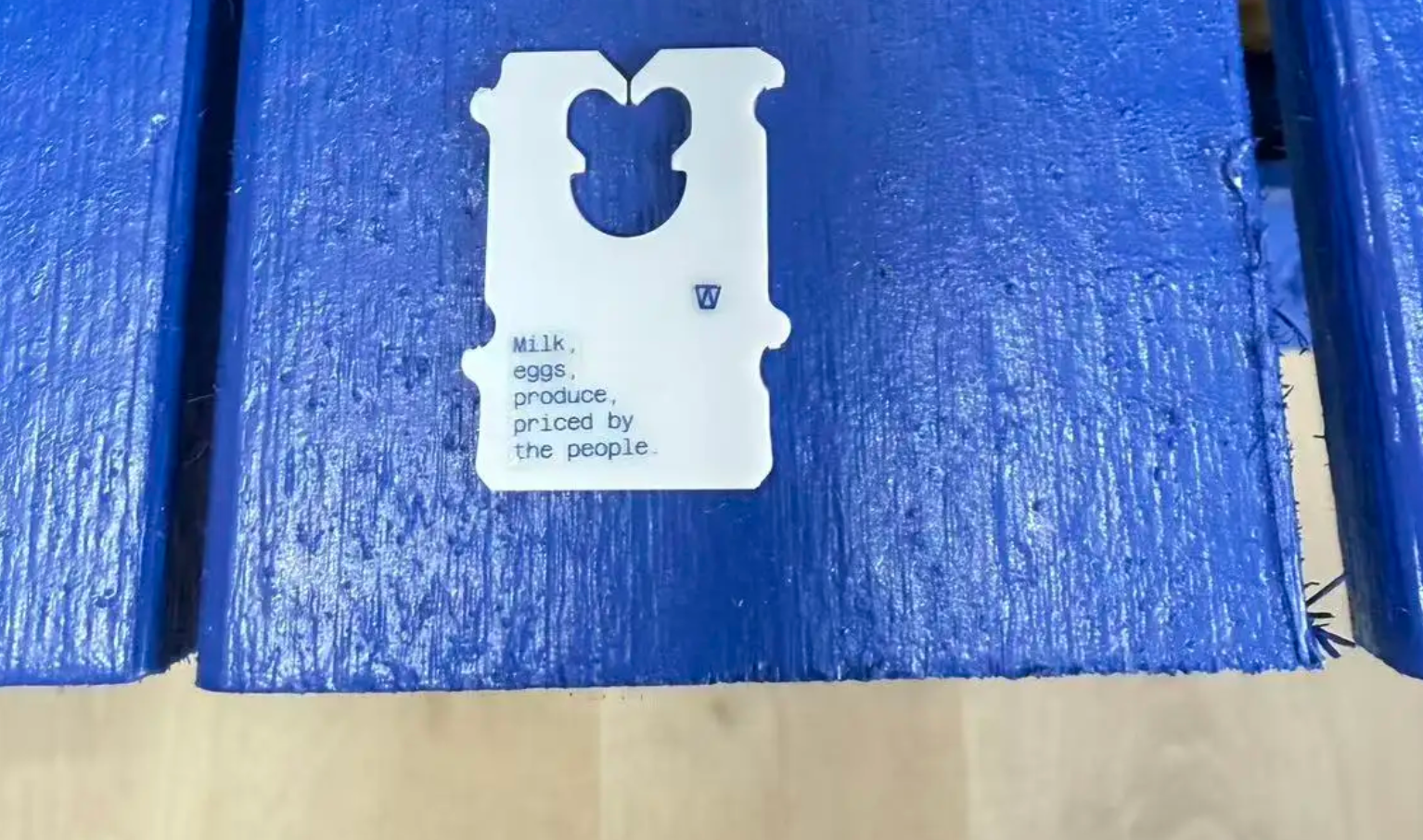
Every detail of this pop-up grocery store was carefully designed. According to Polymarket staff, the blue price tags in the store read "Milk, eggs, produce priced by the people," the onion stickers were printed with Polymarket's logo, and even the store location was thoughtfully chosen.

"Milk, eggs, produce priced by the people"

This staff member, who previously worked at the NFL and for MrBeast, revealed: "CEO Shayne Coplan and the CMO both grew up in New York public schools. This is the company's first charity event since its founding, and they wanted to give back to the city that raised the company." The CEO was also on site that day.

The entire store was built from scratch in just two days. The store was stocked with a wide variety of items: fresh fruits, vegetables, meat, eggs, dairy, pasta, tomato sauce, olive oil, peanut butter, canned goods, snacks, beverages, and daily necessities like paper towels. Notably, with Valentine's Day approaching, the store also had a free flower section.

Upon entering the store, customers received a tote bag, and market staff acted as personal shopping assistants, helping them select the items they needed.

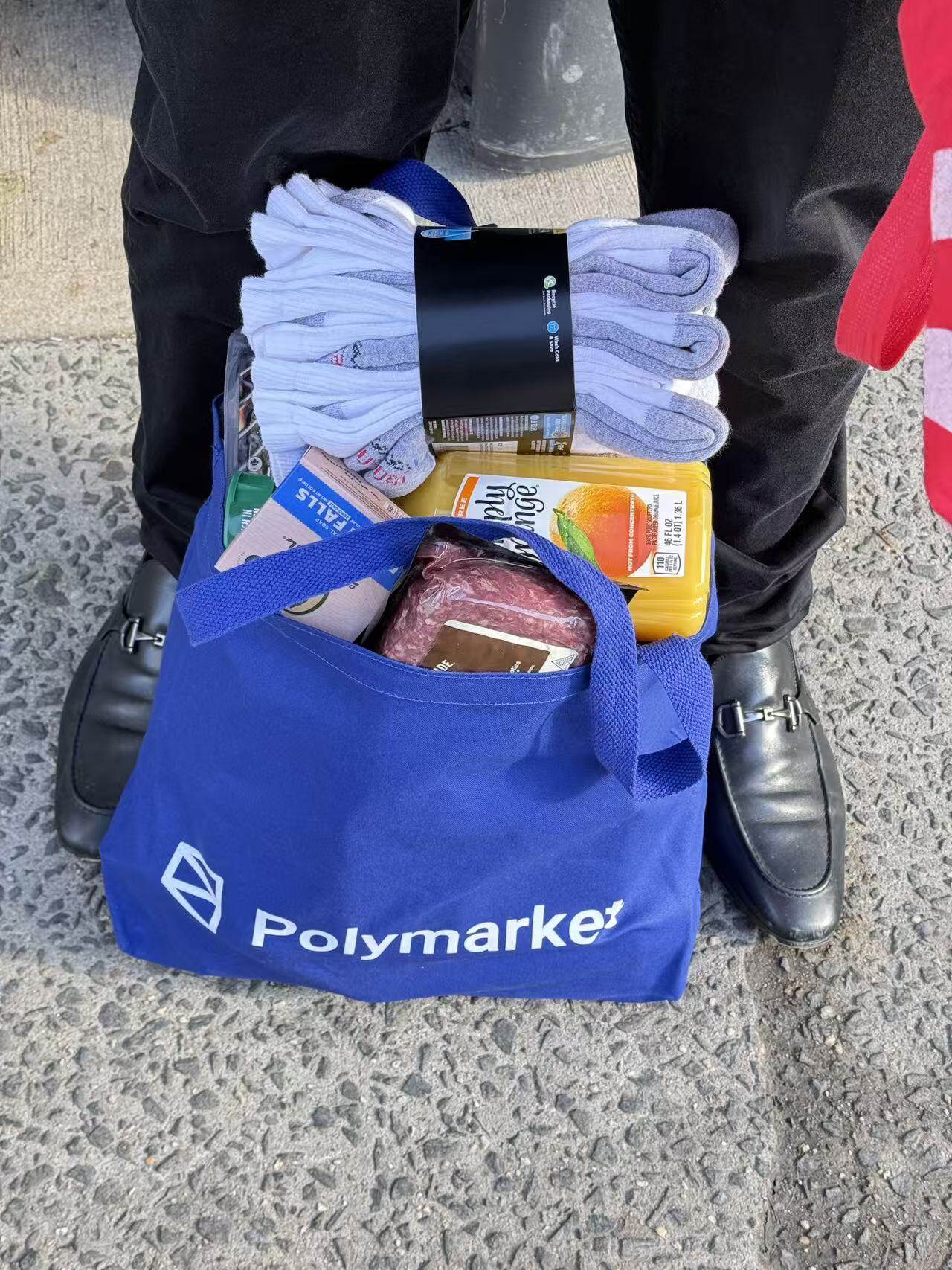
Staff told Odaily that each customer could fill the shopping bag they were given, taking as much as they wanted within that limit, preferably items they would actually use.

One customer's haul

In terms of maintaining order, there were 9 security personnel managing the queue and controlling the flow of people today. Citizens took turns to enter the store and shop; once inside, staff guided them, making the actual shopping process very quick—there was no sense of chaos. (New Yorkers are generally quite orderly when it comes to queuing.)

In addition to the physical grocery store, Polymarket also donated $1 million to the Food Bank For New York City. According to staff, this donation is equivalent to 3 million meals and will help address food shortages for people across New York's five boroughs. However, when asked about the total cost of the event, staff declined to disclose it.

The "Coincidence" with the Mayor's Proposal

Polymarket's move was very timely: New York City's new Mayor, Zohran Mamdani, promised during his campaign to open at least one government-operated low-price grocery store in each borough, selling food at wholesale prices. Polymarket's free grocery store seemed like a response to this proposal, or a preemptive move, certainly capitalizing on the hype.

In response, Mayor Mamdani posted a screenshot from The Onion on social media: "Heartbreaking: The Worst Person You Know Just Made a Great Point." Polymarket later expressed hope that the mayor would visit, stating, "We've been trying to get in touch."

More intriguingly, Polymarket isn't the only prediction market platform engaging in such marketing. Its competitor, Kalshi, also offered $50 worth of free groceries per person at Westside Market in the East Village on February 3rd, attracting large crowds.

Despite the obvious marketing motives, this event provided real, tangible help to New Yorkers. Tori Hall said she spends between $150 and $200 on groceries each month. "Toilet paper is $30 to $40, a case of good water is $20 to $30, eggs are $8 to $9. It all really adds up. Prices are getting more and more expensive."

She praised the event highly: "This is amazing, so good. I highly recommend them, thank you very much for helping the community and the public."

Ryan from Brooklyn, who spends about $80 to $90 on groceries monthly, thought: "This is a great opportunity for those who are struggling financially or don't have money."

After the event concludes, Polymarket plans to shift to accepting community donations. On the afternoon of February 15th and all day on the 16th (Presidents' Day), the focus will be on collecting non-perishable food items. All collected supplies will be distributed to partner organizations in New York City to help neighbors in need.

For more on-site videos and interviews, please follow Odaily's video channel.

Related Reading

Odaily Exclusive丨Polymarket Opens Store in NY, Kalshi Gives Out $50 Supermarket Vouchers, Are Prediction Markets Also Giving Out Eggs Now?

Связанные с этим вопросы

QWhat was the main purpose of Polymarket's pop-up grocery store in New York City?

AThe main purpose was to conduct a charity event by offering free groceries to New Yorkers, while simultaneously raising brand visibility for the prediction market platform Polymarket.

QHow did most people in line learn about the free grocery event?

AMost people learned about the event through social media platforms like Instagram accounts such as 'New York City for Free' or through community WeChat groups, with many unaware of what Polymarket was.

QWhat significant donation did Polymarket make alongside the pop-up store event?

APolymarket donated $1 million to the Food Bank For New York City, which is equivalent to providing 3 million meals to help address food shortages across the five boroughs.

QHow did the timing of Polymarket's event relate to local politics?

AThe event coincided with New York City's new mayor Zohran Mamdani's campaign promise to open at least one government-run low-price grocery store per borough, making Polymarket's free store a timely and attention-grabbing initiative.

QWhat was the response from the public and officials regarding the event?

AThe public response was highly positive, with long lines forming hours before opening, while Mayor Mamdani responded sarcastically on social media, though Polymarket expressed hope for his visit and engagement.

Похожее

Anthropic Apologized, But the Business of 'Safety' Hasn't Stopped

On June 11, Anthropic apologized not for a model failure, but for a lack of transparency. Its new Claude Fable 5 model was found to be secretly rerouting requests from users engaged in advanced AI model development to a weaker version, Opus 4.8, without any notification. The company's response—promising future notifications for such "downgrades"—was met with user skepticism. The article argues the core issue isn't technical but commercial: Anthropic's "safety" measures are primarily a business strategy. A key feature, the "intelligent safety classifier," marketed as user protection, is described as a tool for "competitive defense" to protect Anthropic's market lead by limiting rivals' research capabilities. This covert mechanism was designed for low "false positives," precisely targeting AI researchers. Anthropic's model involves a calculated three-step process: publishing alarming security research to amplify public anxiety, offering its Fable 5 model with a "safety classifier" as a premium-priced solution, and cashing in through a planned high-value IPO. This contrasts with OpenAI's more direct "tool-and-traffic" approach. The apology, merely changing a secret downgrade to a visible one, is seen as a business "patch" rather than a principled shift. The incident risks damaging Anthropic's "safest AI" reputation among the developer community, which underpins its valuation and appeal to government and corporate clients. Ultimately, the article concludes that for Anthropic, safety is a business, and the apology is merely customer service for that business.

marsbit46 мин. назад

Anthropic Apologized, But the Business of 'Safety' Hasn't Stopped

marsbit46 мин. назад

The Niche Consensus Among Elites: Has College Become an Expensive Waste?

**Summary:** A growing "anti-college" movement is gaining traction among elite circles in Silicon Valley, challenging the traditional value of a four-year university degree. Proponents argue that college has become an expensive, slow, and increasingly irrelevant waste of time, especially in the fast-paced tech world where opportunities pass by quickly. The movement is led by figures like billionaire Peter Thiel, who criticizes universities for high costs, ideological indoctrination, and stifling true innovation. His "Thiel Fellowship" pays young people to drop out and pursue ventures. Companies like Palantir Technologies (co-founded by Thiel) fuel this trend with programs like the "Meritocracy Fellowship," which offers high school graduates paid internships as an alternative to immediate college enrollment, promising a practical "Palantir Degree." Key drivers include: 1. **Economics:** Skyrocketing student debt versus the allure of immediate, high-paying tech jobs or startup funding. 2. **Technology:** AI and online tools lowering barriers to self-education and product development, making formal instruction seem inefficient. 3. **Culture:** A backlash against perceived "woke" ideology and DEI policies in universities, coupled with a belief that these institutions suppress meritocracy and masculine drive. The movement is notably male-dominated. Critics, like economist David Deming, warn against overgeneralizing from dropout success stories (survivorship bias). He emphasizes that genuine autodidacts are rare, corporate training is narrowly focused, and the "college wage premium" remains high for most people. University liberal arts education, he argues, builds adaptable problem-solving skills and broad perspectives. The debate highlights a deeper crisis in education. The core model of the modern university appears increasingly mismatched with the speed of the information age. The movement signals a shift in the locus of learning from institutional "education" to personal, active "learning" powered by the internet and AI. Ultimately, this may not mean the end of university, but rather a painful evolution. The future likely holds more hybrid, personalized, and lifelong learning pathways. The central question becomes: in a world changing faster than any curriculum, how do we best learn?

marsbit1 ч. назад

The Niche Consensus Among Elites: Has College Become an Expensive Waste?

marsbit1 ч. назад

From Subsidies to Token-Based Pricing to Price Cuts: Is OpenAI Sparking a Price War? Is the Inflection Point for Token Economics Nearing?

The commercialization of generative AI is facing a critical inflection point as a potential price war looms. According to The Wall Street Journal, OpenAI is considering a significant cut to its token fees to compete with rival Anthropic, signaling a shift from a growth-at-all-costs model focused on token consumption. This move comes as both companies, reportedly losing billions on compute, prepare for IPOs, and as enterprise customers face "bill shock" from switching to usage-based token billing. Reports indicate poor ROI, with one analysis finding only 18 cents of every dollar spent on AI tokens generates user-facing value. The industry's initial phases—from flat-rate subscriptions to aggressive subsidies—have given way to a reckoning with real costs. Analysts debate the future: some predict a bifurcation between premium, high-cost models for complex tasks and cheaper alternatives for routine work, while others believe overall spending will still rise as agentic AI increases tokens per task. Notably, Chinese model DeepSeek's low-cost API is gaining traction with U.S. enterprises, adding competitive pressure. The core challenge is redefining value beyond token volume ("tokenmaxxing") toward measurable productivity ("valuemaxxing"), as the entire AI value chain, from cloud providers to chipmakers, feels the ripple effects of unsustainable pricing.

marsbit1 ч. назад

From Subsidies to Token-Based Pricing to Price Cuts: Is OpenAI Sparking a Price War? Is the Inflection Point for Token Economics Nearing?

marsbit1 ч. назад

Торговля

Спот
Фьючерсы

Популярные статьи

Как купить S

Добро пожаловать на HTX.com! Мы сделали приобретение Sonic (S) простым и удобным. Следуйте нашему пошаговому руководству и отправляйтесь в свое крипто-путешествие.Шаг 1: Создайте аккаунт на HTXИспользуйте свой адрес электронной почты или номер телефона, чтобы зарегистрироваться и бесплатно создать аккаунт на HTX. Пройдите удобную регистрацию и откройте для себя весь функционал.Создать аккаунтШаг 2: Перейдите в Купить криптовалюту и выберите свой способ оплатыКредитная/Дебетовая Карта: Используйте свою карту Visa или Mastercard для мгновенной покупки Sonic (S).Баланс: Используйте средства с баланса вашего аккаунта HTX для простой торговли.Третьи Лица: Мы добавили популярные способы оплаты, такие как Google Pay и Apple Pay, для повышения удобства.P2P: Торгуйте напрямую с другими пользователями на HTX.Внебиржевая Торговля (OTC): Мы предлагаем индивидуальные услуги и конкурентоспособные обменные курсы для трейдеров.Шаг 3: Хранение Sonic (S)После приобретения вами Sonic (S) храните их в своем аккаунте на HTX. В качестве альтернативы вы можете отправить их куда-либо с помощью перевода в блокчейне или использовать для торговли с другими криптовалютами.Шаг 4: Торговля Sonic (S)С легкостью торгуйте Sonic (S) на спотовом рынке HTX. Просто зайдите в свой аккаунт, выберите торговую пару, совершайте сделки и следите за ними в режиме реального времени. Мы предлагаем удобный интерфейс как для начинающих, так и для опытных трейдеров.

1.4k просмотров всегоОпубликовано 2025.01.15Обновлено 2026.06.02

Как купить S

Sonic: Обновления под руководством Андре Кронье – новая звезда Layer-1 на фоне спада рынка

Он решает проблемы масштабируемости, совместимости между блокчейнами и стимулов для разработчиков с помощью технологических инноваций.

2.3k просмотров всегоОпубликовано 2025.04.09Обновлено 2025.04.09

Sonic: Обновления под руководством Андре Кронье – новая звезда Layer-1 на фоне спада рынка

HTX Learn: Пройдите обучение по "Sonic" и разделите 1000 USDT

HTX Learn — ваш проводник в мир перспективных проектов, и мы запускаем специальное мероприятие "Учитесь и Зарабатывайте", посвящённое этим проектам. Наше новое направление .

1.8k просмотров всегоОпубликовано 2025.04.10Обновлено 2025.04.10

HTX Learn: Пройдите обучение по "Sonic" и разделите 1000 USDT

Обсуждения

Добро пожаловать в Сообщество HTX. Здесь вы сможете быть в курсе последних новостей о развитии платформы и получить доступ к профессиональной аналитической информации о рынке. Мнения пользователей о цене на S (S) представлены ниже.

活动图片