NYSE-listed NovaBay pivots to crypto, rebrands as Stablecoin Development Corporation

ambcryptoОпубликовано 2026-04-03Обновлено 2026-04-03

Введение

NovaBay Pharmaceuticals, listed on the NYSE, is fully pivoting to cryptocurrency and rebranding as Stablecoin Development Corporation (ticker: SDEV). The company will shift its focus to on-chain treasury and staking activities, moving away from its legacy pharmaceutical business. As of March 16, NovaBay disclosed holdings of approximately 2.06 billion SKY tokens and is actively staking them to generate yield, adopting a DeFi-aligned strategy rather than passive crypto investment. SKY has traded in a stable range between $0.055 and $0.08, reflecting its role as a governance and yield-generating asset. This transition highlights a broader trend of public companies moving beyond Bitcoin holdings to actively participate in on-chain ecosystems.

NovaBay Pharmaceuticals is moving deeper into crypto, announcing a full strategic pivot that includes a rebrand to Stablecoin Development Corporation and a shift toward on-chain treasury and staking activities.

In a Form 8-K filing, the company said it will adopt the new name and begin trading under the ticker SDEV on the NYSE American on 3 April. The move marks a significant transition from its legacy pharmaceutical business toward a crypto-focused operating model.

From pharma to on-chain strategy

The filing shows that the company is no longer experimenting with digital assets but actively restructuring around them. NovaBay disclosed holdings of approximately 2.06 billion SKY tokens as of 16 March, alongside accumulated staking rewards.

Rather than holding crypto passively, the firm said it is engaging in “SKY-related on-chain activities,” including staking. This model allows token holders to earn yield by participating in network operations.

The shift effectively positions the company as an on-chain holding entity, aligning its treasury strategy with the mechanics of decentralized finance [DeFi].

A yield-focused crypto treasury

Unlike corporate Bitcoin strategies that focus on long-term price appreciation, NovaBay’s approach centers on yield generation. By staking its SKY holdings, the company is tapping into a recurring reward mechanism native to blockchain networks.

This structure suggests a different risk and return profile—one tied not only to token price movements but also to network activity and participation incentives.

The company did not provide detailed disclosures on how its SKY position was accumulated. Still, the scale of the holdings signals a high-conviction allocation.

SKY price reflects steady, range-bound behavior

Recent market data shows that SKY has traded within a relatively stable range compared to more volatile crypto assets.

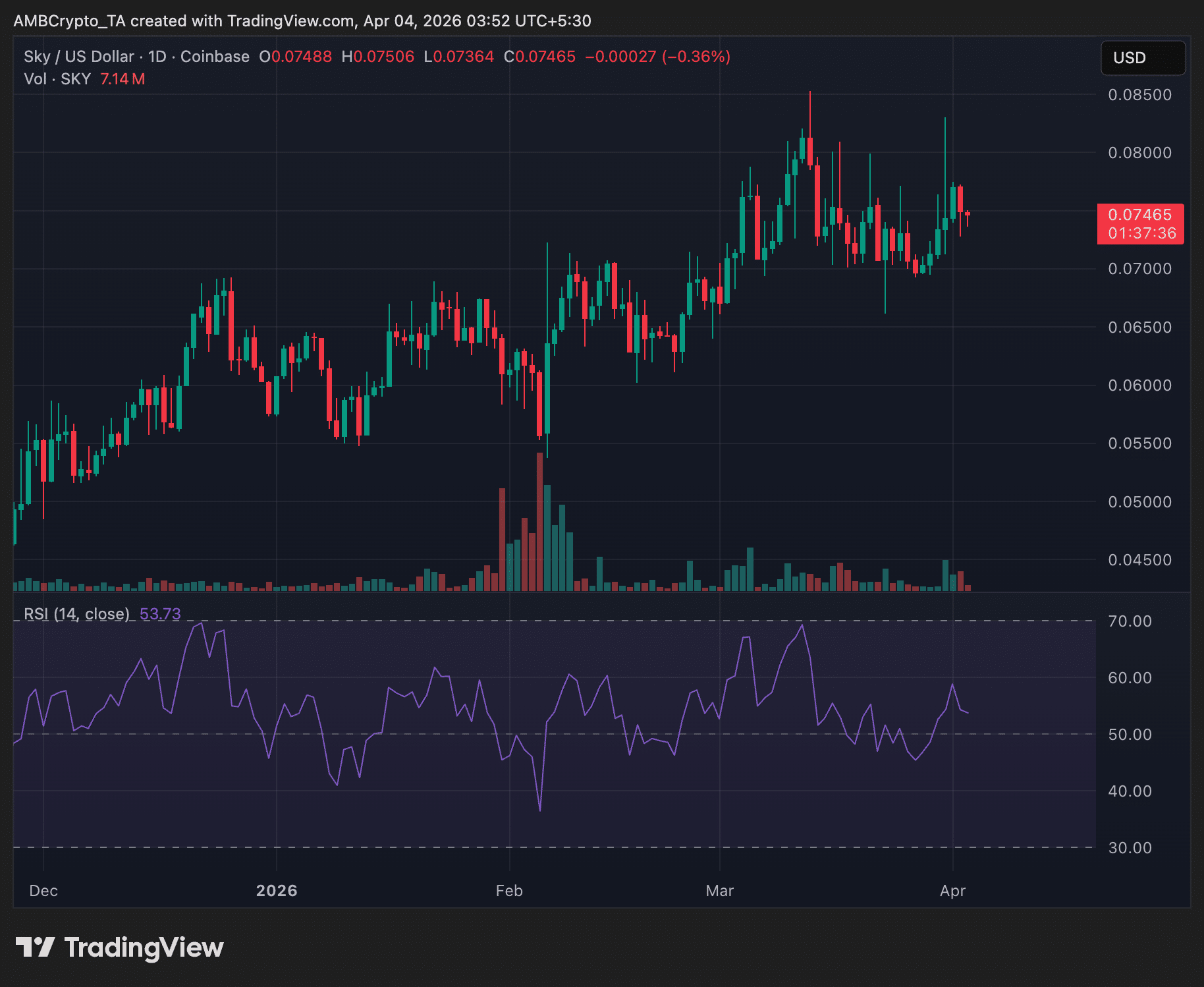
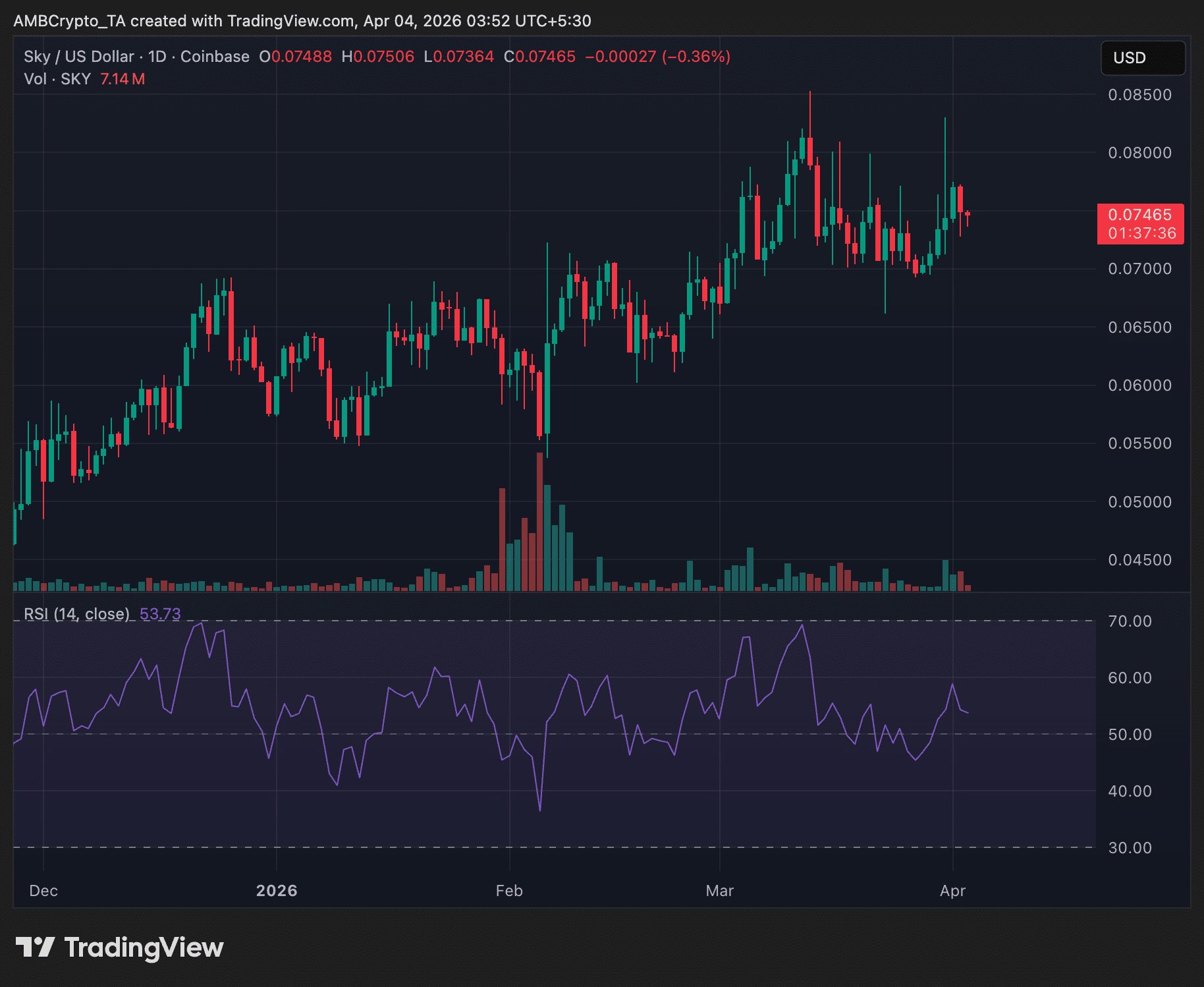
The token has largely fluctuated between $0.055 and $0.08 in recent months, with its Relative Strength Index [RSI] hovering near neutral levels around 50–55. This suggests balanced momentum rather than speculative overheating.

Source: TradingView

The relatively stable price action aligns with SKY’s role as a governance and yield-generating asset, rather than a purely narrative-driven token.

This may also underpin the company’s strategy, which appears focused on long-term participation and reward generation rather than short-term trading gains.

A broader shift in corporate crypto adoption

NovaBay’s transformation reflects a growing trend of publicly listed firms integrating crypto more directly into their core business models.

While earlier corporate adoption focused on holding Bitcoin as a treasury reserve, newer strategies are emerging that involve active participation in on-chain ecosystems — including staking, liquidity provision, and governance.

By rebranding and aligning its identity with stablecoin and DeFi infrastructure, the company is signaling a deeper commitment to this evolving model.

The transition also highlights how traditional corporate structures are increasingly intersecting with decentralized financial systems.


Final Summary

  • NovaBay is rebranding as Stablecoin Development Corporation and shifting to an on-chain treasury model built around staking and token holdings.
  • The move signals a broader evolution in corporate crypto adoption, with firms increasingly engaging in yield-generating DeFi strategies rather than passive exposure.

Связанные с этим вопросы

QWhat is the new name and ticker symbol for NovaBay Pharmaceuticals after its rebranding?

AThe new name is Stablecoin Development Corporation and it will trade under the ticker SDEV on the NYSE American.

QWhat significant change is NovaBay making to its core business model?

ANovaBay is making a full strategic pivot from its legacy pharmaceutical business to a crypto-focused operating model, centering on on-chain treasury and staking activities.

QWhat specific crypto asset does the company hold a large amount of, and how many?

AThe company disclosed holdings of approximately 2.06 billion SKY tokens as of 16 March.

QHow does NovaBay's crypto strategy differ from a typical corporate Bitcoin strategy?

AUnlike corporate Bitcoin strategies that focus on long-term price appreciation, NovaBay’s approach centers on yield generation through staking its SKY holdings to earn recurring rewards.

QWhat does the recent price action and RSI of the SKY token suggest about its market behavior?

ASKY has traded in a relatively range-bound manner between $0.055 and $0.08, with its RSI near neutral levels around 50–55, suggesting balanced momentum rather than speculative overheating.

Похожее

Super-Rich Hoarded Record Cash in February, Stock Market Hit New Highs Four Months Later: Who's Getting Fooled?

In February, the total assets in US money market funds reached a record high of approximately $8.25 trillion, a trend highlighted by high-net-worth individuals increasing their cash holdings. Notably, Warren Buffett's Berkshire Hathaway amassed a $381.7 billion cash pile ahead of his 2025 retirement, while other prominent figures like Peter Thiel sold tech stocks, fueling narratives of wealthy investors seeking safety. However, by June, the trend reversed. Money market fund assets fell to around $7.87 trillion, indicating a flow of capital back into equities. Concurrently, the S&P 500 and Nasdaq reached all-time highs, with the S&P 500 surpassing 7600 points. This market surge occurred despite the earlier defensive moves, highlighting a potential opportunity cost for those who retreated to cash. Analysis shows that since early 2022, the S&P 500's total return significantly outpaced that of prime money market funds. The capital shifted from equities appears to have been partly reallocated into alternative investments like real estate, art, and private credit, especially among ultra-high-net-worth individuals. Meanwhile, major investment banks like Goldman Sachs and Morgan Stanley have raised their year-end targets for the S&P 500, citing AI-driven earnings growth, while also cautioning about risks including market concentration and economic fragility beneath the surface rally.

marsbit18 мин. назад

Super-Rich Hoarded Record Cash in February, Stock Market Hit New Highs Four Months Later: Who's Getting Fooled?

marsbit18 мин. назад

Robot Vacuums Have Been Competing for 20 Years, So Why Are 90% of Chinese Households Still Hesitant?

The article explores why over 90% of Chinese households are still hesitant to adopt robotic vacuum cleaners despite two decades of industry development, identifying a core "trust gap" as the primary barrier. The central issue is not a lack of need, but user concerns about reliability in dynamic, real-world home environments. Common anxieties include the robot dragging pet waste, colliding with transparent objects, tangling in cords, scattering cat litter, getting stuck on thresholds, missing corners under furniture, and requiring high-maintenance bases that develop odors. The industry's past focus on competing on technical specs (suction power, mopping functions) has not adequately addressed these practical usability and trust problems. The piece then examines DJI's entry into the market with its ROMO 2 model as a potential new approach. Leveraging its expertise in spatial perception and obstacle avoidance from drones, DJI's solution emphasizes "less intervention" through three key principles: less manual re-cleaning, less user rescue missions, and less maintenance. Specific ROMO 2 features highlighted include advanced obstacle recognition (handling transparent objects and small items), adaptive leg mechanisms for climbing thresholds (up to 8.5cm), an extendable arm for reaching under furniture, AI for identifying and appropriately handling different mess types (e.g., avoiding scattering dry debris), and a self-cleaning base designed to minimize user upkeep. The article argues the next phase of competition should shift from a "parameter race" to a "trust race." It draws a parallel to the iPhone's simplification of the smartphone, suggesting that focusing on a reliable, low-hassle user experience—where people feel confident leaving their floors to the machine—is what's needed to finally convince the vast majority of观望ing families. The ultimate test for products like the ROMO 2 will be long-term user adoption, retention, and口碑, not just technical specifications.

marsbit18 мин. назад

Robot Vacuums Have Been Competing for 20 Years, So Why Are 90% of Chinese Households Still Hesitant?

marsbit18 мин. назад

The Unclear American Economy: Resilient or Cooling Down?

**U.S. Economic Outlook: Resilient or Cooling Down?** This analysis examines whether the U.S. economy is heading towards a recession. While still growing, the economy shows significant signs of strain. Key data points include Q1 2026 GDP growth of 1.6% and Q1 PCE inflation at 4.5% (annualized), more than double the Fed's target. The labor market remains resilient but is softening, with unemployment at 4.3%. Critical recession indicators present a mixed picture: the yield curve has normalized after a prolonged inversion (historically a late-cycle signal), and the Conference Board's Leading Economic Index has been declining. Current recession probability for 2026 is estimated at 19%, but rises to 41% for 2027, indicating heightened delayed risks. Major pressures are building: a wall of corporate debt refinancing at higher rates, depleted consumer savings, a contracting housing sector, and an energy price shock. The economy exhibits stagflationary characteristics—high inflation alongside slowing growth—which constrains the Federal Reserve's policy options. Historical patterns show recessions are often preceded by Fed tightening and yield curve inversions. If a recession occurs, it is expected to be mild, similar to 2001 rather than 2008. For investors, a defensive portfolio shift toward staples, healthcare, and short-term high-quality bonds may be prudent, while maintaining a long-term, diversified perspective. Key developments to monitor include upcoming GDP, employment, and inflation data, as well as policy signals from the new Fed Chair.

marsbit25 мин. назад

The Unclear American Economy: Resilient or Cooling Down?

marsbit25 мин. назад

Торговля

Спот
Фьючерсы
活动图片