Nvidia's Wednesday Earnings Night: The Battle That Decides the Fate of the AI Bull Market is Here

marsbitОпубликовано 2026-05-18Обновлено 2026-05-18

Введение

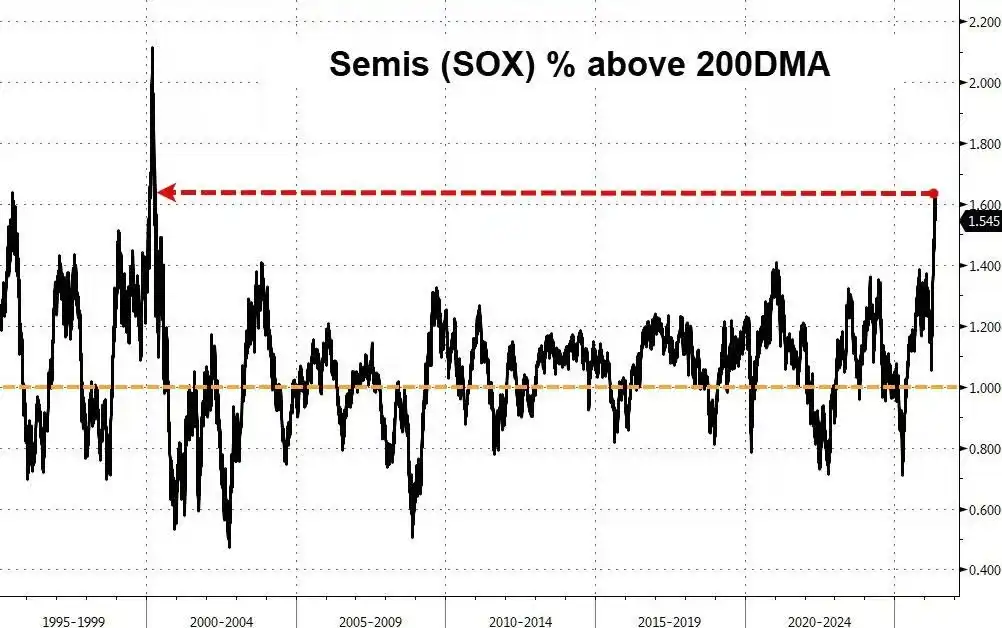
NVIDIA is set to report its quarterly earnings after the U.S. market closes on Wednesday, May 20. This event is widely seen as a crucial test for the current AI-driven bull market. The semiconductor sector is exhibiting severe technical overbought conditions, with the Philadelphia Semiconductor Index (SOX) trading approximately 60% above its 200-day moving average—the most extreme deviation since the dot-com bubble peak of 1999/2000. Market sentiment is highly concentrated on a few AI-related stocks, raising concerns about overall market breadth. Analysts highlight a key contradiction: while fundamentals for AI and semiconductors remain strong, significant technical pressures are building. Option market activity reflects this tension. Positions are heavily skewed towards bullish calls, yet there is also notable hedging activity through put options on broad indices and sector ETFs, signaling preparation for potential downside volatility. An unusual pattern of rising stock prices alongside rising implied volatility further underscores the market's expectation for a major move. For NVIDIA specifically, the market's primary focus will be on its forward guidance for the next quarter, which is deemed more critical than the immediate earnings results. Despite a recent seven-day rally adding roughly $1.7 trillion in market cap, historical data shows NVIDIA's stock has often declined the day after its past five earnings reports. The outcome of this report is expected to have a signi...

Original Author: Zhang Yaqi

Original Source: Wall Street Insights

Nvidia is set to release its quarterly report after the US market closes on Wednesday, May 20th (Eastern Time), serving as a crucial stress test for the current AI bull market cycle. The semiconductor sector's technically overbought condition, heavily bullish options positioning, and the rare signal of "stock price and implied volatility rising simultaneously" have significantly amplified the two-way risk around this earnings window compared to the past.

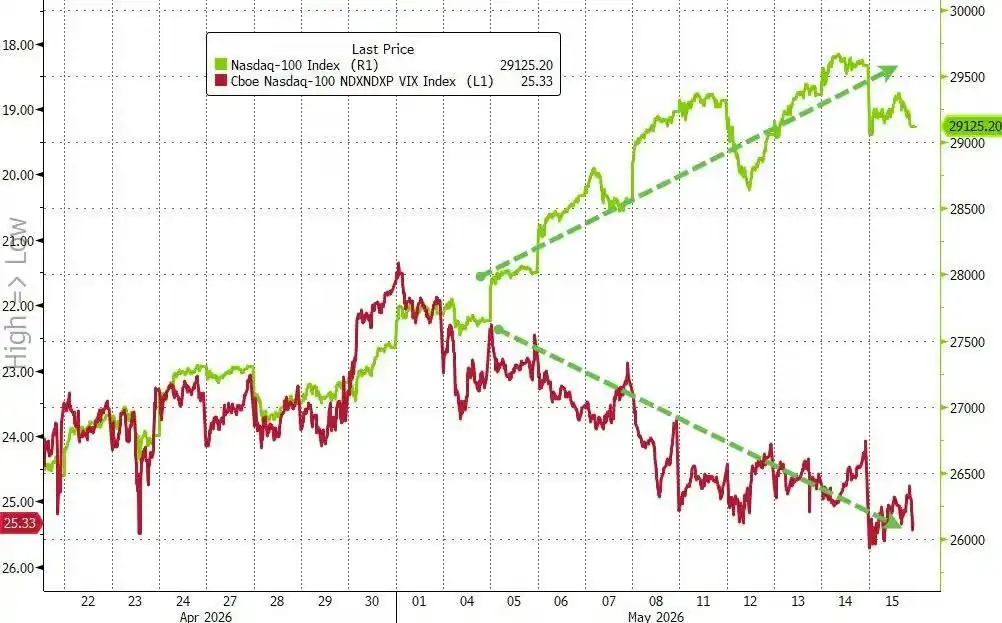
In a briefing titled "Yellow Light" issued on Monday, Peter Callahan, Goldman Sachs' TMT Chief Specialist, pointed out that the Nasdaq 100 Index (NDX) and the Philadelphia Semiconductor Index (SOX) recorded their first weekly decline of the quarter last week; the 10-year Treasury yield rose to around 4.60%, marking its largest weekly increase in over a year; oil prices rebounded to approximately $109 per barrel; and the VIX moved higher concurrently. He noted that the core contradiction currently facing the AI and semiconductor themes is: fundamentals remain robust, while technical pressure continues to accumulate.

Options analytics firm SpotGamma highlighted in a recent report that the market is exhibiting a rare parallel pattern of "rising stock prices alongside climbing volatility"—typically, these two should have an inverse relationship. This signal indicates that traders are chasing gains while simultaneously paying a premium for protection against significant volatility. The implied move around Nvidia's earnings is currently priced at +/-6%, with market attention highly focused on this event.

The earnings results and forward guidance will directly test the market's conviction in the AI computing super-cycle thesis. Given Nvidia's high correlation with the semiconductor sector and broader tech market, its earnings performance, whether positive or negative, is expected to trigger widespread ripple effects across the market.

Technical Indicators Flash Most Extreme Warning Since 1999/2000

The magnitude and speed of the recent semiconductor rally have pushed technical indicators to historically overbought extremes.

Goldman Sachs data shows the SOX index has surged approximately 70% from its late March low, adding over $5 trillion in market value along the way. Driving factors include a temporary easing of geopolitical tensions, better-than-expected corporate earnings—such as AMAT raising its full-year guidance more than anticipated and CSCO achieving 35% year-over-year growth in product orders—as well as investor confidence in AI computing demand; earnings expectations for the semiconductor industry have been revised upwards by over 25% year-to-date.

However, Peter Callahan specifically pointed out that the SOX index currently trades about 60% above its 200-day moving average, a deviation not seen since the peak of the 1999/2000 internet bubble. He also noted that Goldman Sachs' high momentum factor portfolio has experienced 12 trading days with daily moves of ±5% or more this year, accounting for nearly 15% of all trading days; the rapid expansion of leveraged ETFs and options products further amplifies this two-way volatility.

"It's worth keeping these tactical dynamics in mind ahead of the summer trading period, after this week's key earnings event (Nvidia on May 20) concludes," Callahan wrote. While Goldman's trading desk maintains a constructive medium-term view on the AI and semiconductor themes, it tactically advises investors to remain cautious regarding technical headwinds.

Nvidia Earnings: Forward Guidance May Be More Crucial Than Quarterly Results

Market optimism about Nvidia's fundamental prospects remains, but recent stock price movements have already priced in some of these expectations.

According to Goldman Sachs' Nvidia earnings preview, analysts generally expect the company's revenue for this quarter to exceed consensus estimates by approximately $2 billion—its typical historical beat margin has been around 2% to 3%. The market is more focused on forward guidance for the next quarter, with the current analyst consensus around $86 billion, implying a sequential increase of about 9%. Other key areas of focus include: potential for further upward revision to Nvidia's ~$1 trillion cumulative data center revenue target, and the narrative of accelerating Agentic AI inference demand—particularly its pure CPU rack product expected to begin shipments in the second half of 2026.

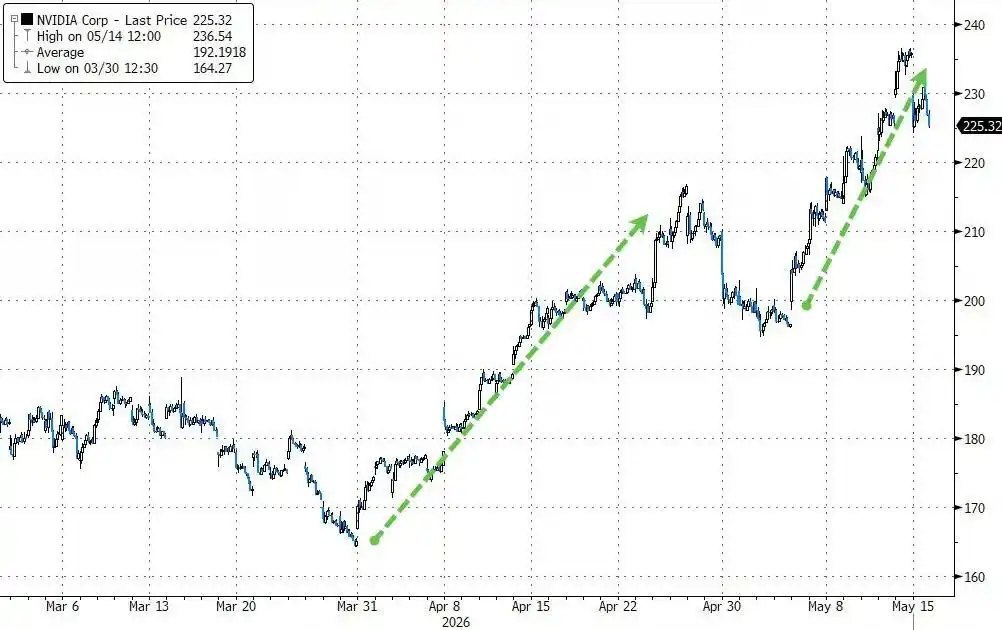
From a recent price action perspective, Nvidia has risen for seven consecutive trading days, gaining 20% during this stretch, marking its longest winning streak in nearly two years; it has added roughly $1.7 trillion in market capitalization since its late March low. However, Goldman data also shows that on the trading day following Nvidia's last five earnings reports (T+1), the stock declined four times. Since May 2022, a single-day surge triggered by earnings has not occurred.

Options Market: Extreme Bullish Bets and Tail Hedging Deployed Simultaneously

Options positioning reveals a set of inherently contradictory signals.

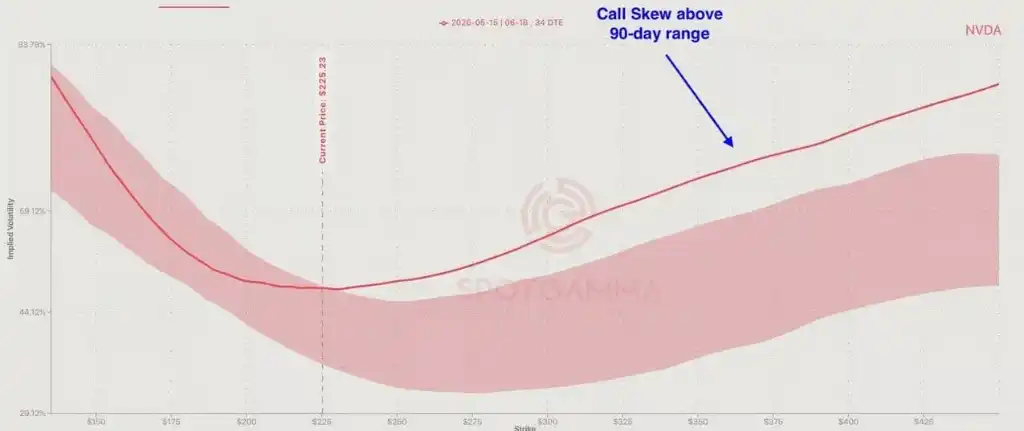
According to SpotGamma data, overall positioning remains heavily skewed towards bullish bets, with traders consistently rolling Nvidia call options to higher strike prices. The call skew remains at the high end of its 90-day historical range, while demand for downside protection is extremely limited. Data cited by 22V Research shows that nominal S&P 500 call option trading volume hit a record $2.6 trillion last Friday, with call volume accounting for 60% of total options activity; the RSI for the Philadelphia Semiconductor Index also rose to its highest level since March 2000.

Meanwhile, hedging against downside risks is also quietly underway. SpotGamma points out that significant put option structures and buying activity have increased noticeably around the S&P 500 (SPY), semiconductor ETF (SMH), and DRAM-related assets, concentrated in deep out-of-the-money strike price ranges, indicating their function is more akin to tail risk hedging rather than pure directional bets. "Market participants are not bearish on Nvidia, but preparation for downside scenarios is non-trivial," SpotGamma wrote in its report, "Any directional shift is likely to quickly spill over into the broader market."

SpotGamma adds that Nvidia has rallied over 35% from its March low, and the size of current call option positions implies that disappointing earnings or a large-scale profit-taking event could potentially trigger a significant directional reversal.

Market Breadth Concerns: Rally Supported by a Handful of Stocks

Beneath the strong performance of semiconductor and large-cap tech stocks, the lack of broad market participation is forming a structural worry.

Peter Callahan noted in his report that although the S&P 500 is up about 8% year-to-date, only about 52% of its constituents are in positive territory. Sectors significantly lagging this year include residential real estate, medical devices, engineering & construction without government business exposure, federal IT services, software & services, independent power producers, restaurant chains, commercial real estate brokerage, and insurance brokerage, among others.

Callahan admits that when examining the charts of these sectors, it makes him question whether the current market performance reflects overall "health" or simply a "funding source" effect, where investors are forced to concentrate capital in a few large-cap AI stocks. Oppenheimer's equity derivatives team similarly pointed out that only about one-fifth of S&P 500 constituents have outperformed the index over the past month, with the dispersion index rising to its highest level in over a year, while implied correlation remains near year-to-date lows. Latest data from Goldman Sachs' Prime Brokerage (PB) desk also shows a clear "risk-off" move in the tech sector recently.

Связанные с этим вопросы

QWhy is Nvidia's upcoming earnings report on May 20th considered a critical stress test for the current AI bull market?

ANvidia's earnings report is considered a critical stress test because it directly tests the market's confidence in the AI compute super-cycle. The company is highly correlated with the semiconductor and broader tech sectors, meaning its results will likely trigger significant market-wide reactions regardless of whether they are positive or negative. The market is technically overextended, with extreme bullish positioning in options, making the event a key pressure point that could determine the near-term fate of the AI bull cycle.

QWhat is the core contradiction identified by Goldman Sachs' Peter Callahan regarding the AI and semiconductor theme?

AThe core contradiction is that the fundamentals remain strong (e.g., strong corporate earnings, upward revisions to profit expectations), while technical pressures are continuously accumulating. Key technical pressures include the SOX index trading at its most extreme deviation from its 200-day moving average since the 1999/2000 internet bubble peak and heightened market concentration in a few large-cap stocks.

QWhat is the unusual market signal that SpotGamma reports, and what does it indicate about trader behavior?

ASpotGamma reports the unusual signal of stock prices rising while implied volatility simultaneously climbs. Normally, these two have an inverse relationship. This pattern indicates that while traders are chasing the rally (buying stocks/calls), they are also paying a premium to hedge against significant volatility, preparing for a potential sharp move in either direction around high-stakes events like Nvidia's earnings.

QAccording to the article, what aspect of Nvidia's report might be more crucial than the quarterly results themselves?

AThe forward guidance for the next quarter is potentially more crucial than the immediate quarterly results. While analysts expect quarterly revenue to beat estimates by a significant margin, the market's primary focus is on the guidance for the upcoming quarter (estimated at around $86 billion) and whether there is further upside to Nvidia's cumulative data center revenue target of approximately $1 trillion.

QWhat does the data on market breadth and the 'funding source' effect suggest about the health of the current U.S. stock market rally?

AThe data on market breadth suggests underlying weakness and a lack of broad participation. While the S&P 500 is up year-to-date, only about 52% of its constituents have posted gains. The rally is being driven by a narrow concentration of capital in a few large-cap AI stocks like Nvidia, creating a 'funding source' effect. This raises questions about whether the market's performance reflects overall economic health or is simply a consequence of investors being forced to crowd into a shrinking pool of high-performing names.

Похожее

BNB Chain Releases Research Report, Exploring Post-Quantum Cryptography Migration Path for BSC

BNB Chain, a leading Layer-1 blockchain ecosystem, has released a research report exploring the potential migration path for BNB Smart Chain (BSC) to post-quantum cryptography. The study evaluates replacing traditional cryptographic systems with quantum-resistant alternatives, specifically examining the use of ML-DSA-44 for transaction signing and pqSTARK for aggregating validator consensus signatures. While quantum computers are not currently a practical threat to existing blockchain cryptography, the research represents a proactive effort to ensure long-term network security and infrastructure resilience. The report assessed several core areas of the BSC tech stack, including post-quantum transaction signing, validator signature aggregation, transaction validation, public key storage, and network performance under increased data loads. A key finding is that achieving post-quantum readiness is technically feasible today but requires significant trade-offs in scalability. Test data indicates: • Transaction size would increase from ~110 bytes to ~2.5 kilobytes. • Block size would grow from ~110 kilobytes to ~2 megabytes. • Native transfer TPS would decrease from 4,973 to 2,997. The primary performance bottleneck is not signature verification itself, but the increased network transmission overhead caused by larger transaction and block sizes. Conversely, the pqSTARK aggregation technology proved highly efficient, compressing validator signatures by an approximately 43:1 ratio, which helps manage consensus-layer overhead. The report notes that post-quantum alternatives for areas like P2P handshakes and KZG commitments were not within the scope of this evaluation and require further research and broader ecosystem coordination. BNB Chain emphasizes this work is a research-oriented exploration and not a response to any imminent security threat.

marsbit49 мин. назад

BNB Chain Releases Research Report, Exploring Post-Quantum Cryptography Migration Path for BSC

marsbit49 мин. назад

After Developer Numbers Halved: Crypto Isn't Dead, It's Just Giving Up Talent to AI

The title "After a 50% Drop in Developer Count: Crypto Isn't Dead, It's Just Ceding Talent to AI" suggests a shift, not an end. The article analyzes GitHub data showing a significant drop in overall Crypto developer activity from a peak of 45K monthly active developers in 2022 to about 23K in 2026. However, this masks a deeper trend of "talent deleveraging." The exodus consists mainly of newcomers who entered during the bull market for hype-driven roles (e.g., NFT contracts, forked DeFi protocols), with over 50% of developers with less than one year of experience leaving. In contrast, established developers (2+ years of experience) have hit record highs, contributing roughly 70% of the code. They are consolidating in ecosystems with real users and revenue, like Bitcoin and Solana. These experienced builders possess unique skills forged in Crypto's "code is law" environment: the ability to build trust and functional systems from scratch in the absence of external authority or rules, with zero tolerance for error. The article argues that AI's scaling faces structurally similar trust, coordination, and verification problems—particularly regarding compute aggregation, multi-agent incentive alignment, and autonomous payments. Crypto builders are already applying these skills in AI. Examples include CoreWeave (mining to AI compute), OpenRouter (NFT marketplace routing to AI model routing), and projects like Hyperbolic (using crypto-native mechanisms for decentralized compute verification) and EigenLayer (applying restaking logic to AI agent governance). Stablecoin infrastructure is becoming critical for AI agent micro-payments (e.g., x402 protocol). The role of these builders is evolving from writing smart contracts to "designing trusted mechanisms for autonomous AI systems." This shift is reflected in new hiring trends at major exchanges and significant venture capital flowing into the crypto-AI convergence (e.g., funds from Paradigm, Haun Ventures). The article concludes that while developer numbers have halved, the core density of talent has increased, and their uniquely cultivated skills are finding a new, larger stage in the AI era.

marsbit58 мин. назад

After Developer Numbers Halved: Crypto Isn't Dead, It's Just Giving Up Talent to AI

marsbit58 мин. назад

Торговля

Спот
Фьючерсы

Популярные статьи

Как купить NIGHT

Добро пожаловать на HTX.com! Мы сделали приобретение Midnight (NIGHT) простым и удобным. Следуйте нашему пошаговому руководству и отправляйтесь в свое крипто-путешествие.Шаг 1: Создайте аккаунт на HTXИспользуйте свой адрес электронной почты или номер телефона, чтобы зарегистрироваться и бесплатно создать аккаунт на HTX. Пройдите удобную регистрацию и откройте для себя весь функционал.Создать аккаунтШаг 2: Перейдите в Купить криптовалюту и выберите свой способ оплатыКредитная/Дебетовая Карта: Используйте свою карту Visa или Mastercard для мгновенной покупки Midnight (NIGHT).Баланс: Используйте средства с баланса вашего аккаунта HTX для простой торговли.Третьи Лица: Мы добавили популярные способы оплаты, такие как Google Pay и Apple Pay, для повышения удобства.P2P: Торгуйте напрямую с другими пользователями на HTX.Внебиржевая Торговля (OTC): Мы предлагаем индивидуальные услуги и конкурентоспособные обменные курсы для трейдеров.Шаг 3: Хранение Midnight (NIGHT)После приобретения вами Midnight (NIGHT) храните их в своем аккаунте на HTX. В качестве альтернативы вы можете отправить их куда-либо с помощью перевода в блокчейне или использовать для торговли с другими криптовалютами.Шаг 4: Торговля Midnight (NIGHT)С легкостью торгуйте Midnight (NIGHT) на спотовом рынке HTX. Просто зайдите в свой аккаунт, выберите торговую пару, совершайте сделки и следите за ними в режиме реального времени. Мы предлагаем удобный интерфейс как для начинающих, так и для опытных трейдеров.

374 просмотров всегоОпубликовано 2025.12.08Обновлено 2025.12.08

Как купить NIGHT

Обсуждения

Добро пожаловать в Сообщество HTX. Здесь вы сможете быть в курсе последних новостей о развитии платформы и получить доступ к профессиональной аналитической информации о рынке. Мнения пользователей о цене на NIGHT (NIGHT) представлены ниже.

活动图片