Nvidia's Wednesday 'Big Test': The Battle That Will Determine the Fate of the AI Bull Market is Here!

marsbitОпубликовано 2026-05-19Обновлено 2026-05-19

Введение

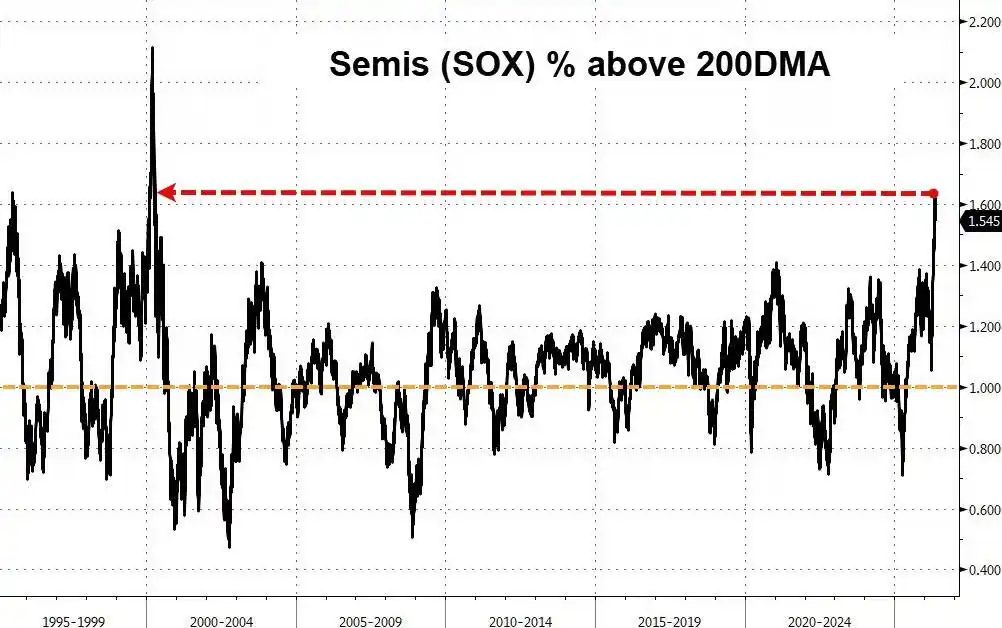
NVIDIA Faces Key AI Bull Market Test with Wednesday Earnings Report NVIDIA is set to release its quarterly earnings after the market close on Wednesday, May 20th (US Eastern Time). This report is seen as a critical stress test for the current AI-driven bull market cycle. The semiconductor sector is technically severely overbought, with extremely bullish options positioning. The rare signal of stock prices and implied volatility rising simultaneously indicates significantly amplified two-way risk around this earnings event. The core tension identified by analysts is strong fundamental demand for AI versus mounting technical pressures. The Philadelphia Semiconductor Index (SOX) is trading approximately 60% above its 200-day moving average, a deviation not seen since the peak of the dot-com bubble in 1999/2000. While NVIDIA's current quarter revenue is expected to beat estimates by a substantial margin, market focus is intensely on the guidance for the next quarter. Historically, NVIDIA's stock has frequently declined on the day following its last five earnings reports. The options market presents contradictory signals: extreme bullish call skew persists, yet there is notable activity in tail-risk hedging via put options on broader indices and semiconductor ETFs. This suggests traders are chasing gains while simultaneously preparing for potential sharp volatility. A broader market concern is narrowing breadth. Despite the S&P 500's YTD gain, only about half of its constitue...

Nvidia will release its quarterly report after the market closes on Wednesday, May 20th (Eastern Time), marking a crucial stress test for the current AI bull market cycle.

The semiconductor sector is severely overbought technically, options positioning is heavily skewed towards bullish bets, and a rare signal of "stock price and implied volatility rising simultaneously" has significantly amplified two-way risks around this earnings window compared to the past.

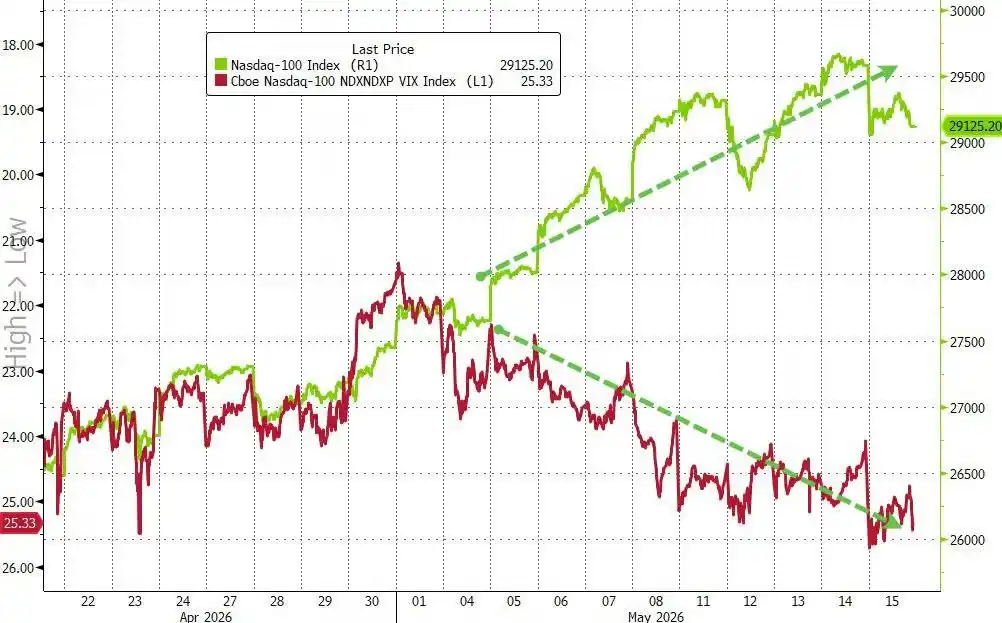
Peter Callahan, Goldman Sachs' TMT chief expert, released a brief titled "Yellow Light" on Monday, noting that the Nasdaq 100 Index (NDX) and the Philadelphia Semiconductor Index (SOX) recorded their first weekly decline of the quarter last week; the 10-year US Treasury yield rose to about 4.60%, marking its largest weekly gain in over a year; oil prices rebounded to around $109 per barrel; and the VIX also climbed.

He pointed out that the core contradiction facing the AI and semiconductor themes currently is: fundamentals remain strong, while technical pressure continues to accumulate.

Options analysis firm SpotGamma noted in a recent report that the market is displaying a rare concurrent pattern of "rising stock prices with simultaneously climbing volatility"—typically, the two should have an inverse relationship. This signal indicates that traders are chasing the rally while also paying a premium for protection against significant volatility.

Nvidia's earnings report currently implies a volatility move of around 6%, with market attention highly concentrated on this timing.

The earnings results and forward guidance will directly test the market's conviction in the AI computing super-cycle thesis. Given Nvidia's high correlation with the semiconductor and broader technology sectors, its earnings performance, whether positive or negative, is expected to trigger widespread ripple effects across the market.

1. Technical Indicators Flash Most Extreme Warning Since 1999/2000

The magnitude and speed of the recent semiconductor rally have pushed technical indicators to historically overbought levels.

Goldman Sachs data shows that the SOX index has surged approximately 70% from its late March low, adding over $5 trillion in market value along the way.

Driving factors include a temporary easing of geopolitical tensions, better-than-expected corporate earnings—such as AMAT raising its full-year guidance more than expected, CSCO reporting a 35% year-over-year growth in product orders—and investors' growing confidence in AI computing demand; earnings expectations for the semiconductor industry have been revised upwards by over 25% year-to-date.

However, Peter Callahan specifically pointed out that the SOX index is currently about 60% above its 200-day moving average, a deviation magnitude not seen since the peak of the dot-com bubble in 1999/2000.

He also noted that Goldman Sachs' high-momentum factor portfolio has experienced 12 trading days with intraday swings exceeding ±5% year-to-date, accounting for nearly 15% of the year's trading sessions; the rapid expansion of leveraged ETFs and options products has further amplified this two-way elasticity.

"It's worth keeping these tactical dynamics in mind heading into summer trading as this week's earnings season (Nvidia, May 20th) concludes," Callahan wrote. While Goldman's trading desk maintains a constructive medium-term stance on the AI and semiconductor theme, it advises investors to remain tactically cautious about technical challenges.

2. Nvidia Earnings: Forward Guidance May Be More Critical Than Current Quarter Results

The market remains optimistic about Nvidia's fundamental outlook, but recent stock price movements have already priced in some of these expectations to an extent.

According to Goldman Sachs' Nvidia earnings preview report, analysts generally expect Nvidia's revenue this quarter to exceed market estimates by about $2 billion—historically, the company's beat margin has typically been between 2% and 3%.

The market is more focused on the forward guidance for the next quarter, with the current analyst consensus estimate around $86 billion, representing a sequential increase of about 9%.

Other areas of focus include: whether there is further upside to Nvidia's cumulative data center revenue guidance of approximately $1 trillion, and the narrative of accelerating Agentic AI inference demand—especially its pure CPU rack products expected to begin shipping in the second half of 2026.

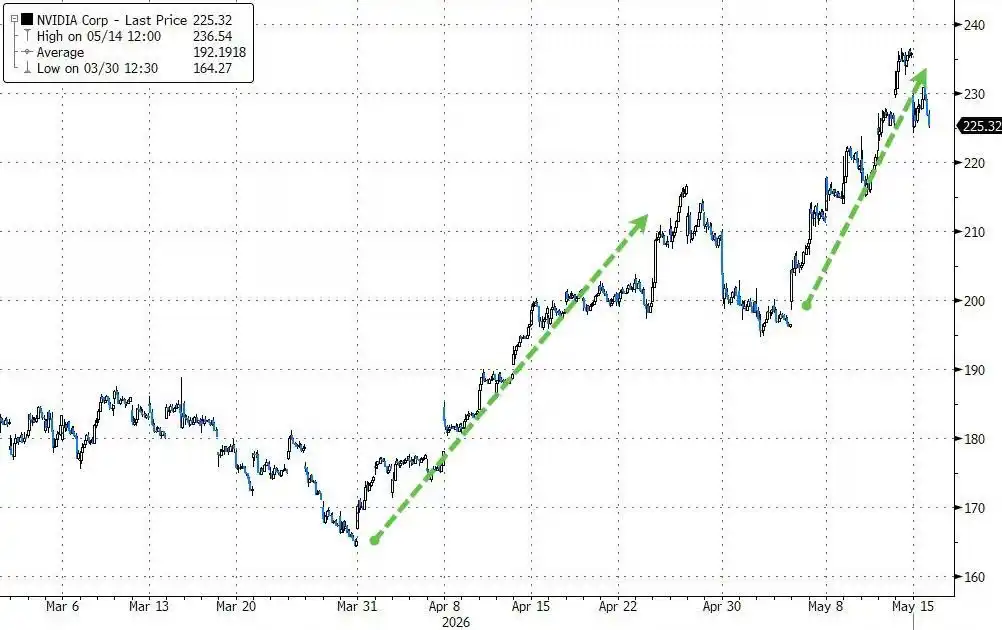
Looking at recent price action, Nvidia has risen for seven consecutive trading days, gaining 20% over that period, marking its longest winning streak in nearly two years; the stock has added about $1.7 trillion in market value since its late March low.

However, Goldman Sachs data also shows that in the trading session (T+1) following Nvidia's past five earnings releases, the stock declined four times. In fact, significant single-day rallies triggered by earnings reports have not occurred since May 2022.

3. Options Market: Extreme Bullish Bets and Tail Hedging Simultaneously in Place

The options positioning structure presents a set of inherently contradictory signals.

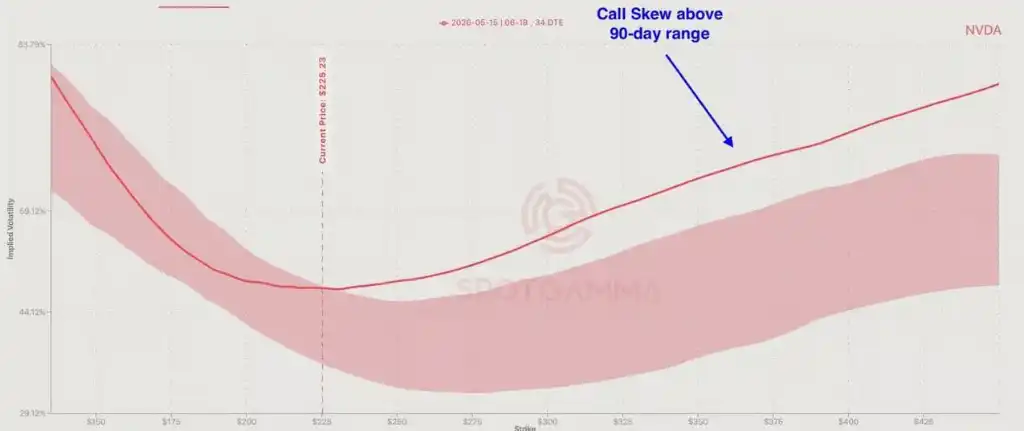
According to SpotGamma data, the overall positioning direction remains extremely skewed towards bullish bets, with traders continuously rolling Nvidia call options to higher strike prices. Call skew remains at the high end of its 90-day historical range, while demand for downside protection is extremely limited.

Citing data, 22V Research reported that last Friday saw a record $2.6 trillion in notional call option volume for the S&P 500, with call options making up a high 60% of total options volume; the Philadelphia Semiconductor Index's RSI also rose to its highest level since March 2000.

At the same time, hedging against downside risks is also quietly underway.

SpotGamma points out that significant put option structures and buying activity have noticeably increased around the S&P 500 (SPY), semiconductor ETF (SMH), and DRAM-related assets, concentrated in deep out-of-the-money strike price ranges, indicating their function is closer to tail risk hedging rather than purely directional bets. "Market participants are not bearish on Nvidia, but preparation for downside scenarios is not trivial," SpotGamma wrote in its report. "Any directional shift will almost immediately ripple through the broader market."

SpotGamma added, Nvidia has risen over 35% since its March low, and the size of current call option positioning implies that if earnings disappoint the market or trigger large-scale profit-taking, it could potentially trigger a significant directional reversal.

4. Market Breadth Concerns: Rally Supported by a Handful of Stocks

Beneath the strong performance of semiconductors and large-cap tech stocks, a lack of broad market participation is creating structural concerns.

Peter Callahan noted in his report that while the S&P 500 is up about 8% year-to-date, only about 52% of its constituents have posted positive returns. Sectors that have significantly lagged year-to-date span residential real estate, medical devices, engineering & construction without government exposure, federal IT services, software & services, independent power producers, restaurant chains, commercial real estate brokers, and insurance brokers, among others.

Callahan admits that when reviewing the charts of these sectors, it makes him question whether the current market performance reflects overall "health" or is merely a "funding source" effect where investors are forced to concentrate capital in a few large-cap AI stocks.

Oppenheimer's equity derivatives team also pointed out that only about one-fifth of S&P 500 constituents outperformed the index over the past month, the dispersion index rose to its highest level in over a year, while implied correlation hovered near year-to-date lows.

Latest data from Goldman Sachs' Prime Brokerage (PB) department also shows clear signs of "risk-off" activity in the technology sector recently.

Связанные с этим вопросы

QAccording to the article, what is the core contradiction currently faced by the AI and semiconductor theme?

AThe core contradiction is that the fundamentals remain strong while technical pressure continues to build up.

QWhat does the article state is a key technical warning sign for the semiconductor sector, comparing it to a historical period?

AThe SOX index is currently trading about 60% above its 200-day moving average, a deviation magnitude not seen since the peak of the 1999/2000 internet bubble.

QRegarding Nvidia's upcoming earnings, what does the article suggest might be even more crucial than the actual quarterly results?

AThe market's focus is more on the forward guidance for the next quarter, which analysts currently expect to be around $86 billion, representing a sequential growth of about 9%.

QWhat contradictory signals are observed in the options market positioning around Nvidia?

AThe positioning is extremely bullish with call skew at the high end of its historical range, but there is also a noticeable build-up of deep out-of-the-money put options on related assets for tail-risk hedging.

QWhat concern does the article raise about the breadth of the current US stock market rally?

AThe concern is that the rally is being supported by only a few large-cap AI stocks, with many sectors underperforming, raising questions about the overall health of the market versus a 'funding source' effect.

Похожее

Google Officially Declares War

Google Declares War with AI-First I/O 2026 At its 2026 I/O developer conference, Google launched an aggressive, multi-pronged offensive, embedding AI across its ecosystem and challenging rivals on performance and price. The event showcased three major releases: Gemini 3.5 Flash, the video-centric Gemini Omni Flash, and the system-level AI assistant Spark. Gemini 3.5 Flash, despite being a smaller "Flash" model, outperforms its Pro counterpart in key benchmarks like mathematical reasoning (GSM8K) and coding (SWE-bench). Google attributes this to "extreme knowledge distillation" from a larger teacher model and a novel, highly granular MoE (Mixture of Experts) architecture with 256 experts, achieving sub-65ms response times. The native multi-modal model, Gemini Omni Flash, offers real-time video understanding with 120ms latency, enabling applications like preventing a cup from overfilling. The new Spark assistant gains deep Android system integration, allowing it to automate complex multi-app workflows based on voice commands. Complementing these, Google unveiled lightweight AI glasses featuring Micro-OLED displays and on-device Gemini chips for instant, offline translation and scene analysis. CEO Sundar Pichai announced Gemini has reached 900 million monthly active users, leveraged through integration into Chrome, Android, and Workspace. Google also slashed prices dramatically: the Gemini 3.5 Flash API is priced at a fraction of competitor rates. This price war is enabled by Google's vertically integrated TPU infrastructure. The strategy signals a shift: standalone AI models are becoming commoditized. Google's advantage lies in its "device + cloud + ecosystem + hardware" integration, aiming to reshape internet traffic from user-initiated searches to AI-driven service distribution. This move pressures pure-play AI firms like OpenAI and Anthropic on business models, and challenges Apple to respond in the next-generation, screen-less device race.

链捕手14 мин. назад

Google Officially Declares War

链捕手14 мин. назад

Top 10 Promising Emerging Hyperliquid Native Protocols to Watch

Title: A Review of 10 Emerging Native Protocols on Hyperliquid Hyperliquid is evolving beyond perpetual contracts into a comprehensive on-chain financial stack. This article highlights 10 key native protocols driving this growth: 1. **Monetrix**: A yield-optimizing protocol akin to Ethena, aggregating funding rates, HLP rewards, maker rebates, and HIP-3 into a single stablecoin yield. 2. **ROSETTA**: An automated stablecoin yield router, allocating USDC across top protocols (e.g., Felix, Aave, HLP) for optimal returns, factoring in gas and slippage. 3. **papertrade.xyz**: A fair-launched perpetuals protocol offering up to 1000x leverage, no funding rates, no slippage, and fully on-chain, oracle-based execution. 4. **alt.fun**: A launchpad where tokens are paired with leveraged perpetual positions (2x-5x), linking token price to trading activity and underlying position performance. 5. **Ventuals**: Pre-IPO perpetual contracts (built on HIP-3) allowing up to 10x leveraged speculation on valuations of private companies like SpaceX and Stripe. 6. **Liminal**: A delta-neutral yield protocol that captures funding rates via automated short positions and uses generated xTokens (xBTC, etc.) as DeFi collateral. 7. **Melt**: Brings tokenized stocks, commodities, and RWAs to Hyperliquid spot markets, enabling 24/7 trading alongside crypto assets. 8. **Chainsight**: An oracle and data infrastructure protocol providing low-latency (<3s) price feeds, volatility indices, and risk metrics for novel derivatives. 9. **rip.xyz**: Tokenized vault strategies on HyperEVM; its flagship rHYPURR offers liquidity and fractional exposure to a Hypurr NFT basket, priced hourly via NAV. 10. **Markets**: A perpetuals exchange (by Kinetiq) for trading stocks, forex, commodities, bonds, and crypto with up to 50x leverage, using USDH collateral and Kaiko oracles. These protocols form the foundational layer for generating real yield, liquidity, and innovative financial products natively on Hyperliquid.

marsbit1 ч. назад

Top 10 Promising Emerging Hyperliquid Native Protocols to Watch

marsbit1 ч. назад

Musk Posted a Recruitment Ad for SpaceX, and After Reading the Comments Section, I Understood

On May 20th, SpaceX filed for a landmark IPO with a $1.75 trillion valuation. Shortly after, Elon Musk posted a recruitment call on X, seeking "world-class engineers and physicists" for SpaceX. The application process was starkly simple: email with three bullet points proving "exceptional ability," with real, complex projects as a plus. Musk promised to review qualifying emails himself. The post garnered millions of views and thousands of replies, revealing a spectrum of responses. Most comments, including a highly-upvoted humorous one listing absurd "skills," merely listed credentials or experiences in a conventional, non-differentiating way. This highlighted a key insight: a traditional resume listing degrees and skills often fails to demonstrate true exceptionalism. Effective self-presentation requires "performance efficiency." A standout reply came from an OpenAI engineering lead, who simply stated "codex." This demonstrated that for those who have built significant, recognized products, the product itself becomes the ultimate resume. The article argues that in the AI era, any tangible, shareable output—a tool, research, or online project—serves as a living, self-evident credential more powerful than a list of attributes. However, a twist emerged when applicants found the provided email address non-functional, leading to speculation that the post might also serve as an IPO publicity stunt, projecting an image of aggressive talent acquisition to investors. Ultimately, the episode served as a microcosm: some participate through performance, others through proof of work, while some question the reality of the stage itself. It underscores the enduring challenge of defining and demonstrating value in an age of abundant, yet often superficial, content.

marsbit2 ч. назад

Musk Posted a Recruitment Ad for SpaceX, and After Reading the Comments Section, I Understood

marsbit2 ч. назад

Торговля

Спот
Фьючерсы

Популярные статьи

Как купить S

Добро пожаловать на HTX.com! Мы сделали приобретение Sonic (S) простым и удобным. Следуйте нашему пошаговому руководству и отправляйтесь в свое крипто-путешествие.Шаг 1: Создайте аккаунт на HTXИспользуйте свой адрес электронной почты или номер телефона, чтобы зарегистрироваться и бесплатно создать аккаунт на HTX. Пройдите удобную регистрацию и откройте для себя весь функционал.Создать аккаунтШаг 2: Перейдите в Купить криптовалюту и выберите свой способ оплатыКредитная/Дебетовая Карта: Используйте свою карту Visa или Mastercard для мгновенной покупки Sonic (S).Баланс: Используйте средства с баланса вашего аккаунта HTX для простой торговли.Третьи Лица: Мы добавили популярные способы оплаты, такие как Google Pay и Apple Pay, для повышения удобства.P2P: Торгуйте напрямую с другими пользователями на HTX.Внебиржевая Торговля (OTC): Мы предлагаем индивидуальные услуги и конкурентоспособные обменные курсы для трейдеров.Шаг 3: Хранение Sonic (S)После приобретения вами Sonic (S) храните их в своем аккаунте на HTX. В качестве альтернативы вы можете отправить их куда-либо с помощью перевода в блокчейне или использовать для торговли с другими криптовалютами.Шаг 4: Торговля Sonic (S)С легкостью торгуйте Sonic (S) на спотовом рынке HTX. Просто зайдите в свой аккаунт, выберите торговую пару, совершайте сделки и следите за ними в режиме реального времени. Мы предлагаем удобный интерфейс как для начинающих, так и для опытных трейдеров.

1.3k просмотров всегоОпубликовано 2025.01.15Обновлено 2025.03.21

Как купить S

Sonic: Обновления под руководством Андре Кронье – новая звезда Layer-1 на фоне спада рынка

Он решает проблемы масштабируемости, совместимости между блокчейнами и стимулов для разработчиков с помощью технологических инноваций.

2.2k просмотров всегоОпубликовано 2025.04.09Обновлено 2025.04.09

Sonic: Обновления под руководством Андре Кронье – новая звезда Layer-1 на фоне спада рынка

HTX Learn: Пройдите обучение по "Sonic" и разделите 1000 USDT

HTX Learn — ваш проводник в мир перспективных проектов, и мы запускаем специальное мероприятие "Учитесь и Зарабатывайте", посвящённое этим проектам. Наше новое направление .

1.8k просмотров всегоОпубликовано 2025.04.10Обновлено 2025.04.10

HTX Learn: Пройдите обучение по "Sonic" и разделите 1000 USDT

Обсуждения

Добро пожаловать в Сообщество HTX. Здесь вы сможете быть в курсе последних новостей о развитии платформы и получить доступ к профессиональной аналитической информации о рынке. Мнения пользователей о цене на S (S) представлены ниже.

活动图片