NodeStrategy: The First Ordinals DAT Project, Bringing the Strategy Treasury Narrative to NFTs

marsbitОпубликовано 2026-05-25Обновлено 2026-05-25

Введение

**Summary: The Fundamental Flaws of NodeStrategy, the 'First Ordinals DAT'** NodeStrategy presents itself as the first Ordinals Digital Asset Treasury (DAT) on Bitcoin. Its model mirrors MicroStrategy's treasury narrative but for NFTs, specifically targeting the NodeMonkes collection (not officially affiliated). The project's core mechanism is a four-step flywheel: a 10% fee on all trades (90% to treasury, 10% to radFi/Bound marketplace) is used to buy NodeMonkes. These NFTs are then listed for sale on Satflow, with 100% of the sale proceeds used to buy back and burn the project's token, NODESTRAT, aiming to create a perpetual value cycle. However, the design contains critical, self-defeating flaws: 1. **Platform Lock-In:** As a Bitcoin Rune, NODESTRAT lacks smart contract functionality and cannot natively enforce the 10% fee. The fee can only be collected on the radFi/Bound marketplace itself. This makes the entire flywheel dependent on a single platform. If liquidity moves elsewhere, fee revenue drops to zero, halting the mechanism. 2. **Self-Suffocating Economics:** The 10% fee acts both as the flywheel's fuel and a major drag on demand. A buy/sell roundtrip incurs a 20% cost, creating a massive hurdle for traders. This strangles the very trading volume needed to generate fees. 3. **Ineffective Value Support:** The flywheel is starved. Low daily volume (~$9K) generates minimal fees for NFT purchases. The NFT "ladder" sales are slow and unpredictable (only 39 total ...

Author: 798.eth

NodeStrategy claims to be the first Ordinals DAT project on Bitcoin. It transplants MicroStrategy's treasury narrative onto NFTs: treasury buys monkeys, buys back and burns, number go up—it sounds smooth. But it's currently at a 0.46x depth discount, and the price is stagnant. The problem lies in the design itself. The fuel that feeds this machine and the cage that locks it are the same thing: that 10% transaction fee. Let's break it down step by step.

First, what is NodeStrategy? It's a Bitcoin Rune token called NODESTRAT, with a total supply of 1 billion. It calls itself The Perpetual Monke Machine, the first Ordinals digital asset treasury on Bitcoin L1. The treasury's underlying assets are NodeMonkes, a blue-chip Ordinals NFT series. Note that it is not affiliated with the official NodeMonkes. The trading venue is radFi, which is now Bound.

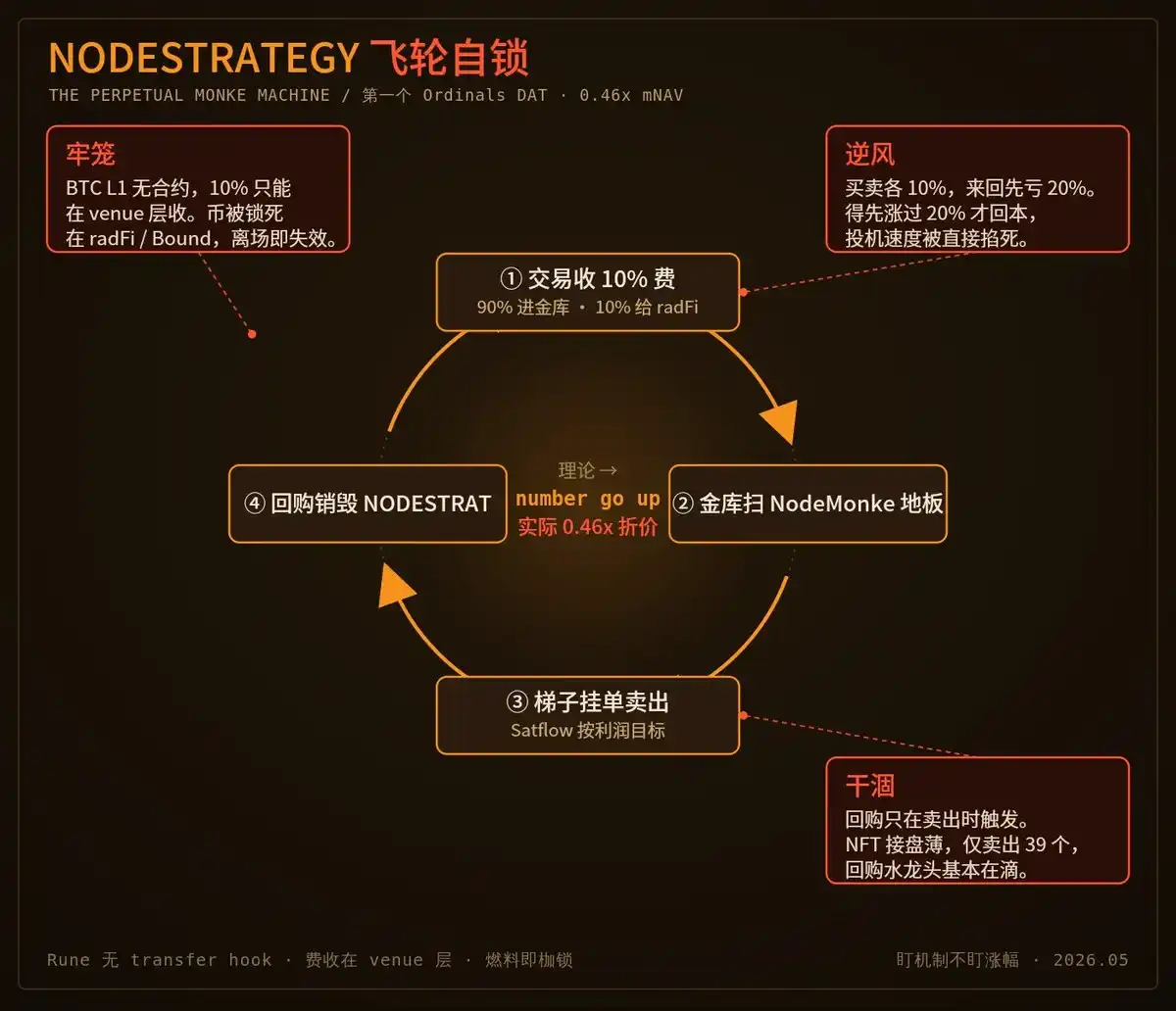
Next, how does the flywheel turn? The story it paints is a four-step closed loop. A 10% fee is charged on each transaction, with 90% going to the treasury and 10% to radFi. The treasury uses this fee to sweep the floor of NodeMonkes. The purchased monkeys are listed in a ladder on Satflow, for sale at different profit targets. The BTC from sold monkeys is 100% used to buy back and burn NODESTRAT. Reduced supply leads to price increases, attracting more traders, which in turn generates more fees. It claims to become more valuable the more it spins. There's only one script, and it sounds self-consistent. But it's not spinning. Here's why.

Point one: Why NODESTRAT can only be traded on radFi / Bound.

First, recognize its lifeline. The entire flywheel—sweeping, selling, buyback and burn—relies entirely on that 10% fee for sustenance. Without this fee, the treasury has no money, and the machine stops instantly.

So who collects this 10%, and at which layer? On Ethereum or Solana, this is simple; the token's contract itself can collect it. ERC20 can implement fee-on-transfer, and Solana's Token-2022 has TransferFee. With each transfer, the token's own code deducts the tax; you can trade it anywhere, and the tax follows the token.

But NODESTRAT is a Rune on Bitcoin. Bitcoin L1 does not have smart contracts. A Rune is just a balance entry on the Runes protocol ledger, etched as a number. It has no code, no transfer hooks, no executable logic whatsoever. You cannot create a Rune that automatically collects taxes. Transferring a Rune is simply a regular Bitcoin transaction moving a balance from one place to another; nothing in between can intercept it and take 10%.

Therefore, this 10% cannot be attached to the token itself; it can only be attached to the trading venue. It's radFi / Bound's liquidity pool that deducts the 10% at the moment you trade NODESTRAT, when constructing the transaction. The tax is collected at the platform layer; the token itself cannot deduct a single satoshi.

The corollary is clear. This 10% fee only exists when trading on radFi / Bound. If you transfer NODESTRAT as a regular Rune peer-to-peer to a friend, or sell it on another Ordinals marketplace, there is no 10% fee, because no place outside of Bound knows about this rule, let alone can enforce it.

Thus, the project is left with only one path to survive: locking all trading strictly within radFi / Bound. This is the only place in the world where this toll fee can be collected. If liquidity flows elsewhere, fee income drops to zero, the treasury stops sweeping, and the flywheel dies immediately.

This also explains that portion of the 10% allocated to radFi. radFi is the toll booth, and NodeStrategy is responsible for directing all traffic onto this road. This token is almost literally Bound by its name; it's honest naming. Its entire value mechanism is held hostage, like a pawn, on a single platform. This fragility is written into its design.

Point two: Why the price isn't rising, and where the root cause lies.

Its script is number go up, so why is it flat? The real issue is that the very fuel for this machine is poisoning its own demand.

First, the machine is out of gas. The flywheel burns on trading volume, and the volume is basically dead—$9K per day. A 10% cut is $900; 90% goes to the treasury, $810, which buys less than 0.01 BTC per day. No volume means no fees, no fees mean no sweeping, no sweeping means no monkeys on the ladder to sell, no sales mean no buybacks, no buybacks mean no burns—resulting in nothing happening to the price. The entire chain is spinning idly.

An even more critical point. That 10% is not just fuel; it is simultaneously a headwind pressing down on its own price. Buying incurs a 10% fee, selling incurs another 10%—a round trip loses 20% upfront. This token needs to rise over 20% just for a trader to break even. You're essentially inviting people to buy something that charges 10% on entry and another 10% on exit, directly strangling speculative velocity. On one side is the tailwind from buybacks and burns, and on the other side is the 20% round-trip tax acting as a headwind—both blowing on the same token. It's fighting itself.

The buyback pipe itself is already tightly screwed. Buybacks only trigger when a NodeMonke is actually sold from the ladder; only the money from sold monkeys goes towards buybacks. But the NFT market has thin order books, sells slowly, and is uncertain. It has only sold 39 monkeys in total, with 15 in the short bucket, and 0 in the medium and long buckets. The buyback faucet is basically dripping. The 30.77% that has been burned so far...

Burning itself does not create demand. Reducing supply can push up the price, but only if demand still exists. There's no volume, and entering the market gets hit with a 10% fee. Burning 30% of the supply results in a smaller, yet equally illiquid, market with no one bidding. Price is about supply and demand at the margin; it's aggressively attacking the denominator while the demand on the numerator side is locked down by the tax and dead volume.

That 0.46x discount is a self-locking trap. The token price is only half of NAV. A normal DAT, when at a premium, can issue more tokens to buy more assets, compounding and growing thicker—that's the real leverage for number go up. The only remaining lever to push the price is buybacks, which are starved by the earlier point. The path to premium is blocked, the path via buybacks is sluggish, and the discount just hangs there, with no mechanism to close it.

Finally, NAV is double the market cap; why isn't the price converging towards NAV?

Holding NODESTRAT offers no redemption channel; you cannot exchange the token for its implied 0.46x worth of NodeMonkes. Your only exit is to sell it to the next bidder on radFi, paying another 10%. That NAV is a marketing number, not a floor price. The market naturally doesn't recognize it, pricing it solely based on cash flow.

That 10% fee was meant to feed the flywheel. Instead, on one hand, it tax-strangles the very demand and volume the flywheel needs most; on the other hand, it can only collect it by locking the token onto a single platform, thereby limiting liquidity. Add to that the fact that the backing is non-redeemable and non-realizable, so NAV cannot anchor the price. This machine's design lets its own fuel source restrict its own demand.

This is not an assessment of price movements, just the mechanism.

Are there any good solutions to get this otherwise well-conceived flywheel spinning again?

Связанные с этим вопросы

QWhat is NodeStrategy and what is its primary function as described in the article?

ANodeStrategy is the first Ordinals DAT (Digital Asset Treasury) project on Bitcoin. Its primary function is to serve as a 'Perpetual Monke Machine'—a digital asset treasury for NodeMonkes NFTs on Bitcoin L1. The project aims to mirror the MicroStrategy treasury model on the Ordinals/NFT ecosystem.

QWhat is the four-step flywheel mechanism designed for NodeStrategy, and why does it fail to operate as intended?

AThe four-step flywheel is: 1) Collect a 10% fee on every NODESTRAT trade. 2) Use 90% of that fee to buy NodeMonkes NFTs from the floor. 3) List the purchased NFTs on Satflow at different profit targets. 4) Use 100% of the proceeds from NFT sales to repurchase and burn NODESTRAT. It fails because the 10% fee, which is its fuel, simultaneously chokes the trading volume and liquidity it needs to function, and the tax is only enforceable on the Bound (radFi) platform.

QWhy is the NODESTRAT token effectively locked to trading on the radFi/Bound platform?

ANODESTRAT is a Rune token on Bitcoin, which lacks smart contract functionality. Therefore, the 10% trading fee cannot be programmed into the token itself and can only be enforced by the trading platform (Bound) when constructing transactions on its order book. If the token trades elsewhere, no fee is collected, starving the treasury and stopping the flywheel.

QWhat are the two main contradictions or self-defeating aspects of the 10% trading fee mechanism?

AFirst, the fee suppresses the very trading volume it relies on for fuel. A round-trip trade incurs a 20% cost, killing speculative demand. Second, the mechanism relies on locking all liquidity to a single platform (Bound) to enforce the fee, creating fragility and limiting market access.

QWhy does the NODESTRAT token trade at a significant discount to its Net Asset Value (NAV) according to the article?

AThe NAV is not actionable for holders. There is no redemption mechanism to exchange NODESTRAT for its underlying NodeMonkes NFTs. The only exit is to sell on the open market (with another 10% fee), so the price is set purely by trading demand and liquidity, which are weak. The NAV is thus a marketing metric, not a functional price floor.

Похожее

Anthropic Cries Wolf: Is the AGI Threat Real, or Just an IPO Story?

Anthropic has published an article titled "When AI builds itself," discussing the emerging concept of "recursive self-improvement," where AI begins to actively participate in designing, training, testing, and optimizing its own subsequent versions. The company presents internal data showing that by May 2026, over 80% of code merged into its codebase was written by Claude, its AI model. Claude's capabilities have expanded to handling complex, open-ended engineering tasks, achieving a 76% success rate in such areas, and even contributing to research processes, such as optimizing code performance and conducting AI safety experiments. Anthropic outlines an evolution from human-driven development to AI-assisted workflows, culminating in the current stage where AI agents can autonomously write, run, and delegate code. The company cautions that the path toward a "closed loop," where AI continuously improves itself, is becoming visible. It calls for coordinated global mechanisms to potentially slow or pause frontier AI development to allow safety research and societal structures to catch up. However, the timing of this warning coincides with Anthropic's preparations for an IPO, framing the narrative not just as a safety concern but also as a demonstration of Claude's advanced capabilities and its integral role in accelerating Anthropic's own R&D—creating a potential "flywheel" effect for competitive advantage. This contrasts with OpenAI's recent, more policy-oriented discussion of the same risks, highlighting the competitive dynamics in the AI industry as companies position themselves in both the technological and regulatory landscape.

marsbit2 мин. назад

Anthropic Cries Wolf: Is the AGI Threat Real, or Just an IPO Story?

marsbit2 мин. назад

BIT Research: ETF Purchases Have Slowed, Strategy (MicroStrategy) Has Slowed, What Else Can Drive Bitcoin's Rise?

Market Refocus on Inflation and Rate Expectations Weighs on Bitcoin Currently, the market is in a phase of macro-repricing dominated by inflation and interest rate expectations. Bitcoin, which previously benefited from easy liquidity and low inflation, is seeing its core bullish drivers weaken. These drivers were market expectations for interest rate cuts and strong inflows from Bitcoin ETFs and institutions like MicroStrategy (referred to as "Strategy" in the text). The logic has shifted. Recent high inflation data (e.g., CPI hitting 3.8% in a May 2026 report) has caused the market to sharply reduce its rate cut expectations for 2025 and even price in potential hikes. This is a key constraint for Bitcoin, as it lacks cash flows and is highly sensitive to rate expectations. Concurrently, institutional capital flows have slowed significantly. Following the hot CPI data, Bitcoin ETFs saw accelerated outflows, with around $4.3 billion leaving over a period. MicroStrategy's ability to keep adding substantial Bitcoin to its balance sheet is also diminishing. Together, ETF and MicroStrategy holdings total roughly $110 billion, but their momentum as growth engines is cooling. In summary, Bitcoin's current pressure stems not from its own fundamentals but from a changing macro environment. As long as inflation stays elevated, Bitcoin is likely to remain in a consolidating phase. However, historically, inflation eventually peaks. Once it recedes and rate cut expectations rebuild, institutional capital could return, potentially fueling a new and more robust recovery phase for Bitcoin.

marsbit9 мин. назад

BIT Research: ETF Purchases Have Slowed, Strategy (MicroStrategy) Has Slowed, What Else Can Drive Bitcoin's Rise?

marsbit9 мин. назад

Earning 1000 Trillion in Half a Year, 'Pocketing' 20 Million per Capita: This Round of Wealth Creation in the Korean Stock Market is Unprecedented in Scale

The South Korean stock market is experiencing an unprecedented wealth surge in 2026, with household equity and fund asset values soaring by over 1,000 trillion KRW (~$730bn) year-to-date. This translates to an average per capita wealth increase of roughly 20 million KRW, fueled by a historic 109% rally in the KOSPI index. The boom is driven by three converging forces: an AI-driven semiconductor supercycle boosting giants like Samsung and SK Hynix; the government's "Value-Up" market reforms addressing long-standing corporate governance issues; and aggressive real estate regulations that have locked capital within financial markets, preventing profits from flowing back into property. This has triggered a wealth effect, boosting high-end consumption significantly. However, the gains are highly concentrated. The two semiconductor behemoths account for over half the index's value, but retail investors own relatively low stakes in them, systematically missing the biggest rallies. Wealth and consumption benefits are skewed towards luxury goods and imported cars, bypassing mainstream retail. Further risks stem from excessive leverage, with high trading volume in leveraged ETFs, and a market sentiment heavily reliant on the AI sector's fortunes and speculative rumors. While this cycle marks a potential shift from real estate to equities as a primary wealth generator for Koreans, its sustainability, amid structural imbalances and leverage, remains a critical test.

marsbit14 мин. назад

Earning 1000 Trillion in Half a Year, 'Pocketing' 20 Million per Capita: This Round of Wealth Creation in the Korean Stock Market is Unprecedented in Scale

marsbit14 мин. назад

Behind ZEC's Over 30% Plunge: An 'Unlimited Minting' Vulnerability with No Way to Prove if It Was Ever Exploited

A critical vulnerability was discovered in Zcash's Orchard privacy pool, allowing for the theoretical creation of undetectable counterfeit ZEC. Researcher Taylor Hornby found the flaw on May 29th, 2024, within the Orchard circuit's cryptographic constraints, which could let an attacker bypass asset conservation rules. Although a rapid emergency fix was deployed within days via a coordinated soft and hard fork, a core uncertainty remains: due to Orchard's privacy features, it is impossible to cryptographically prove whether this "unlimited mint" flaw was exploited in the nearly four years since the pool's 2022 launch. This uncertainty, rather than the patched flaw itself, triggered a market panic, causing ZEC's price to drop over 30%. While the Zcash Foundation stated no evidence of exploitation was found, independent entity Shielded Labs emphasized the impossibility of definitively proving no counterfeit ZEC was ever created. The incident highlights the unique trust challenge in privacy systems. To address this, developers are proposing a new network upgrade with enhanced auditing to allow verifiable proof of supply integrity. Notably, the researcher utilized the newly released AI model Claude Opus 4.8 as a tool during the security review, signaling the growing role of advanced AI in uncovering complex cryptographic vulnerabilities.

marsbit17 мин. назад

Behind ZEC's Over 30% Plunge: An 'Unlimited Minting' Vulnerability with No Way to Prove if It Was Ever Exploited

marsbit17 мин. назад

Торговля

Спот
Фьючерсы
活动图片