muShanghai Discusses Consumer AI: After Continuous Iteration of Large Models, Product Competition Moves Towards Scenarios and Experience

marsbitОпубликовано 2026-05-16Обновлено 2026-05-16

Введение

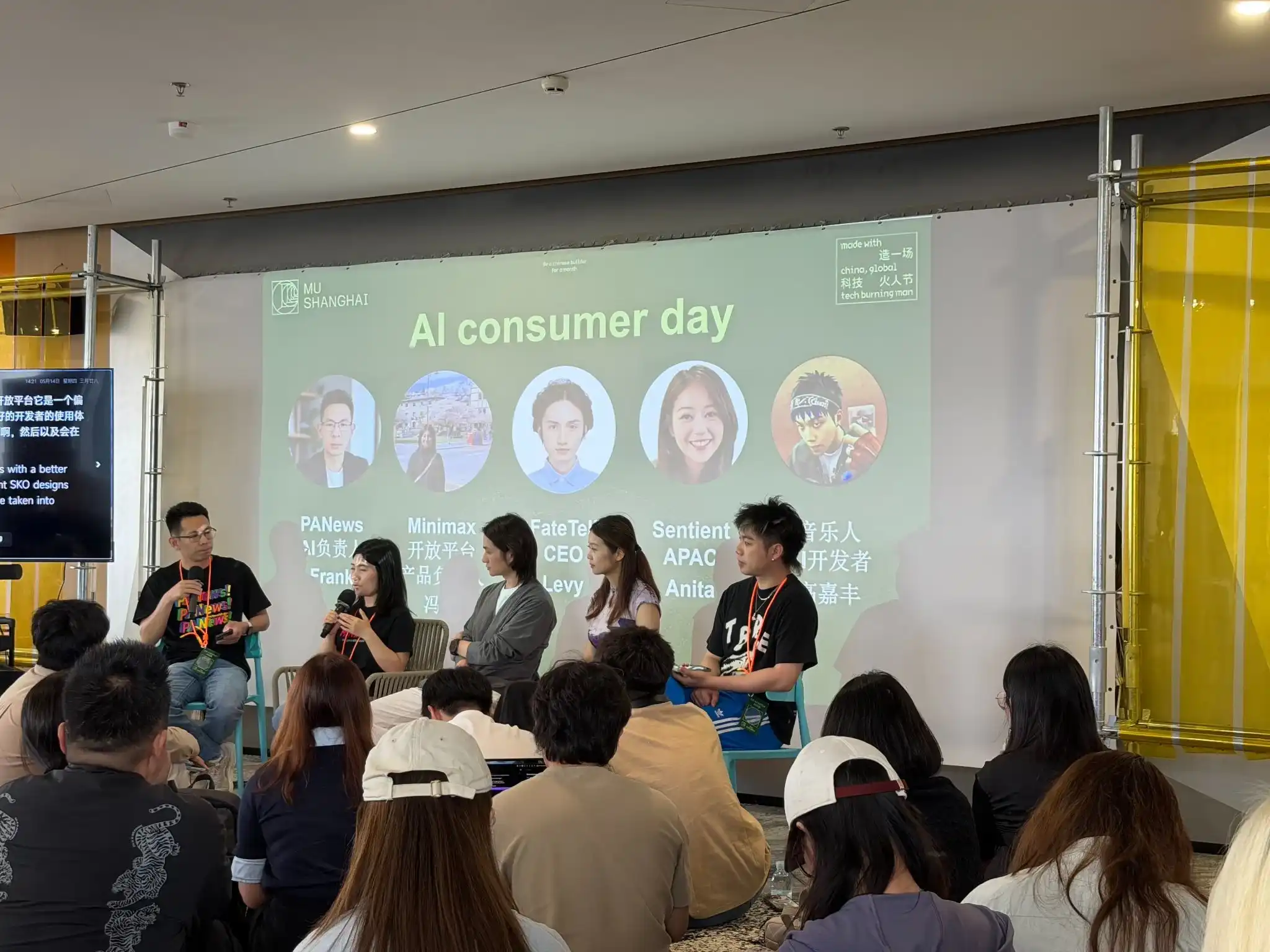
The roundtable discussion "Innovative Practices and Path Exploration of the AI Consumption Ecosystem" at muShanghai AI Week, featuring experts from model platforms, cultural apps, the open-source ecosystem, and music creation, delved into the practical paths for consumer AI products. A key consensus emerged: while AI model advancements lower prototyping barriers, the real challenge for enduring products lies beyond raw technology. True differentiation comes from deep scene understanding, data organization, user education, delivering emotional value, and building open ecosystems. The competition is shifting from "who has the stronger model" to "who best understands the specific user and scenario." Participants highlighted that application-layer barriers, such as accumulated contextual data and cultural localization (e.g., FateTell's translation of Eastern metaphysics for global users), are not easily erased by model updates. They cautioned that AI simplifies prototyping but not the core entrepreneurial hurdles: user acquisition, community building, and commercialization. The discussion emphasized that value must return to human needs—like emotional comfort (FateTell) or preserving the creative *process* in music-making, as highlighted by musician-developer Gao Jiafeng, rather than just outputting a final product. With the rise of AI Agents, user education is evolving from manual documentation reading to more guided, interactive learning within the product experience itself...

Author:Frank,PANews

As AI shifts from technical marvels to practical applications, the implementation of AI applications is accelerating rapidly to meet growing consumer demands. Meanwhile, with the continuous advancement in large model capabilities, AI seems to have entered an era where "everyone can create a product prototype."

During muShanghai AI Week, a roundtable titled "Innovation Practices and Path Exploration of the AI Consumer Ecosystem," hosted by PANews, focused on the real-world implementation paths for consumer-grade AI products. The guests included Feng Wen, Product Lead of the MiniMax Open Platform; Levy, CEO of FateTell; Anita, APAC Head of Sentient; and independent developer and electronic musician Gao Jiafeng, representing diverse fields such as open model platforms, cultural export applications, open-source AI ecosystems, and music creation practices.

In the view of the guests, the core issues of consumer AI have not become simpler with technological iterations. As model capabilities leap forward, the real barriers are shifting towards understanding scenarios, organizing data, user education, emotional value, and building open ecosystems.

AI Has Not Reduced the Difficulty of Entrepreneurship; The Real Barrier Remains the Application Scenario

A common contradiction in the AI industry is that models are becoming increasingly powerful, the threshold for entrepreneurship appears to be lower, but many products still struggle to find long-term viable scenarios. Applications that seem feasible today may quickly lose their relevance with the next model release.

According to Feng Wen, for consumer AI products, product ideas and scenario judgment are still more critical. As a large model and open platform provider, MiniMax places greater emphasis on underlying model capabilities, token-related product design, and the end-to-end experience for developers. However, from an entrepreneur's perspective, products should be designed based on the "intelligence level of the model six months from now."

His assessment is that, in the context of ongoing model scaling laws and continuous improvements in model capabilities, entrepreneurs should not be overly constrained by current model speed, cost, or capability limits. Instead, they should think more boldly about target users, specific scenarios, and the problems to be solved. Model providers will continue to offer cheaper, faster, and more cost-effective capabilities, while the application layer needs to more clearly answer "why this scenario."

Levy added another perspective on barriers from the application layer. He believes that while technology changes rapidly, the data and understanding associated with specific scenarios will not be quickly erased. Many previously thought that only fine-tuning a model could create a data moat. However, with the maturation of context engineering and prompt engineering, the data and structure accumulated in an application's context management can also influence model performance. This is particularly true for highly vertical, culturally specific, or personalized data that may not enter generic model weights, potentially serving as a differentiated foundation for consumer AI products against model iterations.

Anita offered a more cautious view on "AI lowering the entrepreneurship threshold." She noted that while AI has made it easier to generate demo prototypes, quickly build models, and launch initial products, the truly challenging aspects of entrepreneurship have not disappeared—in fact, they may be more prominent. These include how to acquire customers, build community stickiness, achieve commercial viability, and establish human connections beyond coding. She mentioned that concepts like "super individuals" and "one-person companies" are gaining attention, but those who succeed often possess more composite skills than just the ability to call large models.

From BaZi to Music: "Understanding Users Better" Becomes the Barrier for Consumer AI

As technical capabilities continuously advance, the value of consumer AI products must ultimately return to human needs.

The practice of FateTell offers a typical case. Levy introduced FateTell as an AI + Eastern metaphysics/BaZi application targeting overseas users, currently serving users in over 90 countries. The team initially avoided pure efficiency tools, instead focusing on spiritual consumption and emotional value.

In his view, understanding one's destiny, seeking explanations, and finding comfort are underlying psychological needs that cross cultures and endure over time. AI has historically struggled to build trust in this domain, but advancements in models like DeepSeek-R1 have objectively helped users and investors recognize the potential of "large models performing complex reasoning and explanations." The challenges FateTell faces are not limited to model capabilities but also include translating and interpreting Chinese cultural concepts like the Heavenly Stems and Earthly Branches, the I Ching, and BaZi for overseas users, and conveying their appeal through language, visuals, and interaction across different cultural backgrounds.

Gao Jiafeng, from a music creator's perspective, raised a similar issue: AI should not only deliver results but also preserve the process. He noted that tools like Suno make music generation very direct, but they also bypass the creative process, leading to a lack of user engagement and a sense of ownership. For musicians and ordinary users alike, creation is not solely about obtaining a "finished song"; the process itself is part of the experience.

He used football as an analogy: even if ordinary people can never surpass Messi or Ronaldo, they still play the sport out of passion. The same applies to music creation. Gao Jiafeng is developing the "Music AI GameBoy" (music AI game console), which attempts to use AI large or small models to drive musical code, combined with gamified interactions, allowing people with no musical background to participate in creation through play. For him, the real scenario is not "automatically generating a song" but returning the interactive process of music creation to the user.

After the Rise of Agents, User Education Logic is Changing

In consumer AI products, user education often determines whether a product can be genuinely used.

Feng Wen mentioned that among users of the MiniMax Open Platform, some have a development background but are still hindered by API documentation, parameters, error codes, and token usage. To address this, the platform provides model trial platforms, development guides, demo cases, and video tutorials to help developers transition from understanding to implementation more quickly.

With the development of Agents, the methods of user education are also changing. Previously, users needed to read documentation, understand interfaces, and troubleshoot errors. However, with performance upgrades in Agents, many users now rely on Agents to directly read documentation, search for solutions, select appropriate models, and automatically correct paths. Model providers need to optimize models, documentation, and platform experience, while communities, developers, and diverse product forms collectively lower the usage threshold.

For Sentient, the open ecosystem itself is part of user education and product implementation. Anita explained that Sentient focuses on the open-source AI ecosystem and related infrastructure, gathering developers through hackathons, grant programs, and other initiatives. She emphasized that a product must first identify its target users clearly: who they are, where they appear, and how trust is established through which channels. For developer tools, hackathons and ecosystem collaborations are effective entry points; for consumer products, KOLs, KOCs, and social media content are equally important.

In the context of rapidly declining AIGC costs, startup teams can produce trailers, visual materials, and promotional content at lower costs, enabling products to reach their first users more quickly. Gao Jiafeng also believes that product design should strive to be closer to users, allowing them to learn naturally through interaction and entertainment rather than relying on extensive manuals. This "learning by using" approach may be more suitable for consumer AI than traditional tutorials.

Hardware Enters the Real World, Personalization and Emotional Value Continue to Amplify

Looking ahead three to five years, the guests generally agree that the AI consumer market is still in its early penetration phase, but product forms will undergo significant changes.

Feng Wen predicts that in the next three to five years, smart hardware, robotics, and embodied intelligence will reach important inflection points. With improved model capabilities, AI will no longer exist solely in software interfaces but will also enter the real physical world, performing more interactions and tasks. Some products will be aimed at humans, providing efficiency gains or emotional value. Others may be directed at Agents, offering environments, tools, and infrastructure for AI to connect with the physical world. However, regardless of form, products should ultimately remain human-centric, allowing people to devote more time to human connections, family, the real world, and richer life experiences.

Levy believes that making predictions for three to five years in the AI industry is already very difficult; even three to five months are fraught with uncertainty. He observes that while cutting-edge users are deeply engaged with tools like Claude Code, most ordinary users are still in the early stages of AI adoption. In the coming years, AI will further address more fragmented and personalized needs. Compared to the relatively "one-size-fits-all" services of the mobile internet era, AI has the opportunity to provide more specific and segmented services for each individual. Simultaneously, unemployment anxiety and uncertainty driven by technological development may further amplify the demand for psychological companionship and other forms of spiritual consumption.

Anita summarizes this change as "technological democratization." She suggests that future distinctions between humanities, sciences, arts, and technology will be weakened. A small vendor might use AI to create advertisements and target information, thereby improving their business. The value of AI may not necessarily be making everyone a top programmer but helping people in various life scenarios access better tools. Meanwhile, fears of unemployment and loneliness will drive demand for emotional value, creating more opportunities for hardware, AI pets, companion devices, and multi-sensory interactive products.

Gao Jiafeng approaches this from the perspective of cultural transformation. He believes that future forms of content, such as music, film, and video, will be restructured. It is even uncertain whether a "song" will remain the smallest unit of music consumption. Current concepts like multitrack audio and audio tracks may be further deconstructed into more atomic units of creation. However, as forms dissolve, the emotional connections carried by IPs, brands, and specific individuals will become more important. What people seek is not always perfect works but imperfect, warm objects capable of establishing emotional relationships.

Although the guests did not provide a unified answer for consumer AI, discussions from different fields—model platforms, cultural applications, open-source ecosystems, and music creation—collectively point to the same trend: as model capabilities continue to advance, competition in consumer AI is no longer just about "who calls a stronger model," but about the ability to understand more specific users, real-world scenarios, and emotional needs.

The future AI consumer ecosystem may simultaneously include stronger open infrastructure, lower development barriers, more personalized services, hardware with stronger companionship value, and more new product forms centered around culture and the creative process. Models will continue to evolve, but what truly endures will be products that are needed by people, understood by them, and capable of establishing meaningful connections.

Связанные с этим вопросы

QAccording to the article, what has become the real barrier for consumer AI products after the continuous iteration of large models?

AAccording to the discussion, the real barriers have shifted towards scenario understanding, data organization, user education, emotional value, and the construction of open ecosystems. The competition is no longer just about who uses a stronger model, but about understanding specific users, real scenarios, and emotional needs.

QWhat was the common perspective among the panelists regarding whether AI has lowered the barrier for entrepreneurship?

AWhile acknowledging that AI makes creating prototypes easier, the panelists generally agreed it has not simplified core entrepreneurial challenges. MiniMax's Feng Wen emphasized that product ideas and scenario judgment remain crucial. Anita from Sentient cautioned that the real difficulties like customer acquisition and building community stickiness persist. They argued that true barriers now lie in applying AI to specific, sustainable user scenarios.

QHow does FateTell's CEO Levy describe the application's core value proposition and its key challenges?

ALevy described FateTell's core value as providing spiritual consumption and emotional value through AI-powered Eastern metaphysics/astrology (Ba Zi) for overseas users. Its key challenge is not just model capability, but the translation and cultural adaptation of complex Chinese concepts like the heavenly stems, earthly branches, and the I Ching for a global audience, making them understandable and engaging across different cultures.

QWhat changes in user education logic for consumer AI products are highlighted, particularly with the rise of Agents?

AThe article notes a shift in user education logic. Previously, users needed to read documentation and understand interfaces. With the rise of Agents, the process is becoming more automated—Agents can read docs, search for solutions, select appropriate models, and automatically correct paths. This means product design should enable learning through interaction and play, reducing reliance on traditional manuals. Platforms now focus on providing good models, documentation, and developer experience while the community lowers the overall usage barrier.

QWhat are some predicted future trends for the consumer AI market over the next 3-5 years, as discussed by the panelists?

APanelists predicted several trends: 1) AI moving into the physical world via smart hardware, robots, and embodied intelligence. 2) A shift towards more personalized, granular services tailored to individual needs. 3) Increased demand for products offering emotional value and companionship (e.g., AI pets, interactive devices) due to unemployment anxiety and loneliness. 4) A 'technology democratization' blurring lines between disciplines, empowering individuals in various life scenarios. 5) An evolution in content forms (like music) towards more atomic units of creation, with increased importance on emotional connection through IP and personal brands.

Похожее

TechFlow Intelligence Bureau: Chip Stocks Lose Trillions in a Single Day, Bitcoin Falls Below $60,000, US-Iran Conflict Escalates

**Daily Tech & Markets Roundup: AI Advances, Market Turmoil, and Geopolitical Tensions** **AI / LLMs**: Anthropic's internal report on AI self-improvement sparked serious discussions about Recursive Self-Improvement (RSI). Meanwhile, debate continues on AI coding tools after Claude was accused of introducing bugs into the rsync codebase. In positive news, DeepSeek V4 Flash impressed in local deployment tests, and GitHub Copilot now supports custom endpoints for local models. A surprising research turn suggests removing chain-of-thought prompting can sometimes improve LLM performance. **Crypto / Web3**: Bitcoin plunged below $60,000, with its RSI hitting levels last seen during the COVID-19 crash, driven by strong U.S. jobs data reviving interest rate hike fears. Discussions highlight Ethereum DeFi's continued lack of a smooth consumer payment layer. **Chips / Hardware**: Chip stocks suffered a massive sell-off, with the Philadelphia Semiconductor Index posting its worst single-day drop in six years, erasing over a trillion dollars in value. Marvell, Micron, AMD, and Intel were among the biggest losers. **Tech Companies**: A leaked Microsoft document revealing goals to make Copilot "addictive" drew criticism. LinkedIn founder Reid Hoffman left Microsoft's board to focus full-time on his AI agent startup, Manus. Google was revealed to be paying SpaceX $920 million monthly for AI training compute. **Markets & Macro**: A blowout U.S. jobs report (172k vs. 80k expected) crushed hopes for near-term rate cuts, sending Treasury yields soaring and triggering a broad market sell-off. CEOs from Kraft, McDonald's, and Whirlpool simultaneously warned U.S. consumers are exhausting their savings. **Geopolitics**: U.S.-Iran tensions escalated with missile/drone interceptions and U.S. strikes on Iranian radar sites, keeping the critical Strait of Hormuz largely closed since late February and posing ongoing oil supply risks. **The Bottom Line**: The strong jobs data acted as a single trigger for correlated sell-offs across equities, crypto, and chips. Underlying the volatility is a stark contradiction between robust employment data and warnings of consumer weakness, alongside geopolitical risks that could reignite inflation, leaving markets to price in a fraught macro outlook with no clear "soft landing" path.

marsbit49 мин. назад

TechFlow Intelligence Bureau: Chip Stocks Lose Trillions in a Single Day, Bitcoin Falls Below $60,000, US-Iran Conflict Escalates

marsbit49 мин. назад

It Took Me a Year to See the Bitter Truth About Agent Payments

After a year building infrastructure for the Agent economy, engaging with major players like Stripe, Visa, and Coinbase, the author shares a sobering analysis of the current state of Agent payments. The core finding is a stark lack of genuine, immediate demand across most envisioned use cases. The article breaks down four key market segments: 1. **Agent-to-Merchant (Consumer Shopping):** For most product categories (e.g., clothing, electronics), conversational AI shopping is a step backwards from visual e-commerce interfaces. While agents excel at understanding needs, they can't replace side-by-side product comparison. Real merchant interest is defensive "Agent Engine Optimization," not driven by current customer demand. Potential exists for high-frequency, low-decision purchases (like food delivery) or navigating complex store UIs, but these require massive B2C distribution channels dominated by giants like Amazon. 2. **Agent-to-API (Developer Services):** Developers already have subscriptions and billing relationships for APIs (compute, data). Prepaid balances solve micro-payment issues for low transaction volumes. A deeper structural problem is that major SaaS vendors' business models rely on enterprise contracts, resisting granular pay-per-call pricing. While protocols like MPP and x402 serve the long tail of niche services, this market is small and developers are historically low-willingness-to-pay. 3. **Agent-to-Agent:** This remains largely theoretical with minimal transaction volume. While it represents a long-term bet on a fundamentally new transaction infrastructure (sub-second, micro-penny to million-dollar, multi-party settlements), it does not constitute a present market. 4. **Agent-to-Finance:** This is the only category with existing, paying demand. Integrating AI into financial workflows (trading, portfolio management) is a natural evolution and enables new capabilities like autonomous rebalancing. However, competition favors established, regulated institutions. The "real problem" is not moving money between agents, but the broader challenge of **coordination**—orchestrating work between agents and humans, verifying outcomes, and settling results. Payment is just one component of settlement, which is itself part of coordination. Companies that solve the coordination layer will subsume payment, not the other way around. While well-funded incumbents build defensively for a long-term future, startups must find where the market is today—which, for the author's team, lies outside these four categories in an area of real, growing, and underserved activity.

marsbit1 ч. назад

It Took Me a Year to See the Bitter Truth About Agent Payments

marsbit1 ч. назад

It Took Me a Year to See the Hard Truth About Agent Payments

**Title: It Took Me a Year to See the Hard Truth About Agent Payments** Over the past year, I've worked on infrastructure for the Agent economy, engaging with major players like Stripe, Visa, Coinbase, and numerous startups. The findings reveal a stark reality: genuine, widespread demand for Agent-based payments does not yet exist. **Key Observations:** * **Agent-to-Merchant (Shopping):** The user experience for AI shopping often falls short, especially for visual product discovery. While AI excels at understanding needs, conversational interfaces can't yet replace browsing and comparing multiple products visually. Current merchant interest is largely defensive ("Agent Engine Optimization") for a future that hasn't arrived. High-frequency, low-friction purchases (like food delivery) are potential fits, but lack open APIs and face high AI inference costs. Simpler, more affordable, or cross-language interactions for complex UIs are a niche opportunity but require massive consumer distribution to scale. * **Agent-to-API (Developer Tools):** Developer payment needs for APIs (computing, data, models) are already met through subscriptions and prepaid credits. The core challenge is not payment friction but supplier economics: most large SaaS providers prefer enterprise contracts over micropayments for API calls. Protocols like MPP and x402 suit the long-tail of smaller services but cater to a developer market historically reluctant to pay for these tools. Major infrastructure needs at the top of the stack are already being addressed. * **Agent-to-Agent (Machine Commerce):** This is a long-term vision with almost no current transaction volume. While a future with high-speed, high-frequency, multi-party machine-to-machine transactions would require novel infrastructure, it remains theoretical. The market is not here yet. * **Agent-to-Finance:** This is the only category with clear, present demand. Financial professionals and DeFi users already pay for tools, and AI augmentation is a natural evolution. Autonomous AI agents can enable entirely new financial strategies. However, competition is fierce from established, regulated incumbents who can more easily layer AI onto their existing products. **The Core Insight:** Companies, especially giants with long time horizons, are building defensively for a potential future of mass machine commerce. For them, early investment is a low-cost hedge. For startups, the current market reality is different. The primary challenge isn't just moving money between agents (payments). The larger, unsolved problem is **orchestration** – coordinating work between agents and humans, verifying outcomes, and then settling. Payment is just a part of settlement, which is just a part of orchestration. Companies that solve the orchestration problem will subsume payments, not the other way around. After a year of building, we see the real, growing, and underserved market opportunity lies in this broader domain of orchestration.

链捕手1 ч. назад

It Took Me a Year to See the Hard Truth About Agent Payments

链捕手1 ч. назад

Claude Opus 4.8 Finds a $4.5 Billion Bug: The AI Era is Mass-Producing Hackers

A researcher discovered a critical "infinite mint" vulnerability in the Zcash cryptocurrency's Orchard protocol using Claude Opus 4.8, leading to a swift fix but also a 50% market drop, erasing billions in value. This incident highlights a new era where powerful, accessible AI models are dramatically lowering the barrier to finding software vulnerabilities. Previously, the security community feared specialized models like Claude Mythos Preview, capable of finding decades-old zero-day exploits. The Zcash case, however, involved a publicly available, general-purpose model. This shift makes advanced security auditing—and attack capabilities—accessible to far more people, not just experts. The mass democratization of vulnerability discovery brings a dual challenge: a flood of low-quality, AI-generated false reports that overwhelm maintainers, and the real, rapid uncovering of deep, dangerous bugs. Open-source projects, often understaffed and unfunded, are particularly vulnerable to this "attention DDoS." The article cites examples like curl shutting down its bug bounty program due to the unsustainable workload. Our perceived digital safety has often been luck, relying on the high cost and effort required to find deeply hidden flaws in complex systems, as seen with historical vulnerabilities like Heartbleed or Baron Samedit. AI changes this cost structure, effectively "mass-producing flashlights" to illuminate every corner of our codebase. While large companies operate extensive security chains involving external white-hat hackers and massive defensive operations, the global cybersecurity workforce faces a severe shortage, especially of experienced personnel capable of analyzing complex threats and coordinating fixes. The core dilemma emerges: AI makes *finding* bugs cheap and scalable, but *fixing* them remains a slow, expensive, and human-intensive process. The article concludes that AI won't destroy the internet but acts as a bright light, revealing that our digital existence is not inherently secure but is precariously maintained by ongoing human effort. The true cost in the AI era may not be discovery, but whether there will be enough people left willing and able to do the hard work of repair.

marsbit2 ч. назад

Claude Opus 4.8 Finds a $4.5 Billion Bug: The AI Era is Mass-Producing Hackers

marsbit2 ч. назад

Торговля

Спот
Фьючерсы

Популярные статьи

Неделя обучения по популярным токенам (2): 2026 может стать годом приложений реального времени, сектор AI продолжает оставаться в тренде

2025 год — год институциональных инвесторов, в будущем он будет доминировать в приложениях реального времени.

1.8k просмотров всегоОпубликовано 2025.12.16Обновлено 2025.12.16

Неделя обучения по популярным токенам (2): 2026 может стать годом приложений реального времени, сектор AI продолжает оставаться в тренде

Обсуждения

Добро пожаловать в Сообщество HTX. Здесь вы сможете быть в курсе последних новостей о развитии платформы и получить доступ к профессиональной аналитической информации о рынке. Мнения пользователей о цене на AI (AI) представлены ниже.

活动图片