MSTR Earnings Review: The 'Flywheel' Now Has a 'Safety Valve', Arbitrage Opportunity Emerges

marsbitОпубликовано 2026-05-08Обновлено 2026-05-08

Введение

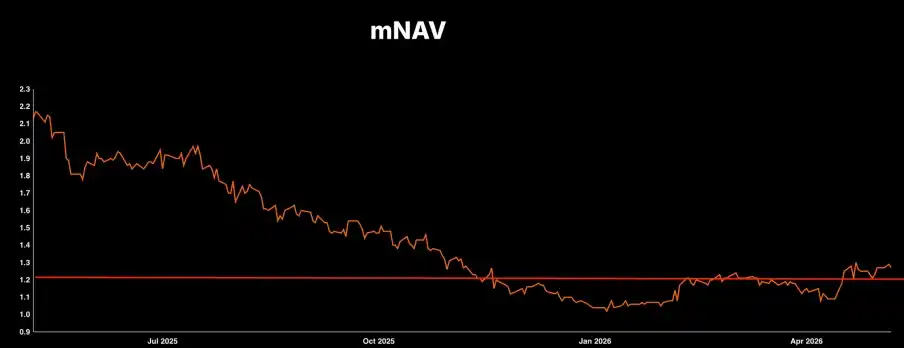
MicroStrategy's recent earnings call has fundamentally changed its strategy. Management has explicitly stated a key metric: a 1.22x premium to its mNAV (adjusted net asset value). This acts as a trigger for the company's actions regarding its Bitcoin holdings. If MicroStrategy's stock trades at a premium **above** 1.22x mNAV, the company will continue its established playbook: issuing equity to raise capital and buying more Bitcoin. However, if the premium falls **below** 1.22x, the strategy reverses. Management committed to selling Bitcoin to generate cash, which would then be used for debt management, dividends, or stock buybacks. This clear threshold creates a potential arbitrage opportunity. Should the premium dip below 1.22x, a trade involving going long MSTR stock while shorting an equivalent value of Bitcoin could profit. The logic is that the company's promised actions (selling BTC, buying back stock) would directly work to close that valuation gap, providing a catalyst for the trade. For holders of MicroStrategy's high-yield preferred stock (STRC), this policy introduces a significant safety net. The commitment to sell BTC to protect the balance sheet and meet obligations reduces the prior risk of the company facing a liquidity crisis during a deep Bitcoin downturn, making STRC resemble a more traditional corporate bond. Regarding Bitcoin's market impact, the announcement has mixed implications. In the short term, it is sentimentally bearish as it ends the narrat...

This MicroStrategy (MSTR) earnings report has completely changed its game: it used to be "mindlessly print shares to buy Bitcoin," but now the company has provided a clear-cut metric – a 1.22x mNAV (asset value premium). This number will determine whether MSTR buys or sells coins next.

● For MSTR:

○ Premium > 1.22x: Continue the old playbook: issue high-priced shares, take the money to buy BTC.

○ Premium < 1.22x (the core reversal): It no longer makes sense for the company to issue more shares. Management has explicitly stated that if the premium falls below this level, they will sell BTC, use the cash to repay debt or repurchase shares.

● How to arbitrage: If MSTR's premium falls below 1.22x, it will trigger a conditional arbitrage opportunity: "long MSTR, short BTC." Because at that point, the company will personally step in to "sell Bitcoin, buy its own shares." The company's selling action will close the price gap. Management's stance is the core confidence behind this arbitrage trade.

● For STRC (Preferred Stock): Previously, people feared that a MicroStrategy blow-up would render these 11.5% dividend preferred shares worthless. Now, the official statement "will sell Bitcoin to repay debt if necessary" means STRC has a solid safety net; it's no longer a Ponzi gamble.

● For the broader BTC market: The myth of "MicroStrategy will never sell" is shattered, which is negative for short-term sentiment. The benefit is that the company's proactive selling to reduce leverage completely eliminates the future risk of a "forced, cascading liquidation" during a deep bear market.

Diamond Hands No More: The 1.22x mNAV is the Lifeline and Bitcoin's Bull/Bear Dividing Line

Over the past two years, there has been much FUD in the market regarding MSTR, particularly about how they manage their leverage and interest expenses. Bitcoin is an asset without cash flow, yet MSTR has to pay significant interest for financing it. Where would this come from? In this Q1 earnings call, management personally declared: they will sell Bitcoin if the mNAV premium falls below 1.22x.

This is equivalent to revealing the company's "bottom card" and "auto-execution program":

● Above the waterline (balance sheet expansion phase): The company is a die-hard BTC bull. As long as retail investors are willing to give a premium higher than 1.22x, MicroStrategy can engage in "risk-free arbitrage balance sheet expansion." Issue shares to raise capital -> massively buy BTC -> increase book assets -> push the stock price higher. This positive flywheel keeps spinning.

● Below the waterline (defensive balance sheet contraction phase): The flywheel slams on the brakes. If MSTR trades at too steep a discount relative to its Bitcoin holdings, issuing more shares would mean selling company assets at a discount. Management very rationally stated that at this point, selling BTC for cash, using it to pay dividends, manage debt, or directly repurchase MSTR common shares at low prices would provide the greatest value enhancement for existing shareholders.

This means MSTR finally has a hard "value support line." It is no longer a runaway train without brakes.

Arbitrage Opportunity: Long MSTR / Short BTC when the mNAV premium falls below 1.22

What is the biggest fear in arbitrage? It's finding an excellent price discrepancy, but the market remains irrational for an extended period (e.g., MSTR stays at a discount), and eventually, your hedge position gets worn down by funding rates or interest costs.

However, the 1.22x threshold provided by MSTR this time offers an arbitrage opportunity with strong certainty.

In-depth practical logic:

● Strict trigger condition: Only when MSTR's mNAV premium falls significantly below 1.22x.

● Position entry: At this point, MSTR's price is "excessively undervalued" relative to its underlying BTC assets. Traders should go long MSTR and simultaneously short an equivalent market value of BTC.

● The winning underlying logic: Even if market participants don't close the gap, MicroStrategy's management will force it to converge. Once the threshold is breached, to maximize "Bitcoin per share," management will initiate their promised self-rescue operation – "sell BTC, repurchase undervalued MSTR shares." Do you see it? The direction of your long/short position will be completely synchronized with the official market intervention direction of MicroStrategy's tens of billions of dollars. You don't need to predict whether BTC will rise or fall tomorrow; you just need to calmly capture the "price gap convergence" profit, which is essentially risk-free.

Monitoring tip: Currently, MSTR's premium is fluctuating around 1.28x, not yet triggering the arbitrage condition. Blindly opening positions is premature. However, it has already entered an excellent targeting zone. Set up price alerts and wait for it to drop below the threshold before acting.

3. Significantly Enhanced Safety Net for STRC (Preferred Shares)

STRC offers a high dividend yield of 11.5%. In the previous bearish narrative, MicroStrategy was a gambler with massive leverage. Once Bitcoin faced a black swan event like a halving or more in price, MicroStrategy's cash flow would break, and STRC preferred shares would instantly become worthless.

But the Q1 earnings report completely revealed the company's true financials, not only refuting the shorts but also giving fixed-income investors a dose of confidence:

● Impressive asset thickness: On the liabilities side, the company has $13.5 billion in preferred shares and $8.2 billion in convertible bonds. On the asset side, there is a corresponding $64 billion in BTC reserves. The net leverage ratio is a negligible 9%, which is considered extremely robust in traditional finance.

● Extreme downside stress test: Even if the crypto market experiences another major crash, with BTC plummeting 90% from current levels (all the way down to $7,300), selling their coins would still be enough to repay all net debt.

● Cash moat: As a last resort, even if Bitcoin liquidity dries up and they can't sell quickly, the company still holds $2.25 billion in pure cash on its books. The interest earned from this cash alone, even at a savings rate, would be enough to cover the future 1.5 years (annual $1.5 billion) of debt interest and preferred dividends without lifting a finger. Overall, as long as BTC appreciates by a mere 2.3% annually, STRC's interest obligations can be perfectly covered.

The most crucial expectation reversal lies in this: management has broken the dogma of "never selling coins." This means they will proactively and gradually sell Bitcoin to preserve the company's credit rating and ability to pay interest before an extreme crisis hits. STRC has completely shed the label of "crypto Ponzi high-yield debt." Its risk pricing logic is now moving closer to that of traditional high-quality corporate bonds, making it highly likely to attract allocation buys from traditional institutional funds.

4. Impact on the Broader BTC Market: Losing a "Die-hard Buyer," Removing a "Cascade Liquidation Landmine"

The sentiment shock from this earnings call on the broader BTC spot market is two-sided, requiring traders to view it through different timeframes:

● Short-term pain (sentiment negative): Retail investors previously viewed MicroStrategy as a "bottomless pit" that only buys and never sells, providing perpetual support. Now, management's admission that "they will sell if valuation is wrong" directly shatters this bullish totem. In the short term, this is a significant blow to market optimism and speculative hype.

● Long-term benefit (structural upgrade of the foundation): Traders who understand a bit of cycle history know why the last bear market (2022) fell so hard. Because giants like LUNA, Three Arrows Capital, and Celsius "held on to the bitter end," until liquidity completely dried up and they were forcibly liquidated, leading to cascading sell-offs. The current MicroStrategy is no longer a "believer" swept up by狂热; it's a savvy "Wall Street veteran" who knows how to crunch numbers. It has set a clear early warning line for selling and understands how to proactively reduce leverage by adjusting its portfolio at the onset of a crisis. This is equivalent to defusing the largest "systemic liquidation nuke" hanging over the crypto market in advance.

Summary: MicroStrategy remains the largest "BTC bull commander-in-chief" in the entire U.S. stock market. However, it has evolved from a reckless charger into a precise calculator that knows when to advance and retreat, even harvesting market sentiment in reverse.

Связанные с этим вопросы

QWhat is the significance of the 1.22x mNAV threshold for MicroStrategy, according to the article?

AThe 1.22x mNAV (premium to net asset value) is a critical threshold that dictates MicroStrategy's capital allocation strategy. If MSTR's premium is above 1.22x, the company will continue its historical playbook of issuing stock to buy more Bitcoin (BTC). If the premium falls below 1.22x, management has explicitly stated they will reverse course, selling BTC to raise cash for debt repayment, stock buybacks, or dividends. This provides a hard 'value floor' and removes uncertainty for investors.

QHow does the article describe the arbitrage opportunity related to MSTR and BTC?

AThe article describes a conditional arbitrage strategy triggered when MSTR's premium to its Bitcoin holdings falls below the 1.22x mNAV threshold. At that point, a trader would go long on MSTR stock while simultaneously shorting an equivalent amount of BTC. The 'sure win' logic is that if the market doesn't correct the price disparity, MicroStrategy's management will force it to converge by executing their promised action of selling BTC to buy back their own undervalued shares, aligning with the trader's position.

QWhy is the STRC (Series 2 Preferred Stock) considered to have a significantly improved safety cushion after MicroStrategy's Q1 report?

ASTRC's safety cushion improved because the Q1 report and management commentary changed the risk profile. Previously, STRC, which pays an 11.5% dividend, was seen as risky if a crypto crash forced MSTR into insolvency. Now, management's commitment to sell BTC if necessary to manage liabilities provides a concrete backstop. The article highlights that MSTR's leverage is low (9%), and even a 90% drop in BTC's price would still leave enough value to cover net debt, while the company's cash reserves could cover interest and preferred dividends for 1.5 years without selling any BTC.

QWhat are the two-sided impacts of MicroStrategy's new policy on the broader Bitcoin (BTC) market, as outlined in the article?

AThe impacts are twofold: 1) Short-term negative sentiment (bearish): The policy shatters the myth of MicroStrategy as a 'diamond hands' perpetual buyer that would never sell, removing a key psychological and speculative support pillar for the market. 2) Long-term structural positive (bullish): By establishing a clear selling threshold and showing willingness to de-leverage proactively, MicroStrategy eliminates the risk of a future 'forced liquidation cascade' during a deep bear market. This removes a major potential systemic risk, making the market's foundation healthier.

QHow has MicroStrategy's role in the market evolved, according to the article's conclusion?

AAccording to the article's conclusion, MicroStrategy has evolved from being a reckless, dogma-driven 'believer' or 'charging fool' into a strategic 'Wall Street veteran' or 'actuary.' It remains the largest 'BTC bull commander' in the stock market, but it has transformed into a more rational entity that calculates carefully, advances and retreats with discipline, and can even profit from market sentiment reversals, rather than just blindly accumulating Bitcoin at any cost.

Похожее

SpaceX, OpenAI, Anthropic: The Three AI Giants Racing for IPO, Which One Is Worth Betting On?

SpaceX, OpenAI, and Anthropic are poised for historic IPOs within weeks, potentially raising a combined $180 billion—a sum exceeding the entire internet bubble's fundraising. The hosts of the Limitless Podcast argue this isn't just individual company financing but an unprecedented capital concentration for AI infrastructure, driven by an insatiable need for compute, data centers, power, and chips. SpaceX's IPO is notable for reportedly changing market index rules to allow faster inclusion, potentially funneling trillions in passive retirement funds into its stock, despite its unproven space-based data center business model. In contrast, Anthropic demonstrates explosive growth, with ARR reportedly hitting $45 billion and approaching profitability, fueled by strong enterprise adoption of products like Claude Code. Google's separate $80 billion raise highlights the immense capital pressure, even for giants. The discussion acknowledges bubble risks but leans optimistic. The hosts contend the massive spending is building essential physical infrastructure for the next technological era. A key bottleneck isn't capital but the real-world limits of chip manufacturing and construction speed. As long as demand for AI compute outstrips supply, this investment cycle represents a foundational build-out rather than a purely financial bubble. All three companies are seen as foundational bets on the future, with Anthropic often cited as the most immediately compelling due to its proven revenue trajectory.

marsbit34 мин. назад

SpaceX, OpenAI, Anthropic: The Three AI Giants Racing for IPO, Which One Is Worth Betting On?

marsbit34 мин. назад

From 'Old Guys' to 'New Favorites': How AI Is Revaluing Old Infrastructure from Dell to Nokia?

From "Vintage Tech" to "New AI Darlings": How AI Revalues Old Infrastructure One year ago, tech giants like Dell, Nokia, Cisco, and Western Data were seen as slow-growth, low-valuation stories, far from the AI spotlight dominated by players like Nvidia. Now, these legacy tech stocks are gaining market attention, sparking debate on whether this is genuine industry revaluation or a temporary narrative. As AI moves from model parameters to real-world data centers, the market is recognizing companies with proven delivery and infrastructure capabilities. This shift marks a change in the AI investment thesis: from pure model and GPU focus to the complex systems engineering required for deployment. Companies like Dell, HPE, and Corning are being revalued not for being "sexy" AI innovators, but for their decades of accumulated expertise in supply chains, enterprise delivery, and infrastructure—assets that have become critical in the AI buildout phase. The revaluation is unfolding across three key infrastructure lines: 1. **Servers & System Integration:** Dell and HPE are emerging as crucial system integrators or "general contractors" for AI data centers, translating GPU orders into complete, deployable server racks integrated with power, cooling, and networking. 2. **Networking & Connectivity:** AI's scale demands robust high-speed connections. Corning (fiber optics), Nokia (AI-RAN, 6G), and Cisco (data center switches) are gaining importance for enabling efficient data transfer within and between AI clusters. 3. **Storage:** Beyond high-speed memory (HBM/DRAM), the AI data explosion is driving demand for high-capacity hard drives (HDDs) from companies like Western Digital and Seagate to handle training data, logs, and cold storage cost-effectively. For this revaluation to be substantive and not just a narrative, three criteria are key: 1) Concrete AI-related order and revenue growth (e.g., Dell's AI server sales), 2) Upward revisions to company financial guidance, and 3) Sustainable improvements in profit quality, not just top-line revenue spikes. In essence, AI's transition to a real construction phase is re-pricing "old assets" against "new demand." The opportunity, however, is selective. Only those legacy firms that are demonstrably integrated into the capital expenditure chains of data center and enterprise AI deployment are likely to experience a true "logic re-rating" rather than just a temporary valuation bounce.

marsbit40 мин. назад

From 'Old Guys' to 'New Favorites': How AI Is Revaluing Old Infrastructure from Dell to Nokia?

marsbit40 мин. назад

The Merger of Codex and ChatGPT Marks the Beginning of a Major Reshuffle in Programming Tools

OpenAI is shifting its strategic focus from ChatGPT to Codex, merging them along with the browser tool Atlas into a unified desktop super-app. This move signals an internal belief that Codex, originally a programming tool, represents the next evolution of AI more than conversational models like ChatGPT. Over the past year, Codex's weekly active users have surged past 5 million. The key distinction is that while ChatGPT answers questions, Codex executes tasks. Enterprises increasingly value this ability to get work done over simply receiving advice. Consequently, Codex is attracting professionals beyond developers, including analysts, bankers, marketers, and product managers. OpenAI's reorganization and increased investment in Codex stem from recognizing that the future of AI competition lies in execution capabilities, not just conversation. The company is launching role-specific plugins (e.g., for data analysis, sales, design) to transform Codex into a broad knowledge work platform that automates and redefines white-collar workflows. Beyond being a tool, Codex reflects OpenAI's ambition to redefine software. New features like "Sites"—which generates interactive websites from documents—and collaborative "Annotations" aim to create a paradigm where the AI understands the goal and handles the tools and steps, functioning more like a digital colleague than traditional software. The ultimate goal is a unified experience where the user cares only about the completed task.

marsbit49 мин. назад

The Merger of Codex and ChatGPT Marks the Beginning of a Major Reshuffle in Programming Tools

marsbit49 мин. назад

Interpreting Investment Opportunities in the Age of Great Navigation, Invesco Great Wall Fund Releases '2026 Report on Chinese Enterprises Going Global'

Invesco Great Wall Fund has released its "2026 China Corporate Globalization Report," titled "The 'Great Navigation Era' of Chinese Enterprises." The report analyzes the new trends and investment opportunities as Chinese companies expand globally, moving from simple product exports to comprehensive overseas operations involving services, branding, and local production. Driven by factors like trade friction, the pursuit of higher profit margins abroad, and policy support, globalization is becoming essential for Chinese companies. The report outlines an evolution: from early product export ("Globalization 1.0") to the current "Globalization 2.0," characterized by overseas capacity, capital goods investment, consumer brand expansion, and service exports. Chinese firms' competitive advantages are highlighted, including a vast engineer talent pool, low-cost and robust infrastructure, and complete industrial clusters. Specific sectors with significant出海 potential are identified: * **Capital Goods** (e.g., engineering machinery, power equipment): Benefiting from global demand, especially in Belt & Road markets and the AI-driven power grid upgrade cycle. * **Consumer Brands**: Transitioning from cost to brand advantage, leveraging供应链 efficiency. * **Technology & Innovation**: Including AI applications, optical modules within global tech supply chains, and new energy vehicles focusing on local production. * **Pharmaceuticals**: Chinese biotech firms are becoming preferred partners for global pharma, with potential for breakthrough drugs in areas like oncology and weight loss. The report concludes that corporate globalization represents a sustained, core theme for China's capital markets, though companies must navigate challenges like geopolitics and localization.

marsbit1 ч. назад

Interpreting Investment Opportunities in the Age of Great Navigation, Invesco Great Wall Fund Releases '2026 Report on Chinese Enterprises Going Global'

marsbit1 ч. назад

Торговля

Спот
Фьючерсы
活动图片