Moutai Moment: When Liquidity Dries Up, Everyone Huddles Around HYPE and ZEC

marsbitОпубликовано 2026-05-21Обновлено 2026-05-21

Введение

In May 2026, a notable sentiment shift is occurring in the crypto market, symbolized by prominent Ethereum advocate David Hoffman selling his remaining ETH. While major assets like ETH and SOL struggle—ETH is down over 50% from its 2025 high—two assets, HYPE and ZEC, are rallying strongly. This divergence mirrors the "core asset crowding" phenomenon seen in traditional markets during liquidity crunches, where capital concentrates in few perceived safe havens. The market faces liquidity pressure, partly due to Bitcoin ETF outflows and stalled narratives for major Layer 1s. In contrast, Hyperliquid (HYPE) attracts capital due to its strong fundamentals as a leading decentralized perp exchange with substantial protocol revenue and a share of USDC reserve yields. Its tokenomics, heavily favoring users, add to its appeal. Meanwhile, Zcash (ZEC) surges as a "privacy beta" play, driven by growing fears over AI-driven deanonymization and quantum computing threats. Endorsements from figures like Arthur Hayes and Multicoin Capital's Tushar Jain, alongside regulatory clarity and ETF expectations, fuel its rise. This crowding poses risks. Similar to the A股白酒 rally that ended when liquidity returned, the current crypto crowding could unravel if macro conditions improve or if positions become too concentrated, leading to a sharp correction. The article concludes by questioning whether investors hold assets out of conviction or inertia and prompts consideration of what the next crowded tr...

Author: Deep Tide TechFlow

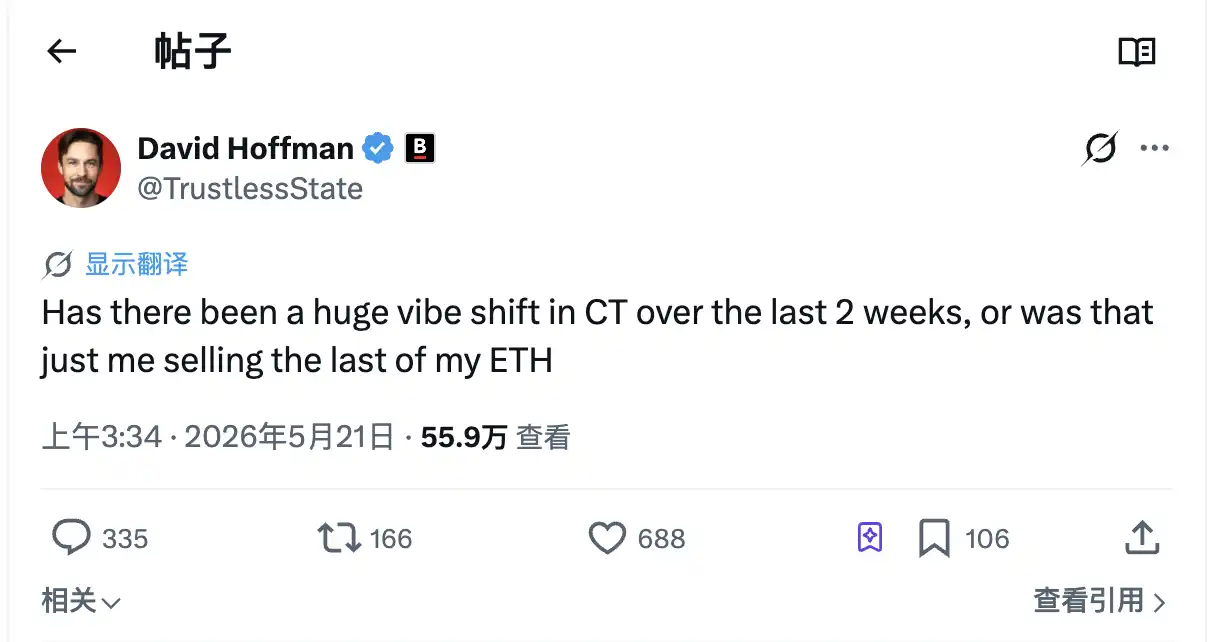
David Hoffman tweeted at dawn on May 21, 2026.

Just one sentence: "Has the vibe on Crypto Twitter genuinely shifted over the last two weeks, or have I just sold my last ETH?"

David Hoffman is the co-founder of Bankless, one of Ethereum's biggest public evangelists over the past six years. He once wrote on his personal page, "99% of wealth isn't in banks, it's on Ethereum." This is the man who authored "Ether: The Triple Point Asset" and was a core missionary in the narrative that defined ETH as "ultrasound money."

Now, he has cleared his position.

If last year some still viewed ETH as "the bond of the future world" and SOL as "a high-speed Nasdaq," by May 2026, the market had voted with its prices to complete a thorough de-faithing. ETH is currently struggling around $2,100, halved from its peak of $4,946 in August 2025.

Yet, in the very same market, HYPE is just one step away from its all-time high of $59.39, up 15% in the past seven days; ZEC has more than doubled in the past month, with a year-to-date increase of over 1400%, and its market cap has already squeezed into the top 20.

One market, two different climates.

The Former Baijiu

This isn't the first time such a split has appeared in the crypto world. But you need to temporarily look away from the screen and return to the A-share market in 2020.

From the second half of 2020 to early 2021, A-share liquidity peaked and receded, forcing mutual funds to make a choice: either spread their positions evenly across over 3,000 stocks and accept mediocre beta returns, or concentrate their ammunition on a handful of core assets with clear future cash flow stories. Everyone ultimately chose the latter. The result was that Moutai and Wuliangye were lifted to the sky, while the rest of the stocks were thrown into "garbage time" by the market.

That year, there was a very precise term called "core asset huddling." Its essence wasn't fund managers colluding, but an inevitable reaction in an environment of contracting liquidity. When the water in the pool shrinks, all the fish swim to the deepest corner.

The crypto market is now swimming towards that deepest corner.

What happened in the past year? Bitcoin ETFs absorbed roughly $70 billion in funds from 2024-2025, turning Bitcoin into an "asset priced by Wall Street." But this also means Bitcoin's marginal buying power began to be constrained by macro interest rates and stock market risk appetite. Q1 2026 inflation data exceeded expectations, coupled with a single-week net outflow of $1 billion from ETFs, causing the entire market to tremble.

What's more critical is the collapse of the narrative side. Citi cut its 12-month target price for ETH from $4,304 to $3,175 at the beginning of 2026, citing "stalled market structure legislation and weakening on-chain activity"; JPMorgan stated more bluntly in a May 19 report, "ETH needs stronger network growth and DeFi adoption to reverse its weakness relative to Bitcoin." The short-selling research firm Culper Research even publicly shorted ETH and released a report claiming that the Fusaka upgrade weakened the burn mechanism of EIP-1559, stripping ETH of its previous deflationary properties.

Solana is caught in another dilemma. It remains the best chain for DePIN, meme coins, and on-chain transaction experience, but when the market enters a risk-averse period, its greatest asset in the past, "high beta," ironically becomes a liability. Tushar Jain from Multicoin, the man who once carried Solana out of the ruins, publicly announced at Consensus Miami in May that Multicoin had taken a significant long position in Zcash.

This is a landmark moment. Solana's earliest and largest financial backer began shifting faith to another chain.

Huddling Around HYPE and ZEC

So, where did the money go?

The answer is surprisingly consistent: HYPE and ZEC.

The story of Hyperliquid was actually foreshadowed from the almost perfect airdrop in November 2024. The team, led by Harvard alumni Jeff and Iliensinc with backgrounds from Caltech/MIT/Citadel/Hudson River Trading, did something almost no one in crypto had managed in the past decade: distributing 76% of the tokens to users, with zero VC allocation.

If you only see this, you only see its "morality story." What truly propelled HYPE to rise against the trend during the liquidity drought of 2026 is its "cash flow story."

HYPE is not a traditional "narrative token." It is a complete chain, more accurately, a high-speed on-chain ATM in operation: as the largest decentralized perpetual contract exchange, it generates over $1.2 billion in annual protocol revenue; it has an agreement with Circle to share 90% of the USDC reserve yield, a stream alone contributing $135 to $160 million annually to token buybacks; this week (May 19), Bitwise announced adding HYPE to its balance sheet and launched an ETF product based on HYPE.

HYPE's contract open interest currently stands at $2.1 billion, and the funding rate has turned positive, indicating that new long-side capital is continuously entering, not a false prosperity from short squeezes.

The story of ZEC belongs to a completely different dimension. It's not a "cash flow story"; it's a "fear story."

Arthur Hayes wrote directly in his January essay, "This year's dominant narrative is privacy, and ZEC will be the privacy beta. To outperform Bitcoin and Ethereum, I will sell BTC to fund my privacy positions." His fund, Maelstrom, started building positions from Q3 2025.

Then, in early May, Multicoin Capital's Tushar Jain publicly doubled down at Consensus. CoinDesk's March research labeled ZEC with the tag "encryption supremacy," meaning privacy networks have become a dominant infrastructure. The underlying logic chain is the simultaneous convergence of three factors: AI gaining the ability to deanonymize users en masse on transparent blockchains, the threat of quantum computing creating long-term uncertainty for existing wallet encryption systems, and on-chain quarterly trading volume surpassing $100 billion for the first time, turning "wealth visible to the entire network" into a real fear.

The proportion of ZEC supply locked in shielded addresses has reached 30%, a historical high, meaning real privacy demand has quantifiable evidence on-chain, no longer just a literary narrative. The SEC officially closed its over-two-year investigation into the Zcash Foundation on May 20 without proposing any enforcement action. Robinhood has already listed ZEC, and expectations for a Grayscale ZEC ETF are being pushed to the forefront.

Hayes predicts ZEC's market cap will eventually reach 10% of Bitcoin's, corresponding to a token price 15-20 times above current levels.

Will the Huddle Dissolve?

When will the huddle break?

The A-share baijiu huddle broke after the Lunar New Year in 2021. The trigger wasn't deteriorating fundamentals, but a shift in central bank policy, turning the market from a zero-sum game back to a game of incremental funds. When the water in the pool starts to rise, all the fish no longer need to cram into the deepest corner.

When will the crypto world's pool expand? That depends on when the Fed cuts rates, when ETF funds flow back in, when stablecoin market cap hits new highs, and when traditional finance moves more money on-chain.

But one must also be wary of another possibility: the huddle could collapse under its own weight from becoming "too tight." ZEC's contract open interest surged 40% in the past 24 hours to $1.3 billion. This concentration itself is a risk signal. Hayes, Multicoin, retail traders, Robinhood users—everyone crowding into the same trade means the exit of any marginal buyer could trigger a chain reaction of long liquidations. HYPE's funding rate has turned positive and continues to rise, building up financing costs.

The endgame of a huddle is either a rising tide lifts all boats, and everyone takes profits together; or a stampede for the exit, with the last person in taking all the chips.

At which stage are we now? No one can give a definitive answer. But one question is worth asking for everyone reading this article:

If even David Hoffman has sold, the ETH still in your wallet—do you hold it because you believe in it, or because you forgot it was there?

The next question is more practical: When a market has only two names left to huddle around, what will the third name be? Aave? Maker? Some undiscovered privacy L2? Some high-performance chain yet to issue a token?

The person who figures this out will be the first to join the next huddle.

The person who doesn't will be the last to hold the bag when the next huddle breaks.

Связанные с этим вопросы

QWhy is the crypto market showing such a split performance between assets like ETH and HYPE/ZEC?

AThe crypto market is experiencing a significant liquidity contraction. As Bitcoin ETFs have absorbed massive inflows and traditional finance factors now influence its price, broader market liquidity has dried up. In such an environment, capital tends to 'huddle' towards a few select assets with the strongest narratives or fundamentals. HYPE offers a strong cash flow story through its protocol revenue and tokenomics, while ZEC is seen as a prime 'privacy beta' hedge against increasing surveillance and AI-driven de-anonymization threats on transparent blockchains. This creates a two-tier market where money flows only to the perceived safest or highest-conviction bets, leaving former leaders like ETH behind.

QWhat are the main reasons for HYPE's (Hyperliquid) strong performance during the market downturn?

AHYPE's strength is driven by its dual narrative of 'moral legitimacy' and a robust 'cash flow story.' Firstly, its token distribution, with 76% allocated to users and no VC allocation, builds strong community trust. More importantly, it functions as a cash-generating machine: it's the largest decentralized perpetual exchange, generating over $1.2B in annual protocol revenue. A key revenue stream is its agreement with Circle, sharing 90% of the USDC reserve yield, which contributes $135-160M annually for token buybacks. Its recent inclusion in Bitwise's balance sheet and the launch of an HYPE-based ETF further solidify its status as a 'quality asset' in a risk-off environment.

QWhat is the core narrative driving the massive surge in ZEC's price?

AThe surge in ZEC is driven by a 'fear narrative' centered on privacy becoming a critical infrastructure need. Key catalysts include the growing capability of AI to de-anonymize users on transparent blockchains, the long-term threat of quantum computing to existing cryptographic security, and the psychological impact of managing increasingly large, publicly visible on-chain wealth. Figures like Arthur Hayes and funds like Multicoin Capital have publicly endorsed ZEC as the premier 'privacy beta' play. Tangible evidence includes a record 30% of ZEC's supply being locked in shielded addresses, indicating real usage. Furthermore, the SEC's closure of its investigation into the Zcash Foundation without action removed a regulatory overhang, boosting confidence.

QWhat historical market phenomenon does the article compare the current crypto market situation to?

AThe article compares the current situation in crypto to the 'core asset huddle' (or '抱团') seen in China's A-share market in 2020-2021. During that period, as market liquidity peaked and began to recede, mutual funds concentrated their capital into a handful of 'core assets' like Kweichow Moutai (茅台) and Wuliangye (五粮液) that had clear future cash flow stories, while neglecting the broader market. The article uses the metaphor: 'When the water in the pond decreases, all the fish swim to the deepest corner.' This mirrors the current crypto environment where shrinking liquidity is forcing capital to concentrate in assets like HYPE and ZEC.

QAccording to the article, what are the potential outcomes for the current market 'huddle' around HYPE and ZEC?

AThe article outlines two potential outcomes for the current 'huddle.' The first is a positive scenario where 'the tide lifts all boats'—increased overall market liquidity from factors like Fed rate cuts, ETF inflows, or stablecoin growth allows everyone in the trade to profitably exit. The second is a negative, self-destructive scenario where the huddle becomes too crowded and collapses. Warning signs include ZEC's open interest surging 40% in 24 hours and HYPE's funding rate turning positive and rising, indicating high leverage and concentrated positions. A single shift in marginal buying pressure could trigger a cascade of liquidations, leaving the last entrants holding the bag ('the last person to enter takes all the chips').

Похожее

After Marvell's 32% Surge, the Chinese Chip Family Behind It Emerges

The stock price of Marvell Technology surged 32.5% on June 2nd, driven by NVIDIA CEO Jensen Huang highlighting its custom ASICs and optical interconnects as core to AI data center architecture. This event brought attention to the Chinese semiconductor family behind Marvell: the Dai siblings. The story centers on three siblings, all UC Berkeley graduates, whose three-decade entrepreneurial journey aligns with major semiconductor industry shifts. In 1995, youngest sister Dai Wei Li co-founded Marvell with her husband Sehat Sutardja and his brother, focusing on storage controllers. Eldest brother Dai Wei Min founded EDA company Ultima, later sold to Cadence, and later founded VeriSilicon (芯原) in China, becoming a leading semiconductor IP provider. Second brother Dai Wei Jin co-founded EDA firm Silicon Perspective (sold to Cadence) and GPU IP company Vivante, later acquired by VeriSilicon. The combined "Dai-Sutardja" family network extends beyond Marvell. Their ventures and investments form a comprehensive ecosystem for the post-Moore's Law, chiplet era. Key holdings include: Dream Big Semiconductor (AI SuperNICs, acquired by Arm), Alphawave (high-speed SerDes IP, acquired by Qualcomm), and Silicon Box (a chiplet advanced packaging foundry). VeriSilicon itself thrives on the AI ASIC and IP boom in China. Collectively, the family's AI infrastructure-related portfolio is estimated at over $22 billion. Their strategy represents a distinct path: building critical components for open standards and key manufacturing capacity in the chiplet era, rather than pursuing standalone AI chip dominance. While this path may not create the next NVIDIA, it has enabled repeated successful exits and sustained influence within the global semiconductor industry.

marsbit48 мин. назад

After Marvell's 32% Surge, the Chinese Chip Family Behind It Emerges

marsbit48 мин. назад

Microsoft is Afraid of Being Marginalized by AI Giants

Microsoft, once the defining force of the PC era, now faces a familiar challenge in the AI age: the risk of being relegated to a profitable but invisible infrastructure provider. This anxiety was laid bare at Build 2026, where CEO Satya Nadella unveiled a major strategic pivot. The catalyst was a quiet April agreement that dissolved Microsoft's exclusive licensing and cloud-hosting deal with OpenAI, its once-vital partner. This erased Microsoft's key AI moat. With OpenAI and Anthropic defining AI applications and gaining enterprise traction—even within Microsoft's own ranks—Nadella had to answer: without exclusivity, what is Microsoft's role? The answer was a suite of seven in-house AI models, a developer-focused AI workstation (Surface RTX Spark Dev Box), and, most crucially, the Agent 365 platform for enterprise AI governance. The models, notably targeting Anthropic's strengths in coding and enterprise, signal a defensive move. However, the broader strategy is to make the models themselves less decisive. Financially, Microsoft's AI revenue is strong, driven largely by Azure running others' models. Yet its user-facing products like Copilot show weak penetration and engagement. Microsoft earns infrastructure money but lacks direct user mindshare. Nadella's core fear is being "hollowed out." As OpenAI and Anthropic prepare for IPOs and gain financial independence, they may build their own infrastructure, threatening Azure's lucrative AI revenue stream. Microsoft's window is to entrench itself deeper: not as the model creator, but as the indispensable platform for securely deploying, managing, and governing all AI models within the enterprise through Agent 365. Build 2026 revealed Microsoft's bet: in the AI era, the ultimate power lies not in any single model, but in the enterprise "operating system" that controls them. Nadella is determined to ensure Microsoft is the driver of this new era, not just a passenger.

marsbit1 ч. назад

Microsoft is Afraid of Being Marginalized by AI Giants

marsbit1 ч. назад

CPU, Quietly Returning to the Center of the AI Computing Power Stage

Over the past three years, AI computing power narratives have been dominated by GPUs. However, starting in 2026, this story began to shift. While training large models remains GPU-intensive, the rapid growth of inference and AI agent workloads, which require high levels of task orchestration, concurrency, and data flow management, has highlighted a renewed critical role for CPUs. These are tasks GPUs are not designed to handle. Intel's recent launch of the Xeon 6+ processor, built on its Intel 18A process and featuring up to 288 efficiency cores (E-cores), exemplifies this strategic pivot. It is positioned not as a mere companion to GPUs but as the essential "control plane" for AI infrastructure, optimized for high-density, energy-efficient, and high-throughput workloads characteristic of AI agents and inference. This "CPU resurgence" is not about CPUs outperforming GPUs in raw computation. It reflects a systemic bottleneck: as AI scales from training single models to deploying countless intelligent agents, the demand for coordination and data handling surges. Major cloud providers are also developing their own high-density ARM-based server CPUs for similar workloads. However, Intel's success with this strategy faces significant challenges. Competition includes NVIDIA's integrated CPU-GPU solutions, the expanding adoption of cloud vendors' in-house ARM CPUs, and the crucial market test of Intel's 18A manufacturing process against rivals like TSMC's N2. In conclusion, CPUs are indeed reclaiming a central, though redefined, role in AI compute—managing the complex orchestration that enables massive-scale AI deployment. While the trend is clear, which company will ultimately lead this CPU resurgence remains an open question to be decided in the data centers of 2027 and beyond.

marsbit1 ч. назад

CPU, Quietly Returning to the Center of the AI Computing Power Stage

marsbit1 ч. назад

Торговля

Спот
Фьючерсы

Популярные статьи

Как купить HYPE

Добро пожаловать на HTX.com! Мы сделали приобретение Hyperliquid (HYPE) простым и удобным. Следуйте нашему пошаговому руководству и отправляйтесь в свое крипто-путешествие.Шаг 1: Создайте аккаунт на HTXИспользуйте свой адрес электронной почты или номер телефона, чтобы зарегистрироваться и бесплатно создать аккаунт на HTX. Пройдите удобную регистрацию и откройте для себя весь функционал.Создать аккаунтШаг 2: Перейдите в Купить криптовалюту и выберите свой способ оплатыКредитная/Дебетовая Карта: Используйте свою карту Visa или Mastercard для мгновенной покупки Hyperliquid (HYPE).Баланс: Используйте средства с баланса вашего аккаунта HTX для простой торговли.Третьи Лица: Мы добавили популярные способы оплаты, такие как Google Pay и Apple Pay, для повышения удобства.P2P: Торгуйте напрямую с другими пользователями на HTX.Внебиржевая Торговля (OTC): Мы предлагаем индивидуальные услуги и конкурентоспособные обменные курсы для трейдеров.Шаг 3: Хранение Hyperliquid (HYPE)После приобретения вами Hyperliquid (HYPE) храните их в своем аккаунте на HTX. В качестве альтернативы вы можете отправить их куда-либо с помощью перевода в блокчейне или использовать для торговли с другими криптовалютами.Шаг 4: Торговля Hyperliquid (HYPE)С легкостью торгуйте Hyperliquid (HYPE) на спотовом рынке HTX. Просто зайдите в свой аккаунт, выберите торговую пару, совершайте сделки и следите за ними в режиме реального времени. Мы предлагаем удобный интерфейс как для начинающих, так и для опытных трейдеров.

474 просмотров всегоОпубликовано 2024.12.11Обновлено 2026.06.02

Как купить HYPE

Обсуждения

Добро пожаловать в Сообщество HTX. Здесь вы сможете быть в курсе последних новостей о развитии платформы и получить доступ к профессиональной аналитической информации о рынке. Мнения пользователей о цене на HYPE (HYPE) представлены ниже.

活动图片