Mastercard Just Built A Payment Network For AI Agents — And It Runs On Crypto

bitcoinistОпубликовано 2026-06-10Обновлено 2026-06-10

Введение

Mastercard has launched "Agent Pay for AI," a new payment protocol enabling AI agents to conduct small, automated, machine-to-machine transactions. The system addresses a gap in traditional payment infrastructure, which is poorly suited for such micropayments. A key feature is the storage of human-granted permissions on the Polygon blockchain, allowing for decentralized verification without a central authority. Mastercard is developing the protocol with partners Adyen, Coinbase, and Cloudflare. It enters a competitive field where Visa, Stripe, and Google have also introduced similar AI payment tools. While Mastercard's Chief Product Officer, Jorn Lambert, does not expect significant near-term revenue, he views it as a strategic infrastructure investment for an anticipated future where AI agents facilitate a meaningful share of commerce. This move follows Mastercard's recent integration of stablecoins, signaling a broader shift towards incorporating crypto into its core systems.

Mastercard has launched Agent Pay for AI, a new protocol designed to enable artificial intelligence agents to pay each other and send micropayments — storing the permissions that humans grant their AI agents on Polygon, a blockchain network built on top of Ethereum, according to an exclusive report by Fortune published June 10.

Related Reading: Trump’s Crypto Deals May Have Increased The Family Fortune By $2 Billion—At Investors’ Expense

The protocol is built around a specific use case that existing payment infrastructure handles poorly: small, automated, machine-to-machine transactions. When an AI agent needs to access data piecemeal from a website, or pay another service incrementally for a task it is performing on a user’s behalf, traditional card rails — built for human-initiated, merchant-facing transactions — are poorly suited for the job. Agent Pay for AI is designed to fill that gap, per Fortune’s reporting.

The decision to log permissions onto a public blockchain rather than a private database is a deliberate architectural choice. Multiple parties that want to verify whether an agent is acting within the boundaries a human has authorized can access that information directly on-chain, without relying on a single centralized authority to confirm it, per Fortune. Mastercard selected Polygon for the initial deployment.

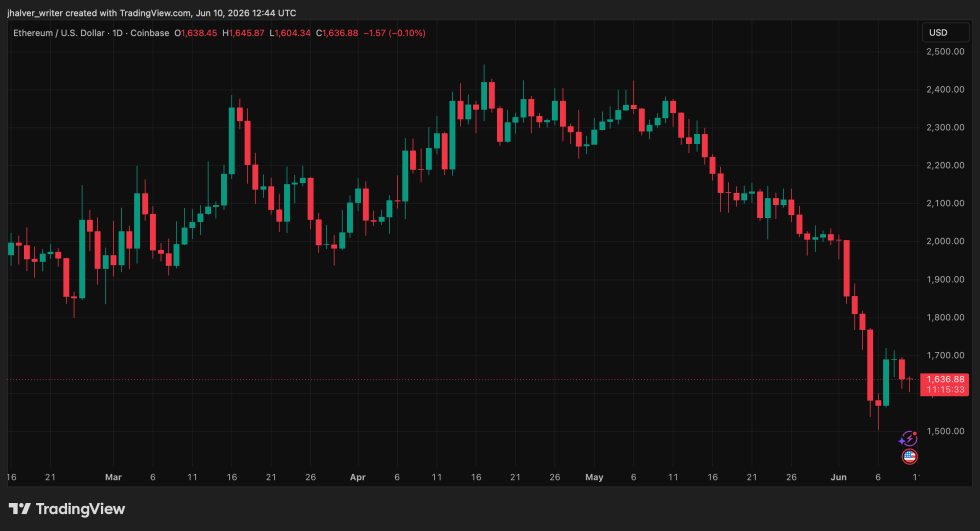
ETH's price trends to the downside on the daily chart. Source: ETHUSD on Tradingview

The Partners And The Crypto Competition

Three companies are working with Mastercard to develop the protocol: fintech platform Adyen, crypto exchange Coinbase, and web infrastructure giant Cloudflare, per Fortune’s reporting. The combination of a payment processor, a crypto-native exchange, and the company that handles a significant share of the internet’s traffic signals that Mastercard is building Agent Pay for AI as interoperable infrastructure rather than a proprietary walled garden.

The competitive landscape is already crowded. Visa and Stripe have each built tools anticipating a world where AI bots buy groceries, manage bank accounts, and pay for subscriptions. Coinbase launched the x402 protocol for AI payments, Stripe collaborated with Tempo to develop the Machine Payments Protocol, and Google released its own standard in September 2025, per Fortune.

Jorn Lambert, Mastercard’s Chief Product Officer, was measured about near-term commercial expectations in his conversation with Fortune. He does not expect Agent Pay for AI to be a significant revenue driver in the next twelve months. Over five years, however, he described it as a meaningful new addressable market. Lambert separately predicted that AI chatbots will eventually sit between a meaningful share of e-commerce transactions — framing the protocol not as a speculative bet but as infrastructure being built ahead of an inevitable shift in how commerce flows.

Related Reading: Japan’s SBI Bank Expands Crypto Push With BTC, ETH, XRP Rewards Program For Depositors

This development marks a pivotal moment for the nascent sector’s convergence with artificial intelligence. Mastercard choosing a public blockchain to anchor the permissions layer of its AI payment infrastructure — one week after opening its global settlement rails to six regulated stablecoins across eight blockchain networks — confirms that the world’s second-largest card network is systematically rebuilding its core architecture around crypto rails rather than alongside them.

Cover image from Grok, ETHUSD chart from Tradingview

Связанные с этим вопросы

QWhat is the name of the new protocol launched by Mastercard for AI agents, and what problem does it aim to solve?

AMastercard launched the Agent Pay for AI protocol. It aims to solve the problem of enabling small, automated, machine-to-machine (AI agent-to-agent) payments and micropayments, a use case poorly handled by traditional card payment infrastructure designed for human-initiated, merchant-facing transactions.

QOn which blockchain network is Mastercard storing the permissions for its Agent Pay for AI protocol, and why was a public blockchain chosen?

AMastercard is storing the permissions for its Agent Pay for AI protocol on the Polygon blockchain. A public blockchain was chosen so that multiple parties can directly verify on-chain whether an agent is acting within authorized boundaries, without relying on a single centralized authority.

QWhich three companies are partnering with Mastercard to develop the Agent Pay for AI protocol?

AThe three companies partnering with Mastercard are the fintech platform Adyen, the crypto exchange Coinbase, and the web infrastructure giant Cloudflare.

QAccording to Mastercard's Chief Product Officer Jorn Lambert, what is the commercial outlook for the Agent Pay for AI protocol in the near term and over a longer period?

AAccording to Jorn Lambert, Agent Pay for AI is not expected to be a significant revenue driver in the next twelve months. However, over a five-year horizon, he described it as a meaningful new addressable market.

QHow does Mastercard's recent launch of Agent Pay for AI, combined with another recent action, indicate its strategic direction regarding cryptocurrency infrastructure?

ACombined with its decision the week prior to open its global settlement rails to regulated stablecoins, the launch of Agent Pay for AI on a public blockchain confirms that Mastercard is systematically rebuilding its core architecture around crypto rails, rather than just operating alongside them.

Похожее

Raising Interest Rates Is Not a Tech Killer, EPS Is: A Strategy for Discarding the Weak and Retaining the Strong After the AI Theme's Sharp Decline

**Summary: Rising Interest Rates Are Not the Killer of Tech; EPS Is: The "Keep the Strong, Ditch the Weak" Strategy After the AI Theme Plunge** The author argues that the sharp sell-off in tech and AI-related stocks, triggered by a strong US jobs report that heightened Fed rate hike fears, represents a "pullback to pick up passengers" rather than a "car crash." The true end of a tech bull market is not determined by an extra 25 basis point hike, but by industry overcapacity and the disproval of earnings per share (EPS) expectations. Historical analysis shows that during past rate hike cycles, the Nasdaq-100 often outperformed, provided EPS growth remained strong. The current phase is seen as a shift from a "broad narrative-driven rally" to a "focused verification stage" for AI. The investment strategy should be to "keep the strong, ditch the weak." * **Retain exposure** to high-conviction AI infrastructure leaders with clear order visibility, stable margins, strong cash flow, and upward EPS revisions (e.g., AI servers, advanced packaging, optical modules, key cloud suppliers). * **Reduce exposure** to high-beta, narrative-driven stocks with unclear profit paths (e.g., some quantum computing, space, or speculative chip stocks), especially on rebounds. Valuation concerns should focus on whether earnings can catch up to high multiples, not on high P/E alone. Crowded positioning signals a concentration into quality assets, not necessarily a market top. The upcoming Q2 earnings season will be a key validation point. The core principle is to hold stocks with proven EPS, while using macro events (CPI data, central bank meetings) to manage timing and risk.

marsbit4 ч. назад

Raising Interest Rates Is Not a Tech Killer, EPS Is: A Strategy for Discarding the Weak and Retaining the Strong After the AI Theme's Sharp Decline

marsbit4 ч. назад

Торговля

Спот
Фьючерсы

Популярные статьи

Неделя обучения по популярным токенам (2): 2026 может стать годом приложений реального времени, сектор AI продолжает оставаться в тренде

2025 год — год институциональных инвесторов, в будущем он будет доминировать в приложениях реального времени.

1.8k просмотров всегоОпубликовано 2025.12.16Обновлено 2025.12.16

Неделя обучения по популярным токенам (2): 2026 может стать годом приложений реального времени, сектор AI продолжает оставаться в тренде

Обсуждения

Добро пожаловать в Сообщество HTX. Здесь вы сможете быть в курсе последних новостей о развитии платформы и получить доступ к профессиональной аналитической информации о рынке. Мнения пользователей о цене на AI (AI) представлены ниже.

活动图片