Mark Cuban Cleared As Court Dismisses Voyager Digital Investor Lawsuit

bitcoinistОпубликовано 2026-01-03Обновлено 2026-01-03

Введение

A US federal judge dismissed a class-action lawsuit against Mark Cuban and the Dallas Mavericks brought by former Voyager Digital customers. The court ruled it lacked personal jurisdiction in Florida, as the defendants were not conducting business in the state. The lawsuit stemmed from Voyager's 2021 bankruptcy, where customers lost funds and alleged misleading statements. Plaintiffs argued Cuban's promotion of Voyager, including a fan incentive offer, encouraged platform use. The dismissal was based solely on jurisdictional grounds and did not address the case's merits. Plaintiffs may refile in another court.

A US federal judge has tossed a class-action lawsuit brought by former Voyager Digital customers against billionaire Mark Cuban and the Dallas Mavericks, ruling the court did not have the power to hear the case.

The order, entered at the end of December, dismissed the suit in its entirety after finding the plaintiffs failed to show the defendants were subject to personal jurisdiction in Florida.

Mark Cuban Vs. Voyager: Judge Cites Lack Of Personal Jurisdiction

According to the court filing, Judge Roy K. Altman concluded that Mark Cuban and the Mavericks did not “carry on a business or business venture in Florida” in a way that would let the Miami-area court preside over the matter.

The decision follows extensive jurisdictional discovery and multiple amended complaints that, the judge said, still fell short of establishing the necessary legal ties to Florida. The defense team hailed the ruling as a complete win for their clients.
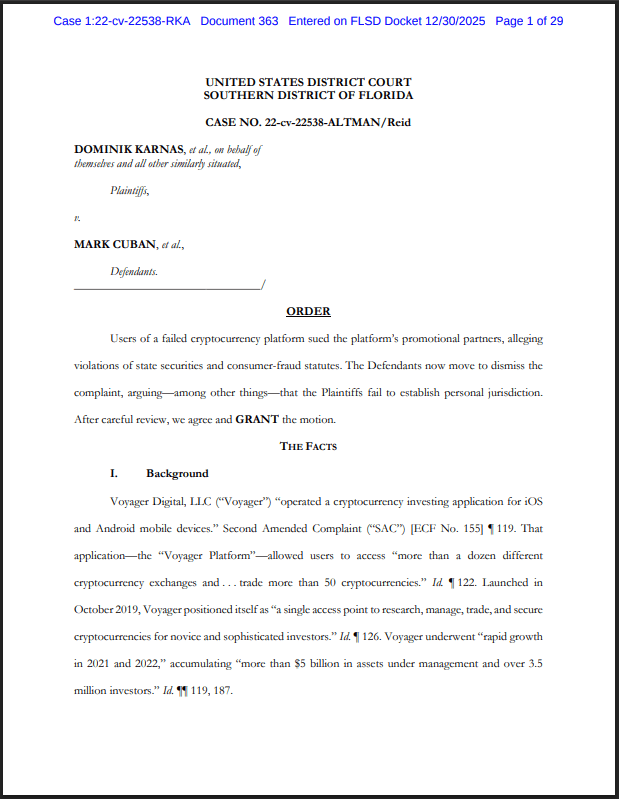
Source: Courtlistener

The suit traces back to 2022, when Voyager Digital filed for Chapter 11 protection after a sharp market downturn and loan defaults. Voyager’s bankruptcy and the fallout led to a wave of litigation by users who said they lost access to funds and were misled by the company’s statements. Reports have noted the firm had roughly $1.3 billion in customer crypto assets implicated during restructuring talks.

Image: www.mak.kg

Promotion And The $100 Fan Offer

Based on reports from earlier coverage, the dispute focused on a 2021 promotion in which Cuban and the Mavericks partnered with Voyager and offered fans incentives tied to deposits and trading.

Bitcoin is currently trading at $89,299. Chart: TradingView

Plaintiffs argued the partnership and public backing helped convince customers to use the platform. Other defendants in related Voyager litigation have settled; Cuban and the Mavericks maintained they would fight the claims.

Legal experts say the outcome highlights the limits of suing public figures in forums far from where those figures are based. Courts increasingly demand concrete evidence that a defendant targeted a state before allowing local lawsuits to proceed. This dismissal does not decide whether the promotional statements were true or false; it addresses only where the case could be heard.

Plaintiffs’ Options And Wider Litigation

Reports have not shown an immediate refiling in another court by the named plaintiffs. Because the judge dismissed the complaint for lack of jurisdiction, the plaintiffs were denied the chance to proceed in that Florida court but may pursue claims elsewhere if they choose.

Featured image from MediaNews Group via Getty Images, chart from TradingView

Связанные с этим вопросы

QWhy was the class-action lawsuit against Mark Cuban and the Dallas Mavericks dismissed?

AThe lawsuit was dismissed because the US federal judge ruled that the court did not have personal jurisdiction over Mark Cuban and the Dallas Mavericks in Florida, as they did not 'carry on a business or business venture in Florida' in a way that would allow the Miami-area court to preside over the case.

QWhat was the central argument made by the plaintiffs in the lawsuit?

AThe plaintiffs argued that the partnership and public backing from Mark Cuban and the Dallas Mavericks helped convince customers to use the Voyager Digital platform, and they were misled by the company's statements, leading to financial losses.

QWhat event precipitated the wave of litigation against Voyager Digital and its partners?

AThe wave of litigation was triggered after Voyager Digital filed for Chapter 11 bankruptcy protection in 2022 following a sharp market downturn and loan defaults, which caused users to lose access to their funds.

QDoes the court's dismissal rule on the truthfulness of the promotional statements made by Mark Cuban and the Mavericks?

ANo, the dismissal does not decide whether the promotional statements were true or false; it addresses only the issue of jurisdiction and where the case could be heard.

QWhat are the legal options for the plaintiffs following this dismissal?

AThe plaintiffs were denied the chance to proceed in the Florida court but may choose to pursue their claims by refiling the lawsuit in another court that has proper jurisdiction over the defendants.

Похожее

Breaking: OpenAI Undergoes Major Reorganization, President Brockman Assumes Command

OpenAI has announced a major internal reorganization just months before its anticipated IPO. The company is merging its three flagship product lines—ChatGPT, Codex, and the API platform—into a single, unified product organization. The most significant leadership change involves co-founder and President Greg Brockman moving from a background technical role to take full, permanent control over all product strategy. This follows the indefinite medical leave of AGI Deployment CEO Fidji Simo. Additionally, ChatGPT's longtime lead, Nick Turley, has been reassigned to enterprise products, with former Instagram executive Ashley Alexander taking over consumer offerings. The consolidation, internally framed as a strategic move towards an "Agentic Future," aims to break down internal silos and create a cohesive "Super App." This planned desktop application would integrate ChatGPT's conversational abilities, Codex's coding power, and a rumored internal web browser named "Atlas" to autonomously perform complex user tasks. The reorganization occurs amid significant internal and external pressures. OpenAI has recently seen a wave of high-profile departures, including Sora co-lead Bill Peebles and other senior technical leaders, leading to concerns about a thinning executive bench. Externally, rival Anthropic recently secured funding at a staggering $900 billion valuation, surpassing OpenAI's own. Google's upcoming I/O developer conference also poses a competitive threat. Analysts suggest the dramatic restructure is a pre-IPO move to present a clearer, more focused narrative to Wall Street—streamlining operations and demonstrating decisive leadership under Brockman to counter internal turbulence and intense market competition.

marsbit1 ч. назад

Breaking: OpenAI Undergoes Major Reorganization, President Brockman Assumes Command

marsbit1 ч. назад

Two Survival Structures of Market Makers and Arbitrageurs

Market makers and arbitrageurs represent two distinct survival structures in high-frequency trading. Market makers primarily use limit orders (makers) to profit from the bid-ask spread, enjoying high capital efficiency (nominally 100%) but bearing inventory risk. This "inventory risk" arises from passive, fragmented, and discontinuous order fills in the limit order book (LOB). This risk, while a potential cost, can also contribute to excess profit if managed within control boundaries, allowing for mean reversion. Market makers essentially sell "time" (uncertainty over execution timing) to the market for price control and low fees. In contrast, cross-exchange arbitrageurs typically use market orders (takers) to exploit price differences or funding rates, resulting in lower nominal capital efficiency (requiring capital on both exchanges) and higher transaction costs. Their risk exposure stems from asymmetries in exchange rules (e.g., minimum order sizes), execution latency, and infrastructure risks (e.g., ADL, oracle drift). These exposures are active, exogenous gaps that primarily erode profits rather than contribute to them. Arbitrageurs essentially sell "space" (capital sunk across venues) for localized, immediate certainty. Both strategies engage in a trade-off between execution friction and residual risk. Optimal systems allow for temporary, controlled risk exposure rather than enforcing zero exposure at all costs. Their evolution converges towards hybrid models: arbitrageurs may use maker orders to reduce costs, while market makers may use taker orders or hedges for risk management. Ultimately, both use different forms of risk exposure—market makers exposing inventory, arbitrageurs immobilizing capital—to extract marginal, hard-won certainty from the market.

链捕手1 ч. назад

Two Survival Structures of Market Makers and Arbitrageurs

链捕手1 ч. назад

Who Will Define the Rules of the AI Era? Anthropic Discusses the 2028 US-China AI Landscape

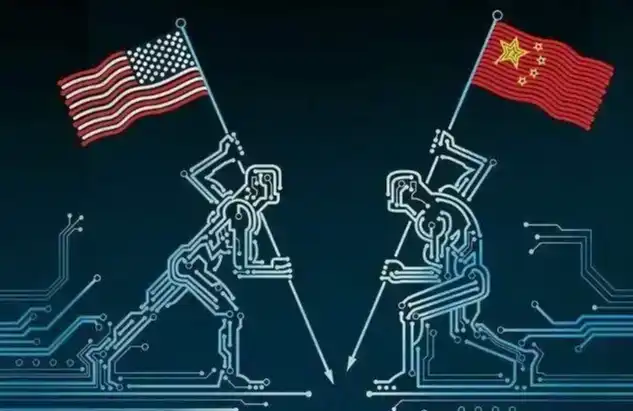
This article, based on Anthropic's analysis, outlines the intensifying systemic competition between the U.S./allies and China for AI leadership by 2028. It argues that access to advanced computing power ("compute") is the critical bottleneck, where the U.S. currently holds a significant advantage through chip export controls and allied innovation. However, China's AI labs remain competitive by exploiting policy loopholes—via chip smuggling, overseas data center access, and "model distillation" attacks to copy U.S. model capabilities—keeping them close to the frontier. The piece presents two contrasting scenarios for 2028. In the first, decisive U.S. action to tighten compute controls and curb distillation locks in a 12-24 month AI capability lead, cementing democratic influence over global AI norms, security, and economic infrastructure. In the second, policy inaction allows China to achieve near-parity through continued access to U.S. technology, enabling Beijing to promote its AI stack globally and integrate advanced AI into its military and governance systems, altering the strategic balance. Anthropic contends that maintaining a decisive U.S. lead is essential for shaping safe AI development and governance. The core recommendation is for U.S. policymakers to urgently close compute and model access loopholes while promoting global adoption of the U.S. AI technology stack to secure a lasting strategic advantage.

marsbit3 ч. назад

Who Will Define the Rules of the AI Era? Anthropic Discusses the 2028 US-China AI Landscape

marsbit3 ч. назад

Торговля

Спот
Фьючерсы
活动图片